

Stop treating your acting career like a lottery ticket and start treating it like the high-stakes startup it actually is. If you've ever felt like a talented hobbyist stuck on the outside looking in, you aren't alone. It's exhausting to watch your peers land roles while you struggle with unoptimized marketing materials and a total lack of access to the rooms where decisions happen. You deserve a career that offers security and growth rather than just the occasional lucky break.
This guide provides the definitive 2026 actor business plan to transform your professional trajectory. By implementing a strategic 12-month roadmap, you'll move from the chaos of random auditions to a scalable business model that commands respect from casting directors. We will explore how to audit your professional brand, utilize portfolio reviews as a "board of directors" for your career, and secure the industry connections needed to increase your booking rates for paid jobs. It's time to stop guessing and start executing with the precision of an industry insider.
Key Takeaways
- Shift your perspective from being just "talent" to becoming a talent-entrepreneur to meet the high professional standards required in 2026.
- Identify the five core pillars of a successful actor business plan, ranging from your executive summary to deep market analysis.
- Position your brand within exclusive, private networks so you aren't lost in the noise of social media.
- Create a disciplined 12-month roadmap that organizes your year into productive training phases and high-intensity submission windows.
- Understand why elite mentorship keeps your strategy resilient.
Beyond the Script: Adopting the Actor-CEO Mindset in 2026
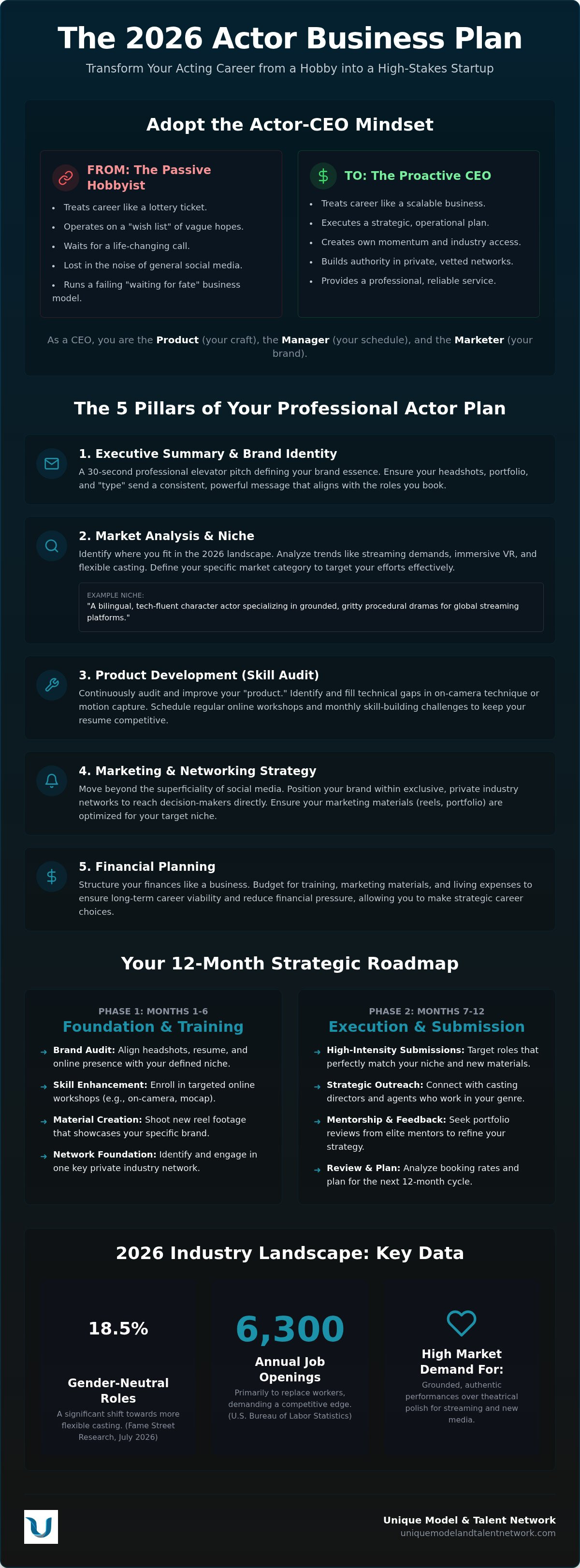
In 2026, talent is simply the price of entry. To survive and thrive, you must evolve from a performer into a talent-entrepreneur. Most actors operate on a "wish list" filled with vague hopes like "getting signed" or "booking a lead." A professional business plan replaces these fantasies with operational reality. You're the CEO of a company where you are simultaneously the product, the manager, and the marketing director. As the product, you refine your craft; as the manager, you oversee your schedule and budget; as the marketer, you ensure your brand reaches the right eyes. This structural approach creates immediate legitimacy when you step into a room. Casting directors aren't just looking for a good read. They're looking for professional partners who understand their market value and can deliver consistently under pressure.
The Shift from Passive to Proactive
The "waiting for fate" cycle is a career killer. If you're sitting by the phone hoping for a life-changing call, you're running a failing business model. Even top agents in 2026 expect their clients to bring existing momentum to the table. You must take total ownership of your professional bonds and industry access. This involves moving away from the superficiality of general social media and toward concentrated, private networks. When you stop asking for permission to be an actor and start providing a professional service, your authority in the industry shifts. This proactive stance is exactly what turns a hobby into a career.
Identifying Your Market Niche
An effective actor business plan requires a cold look at where you fit in the current recruitment landscape. The 2026 market values grounded, authentic performances over theatrical polish. According to Fame Street Research from July 2026, roles open to any gender now make up 18.5% of listings, suggesting a move toward more flexible casting. You need to analyze whether your "look" aligns with current streaming demands or if your skill set is better suited for the rising immersive and virtual reality sectors. Determining your niche prevents you from wasting money on unoptimized marketing materials that don't land. My primary market category for the year is: "I am a bilingual, tech-fluent character actor specializing in grounded, gritty procedural dramas for global streaming platforms."
By defining your niche, you can use Portfolio & Reel Reviews as a key business audit tool. This ensures every piece of content you put out reinforces your CEO-level strategy rather than undermining it with mixed messages. It's about building a brand that feels inevitable rather than accidental.
The 5 Essential Components of a Professional Actor Plan
A formal document turns your ambitions into an actionable roadmap. Your actor business plan must include five core pillars: an executive summary, market analysis, product development, marketing strategy, and financial planning. This structure forces you to look at your career through a lens of professional accountability. By defining these components, you move away from the "hope and pray" method and toward a system where every dollar and hour spent serves a specific growth objective.
The Executive Summary and Brand Identity
Your executive summary is more than a bio; it's a 30-second professional elevator pitch that defines your brand essence for vetted industry experts. You must align your "essence" with the roles you are actually booking. If your brand is "the relatable tech genius" but your headshots scream "period drama villain," your business is sending mixed messages. This identity should be visually and strategically anchored in a professional acting portfolio that mirrors the quality of the high-level productions you aim to join.
Product Development: The Skill Audit
Product development in acting means a constant skill audit. You can't sell a product that isn't ready for the shelf. Identify technical gaps in your on-camera technique or motion capture skills to stay competitive in the 2026 landscape. Participating in acting workshops online is a non-negotiable line item for professional growth. Scheduling Monthly Skill-Building Challenges ensures your resume never stagnates and that you are always adding new, marketable skills to your toolkit.
Your market analysis should also account for the broader industry outlook. The U.S. Bureau of Labor Statistics projects roughly 6,300 job openings for actors annually through 2035. Most of these roles come from the need to replace workers leaving the field, meaning your strategy must focus on being the most prepared candidate when a seat at the table opens up. Don't just target "the industry." Target the specific casting offices and production houses that handle your niche, such as procedural dramas or commercial lifestyle campaigns.
Executing a comprehensive actor business plan requires a budget that reflects your professional standards. Success requires capital. Professional headshots in major markets like New York or Los Angeles typically range from $295 to $600. If you are aiming for union status, you must account for the SAG-AFTRA national initiation fee of $3,000 and annual base dues of $246.14. Effective Financial Planning for Actors prevents you from being blindsided by these essential costs and keeps your business solvent during slow seasons.
Refining these pillars is significantly easier when you have a board of directors to guide you. Joining The Network Membership provides the portfolio reviews and expert Q&A sessions needed to finalize your plan and ensure your marketing strategy is optimized for 2026 recruitment demands.
Strategic Brand Positioning: Defining Your Market Value
Your brand acts as the bridge between your raw talent and a production's bottom line. While most actors spend their energy "winging it" on public social media, a professional actor business plan prioritizes strategic positioning within private, high-stakes networks. Public platforms frequently reward vanity metrics that fail to translate into paid work. Strategic planning focuses on where the decision-makers actually operate. This requires optimizing your digital footprint on the best casting websites in 2026 rather than chasing viral trends that evaporate in days.
Defining your market value requires a disciplined competitor analysis of actors in your specific casting bracket. This is a standard market research practice. Identify five actors who are consistently booking the types of roles you are targeting. Study their headshots, the specific tone of their reels, and their recent credits. If their materials project a higher level of professional accreditation, you've found a critical area for improvement. In a year where casting directors prioritize grounded, emotionally truthful performances, your materials must prove you can meet that demand without appearing "theatrical" or unpolished. You aren't just looking for roles; you're looking for where your specific "product" is in high demand.
The Pitfalls of Unorganized Social Media
Public platforms are often loud, chaotic, and filled with distractions that pull you away from serious career development. High-level talent in 2026 is migrating toward private, gated communities. These moderated spaces allow for focused growth and direct access to industry leaders without the interference of algorithm-driven noise. Maintaining professional standards in these environments involves treating every digital interaction with the same level of integrity you would bring to a physical set. It's about building professional bonds rather than just collecting followers. By moving your brand to a more exclusive environment, you signal to the industry that you value quality over quantity.
Vetting Your Marketing Materials
Your marketing materials must pass the "Casting Director Test" instantly. If a CD can't categorize your look and skill set within three seconds, they'll move on to the next profile. Your headshots and reels should reflect the financial legitimacy of your brand, signaling that you are a reliable professional rather than a hobbyist. A professional portfolio review is a business audit that ensures your visual assets are working as hard as you are. It's the only way to verify that your brand positioning is actually aligned with the 2026 recruitment market. When you invest in high-standard reviews, you gain the confidence that your materials are optimized for the decision-makers who matter most.
Building Your 12-Month Roadmap and Financial Strategy
A strategic actor business plan is only as strong as the timeline supporting it. Most performers fail because they set vague intentions instead of SMART goals. Your roadmap must be Specific, Measurable, Achievable, Relevant, and Time-bound. Instead of saying you want to "book more work," your plan should specify that you will "secure three guest-star auditions for procedural dramas by the end of Q2." This level of precision allows you to track your progress with the same rigor as any other small business owner.
Quarterly Milestone Planning
Your year should be divided into distinct operational phases to prevent burnout and ensure consistent growth. Each quarter serves a specific purpose in your talent-entrepreneurial cycle.
- Q1: Brand Refinement and Asset Update. Use this time to audit your current materials. If your headshots don't reflect your 2026 casting bracket, schedule a session. Budgeting for professional photography, which typically ranges from $295 to $600 in major markets, is a priority here.
- Q2: Intensive Networking and Film Industry Auditions. With your assets polished, shift your focus to active submissions and direct outreach. This is the quarter for high-volume activity and testing your brand positioning in front of decision-makers.
- Q3: Skill Expansion and Workshop Participation. Focus on product development. Whether it's a scene study class costing $300 to $600 for an eight-week block or private coaching at $100 to $250 per hour, use this phase to sharpen your technical edge.
- Q4: Relationship Maintenance and Next-Year Strategy. Review your wins and losses. Reconnect with the professional bonds you've built throughout the year and begin drafting your roadmap for the following season.
The Financial Reality of an Acting Business
Treat your career expenses as investments rather than costs. You must track your "Net Worth" not just in dollars, but in industry connections and vetted leads. Calculating your cost-per-lead helps you understand the efficiency of your marketing spend. For example, if you spend $500 on a workshop that results in two high-quality auditions, your cost-per-lead is $250. This data-driven approach removes the emotional sting of career spending and replaces it with a focus on ROI.
Allocating funds for recurring dues is essential for professional legitimacy. This includes the SAG-AFTRA annual base dues of $246.14 and any platform memberships that provide direct access to casting notices. A managed talent community offers the highest ROI for your budget because it consolidates workshops, portfolio reviews, and expert access into a single, high-standard environment. It eliminates the wasted money often spent on unoptimized or predatory services.
To ensure your financial strategy aligns with your professional goals, you need a board of directors to review your progress. Join The Network Membership to access the expert Q&A sessions and portfolio reviews that keep your 12-month roadmap on track.
Executing Your Plan: The Role of Networking and Mentorship
Even the most detailed actor business plan remains static without a vibrant ecosystem of professional support. You can have polished headshots and a precise 12-month roadmap, but if you're stuck in the "cold submission" pile, your business isn't moving. Success in 2026 relies on leveraging acting industry networking to create direct pathways to decision-makers. Bypassing the noise requires more than just luck; it requires a managed approach to building professional bonds. While your strategy provides the structure, your network provides the fuel.
Finding Your Professional 'Board of Directors'
Mentorship isn't about finding someone to hand you a role. It's about finding experts who provide the clarity needed to pivot your plan when the market shifts. You need mentors who offer internal industry perspectives, such as casting directors or high-end photographers, who can audit your progress with an objective eye. Peer accountability is equally vital. When you're surrounded by other high-standard professionals, executing your plan becomes a shared mission rather than a lonely struggle. Peer groups help you stay disciplined during the slow seasons and celebrate the wins that move the needle.
The Network Membership acts as a career accelerator by providing this exact structure. It moves you away from the unorganized, chaotic communication typical of general social media and into a gated environment where integrity and growth are the primary currencies. Having a "board of directors" ensures you aren't making critical business decisions in a vacuum.
Converting Connections into Paid Jobs
Networking in a private, moderated environment requires a specific professional etiquette. It's not about asking for favors; it's about demonstrating your market value and reliability. When you transition from "discovered talent" to "booked professional," it's because you've proven you can handle the financial and professional stakes of a high-level production. Direct access to casting directors through live workshops and expert Q&A sessions allows you to humanize your brand. These interactions build the trust necessary for a CD to call you in when the right role appears.
By maintaining high standards in your digital interactions, you signal that you are ready for the responsibilities of a professional set. This disciplined approach to relationship management is what ultimately turns a strategic actor business plan into a series of paid contracts and long-term career security. Stop waiting for the industry to notice you and start building the connections that make your success inevitable.
Join the Unique Model & Talent Network to launch your plan today.
Take Command of Your Professional Future
You've moved beyond the "talent" label to embrace the role of a talent-entrepreneur. By structuring a formal actor business plan, you've replaced uncertainty with a clear 12-month roadmap and a disciplined financial strategy. You now understand that your brand positioning and your professional bonds are the primary drivers of your market value. This shift in perspective is what separates those who wait for opportunities from those who create them.
Executing this vision requires more than just willpower; it requires the right environment. You need direct access to casting directors and exclusive portfolio reviews to ensure your materials meet the highest industry standards. Joining a vetted community of professionals provides the "board of directors" your business needs to stay resilient and focused. Ready to build a career that books? Join The Network Membership today. Step into a space designed for your success and start turning your strategic roadmap into a series of professional bookings. Your career is too important to leave to chance.
Frequently Asked Questions
Do I really need a written business plan if I have an agent?
Yes, you absolutely need a written plan even with representation. Your agent acts as your sales team, but you remain the CEO of your own company. An agent's job is to submit you for roles, while your actor business plan ensures you are providing them with the high-quality assets and brand clarity they need to sell you effectively. Without your own strategy, you're essentially abdicating your career growth to someone else's schedule.
What is the most important part of an actor business plan?
Market analysis and brand positioning are the most critical components. You must clearly identify your specific casting niche and understand which decision-makers are currently recruiting for those roles. If you don't know who your competitors are or what the current demand is for your look in the 2026 landscape, even the best acting skills won't result in consistent bookings. Clarity in your brand identity dictates every other business decision you make.
How much should an actor spend on their business plan annually?
Your budget should reflect your professional level and career goals. Essential costs often include professional headshots ranging from $295 to $600 and acting classes that can cost between $250 and $750 per session. If you are a union member, you must also account for SAG-AFTRA annual base dues of $246.14. Investing in The Network Membership provides high ROI by consolidating workshops and portfolio reviews into a single, managed professional expense.
Can I write a business plan if I'm just starting out?
Starting with a plan is the best way to avoid the expensive mistakes many new actors make. A business plan provides a roadmap that prevents you from wasting money on unoptimized headshots or classes that don't serve your specific niche. It allows you to set SMART goals from day one, ensuring that every action you take builds toward a scalable, professional career rather than a series of random, uncoordinated efforts.
How often should I update my acting career roadmap?
You should review your milestones quarterly and conduct a full strategy audit annually. The entertainment industry moves quickly, and your actor business plan must be flexible enough to adapt to new recruitment trends or changes in your casting bracket. Quarterly reviews allow you to pivot your networking strategy or training focus based on the feedback you receive from auditions and portfolio reviews, keeping your career trajectory proactive rather than reactive.
Does a business plan help me get noticed by casting directors?
A business plan helps you get noticed by ensuring your marketing materials are optimized for what casting directors actually need. When your headshots, reels, and digital footprint are aligned with a professional strategy, you project a level of financial legitimacy that commands respect. CDs are looking for reliable professional partners. Showing up with a clear brand and vetted materials signals that you are ready for the responsibilities of a high-level set.
What are the common mistakes actors make when planning their careers?
The most common mistakes include setting vague wish list goals and neglecting the financial reality of the business. Many actors focus entirely on their craft while ignoring the marketing and networking strategies required to get that craft seen. Another frequent error is relying on public social media for career growth instead of seeking out private, moderated communities. These mistakes often lead to the hobbyist plateau where talent exists but professional access does not.
How do I include networking in my business strategy?
Networking should be a scheduled, line-item activity in your strategy. Rather than cold calling or random social media interactions, focus on managed networking within a private community. This includes attending live industry workshops and expert Q&A sessions where you can build professional bonds with casting directors and peers. Treat networking as a relationship-maintenance phase of your roadmap, moving from discovered talent to a trusted, booked professional through consistent, high-standard digital interactions.


