

What if the very thing holding your career back isn't a lack of talent, but a technical glitch in your nervous system? You've spent hours perfecting the scene, yet the moment the lens focuses on you, your hands shake and your best choices vanish. It's a common frustration for even the most gifted performers who struggle with how to overcome stage fright on camera. You aren't alone in feeling like your personality evaporates the second you hit record. This guide is designed to shift your perspective. We'll treat performance anxiety not as a permanent hurdle, but as a manageable part of your professional toolkit.
You deserve to walk into every high-stakes audition feeling grounded and ready to book. In this guide, you'll master the psychological and technical tools needed to silence that internal critic and deliver authentic, booking-worthy performances. We'll dive into the specific routines that help you feel at home on a professional film set. From managing physical symptoms like forgetting lines to reclaiming your unique spark, we'll preview the exact steps to accelerate your career and turn your self-tapes into professional wins. Let's start building the confidence your craft deserves.
Key Takeaways
- Reframe the camera from a judgmental observer to a neutral tool by shifting your mental focus from self-evaluation to your character's specific objectives.
- Reduce performance anxiety by mastering technical variables like framing and sound, ensuring that equipment uncertainty doesn't drain your creative energy.
- Discover practical steps for how to overcome stage fright on camera by using high-frequency, low-stakes recording challenges to desensitize your nervous system.
- Leverage professional mentorship and peer feedback in a private, moderated environment to build the resilience required for high-stakes film auditions.
- Replace self-doubt with a disciplined routine that makes you feel at home on any professional set, allowing your authentic personality to shine through the lens.
What is "Lens Anxiety"? Understanding Camera Fright in 2026
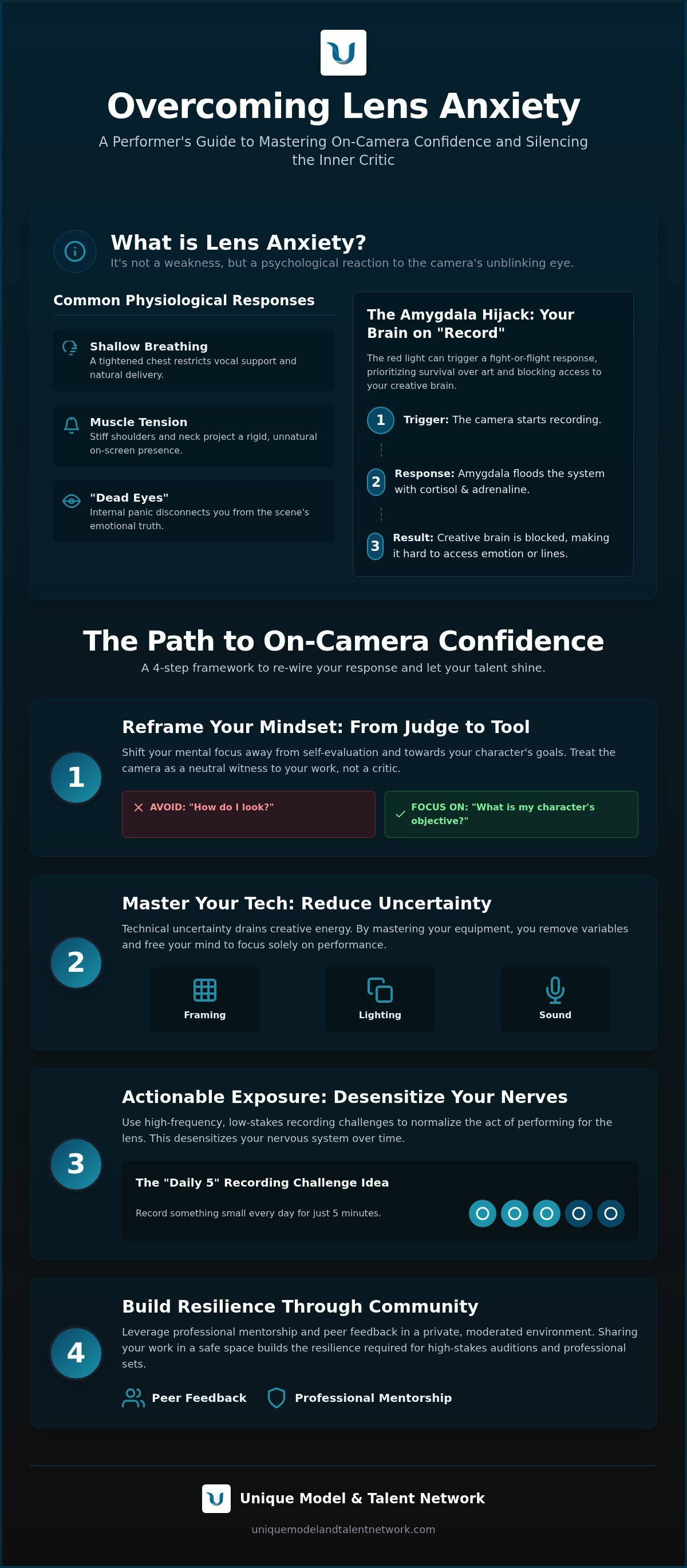
Camera fright isn't a sign of weakness; it's a specific psychological reaction to the unblinking eye of the lens. When you're trying to figure out how to overcome stage fright on camera, you first have to recognize that the lens acts as a judgmental observer. It doesn't blink, it doesn't smile, and it doesn't give you the social cues your brain needs to feel safe. This creates a sense of being under a microscope, where every thought is visible and every mistake feels permanent.
To understand this phenomenon, we can look at the broader definition of What is Stage Fright. While traditional performance anxiety involves a crowd, camera fright is more intimate and often more intense. Your brain perceives the camera as a predator or a high-stakes evaluator. This triggers a physiological response that has nothing to do with your actual skill level. Even elite actors with decades of experience deal with these symptoms:
- Shallow breathing: Your chest tightens, making it hard to support your voice or find natural rhythms.
- Muscle tension: Your shoulders rise and your neck stiffens, which translates as a rigid, unnatural presence on screen.
- "Dead eyes": Internal panic causes your gaze to go flat, effectively disconnecting you from the scene's emotional truth.
Stage vs. Screen: Why the Camera Feels Different
On a stage, you share energy with a live audience. You can feel their presence and adjust your performance in real time. The camera offers no such feedback; it is a void. This lack of immediate response forces you to look inward, which often leads to extreme self-consciousness. Every micro-expression is magnified. A flicker of doubt that wouldn't be seen from the back row of a theater becomes a glaring distraction on a 4K monitor. Learning how to overcome stage fright on camera requires mastering this intimacy rather than fighting it.
The Amygdala Hijack: Your Brain on "Record"
The moment the red light turns on, your amygdala, the brain's alarm system, can take over. This "hijack" triggers a fight-or-flight response, flooding your system with cortisol and adrenaline. This chemical surge effectively blocks access to your creative brain, making it nearly impossible to access nuanced emotions or remember complex blocking. You aren't "bad" at acting; you're simply experiencing a biological override that prioritizes survival over art. Lens anxiety is a manageable technical hurdle for modern talent. By understanding the biology of the record light, you can begin to implement routines that keep your creative brain in the driver's seat.
The Psychology of Presence: Reframing the Judgmental Eye
Presence on screen begins with a fundamental mental shift. You must move away from the perfectionism trap, where you worry about every hair out of place or the exact angle of your chin. This obsession with appearance is the primary enemy of authentic screen acting. It keeps you trapped in your head, rather than in the scene. Instead, re-establish the concept of the Fourth Wall within your digital workspace. Treat the lens as an invisible boundary that protects your character's world rather than a window for judgment. When you shift your primary question from "How do I look?" to "What is my character’s objective?", the camera stops being a threat. It becomes a witness to your truth.
Remember that the learning curve for screen work is steep, and it's okay to feel exposed. Be compassionate with yourself as you navigate this transition. Authenticity is often messy, and casting directors are looking for your unique spark, not a polished, robotic version of a person. Developing this level of self-assurance is a core component of The Network Membership, where talent can explore their craft without the pressure of public social media noise.
Visualization Techniques for Screen Actors
Visualization is a practical tool for those learning how to overcome stage fright on camera. Before you press record, visualize the camera as a trusted friend or the specific person your character is speaking to in the scene. This humanizes the technology. Additionally, practice mental set walk-throughs to normalize your environment. Close your eyes and see yourself setting up your lights, framing the shot, and delivering your lines with effortless confidence. Using positive outcome imagery before a self-tape session primes your nervous system for success rather than defense.
Reframing "Nervous" as "Excited"
Physiologically, the symptoms of anxiety and excitement are nearly identical. Both involve a racing heart, heightened awareness, and a surge of adrenaline. The difference is the label you choose to apply. Instead of trying to suppress your nerves, reframe them as the high-stakes energy your character needs. Channel that vibration into your character’s objectives. If the scene is intense, use that nervous energy to fuel the character's urgency. Finally, establish a consistent pre-roll ritual to ground your energy. Whether it's a specific vocal warm-up or a physical shake-off, this routine signals to your brain that you are in control and ready to perform.
Technical Mastery: Reducing Variables to Combat Fear
Technical uncertainty is a silent killer of creative flow. When you are preoccupied with whether the ring light is too bright or if the microphone is clipping, your focus shifts from the character to the equipment. This split focus is exactly where performance anxiety takes root. One of the most effective ways to understand how to overcome stage fright on camera is to eliminate as many technical variables as possible before you even step into the frame. By establishing a "set-and-forget" routine, you free your mind to inhabit the scene fully.
There is a direct correlation between technical preparedness and emotional confidence. Knowing your lines is only half the battle; you must also trust your environment. A professional acting portfolio requires consistent, high-quality self-tapes that showcase your range without the distraction of poor production values. When your setup is optimized, you remove the "tech-fright" that often precedes a high-stakes audition. This allows you to walk onto your home set with the same authority you would bring to a network studio.
The Professional Self-Tape Environment
Your workspace should be a sanctuary of focus. A consistent background, ideally a neutral grey or blue, prevents visual clutter from draining your mental energy. Lighting should be soft and directional; once you find the perfect placement, mark it on the floor. A reliable reader is another crucial variable. Whether they are in the room or on a video call, a reader who understands the pace of the scene helps the camera disappear. Finally, silence is your best friend. Eliminating external noise ensures that you aren't listening for the neighbor's lawnmower instead of your partner's cues.
Script Memorization Strategies for Anxious Actors
Many actors struggle with how to overcome stage fright on camera because they only "mostly know" their lines. This is a dangerous trap. If your brain has to work to retrieve a word, it cannot simultaneously process complex emotions. You must reach an unconscious level of memorization. Practice your dialogue while doing chores, driving, or exercising. If you can recite the scene perfectly while folding laundry, you can do it under the pressure of a recording light. Use industry-standard apps to drill your lines until they become muscle memory. This level of preparation ensures that even if panic strikes, your dialogue will remain steady.
Actionable Exposure: The "Daily 5" Recording Challenge
Exposure therapy is the most effective psychological tool for long-term change. To truly master how to overcome stage fright on camera, you must desensitize your nervous system to the presence of the lens. This doesn't happen during a high-stakes audition; it happens in the quiet moments of your daily routine. By increasing the frequency of your recording sessions while lowering the stakes, you rewire your brain to stop perceiving the camera as a threat. The goal is to reach a point where the "record" light feels as mundane as turning on a light switch.
Commit to a 30-day challenge of recording yourself every single day. The secret to this exercise is the "no-post" rule. When you remove the possibility of external judgment from social media or casting directors, you grant yourself the freedom to be imperfect. This allows you to watch your playback with a technical eye rather than a critical one. Instead of judging your features or your talent, look for technical improvements in your eyeline, your stillness, and your vocal clarity. If you're looking for a moderated, professional space to test these skills before a real audition, explore The Network Membership for supportive peer feedback.
The 5-Minute Daily Routine
Consistency beats intensity every time. Follow these four steps to build your camera resilience:
- Step 1: Record 60 seconds of a mundane activity. Talk to your pet, describe what you're cooking, or narrate your morning coffee routine. This normalizes the lens in your personal space.
- Step 2: Record a 60-second monologue or a piece of commercial copy. Focus on your character's objective, not the equipment.
- Step 3: Watch the footage once. Limit your notes to technical variables only, such as lighting, sound, or framing.
- Step 4: Delete the footage immediately. This final step is vital because it removes the pressure of "keeping" the performance, reinforcing that this is a safe space for growth.
Breathing and Grounding Drills
Physiological resets are essential when you feel the "fright" start to spiral. Use the Box Breathing method: inhale for four counts, hold for four, exhale for four, and hold for four. This simple rhythm forces your heart rate to slow down and signals safety to your brain. If you feel disconnected from the room, use the 5-4-3-2-1 grounding technique. Silently identify five things you see, four things you can touch, three things you hear, two things you can smell, and one thing you can taste. This pulls you out of your internal panic and back into your physical environment. When you make a mistake during a take, don't apologize or stop. Simply pause, use a grounding breath, and start the beat again. This level of professional composure is what sets booking-ready talent apart from the rest.
Building Confidence Through Professional Mentorship
Isolation is the greatest catalyst for performance anxiety. When you attempt to navigate the industry in a vacuum, every stumble feels like a terminal failure. This isolation significantly increases the pressure of film industry auditions, where the stakes already feel astronomical. Transitioning from a solitary practice to a mentored environment is a critical step in learning how to overcome stage fright on camera. By surrounding yourself with professional peers and seasoned mentors, you replace internal speculation with external clarity.
The Network Membership is designed to be the ultimate safe space for this transition. Unlike the chaotic and often predatory nature of public social media, this moderated environment focuses on tangible skill-building and career development. Live workshops led by casting directors help normalize the audition process, turning a high-pressure event into a familiar professional routine. This sense of community belonging provides the psychological safety net required to take creative risks without the fear of permanent career damage.
The Power of Expert Feedback
Seeking validation through social media likes is a dangerous distraction for serious talent. These metrics provide no professional guidance and often fuel the very perfectionism that causes lens anxiety. In contrast, acting workshops online offer real-time adjustments from industry experts who understand the nuances of the 2026 market. Watching your peers receive feedback is equally valuable. It reveals that your fears are universal, which immediately reduces their power over you. You begin to see the camera as a tool for storytelling rather than a judge of your worth.
Navigating the Industry with Clarity
Much of the anxiety actors feel stems from the "unknowns" of the business. When you understand the specific technical and professional standards expected of you, the mystery of the industry evaporates. Connecting with a savvy industry insider through our Q&A sessions provides the direction needed to move from a hobbyist mindset to a professional career path. Clarity is the antidote to fear. When you know exactly what is expected in the room, you can focus entirely on your performance. Ready to silence the stage fright and join a professional community? Explore The Network Membership here.
Own Your Presence and Book the Role
Mastering how to overcome stage fright on camera is a journey of technical discipline and psychological reframing. You've learned that lens anxiety is a biological response you can manage through consistent desensitization and professional routines. By removing technical variables and committing to daily low-stakes recording, you transition from a place of defense to one of creative authority. This shift is the difference between a forgotten audition and a booking-worthy performance that showcases your true spark.
Growth doesn't happen in isolation. To truly accelerate your career, you need a safe space to fail, learn, and excel. The Network Membership offers this sanctuary through a private community on the Mighty Networks platform. You'll gain access to live workshops with industry-leading casting directors and monthly challenges designed to build your resume and confidence simultaneously. Stop letting nerves dictate your potential and start building a career grounded in professional standards.
Join the Unique Model & Talent Network today and take the first step toward feeling at home on any professional set. Your audience is waiting for the authentic you to shine through.
Frequently Asked Questions
How do I stop my hands from shaking on camera during an audition?
Shaking hands are a natural result of excess adrenaline in your system. You can manage this by grounding your feet firmly on the floor or holding a small, weighted object like a stone out of frame. If your hands are visible, try resting them on a table or your lap to provide physical stability. Focus on your character's physical actions rather than your own tremors to redirect your nervous system's energy.
Is it normal to forget my lines as soon as the camera starts recording?
Forgetting lines is a classic symptom of the amygdala hijack. This happens because your brain prioritizes survival over creative memory when it feels threatened by the lens. To prevent this, memorize your dialogue until it becomes muscle memory. Practice your first two lines until you can say them without thinking. This creates a bridge that carries you through the initial spike of anxiety when the recording light turns on.
How can I make my "dead eyes" look more alive on screen?
Eyes look dead when you stop thinking active thoughts and start worrying about the camera. To keep your eyes alive, maintain a constant internal monologue as your character. Every moment on screen should involve a specific thought or reaction to your scene partner. When you are truly listening and thinking, your eyes will naturally reflect that inner life, making you look present and authentic to the casting director.
Should I look directly into the camera lens when I am acting?
In most narrative film and television auditions, you should look slightly off-camera to your reader. Looking directly into the lens breaks the fourth wall and is generally reserved for hosting, commercials, or direct-address scenes. Use a specific eyeline just to the left or right of the camera lens. This allows the lens to capture your expressions without making the audience feel like you are staring at them.
What is the best breathing exercise for performance anxiety?
Box breathing is one of the most effective tools for talent learning how to overcome stage fright on camera. Inhale for four counts, hold for four, exhale for four, and hold for four again. This rhythm forces your parasympathetic nervous system to engage, which naturally lowers your heart rate. Practicing this for two minutes before your slate helps you enter the frame with a calm, focused energy that feels professional.
How many times should I re-record a self-tape before I send it?
Aim for three to five takes maximum to keep your performance fresh. Recording dozens of takes often leads to over-analysis and a robotic delivery that lacks spontaneous life. If you haven't captured the scene in five takes, take a twenty-minute break to reset your energy. Trust your preparation and pick the take that feels the most authentic, even if it has a minor technical imperfection.
Can professional coaching really help with stage fright?
Professional mentorship is often the fastest way to build lasting confidence. Through The Network Membership, you can participate in Live Industry Workshops where casting directors provide direct feedback on your work. This exposure therapy helps normalize the high-stakes environment of the industry. Hearing from experts and watching your peers excel provides the clarity you need to move past fear and focus on your professional growth.
How do I handle a mistake during a live callback on Zoom?
If you make a mistake during a live Zoom callback, don't apologize or break character. Simply take a grounding breath, stay in the moment, and pick up from the last beat. Casting directors value professional composure and the ability to recover more than a perfect first take. Showing that you can handle a technical or performance glitch with grace proves that you are ready for the pressure of a professional film set.


