

A quiet audition pipeline is a signal to investigate, not a verdict on your talent. If you’re asking what to do when you're not getting auditions, first work out where the process is slowing down. The roles you pursue, how you submit, the materials you send, and timing can all affect whether an opportunity moves forward.
It’s frustrating to send applications into silence, especially when you can’t get clear feedback on your headshots, reel, profile, or audition technique. But a quiet stretch doesn’t tell you by itself whether you’re on the wrong track or should give up. It’s a reason to review the parts of your process you can assess and adjust.
This guide will help you check your submission habits, make sure your materials fit the roles you’re pursuing, and choose a focused next step for your skills. You’ll also learn how to seek informed feedback without expecting anyone to promise representation, auditions, or bookings. The goal is a practical reset: a clearer view of what to change and a plan you can follow without treating silence as a judgment of your talent.
Key Takeaways
- When deciding what to do when you're not getting auditions, identify which stage of your pipeline needs attention instead of treating silence as a measure of your talent.
- Use a private submission log to spot patterns in the roles you pursue, the materials you send, and the responses you receive.
- Match your next step to the issue: review your materials, practice a specific skill, or seek informed feedback when self-assessment isn’t enough.
- Follow a manageable 30-day reset to review your process, make a focused adjustment, and check your progress without expecting guaranteed auditions.
- Consider whether workshops, portfolio and reel reviews, or peer connection through The Network Membership fit your development needs. The membership is not a talent agency and doesn’t guarantee representation or bookings.
Not Getting Auditions? Start With the Pipeline
It’s discouraging to put yourself forward and hear nothing back. But a quiet period can’t measure your talent or tell you exactly what to change. Before overhauling your materials or questioning whether you belong in the industry, map the stages between finding a suitable opportunity and hearing about the outcome.
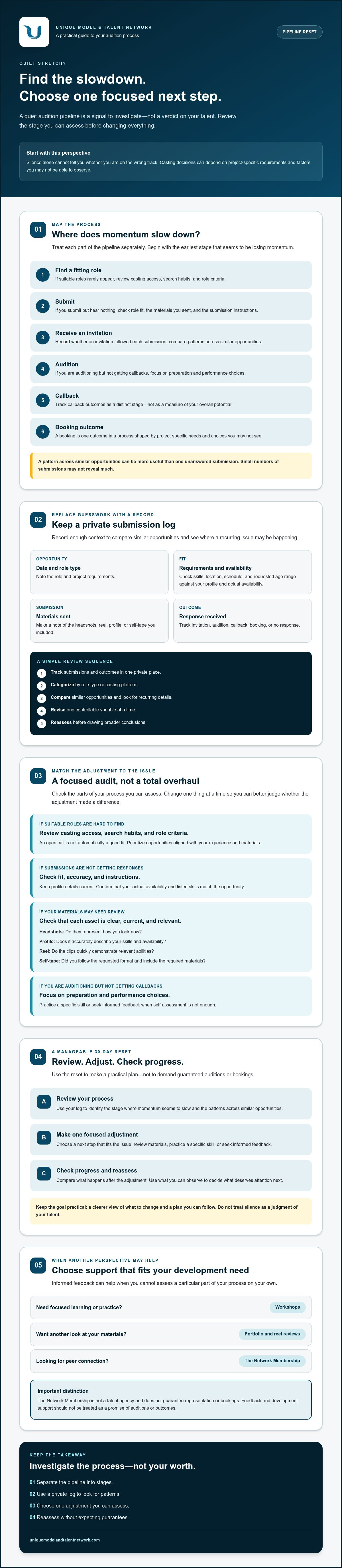
Your audition pipeline may include finding a fitting role, submitting, receiving an invitation, auditioning, getting a callback, and booking. These are separate stages, and a slowdown at one point calls for a different response than a slowdown at another. For a broad overview of the audition process, see Wikipedia, then use the stages below to pinpoint what you can assess in your own experience.
Which part of the audition process has slowed down?
Start with the earliest stage that seems to be losing momentum. If suitable roles rarely appear, review your casting access, search habits, and role criteria. If you’re submitting but not hearing back, check how closely each role fits, whether your materials represent you accurately, and whether you followed the instructions. If you’re auditioning but not getting callbacks, focus on preparation and performance choices rather than changing everything at once.
These patterns aren’t diagnoses by themselves. A small number of submissions may not reveal much, and a response can depend on factors you can’t observe. Still, separating the stages helps you choose a proportionate next step. A submission concern calls for checking role fit and materials. An audition-stage concern may call for targeted practice or informed feedback.
Why audition silence is not a verdict on your potential
Casting decisions are shaped by project-specific requirements, and performers may not know all the factors behind a choice. A role might call for a particular combination of qualities, availability, or on-screen dynamics. One rejection, or no reply to one submission, rarely reveals the full reason. Avoid turning an unknown into a personal conclusion.
Look for patterns across multiple opportunities instead. Are you struggling to find fitting roles, getting few replies after submitting, or reaching auditions without callbacks? Record what happened and what you sent, then compare similar submissions over time. This gives you a more useful basis for deciding what to do when you're not getting auditions: investigate the stage showing a recurring issue, make one focused adjustment, and reassess before drawing broader conclusions about your talent or potential.
How to Diagnose Why Your Audition Submissions Aren’t Converting
If you’re trying to work out what to do when you're not getting auditions, start with records rather than guesswork. Keep a private submission log with the date, role type, project requirements, materials sent, and any response. Note whether you received an invitation, auditioned, got a callback, or heard nothing. This helps distinguish a submission pattern from an audition-stage pattern.
Then use a simple audit sequence: track, categorize, compare, revise, and reassess. Group submissions by role type or casting platform, and compare similar opportunities. Look for recurring details, not a single outcome. Change one controllable variable at a time, such as the materials you send for a particular role type, so you can better judge whether the adjustment made a difference.
Audit role fit, availability, and submission instructions
For each opportunity, check the requested age range, skills, location, and schedule against your profile and actual availability. Confirm that your profile details are current and follow the project’s submission instructions closely. An open call isn’t automatically a good fit. Prioritizing roles that align with your experience and materials makes your submissions more deliberate.
Review headshots, reels, profiles, and self-tapes
Check that every asset is clear, current, and appropriate for the opportunity. Do your headshots represent how you look now? Does your profile accurately describe your skills and availability? Do the clips in your reel quickly demonstrate relevant abilities? For more detailed guidance, see this acting portfolio guide.
For a self-tape, confirm that you followed the requested format and included the required materials. These are checks you can make, but casting decisions aren’t fully visible or within your control. You may not know how a project’s specific needs shaped its choices, so don’t treat silence as proof that one asset caused the outcome.
If you can’t assess your materials objectively, ask a qualified professional for focused feedback. A portfolio or reel review can help you identify a practical adjustment, while a workshop can provide structured learning. The paid The Network Membership offers education, feedback, and industry connection. It isn’t a talent agency and doesn’t guarantee representation, auditions, or bookings. Check current membership features and review access before joining.
Which Audition Fix Should You Try First?
The best next step depends on where you’re getting stuck. If you’re deciding what to do when you're not getting auditions, choose support that answers a specific question about your process, materials, or craft. No workshop, review, or networking opportunity can promise auditions or bookings. Use this comparison to find a proportionate place to start.
| What you’re noticing | A sensible first step |
|---|---|
| You’re unsure which submissions are suitable | Self-review your submission records, role criteria, profile details, and instructions. |
| A particular audition skill feels inconsistent | Choose targeted practice, such as working on self-tape delivery or a specific technique. |
| You’re uncertain about reel choices or presentation | Seek a professional portfolio or reel review and ask for feedback on a defined question. |
| You want guided practice in a craft area | Look for a workshop that clearly addresses that skill and explains how participants will work on it. |
| You want perspective or industry connection | Discuss your goals with trusted peers and build professional relationships without treating networking as a booking route. |
When self-review is enough, and when outside feedback may help
Start with self-review when the question is factual: Did you follow the submission instructions? Is your profile complete? Do your records show which role types you’re pursuing? These checks don’t require you to guess what casting professionals think.
Outside feedback may be more useful when the same uncertainty keeps coming up about performance, reel selections, or how you present yourself. Ask a focused question, such as, “Does this clip show the skill I’m submitting for?” Specific, constructive feedback is easier to apply than general approval.
How to choose between coaching, workshops, and networking
Choose a workshop when you want guided practice in a defined craft or audition skill. A portfolio or reel review can offer a professional perspective on your materials. Peer discussion can help you exchange experiences and build relationships, but it isn’t a substitute for targeted skill feedback. For help assessing workshop options, read this online acting workshops guide.
If your goal is to develop professional connections, look for purposeful conversations and shared learning rather than implied access to work. This acting industry networking guide offers more context. Before investing time or money in any support, check what it provides and whether it addresses the question you identified.
A 30-Day Plan to Get Your Audition Process Moving Again
A reset works best when it gives you useful information, not when it sets a quota for auditions or bookings. Use this four-week plan to make one considered change at a time, then review what you learned. If you’re working out what to do when you're not getting auditions, focus on actions you can control.
- Week one: Find the bottleneck. Review your submission log. Identify the stage with the clearest recurring issue, such as finding suitable roles, receiving responses, or moving forward after auditions. Choose one area to address rather than trying to fix everything at once.
- Week two: Update one relevant asset. Based on your review, select one item to improve, such as a headshot, profile detail, reel clip, or self-tape setup. Check that it suits the opportunities you’re pursuing. If you’re unsure, seek focused feedback before making broader changes.
- Week three: Practice one skill consistently. Choose a craft goal that matches the pattern you observed, such as making clearer performance choices or becoming more comfortable with self-tapes. Use a class, workshop, or trusted professional review to guide your practice. Keep notes on what you’re testing.
- Week four: Reassess and decide. Review new submissions and responses alongside your earlier records. Note what changed, what you learned, and what remains unclear. Keep adjustments that helped you submit more thoughtfully or prepare with greater focus. If there’s no clear learning yet, choose a different variable to test next.
Build a repeatable weekly submission routine
Set aside a consistent block of time to find suitable opportunities, confirm that you meet the stated requirements, and prepare each submission carefully. Prioritize relevant roles over sending the same package everywhere. Log the date, role type, materials sent, and response, if any. Treat the log as a planning tool, not a scorecard for your worth as a performer.
For more context on preparing for film auditions and understanding the process, read this film industry auditions guide.
Practice, review, and reassess without overcorrecting
Keep your focus narrow. If your records point to uncertainty about reel selections, don’t also overhaul your profile and change your audition technique in the same week. A focused adjustment makes it easier to reflect on what you tried, even if the outcome is inconclusive. Casting decisions remain outside your control, so measure the quality of your process as well as any responses.
If structured education, expert feedback, or peer connection would support your next step, explore The Network Membership. It’s a paid community, not a talent agency, and it doesn’t guarantee auditions, representation, or bookings.
How Professional Feedback and The Network Membership Can Support Your Next Step
Once you’ve identified the stage that needs attention, choose one relevant action and decide how you’ll assess its usefulness. A focused question makes feedback easier to apply. For example, ask whether your reel shows the skills you’re submitting for or which part of a self-tape to practice next. Support should help you develop your craft or materials, not promise access to casting opportunities.
What structured access to industry perspectives can offer
The Network Membership is a paid community that connects aspiring models and actors with industry professionals and peers for education, feedback, and connection. Membership offerings include live industry workshops, portfolio and reel reviews, monthly skill-building challenges, and industry expert Q&A sessions. Check the current membership details to confirm what’s available and how review access works.
Workshops can provide a setting to learn and practice, while expert Q&A sessions can help members raise focused questions about professional development. Neither is a route to guaranteed casting. A moderated peer community can also offer a place to exchange experiences, discuss goals, and support consistent practice. Treat peer perspectives as useful context, not as a substitute for project-specific casting decisions or qualified professional feedback.
Decide whether a professional community fits your current goal
A community may suit you if your next step involves ongoing learning, feedback opportunities, or professional connection. It may not fit if you’re looking for direct talent representation, guaranteed auditions, or commission-based booking. The Network Membership is not a talent agency and does not provide representation or guarantee auditions, bookings, or paid work.
If you’re weighing what to do when you're not getting auditions, keep the decision practical: identify your bottleneck, choose the resource that addresses it, and review what you learn. Before joining, confirm current features and whether portfolio or reel reviews are included or priced separately. If education, feedback, and peer connection match your goal, explore The Network Membership and decide whether it fits your development needs.
Take One Focused Step Toward Your Next Audition
A quiet audition pipeline can feel personal, but silence alone doesn’t measure your talent. To decide what to do when you're not getting auditions, identify where the process is slowing down, choose one practical adjustment, and review what you learn before changing course again.
If ongoing education, expert perspectives, and peer connection would support your next step, The Network Membership is a paid community with access to resources such as live workshops, portfolio and reel reviews, skill-building challenges, and expert Q&A. Features and review access may vary, so check what’s currently available. The Network is not a talent agency and doesn’t provide representation or guarantee auditions, bookings, or paid work.
Explore The Network Membership to see whether its current resources fit your goals. Keep your plan focused, protect your confidence, and give yourself room to grow. A slow period is a reason to reassess, not a reason to count yourself out.
Frequently Asked Questions
Why am I not getting auditions?
There may be several reasons, and silence alone can’t identify which one applies. Suitable roles may be limited, your search criteria may be too narrow, or your submissions may not match a project’s requirements. Materials, availability, and submission instructions are also worth checking. Casting decisions can depend on project-specific factors you can’t see, so look for patterns across similar opportunities rather than assuming one rejection reveals the whole story.
What should I do first if I’m not getting auditions?
Start by mapping where your process slows down. Keep a private record of opportunities, role types, dates, materials sent, and responses. If you’re not finding suitable roles, review your casting access and search habits. If submissions get no response, check fit, materials, and instructions. This step-by-step audit gives you a more grounded answer to what to do when you're not getting auditions than changing everything at once.
Can better headshots or a reel help me get more auditions?
Clear, current headshots and a well-chosen reel can help your materials represent you and your relevant skills accurately, but they can’t guarantee more auditions. Check that your images reflect how you look now and that your reel clips suit the kinds of roles you’re pursuing. Follow each project’s submission requirements, too. If you’re unsure what to update, ask a qualified professional for focused feedback before replacing everything.
How long should I wait before changing my audition strategy?
There’s no universal waiting period that fits every performer or casting market. Avoid making a major change after one unanswered submission. Instead, track a group of comparable submissions, identify a recurring pattern, and test one adjustment, such as refining role criteria or updating a relevant asset. Set a review point that gives you enough information to reflect, while remembering that casting outcomes aren’t fully within your control.
Should I hire an acting coach if I’m not getting auditions?
Consider coaching if you’ve identified a specific craft question, such as self-tape delivery, audition preparation, or making clear performance choices. A coach may help you practice and receive targeted feedback, but coaching may not address issues like limited suitable roles or incomplete submission materials. Before committing, clarify what you want to work on and check that the coach’s experience aligns with that goal. No coaching can guarantee auditions or bookings.
Can networking help me get auditions without an agent?
Networking can help you learn from peers and industry professionals, develop professional relationships, and become more informed about the field. It isn’t a guaranteed route to auditions, representation, or paid work. Focus on respectful, genuine conversations and shared learning rather than approaching every connection as a transaction. Keep submitting through legitimate channels that suit your experience and follow each opportunity’s stated process, whether or not you have an agent.
What should I do if I get auditions but no callbacks?
Review the audition stage separately from your submissions. Consider whether you prepared the sides carefully, understood the brief, and made clear performance choices. If you notice a recurring concern, practice that specific skill or seek constructive feedback from a qualified professional. A lack of callbacks doesn’t reveal exactly why casting made its decision, since project needs can vary. Treat each audition as information for your development, not a definitive judgment of your ability.
Is a talent network the same as a talent agency?
No. A talent network and a talent agency aren’t interchangeable. Unique Model & Talent Network is a paid professional community connecting aspiring models and actors with industry experts and peers through education, feedback opportunities, and networking. The Network Membership does not provide direct talent representation or commission-based booking services, and it doesn’t guarantee auditions, bookings, or paid work. Review current membership features to decide whether the community matches your professional development goals.


