

What if the thousands of followers on your social media profile are actually the least important part of your professional application? While the "model-creator" trend is growing, top-tier scouts still value industry-standard technicals over viral moments. Most aspiring talent feel overwhelmed by the noise and fear falling for predatory scams that promise the world but deliver nothing. You're likely wondering how to submit to modeling agencies without getting lost in a crowded digital market or wasting money on unnecessary fees that legitimate agencies never charge.
If you're ready to move past the guesswork, this guide provides the clarity you've been looking for. We'll show you the exact submission strategy that uses professional "digitals" and high-level networking to get you noticed by reputable firms. You'll gain a clear checklist of required materials, learn to spot red flags instantly, and discover how to build the professional bonds that lead to a sustainable career. We're breaking down the industry standards of 2026 to ensure your portfolio lands on the right desks and your talent receives the recognition it deserves.
Key Takeaways
- Master the "Blank Canvas" theory to understand why top agencies prioritize raw, unedited digitals over high-fashion editorials to evaluate your true potential.
- Follow a disciplined, step-by-step strategy on how to submit to modeling agencies using a professional digital kit that meets 2026 technical requirements.
- Protect your professional interests by identifying "photo mill" scams and understanding the financial legitimacy of commission-based representation.
- Replace low-yield cold emailing with a networking strategy that leverages expert feedback to refine your materials before they reach a scout's desk.
The Modern Agency Submission Landscape: Strategy Over Luck
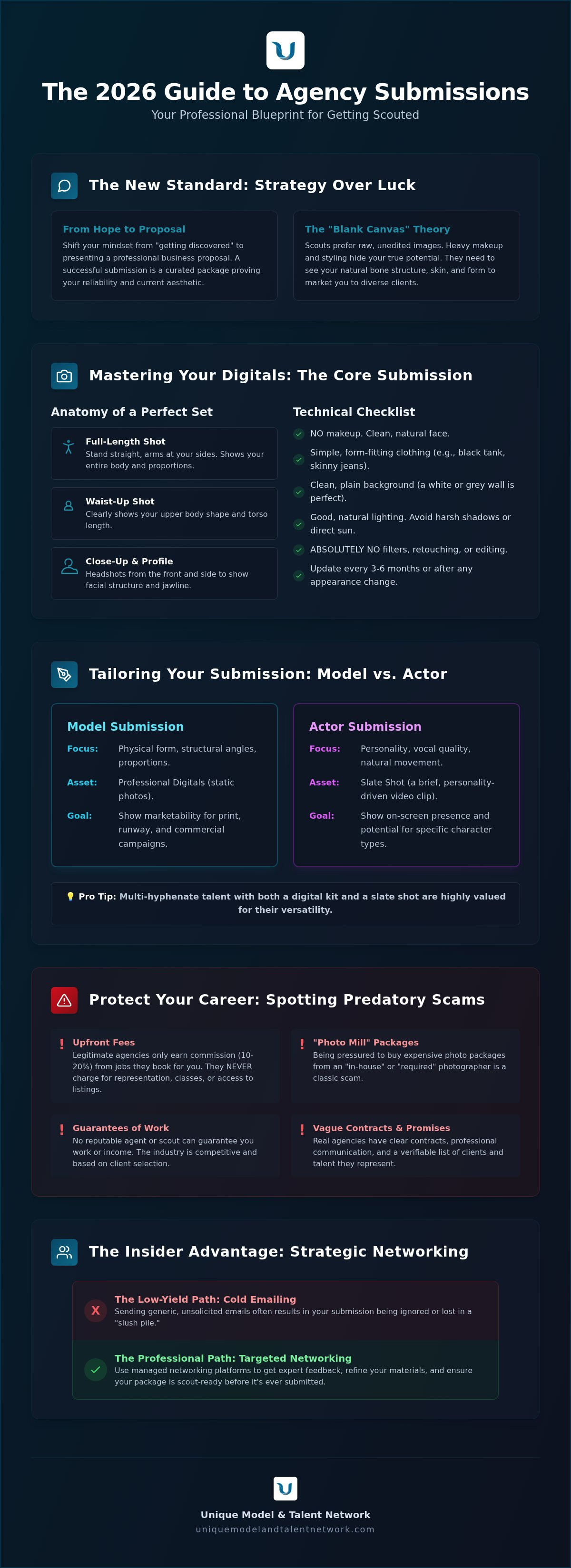
Approaching a scout in 2026 requires a mindset shift from "getting discovered" to presenting a professional business proposal. A successful submission is no longer a random collection of your favorite selfies; it's a digital-first package designed to prove your reliability and current aesthetic. Before you begin, it's vital to understand what a modeling agency is and how they evaluate raw talent to build a profitable board. Agencies don't just look for beauty; they look for a "blank canvas" they can market to diverse clients.
The "Blank Canvas" theory explains why scouts often ignore high-fashion editorials or heavily edited photos in a first-round review. If you're learning how to submit to modeling agencies, you must realize that excessive makeup and complex lighting actually hide your potential. Scouts prefer raw, natural images because they need to see your bone structure and skin health without distractions. They're looking for the foundation they can build upon for various commercial or editorial campaigns. If your materials are over-processed, you're signaling a lack of industry knowledge.
Efficiency is the hallmark of a serious professional. While many talent spend months cold-emailing generic addresses, savvy individuals use a managed acting industry networking platform to refine their materials before they ever hit a scout's inbox. This targeted approach ensures your "Current Look" is always accurate. In 2026, the industry standard requires you to update your submission materials every 3 to 6 months. If your hair length, color, or physical proportions change, your digital kit must reflect that immediately to maintain professional integrity.
The Psychology of the Talent Scout
Scouts are trained to look past the surface. They evaluate specific markers like facial symmetry, natural proportions, and skin vitality. When you submit, a "neutral" expression is your most powerful tool. It proves your versatility for different casting types, from high-end luxury brands to relatable commercial work. Avoid forced poses or dramatic "smizing" in your initial digitals. These often come across as amateur and can make it harder for a scout to visualize you in a client's specific vision.
Models vs. Actors: Submission Differences
While the industries overlap, their technical requirements differ. A "Model Digital" focuses on physical form and structural angles through static images. Conversely, an "Actor Slate Shot" is a brief video clip that captures your personality, vocal quality, and natural movement. The 2026 market increasingly favors multi-hyphenate talent. Having both assets prepared shows you're a versatile professional ready for the shift toward authenticity in both commercial film and print markets. Being prepared with a complete digital kit for both disciplines doubles your visibility without doubling your effort.
Preparing Your Submission Package: Mastering Professional Digitals
Digitals, historically known as polaroids, serve as your professional ID card in the entertainment industry. While your portfolio shows what you can become with a full creative team, scouts use digitals to see who you are right now. In 2026, an application without these raw assets is considered an incomplete submission. This requirement isn't just for models; commercial actors now need these natural shots to complement their acting portfolio and slate shots. A cohesive professional brand is built when your polished editorial work is anchored by the undeniable reality of your raw digitals.
The "No-Filter" mandate is a non-negotiable standard for legitimate representation. Editing or filtering your digitals creates significant legal and logistical liability for an agency. If a client books you based on a filtered image and you arrive on set looking different, the agency may face contract disputes or financial penalties. Adhering to official advice on modeling scams will help you recognize that real agencies want to see your natural skin texture and proportions, not a digital facade. If you're wondering how to submit to modeling agencies successfully, the answer lies in transparency and technical accuracy.
The Anatomy of a Perfect Set
Your digital kit should be a streamlined gallery that answers every physical question a scout might have. Focus on these four essential shots:
- The Full-Length Shot: Stand straight with your arms at your sides to capture your natural proportions, posture, and silhouette.
- The Waist-Up (Medium) Shot: This frame focuses on your torso and arm length, providing a clearer look at your physical frame.
- The Close-Up Headshot: You must include a direct frontal view, a 3/4 profile, and a full profile view to show your bone structure clearly.
- Hair Variations: If you have long hair, take shots with your hair both up and down to reveal your neck and jawline.
Wardrobe and Grooming Standards
The industry "uniform" is designed to be invisible so your features can stand out. Choose simple, form-fitting clothing, such as a black tank top and slim-fit denim, that clearly shows your body line. Grooming should be minimal. Present yourself with clean hair and a "no-makeup" look that highlights your natural skin health. Avoid jewelry or distracting accessories that pull focus away from your face. For footwear, women should use simple heels to improve posture, while bare feet are often preferred for accurate height verification. If you want to ensure your materials meet these elite standards, consider a Portfolio & Reel Review to get expert feedback before you hit send.
The Step-by-Step Guide to Submitting Your Materials
Execution is where many talented individuals falter. Knowing how to submit to modeling agencies involves more than just hitting "send" on an email; it requires a disciplined, multi-stage approach to ensure your materials aren't immediately archived. Your first priority is vetting. Before uploading any personal data, use reputable industry directories to verify an agency's history. This is also the stage where you must remain vigilant about Identifying Predatory 'Agencies' that target newcomers with false promises. Legitimate agencies prioritize your safety and professional standards from the first interaction.
Once you've identified your targets, follow this four-step protocol to maximize your visibility:
- Step 1: Research. Cross-reference agencies with local guides and industry databases to ensure they handle your specific category, whether that's high fashion, commercial, or fitness.
- Step 2: File Preparation. Organize your digital kit. Check every file for resolution and ensure your naming conventions are perfect before you even open your browser.
- Step 3: Submission. Navigate specific agency portals carefully. Many top-tier firms use proprietary forms, while others prefer submissions through vetted casting websites to streamline their recruitment.
- Step 4: The Follow-Up. Patience is a professional skill. Wait at least two to four weeks before checking in. If an agency is interested, they'll contact you. Repeatedly emailing scouts can signal desperation rather than ambition.
Technical Photography and File Setup
Your technical setup determines the quality of your "ID card." For DIY digitals, natural, indirect sunlight is the gold standard. Position yourself near a large window during the day to avoid harsh shadows. You must use a plain, neutral-colored wall, such as white or light grey, to keep the focus entirely on your features. Organization is equally vital. Use a standard naming convention like Firstname_Lastname_Height_Agency for all attachments. This simple step makes it easy for scouts to find your files in a crowded database.
DIY vs. Professional Sessions
You don't always need a professional photographer to get signed. In fact, using the back camera of a modern smartphone provides better resolution and depth than the front-facing "selfie" camera. Studio sessions are only necessary when you're investing in "high-end" digitals for elite international boards. Regardless of the equipment, the "no-retouching" policy is absolute. Do not use apps to smooth skin or alter proportions. Properly crop your files to a standard 4:5 or 2:3 ratio so they display correctly in agency review software. If you're serious about learning how to submit to modeling agencies, remember that technical precision reflects your professional readiness.
Industry Red Flags: Identifying Predatory "Agencies"
The modeling industry is built on financial partnership. If an entity asks for money before you've booked a single job, you're likely dealing with a predatory organization. When you research how to submit to modeling agencies, prioritize firms that operate strictly on commission. Standard agency commissions typically range from 15% to 20% of your earnings. Anything requiring a "registration fee," "application cost," or "website maintenance fee" is a major red flag. Legitimate agents only profit when you profit.
The "Photo Mill" is perhaps the most common trap for emerging talent. These businesses present themselves as agencies but exist solely to sell expensive, mandatory photo packages. If a scout claims you have "potential" but insists you pay for their specific photographer to get signed, walk away. Legitimate agencies accept simple, raw digitals because they have the expertise to see your potential without high-end production. They'll never force you into a specific studio session as a condition of representation.
Unprofessional communication is another warning sign. If a "scout" contacts you via an informal social media DM and avoids providing a professional email address, proceed with extreme caution. Legitimate business development happens through verified channels, not unorganized messaging platforms. Watch out for the "Bait and Switch" where a recruitment offer quickly turns into a pitch for expensive modeling classes or subscriptions. While skill-building is essential, it shouldn't be a prerequisite for signing a contract.
The Legitimacy Checklist
Always verify an agency's physical office and client list. A reputable firm will have a track record of working with known brands and a transparent list of their current board. It's also vital to distinguish between a talent agency and a modeling career coaching service. Agencies book work; coaches provide the training and strategy to help you succeed. Both are valuable, but they serve different purposes. For the highest level of safety, look for agencies with SAG-AFTRA accreditation or those that follow strict New York child model regulations if you're under 18.
Protecting Your Digital Identity
Safe submission practices are paramount. Never send sensitive personal information, such as your social security number or home address, via unencrypted web forms or social media DMs. Predatory individuals often use the informal nature of Instagram or TikTok to bypass professional standards. Private, moderated environments are the only safe spaces for talent discovery in 2026. Within the Unique Model & Talent Network, every industry professional is vetted to ensure member safety and financial legitimacy. If you're ready to connect with experts in a secure space, join the Network today to start building your career with confidence.
The Insider Advantage: Leveraging Networking to Get Signed
Submitting your materials is only half the battle. While the technical steps of how to submit to modeling agencies provide the foundation, networking acts as your career multiplier. Cold emailing is a notoriously low-yield strategy. Scouts at top-tier agencies receive hundreds of submissions daily, and many are archived before a human ever sees them. Learning how to submit to modeling agencies effectively means moving beyond the "hit and hope" method of cold outreach and into a space where your talent is actually seen.
By utilizing Portfolio & Reel Reviews within the Unique Model & Talent Network, you refine your submission package before it reaches a scout's desk. This proactive approach eliminates the guesswork. You can also gain direct insights through acting workshops online, where casting directors provide real-time feedback on your presence and professionalism. This managed environment keeps you focused, removing the distractions and predatory noise found on public social media platforms. It's about building a reputation before you ever step into an agency office.
The Power of the Professional Network
The Network Membership serves as the essential bridge between your raw digitals and a signed contract. It isn't just about access; it's about preparation. Through Monthly Skill-Building Challenges, you'll stay disciplined in updating your submission kit and maintaining your "Current Look" as discussed in previous sections. Peer networking also plays a vital role. Connecting with other serious talent allows you to discover which agencies are currently expanding their boards or looking for your specific "type" without the misinformation common in hobbyist groups. This collective intelligence keeps you ahead of market trends.
Next Steps: Joining the Professional Community
Transitioning from an aspiring talent to a working professional requires a mindset shift. Expert-led Q&A sessions allow you to ask specific questions about contract terms, agency expectations, and market trends in a secure environment. You should always seek professional mentorship and feedback before your first major submission to ensure your materials meet elite industry standards. This level of preparation signals to agencies that you're a serious professional rather than a hobbyist. Ready to get your materials in front of the right people? Join the Unique Model & Talent Network today.
Your Professional Path to Representation
Success in 2026 requires moving beyond the superficiality of social media and embracing the disciplined standards of the professional industry. You now understand that mastering how to submit to modeling agencies is about more than just photos; it's about presenting a reliable, transparent business proposal. By prioritizing raw digitals over edited snapshots and remaining vigilant against predatory upfront fees, you position yourself as a serious candidate ready for the realities of the market.
Don't let your submission be just another unread email in a scout's inbox. You deserve a protective environment where your materials are refined by experts before they ever hit an agency desk. Through our private community, you'll gain access to monthly Portfolio & Reel Reviews and live Q&A sessions with industry-leading casting directors who value professional standards. Elevate your career with professional feedback; Join The Network Membership. Your career acceleration starts with the right guidance and a community dedicated to your growth. We're ready to help you open the door to legitimate opportunities with confidence.
Frequently Asked Questions
Do I need professional lighting to take my digitals at home?
You don't need professional lighting equipment. Natural, indirect sunlight from a large window is the industry gold standard for DIY shots. Avoid using ring lights or heavy artificial lamps, as they can flatten your features or create unnatural shadows. Scouts prefer to see your authentic skin texture and bone structure under natural light to accurately evaluate your potential for various commercial or high-fashion campaigns.
Can I wear makeup in my digitals if it looks very natural?
No makeup is the preferred standard. If you feel you must wear something, stick to a very light "no-makeup" look that only evens out skin tone. Agencies need to see your raw "blank canvas" to visualize how you might look in different client concepts. Heavy makeup or filters create a legal liability for the agency if you arrive on set looking different than your submission photos.
How often should I update my modeling and acting digitals?
You should update your materials every 3 to 6 months to maintain professional standards. If you change your hair length, color, or physical proportions, you must take new photos immediately. Reliability is key when you're learning how to submit to modeling agencies. Providing an outdated look can result in lost jobs and a damaged reputation if you're booked for a role you no longer fit.
Why do agencies ask for Polaroids if they are a digital company?
"Polaroids" is simply traditional industry terminology for raw, unedited digital photos. While the name comes from the instant cameras used in the past, the purpose remains the same. Agencies require these because they provide an honest, unvarnished look at your current appearance. It's the most reliable way for scouts to judge your natural proportions and bone structure without the influence of professional editing or complex studio lighting.
What should I wear for my digital photos if I don’t have a uniform?
Stick to the industry "uniform" of simple, form-fitting clothing. A black tank top and slim-fit denim jeans are the safest choices because they clearly show your body line. Avoid baggy garments, loud patterns, or jewelry that might distract the viewer. The goal is for your clothing to be invisible so that the scout's attention remains entirely on your facial features and natural physical silhouette.
Is it okay to smile in my digital photos?
It's absolutely okay to smile, but only in one specific shot. Most of your digital set should feature a neutral, relaxed expression to show your versatility. Including one "smiling with teeth" shot is helpful for commercial casting directors who need to see your range and dental health. Avoid forced or overly dramatic expressions, as these can make you look amateur and hide your natural bone structure.
Can I use a self-timer, or do I need someone else to take the photos?
You can use a self-timer, but having someone else take the photos is significantly more efficient. A friend can ensure the camera stays at eye level and help you adjust your posture in real-time. If you must work alone, use a tripod and the back camera of your smartphone for the best resolution. Avoid the "selfie" camera, as it often distorts facial proportions and provides lower image quality.
What is the difference between a digital and a comp card?
Digitals are raw snapshots used to prove your current look to scouts. A comp card is a finished marketing asset that includes your stats and polished, professional portfolio images. When you're researching how to submit to modeling agencies, focus on your digitals first. These act as your industry ID card, whereas a comp card is what you'll use for casting calls once you have representation.


