

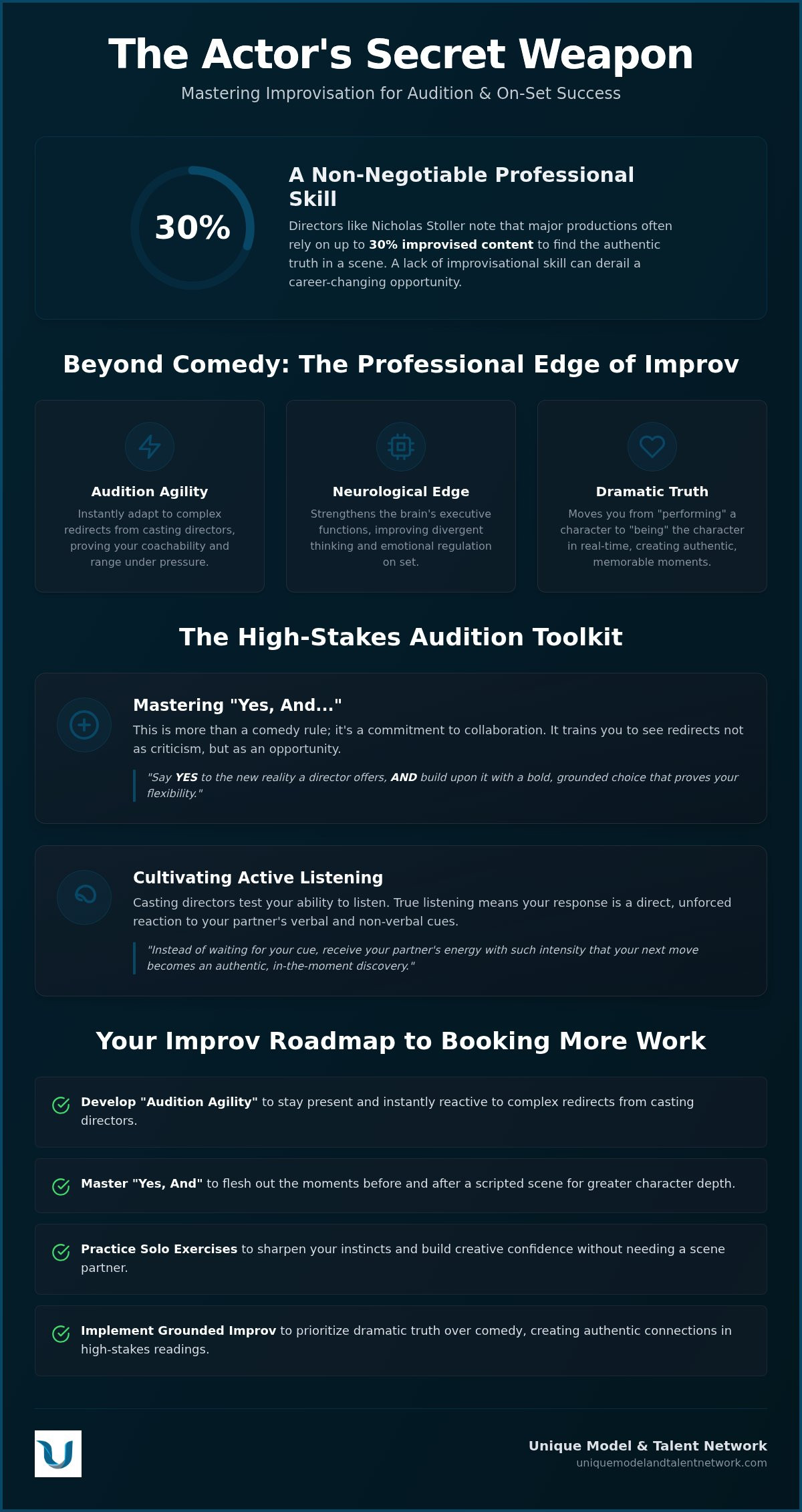
Most actors treat improvisation like a secondary hobby, but the truth is that it's a professional survival skill for the modern audition room. Whether you're facing a sudden redirect from a casting director or a cold reading that feels stiff, your ability to think on your feet determines your booking rate. In fact, directors like Nicholas Stoller have noted that major productions often rely on up to 30% improvised content to find the truth in a scene. If you've ever felt stuck in a script or panicked about losing a line, you know how quickly a lack of flexibility can derail a career-changing opportunity.
It's frustrating to feel like your craft is limited by the words on a page. We'll show you how to break through that rigidity by mastering specific improvisation exercises for actors that build character depth and professional agility. You'll learn to replace audition anxiety with the confidence to make bold, unexpected choices that casting directors crave. This guide covers foundational techniques like active listening and the "Yes, and..." principle; providing you with a clear roadmap to sharpen your instincts and secure more professional work in an increasingly competitive industry.
Key Takeaways
- Develop "audition agility" to stay present and reactive, allowing you to take complex redirects from casting directors instantly.
- Master the professional application of "Yes, And" to flesh out the moments before and after a scripted scene for greater character depth.
- Discover how targeted improvisation exercises for actors can be practiced solo to sharpen your instincts without needing a scene partner.
- Implement grounded improv techniques to prioritize dramatic truth over comedy, creating a more authentic connection during high-stakes readings.
- Learn how to leverage live industry workshops to receive real-time feedback on your improvisational skills from active casting professionals.
Beyond the Laughs: Why Improvisation is a Non-Negotiable Professional Skill
Professional improvisation is often misunderstood as a niche reserved for comedians or sketch performers. In reality, it's the foundation of truthful acting across every medium. For a serious performer, improv is the art of staying present and reactive within the given circumstances of a scene. It demands that you stop "performing" a pre-rehearsed version of the character and start "being" the character in real time. This shift is what separates a stiff, forgettable audition from a performance that books the job. When you engage in consistent improvisation exercises for actors, you develop what industry insiders call "audition agility." This is your capacity to take a sudden redirect from a director and execute it immediately without letting the script's rhythm trip you up.
There is a physiological benefit to this training that goes beyond the craft. Research into neuroplasticity suggests that improvisational training strengthens the brain's executive functions, particularly in areas related to divergent thinking and emotional regulation. It prepares your mind to handle unexpected script changes or technical glitches on set without breaking character. Instead of panicking when a scene partner drops a line, you've trained your brain to see that silence as an opportunity for authentic connection rather than a mistake to be fixed.
Improv vs. Comedy: Clearing the Misconception
Many actors avoid improv because they don't think they're "funny." This is a significant career mistake. Professional improv is a tool for every genre, including heavy drama and procedural thrillers. While the history of improvisational theatre includes many comedic traditions, its core purpose is to foster spontaneity and truth. The "Yes, And" philosophy isn't a setup for a joke; it's a commitment to accept the reality your scene partner provides. This versatility is essential for those pursuing modeling career coaching and acting alike, as both industries value talent who can pivot their energy to match a client's vision instantly.
The Casting Director Perspective
Casting directors use improv in the room to test your range and, more importantly, your coachability. They aren't looking for a stand-up routine. They want to see if you can listen. If you can't deviate from your prepared choices, you become difficult to direct on set, which is a red flag for high-budget productions. Mastering improvisation exercises for actors ensures you stand out during film industry auditions because you're the one who stays grounded when things go off-script.
In a professional setting, Active Listening is the practice of receiving your partner's verbal and non-verbal cues with such intensity that your next response is a direct, unforced reaction to what just happened.
Mastering the "Yes, And" in High-Stakes Audition Environments
When a casting director gives you a redirect that feels completely counter-intuitive to your preparation, your first instinct might be to resist. This is where the "Yes, And" principle becomes your most valuable asset. Instead of viewing the note as a critique of your work, see it as a collaborative gift to explore a new facet of the character. Incorporating specific improvisation exercises for actors into your daily routine trains your brain to accept these shifts without hesitation. It's about saying "yes" to the new reality and "and-ing" it with a bold, grounded choice that proves you're a flexible professional.
This mindset also applies to the "moments before" and "moments after" a scripted scene. A script provides the dialogue, but improv provides the life that exists when no one is talking. By improvising the thirty seconds before the first line, you enter the scene with genuine momentum rather than just waiting for your cue. This technique is especially helpful during cold readings, where you must find the emotional beats and transitions instantly. It helps silence the inner critic that often stops you from making the risky, memorable choices that book rooms.
The 5-Step Audition Improv Framework
To maintain your composure under pressure, follow this structured approach during your next reading:
- Step 1: Identify the Base Reality. Quickly determine who you are, where you are, and what just happened before the first line.
- Step 2: Establish Point of View. Decide exactly how you feel about the person across from you in this specific moment.
- Step 3: Listen for the Gift. Every vocal inflection or physical tick from your partner is a clue; use it to fuel your next line.
- Step 4: React Before You Speak. Let the emotion of your partner's delivery hit your face before the words leave your mouth.
- Step 5: Commit 100%. A bold, "wrong" choice is always more memorable to a director than a safe, boring one.
Handling the Redirect
Redirects are a test of your professional agility. Practice exercises where you "flip" your objective mid-scene; for example, moving from "trying to win an argument" to "trying to make them laugh." This flexibility ensures you stay in character even if you forget a line. If a line drops, don't break; use the silence to deepen the scene's tension. This level of preparation is vital when engaging with an acting industry networking platform where live feedback is a core part of the growth process. You can start practicing with industry veterans today to ensure your instincts are sharp before your next big call.
Solo vs. Group Practice: Building Your Improvisational Toolkit
Many actors believe they can only hone their skills when they're surrounded by a troupe. This myth limits your growth and creates a dependency on others for your professional development. Solo practice allows you to develop an internal focus and character depth that group work often skips. By using improvisation exercises for actors in your own living room, you build a foundation of spontaneity that makes you a stronger asset when you finally step into a collaborative setting. You can use the morning news to trigger high-stakes scenarios; take a headline and immediately improvise the witness statement. Recording these sessions is vital. It allows you to analyze physical "tells", such as shifting weight or nervous hand movements, that could distract a casting director during a high-pressure audition.
Solo drills are about mastering your own instrument. When you practice alone, you aren't distracted by a partner’s choices, which means you can go deeper into the "why" of your own reactions. This internal focus is what builds the character depth that professionals look for in a high-quality reel. Group work, by contrast, is the "gym" where you test those muscles through external reaction. You’re learning to catch the "ball" your partner throws and throw it back with more energy. This is where you practice the "Yes, And" philosophy in a live, unpredictable environment.
Top Solo Improv Exercises
If you're working alone, focus on exercises that stretch your imagination and physical range. These drills ensure you stay sharp between bookings:
- The Object Monologue: Pick a random item, like a stapler or a coffee mug, and give it a soul. Why is it tired? What is its secret ambition? This forces you to find emotional stakes in the mundane.
- The Gibberish Rant: Express a specific emotion, such as rage or betrayal, using only nonsense sounds. This strips away the safety net of words and forces you to rely on physicality and tone.
- Character Walk-ons: Set a timer for 30 seconds and adopt a completely new physicality. Change your center of gravity and your leading body part. Repeat this five times to expand your physical vocabulary.
Maximizing Group Practice
While solo work builds the muscle, group practice tests your ability to react. Group games shift the focus from your internal process to the external "gift" your partner provides. In a professional troupe, you might use the "Three-Line Scene" to establish who, where, and what in under 30 seconds. Another effective tool is the "Ad Game," where you sell a ridiculous product using only emotional appeals like guilt or extreme patriotism. Finding the right environment for these challenges is key to career acceleration. You can access structured peer practice and expert guidance through acting workshops online, which bridge the gap between solo study and professional collaboration.
Grounded Improv: Exercises for Dramatic Depth and Character Building
Grounded improv shifts the focus from "what is funny" to "what is true." While general audiences often associate improvisation with quick-witted comedy, professional actors use it as a surgical tool to dissect a character's emotional life. By utilizing improvisation exercises for actors that prioritize realism over punchlines, you create a performance that feels lived-in rather than performed. This approach is rooted in the belief that if you can't live truthfully in an imaginary scenario, you can't deliver a convincing dramatic performance on screen. One of the most effective ways to build this authentic connection is through Meisner-based repetition, which forces you to focus entirely on your partner's behavior rather than your own internal script.
To deepen your character work, try the "Internal Monologue" exercise. During the natural gaps in a scripted scene, speak your character's hidden thoughts out loud. This reveals the subtext that usually remains buried and helps you find the emotional weight behind every line. You can also create "History" by improvising a pivotal scene that happened ten years before the script begins. This gives you a tangible memory to draw from during your performance, ensuring your character's reactions aren't just surface-level choices but are backed by a decade of imagined experience.
The Emotional Range Drill
Consistency is key, but variety is what makes you memorable. Take a simple two-person scene and play it at different "emotional volumes" on a scale from one to ten. A "volume one" scene might be a whisper of resentment, while a "volume ten" is an explosive confrontation. You can also use the "Statue" exercise: start in a specific physical pose and let your body's position dictate the emotion that follows. Intentional physical tension, such as a clenched jaw or a tight shoulder, acts as an immediate improv trigger that informs the character's emotional state without a single word being spoken.
Building the "Acting Portfolio" of Characters
Every discovery you make during these exercises should be documented to help build your professional acting portfolio. Use improv to find "The Signature" of a new character, which is a unique physical or vocal trait that defines them. Practicing an "Interview in Character" is another powerful way to solidify a role's backstory; have a friend ask you questions about your character's childhood, fears, and secrets while you remain in the role. If you're ready to test these characters in front of industry professionals, apply to join our next live industry workshop to receive direct feedback on your dramatic range.
Elevating Your Craft with the Unique Model & Talent Network
Success in the entertainment industry is rarely a solo endeavor. While you can sharpen your instincts at home, the transition from a student to a working professional requires a high-stakes environment where your choices are evaluated by experts. The Unique Model & Talent Network provides this essential bridge. By joining a managed talent community, you gain a level of career security that public social media simply cannot offer. Improv is a vulnerable craft; it requires you to fail, experiment, and look ridiculous before you find the truth of a character. Our private, moderated environment ensures you can perform improvisation exercises for actors without the distraction of external noise or unprofessional feedback.
This community isn't just a place to talk; it's a place to work. Our Live Industry Workshops allow you to take the techniques you've learned and apply them in front of active casting directors. This real-time feedback is the difference between practicing in a vacuum and developing the specific agility that gets you booked. You'll move beyond the hobbyist mindset and start treating your career development with the discipline it deserves. Within the network, you aren't just another profile; you're a vetted professional building a reputation among industry leaders.
Access to Industry Experts
One of the primary benefits of The Network Membership is direct access to the people who make hiring decisions. We host Industry Expert Q&A Sessions where you can ask specific questions about audition redirects or how to handle a scene partner who isn't giving you anything to work with. Additionally, our Portfolio & Reel Reviews provide a professional lens for your improvisational clips, ensuring your digital presence reflects your actual range. If you're looking for local peers to run lines or practice group games, our private network makes it easy to find serious professionals in your area who share your commitment to the craft.
Join the Next Skill-Building Challenge
We believe that growth happens through consistent, disciplined action. That's why we host Monthly Skill-Building Challenges designed to push you out of your comfort zone and into the spotlight. These challenges aren't just for fun; they're a way to showcase your progress to the vetted industry decision-makers who monitor our community for emerging talent. When you participate, you're proving your coachability and your range to the people who matter most. If you're tired of the uncertainty and lack of access that defines the traditional industry path, it's time to choose a different route. Join our community today to accelerate your career and gain the professional clarity you've been looking for.
Master Your Professional Instincts and Book More Work
Mastering improvisation exercises for actors is the most effective way to transform your audition presence from predictable to magnetic. These techniques build the agility needed to handle redirects and the depth to find truth in every script. Whether practicing solo or in a group, the goal is staying present and reactive when the camera rolls. This isn't just for comedy; it's about being a flexible professional that directors trust with complex roles.
Your journey doesn't have to be a solo climb. By joining a community focused on professional standards, you gain direct access to casting directors and photographers who value your growth. Our private, moderated network offers live workshops and monthly skill-building challenges designed to move you from the practice room to the professional stage. Elevate your craft and connect with industry pros; join the Unique Model & Talent Network today. We're ready to help you turn your instincts into a career-defining asset.
Frequently Asked Questions
Can I practice improvisation exercises for actors alone?
Yes, solo improvisation exercises for actors are highly effective for identifying physical habits and building internal focus. You don't need a partner to practice giving backstories to household objects or performing emotional rants in gibberish. Recording these solo sessions allows you to analyze your performance and eliminate nervous "tells" that might distract a director during a high-stakes audition.
Is improvisation only useful for comedic actors?
No, improvisation is a fundamental skill for actors in every genre, including heavy drama. It trains you to stay grounded and reactive rather than just reciting lines. Industry professionals value this versatility because it proves you can find the truth in a scene even when the script is minimal or the director changes the emotional tone on the fly.
How do improvisation exercises help with cold readings?
Improv instincts allow you to navigate cold readings by quickly identifying the "base reality" and the emotional beats of a scene. Instead of feeling stiff, you'll have the confidence to "flesh out" the moments before and after the written dialogue. This creates a sense of momentum and authenticity that makes your reading feel like a lived-in performance rather than a first glance at a page.
What is the "Yes, And" rule in professional acting?
The "Yes, And" rule is a professional commitment to accept the reality your partner provides and then contribute your own bold choice. In an audition, this means saying "yes" to a casting director's note, even if it feels counter-intuitive. By "and-ing" that note with a specific reaction, you demonstrate that you are a flexible, coachable talent who can pivot instantly.
Do I need an improv class to be a good film actor?
While talent can be innate, structured training provides the disciplined environment necessary to refine your instincts. Film acting requires a high degree of technical precision and spontaneity. Participating in live workshops or monthly challenges within a professional network gives you the real-world feedback needed to transition from a hobbyist to a serious contender for professional bookings.
How can I use improv to get noticed by casting directors?
Casting directors notice actors who are present, reactive, and easy to direct. When you use improv to handle a sudden redirect, you prove that you aren't just a "one-trick" performer. This agility shows that you can handle the unpredictable nature of a film set, making you a safer and more attractive investment for high-budget productions.
What are the best improv games for building cast chemistry?
Games like the "Three-Line Scene" are excellent for establishing who, where, and what within seconds to build trust among a cast. These improvisation exercises for actors force performers to listen intensely and catch the emotional "gifts" thrown by their partners. This collaborative focus builds a cohesive ensemble that can handle technical glitches or script changes without losing the scene's truth.
How does improv training improve my acting resume?
Listing improv training signals to agents and directors that you possess elite listening and reacting skills. It indicates that you're capable of "active listening," a high-value trait in recruitment and talent evaluation. This accreditation on your resume suggests you're prepared for the fast-paced environment of professional sets where script revisions and technical adjustments are constant.


