

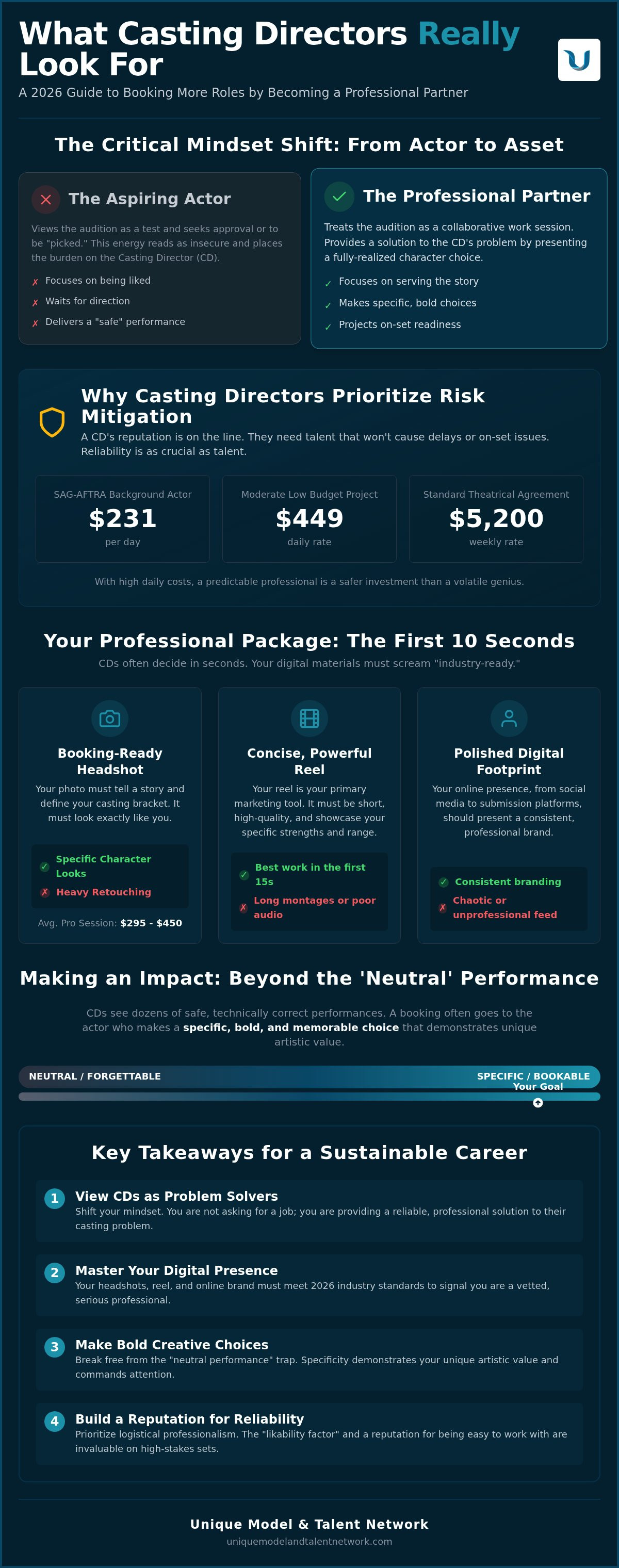
What if the reason you aren't booking has nothing to do with your talent? In a market where a SAG-AFTRA background actor earns $231 a day and weekly performer rates hit $5,200, the stakes for production are too high to gamble on "good" acting alone. You might feel invisible despite submitting polished self-tapes, but the truth is that what do casting directors look for often extends far beyond the lines on the page. They aren't just seeking a performer. They're looking for a professional partner who can mitigate the financial and creative risks of a high-budget set.
It's exhausting to deliver a performance you're proud of only to be met with silence. You've likely felt the anxiety of wondering if your home studio setup is the problem or if you're simply lost in a sea of thousands of applicants. This guide provides the clarity you've been seeking by pulling back the curtain on the casting office's perspective. You'll discover the specific professional traits, performance choices, and 2026 business standards that turn a "maybe" into a booking. We will break down how to build a sustainable reputation that makes you the obvious choice for every role you chase.
Key Takeaways
- Shift your mindset to view the casting director as a professional problem-solver who needs you to be the reliable solution for their production.
- Master the technical standards of your digital presence to ensure you meet exactly what do casting directors look for in a vetted, industry-ready talent.
- Break through the "neutral performance" trap by making specific, bold creative choices that demonstrate your unique artistic value and command of the room.
- Build a sustainable reputation by prioritizing the logistical markers of professionalism, including reliability and the "likability factor" that producers value on high-stakes sets.
- Gain a competitive edge by utilizing live workshops and expert portfolio reviews to receive direct, actionable feedback from industry decision-makers.
The Psychology of the Casting Room: Why CDs are Problem-Solvers
To understand how to book more work, you first have to understand the person across the desk or behind the screen. Casting directors are often viewed as gatekeepers or judges, but in reality, they are high-level project managers. Their primary job is to mitigate risk for the producers, directors, and network executives who hire them. When you walk into a room or upload a self-tape, you aren't just presenting your art; you're presenting a business solution. Understanding what do casting directors look for begins with recognizing that they are looking for the person who makes their own job easier.
Every project comes with immense pressure. Directors are worried about the creative vision, while clients and networks are focused on the bottom line. If a casting director recommends an actor who isn't prepared or who causes delays on set, it's the casting director’s reputation on the line. They need to know that you can handle the technical demands of a professional environment without hand-holding. The difference between an aspiring talent and a professional is how they view the audition. An aspiring actor wants to be "picked." A professional actor understands they are there to solve a casting problem by providing the exact missing piece of a production puzzle.
Understanding the CD's Stakes
A casting director's career depends on their ability to deliver reliable talent. If they cast a "difficult" actor who causes a crew of 50 people to go into overtime, the financial impact is staggering. With 2026 SAG-AFTRA daily rates for moderate low budget projects at $449 and weekly rates for standard theatrical agreements reaching $5,200, every minute on set is a significant investment. Reliability and a lack of ego are often prioritized over raw talent because a predictable professional is a safer investment than a volatile genius. This is why having a professional acting portfolio that signals your experience and readiness is non-negotiable.
Moving from 'Pick Me' to 'I’m the Partner'
You must project the energy of someone who already belongs on set. This starts by reframing the audition as a collaborative work session. Instead of seeking approval, focus on how your interpretation of the character serves the story the director wants to tell. You are not there to be tested; you are there to work. The problem-solver mindset is the commitment to being a technically proficient, emotionally prepared, and logistically reliable professional who treats every audition as a high-level business consultation.
The Professional Package: Beyond the Performance
Casting directors often make a definitive decision within the first 10 seconds of viewing a slate or a self-tape. Your energy, vocal clarity, and confidence speak volumes before you even deliver your first line of dialogue. When considering what do casting directors look for, you must realize they are evaluating your professionalism and "on-set vibe" as much as your craft. They need to see a collaborator who is ready for a high-stakes environment where time is literally money. If you don't project that readiness from the moment the camera rolls, the finest performance in the world may never be seen.
Maintaining a professional acting portfolio is the baseline requirement for 2026. This includes vetted headshots, a concise reel, and a resume that reflects current industry standards. Your digital footprint is now an extension of your audition. If a casting director searches for you on social media or industry-standard submission platforms, they should find a consistent, professional brand rather than a chaotic personal feed. Vetted marketing materials act as your calling card, signaling to the industry that you are a serious professional who understands the business side of show business.
The Anatomy of a Booking-Ready Headshot
Specificity is more valuable than generic beauty. In 2026, casting directors want to see "character looks" that clearly define your casting bracket. Whether you are the "tech genius" or the "hardened detective," your photo must tell a story. Ensure your lighting is professional and your resolution is high. Most importantly, you must look exactly like your photo. Heavy retouching is a major red flag that leads to wasted time in the room. Standard professional sessions in major markets like LA or NYC currently average between $295 and $450, and this investment is critical for your credibility.
Optimizing Your Casting Site Profiles
Your presence on major industry submission databases must be optimized for search algorithms. Use specific keywords in your bio and ensure your "Special Skills" section is honest and updated. A 30-second high-quality clip that showcases a specific character type is far more effective than a three-minute reel of outdated work. If you are unsure if your materials meet these standards, getting expert portfolio and reel reviews can provide the necessary direction to elevate your professional status and improve your booking ratio.
Creative Choices: What Makes a Performance 'Alive'?
Playing it safe is the most dangerous choice you can make in a 2026 audition. When you submit a neutral performance, you are essentially asking the casting team to do the creative work for you. In a crowded market, what do casting directors look for is a performer who brings a specific, lived-in perspective to the role. They prefer a messy, authentic moment that feels real over a polished, robotic performance that hits every mark but lacks a soul. While you must remain directable and open to adjustment, you must first present a clear point of view that makes the character feel like a three-dimensional human being rather than a series of lines on a page.
The balance of directability is a key marker of a professional. If a casting director gives you a note, they aren't necessarily looking for you to "fix" something wrong. They are testing how you process information and whether you can pivot without losing your emotional connection. This collaborative spirit is what separates vetted talent from hobbyists. When you approach film industry auditions with a partner-driven mindset, you show that you can handle the evolving demands of a professional set.
Script Analysis for the Modern Actor
Your analysis must begin with the "hook" in the first three lines of the scene. Casting directors often decide to keep watching or move to the next tape based on this initial engagement. To stand out, you must identify your character's primary objective and, more importantly, how that objective shifts during the scene. A bold choice is only effective if it stays within the established world of the project. You should aim to be the solution to the casting problem by showing a deep understanding of the script's tone and the character's specific needs.
The Self-Tape Technical Edge
In 2026, technical proficiency is no longer optional. Poor framing, inconsistent lighting, or muffled sound will kill a great performance before it even starts. Your self-tape environment must be a clean, non-distracting space that allows the viewer to focus entirely on your eyes. The "eyeline" secret is critical; keep your focus slightly off-camera and close to the lens to maintain an intimate connection with the viewer. By mastering these technical baselines, you demonstrate that you are a professional who respects the casting director's time and the high standards of the industry.
The Unspoken Criteria: Reliability and Reputation
Your performance is the price of entry, but your reputation is what keeps you working. When considering what do casting directors look for, you must remember they are hiring a coworker for a high-pressure environment. A standard film set involves dozens of crew members working 12-hour days under tight deadlines. If you are difficult, entitled, or unprepared, you aren't just an artistic challenge; you are a logistical liability. Casting directors prioritize the "Likability Factor" because they need to know you won't disrupt the chemistry of a set or cause expensive delays. They want to cast the person who makes the director feel confident and the crew feel respected.
The industry is smaller than it appears. Casting directors frequently share "Must-Hire" lists and, conversely, "Red Flag" lists. Punctuality and clear communication are the primary logistical markers of a professional. If you are consistently late to appointments or slow to confirm auditions, you signal that you don't value the production's time. A simple, professional thank-you note or a brief follow-up after a callback can leave a lasting positive impression. These small gestures of professional etiquette often carry as much weight as a solid read because they prove you understand the business side of the craft.
Building Long-Term CD Relationships
A "good" audition that doesn't lead to a booking is still a massive professional win. If you deliver a prepared, specific performance, you've successfully auditioned for every future project that casting office handles. You want to stay on a CD’s radar without becoming a nuisance. This is where live workshops and industry Q&A sessions become invaluable tools. They allow you to build face-to-face rapport in an educational setting, moving you from a digital file to a memorable human being. Building these relationships takes time, but a trusted connection with a casting office is the most sustainable way to ensure consistent access to high-level opportunities.
Professionalism in the Digital Age
In the digital era, your public presence acts as a secondary background check. Casting directors often look for consistency between your professional materials and your public posts. If your social media is filled with complaints about past sets or unprofessional behavior, you are providing a reason to be passed over. Rejection is part of the job, and handling it with the grace of a seasoned veteran is a sign of maturity. Being part of a vetted network signals to decision-makers that you have been held to a high standard of conduct. To ensure your reputation matches your talent, consider joining the Network Membership to connect with industry insiders who can provide direct guidance on your professional standing.
How the Unique Model & Talent Network Opens the Door
Understanding the internal mechanics of the casting office is only half the battle. You also need a structured environment where you can apply those standards and get your work in front of the right people. The Unique Model & Talent Network acts as the definitive bridge between your current craft and the professional market. By providing direct access to decision-makers through acting workshops online, we remove the "black box" mystery that often stalls talented performers. What do casting directors look for is a combination of high-level skill and professional vetting, and our network provides exactly that.
Members receive real-time portfolio and reel reviews from industry experts who know exactly what current 2026 standards require. Instead of guessing if your headshots are hitting the mark, you get actionable feedback that can immediately improve your booking ratio. Our private, moderated environment is designed to foster professional growth without the distractions of general social media. This focus ensures that your energy is spent on career-accelerating activities rather than vanity metrics or unorganized networking.
Bridging the Gap Between Talent and Casting
Our Industry Expert Q&A Sessions are designed to demystify the casting process by giving you a direct line to the people who make hiring decisions. You'll learn how to interpret sides for maximum impact and how to project the partner-driven energy that producers value. To keep your skills sharp, we host Monthly Skill-Building Challenges that push you to expand your range and technical proficiency. Transitioning from "aspiring" to "member" status within our network means you're no longer shouting into a void; you're part of a community that casting directors trust to deliver reliable talent.
Your Career Roadmap Starts Here
Managing a career in this industry can quickly lead to burnout if you're trying to do everything yourself. DIY career management often lacks the objective perspective needed to identify professional blind spots. We provide a supportive peer network and a clear roadmap to help you navigate the complexities of the 2026 market. By surrounding yourself with serious professionals and industry mentors, you gain the career security that comes from being part of an elite community. Don't let your talent go unnoticed in a crowded market. Join the Unique Model & Talent Network and get noticed today.
Take Command of Your Casting Journey
Success in the 2026 entertainment market requires more than just raw talent; it demands a transition from an "aspiring" mindset to that of a vetted professional. If you recognize yourself as a problem-solver for production, you can align your materials and performance choices with exactly what do casting directors look for. Your reputation for reliability is your most valuable asset, and your technical proficiency in self-taping is now a non-negotiable standard. You don't have to navigate this complex landscape alone or rely on the chaotic noise of general social media platforms.
It's time to move past the uncertainty of the "black box" and step into a space designed for your career acceleration. You deserve a clear roadmap and direct feedback from those who understand the current industry standards. Join the Professional Community at Unique Model & Talent Network to gain direct access to industry decision-makers and receive portfolio reviews by professional casting directors. Our distraction-free professional growth environment is built to help you build a sustainable career and a lasting reputation. Your next booking is waiting for the professional version of you to arrive.
Frequently Asked Questions
Do casting directors actually watch the whole self-tape?
Casting directors rarely watch a self-tape from beginning to end unless the first few seconds are exceptional. They often make a decision during your slate or within the first two lines of dialogue. If your technical setup is poor or your energy doesn't match the role, they will move to the next submission to save time. Focus on making your first 10 seconds as impactful and professional as possible.
How much does my social media following matter to a casting director?
Your social media following is secondary to your professional craft and ability to solve the production's casting problem. While some commercial brands value a large reach, theatrical casting directors prioritize your "vetted" status and your ability to deliver a nuanced performance on set. They care more about your reputation for reliability and your portfolio than your follower count on external platforms.
What should I do if I haven't heard back after a callback?
Silence is the standard response in the industry, even after a high-level callback. If you haven't heard back within a week, it's best to assume the production has moved in a different direction and focus on your next submission. Don't take the lack of communication personally; casting offices are managing hundreds of roles simultaneously and rarely have the bandwidth for individual status updates.
Is it okay to ask a casting director for feedback after an audition?
It is generally unprofessional to ask a casting director for individual feedback after an audition or callback. Their schedule is too demanding to provide personal coaching for every applicant. If you want to understand what do casting directors look for, consider joining a moderated professional community where you can receive real-time feedback on your portfolio and reels from industry experts in a workshop setting.
What are the biggest red flags that make a casting director stop watching?
The biggest red flags include poor sound quality, distracting backgrounds, and looking significantly different than your headshot. If a casting director can't hear you clearly or if your video is out of focus, they will stop watching immediately. They view these technical failures as a sign that you aren't ready for the professional standards of a high-budget set.
How do I get noticed by casting directors if I don't have an agent yet?
You can get noticed by using reputable casting platforms like Actors Access and participating in live workshops. This is exactly what do casting directors look for when they need fresh talent who may not yet have representation. Joining a private network allows you to build face-to-face rapport with decision-makers, moving you from a digital file to a memorable, professional partner in their eyes.
Should my headshot always be a recent photo, even if I changed my hair?
Your headshot must always reflect your current appearance, especially if you have made a significant change to your hair or facial features. If you walk into a room or appear on a Zoom callback looking different than your photo, you create a logistical problem for the casting team. They need to know exactly what "product" they are hiring to ensure you fit the established visual world of the project.
What is the difference between a commercial and a theatrical casting director?
Commercial casting directors focus on relatable, high-energy performers who can represent a brand's image in a short timeframe. Theatrical casting directors for TV and film look for nuanced storytelling ability and specific character depth. While commercial work often prioritizes a certain "look" or vibe, theatrical roles require a deeper level of script analysis and emotional range to sustain a longer narrative.


