
What if that "dream casting" video call you just finished wasn't with a real scout, but a sophisticated AI deepfake designed to steal your identity? With deepfake fraud attempts rising by 94 percent in 2025, learning how to avoid modeling scams is no longer just a suggestion; it's a career-saving necessity. You've likely felt the overwhelming noise of social media scouts and the constant worry that a "too good to be true" offer is actually a predatory trap. It's exhausting to pursue your passion while constantly looking over your shoulder for the next financial or physical threat.
This guide arms you with the latest 2026 regulatory updates and insider verification tactics to protect your future. We're moving past the superficial advice of the past to give you a professional shield against modern exploitation. You will learn how the New York State Fashion Workers Act has changed the legal landscape for agency fees, which specific costs a legitimate agency will never ask you to pay upfront, and a foolproof checklist to verify any professional before you sign a single document. It's time to stop guessing and start building your career on a foundation of security and elite standards.
Key Takeaways
- Identify the sophisticated "Instagram Scout" trap where bots and fake profiles mimic legitimate agencies to exploit emerging talent.
- Master how to avoid modeling scams by applying the industry's golden rule: legitimate agencies only earn when you earn through commission.
- Understand the 2026 legal protections under the Fashion Workers Act which prohibit agencies from charging upfront signing fees or registration deposits.
- Implement a professional due diligence process by verifying physical addresses and corporate registrations through official government databases.
- Protect your physical and digital safety by maintaining a strict "no-go" list for unverified meetings and private photo requests.
The Anatomy of a Modeling Scam in 2026
A modeling scam is a deceptive practice designed to extract your hard-earned money or sensitive personal data under the guise of career advancement. To understand the Anatomy of a Modeling Scam, you must recognize that these predators rely on your ambition to cloud your professional judgment. They create a convincing illusion of opportunity that feels both exclusive and urgent, targeting emerging talent who are eager to break into the industry.
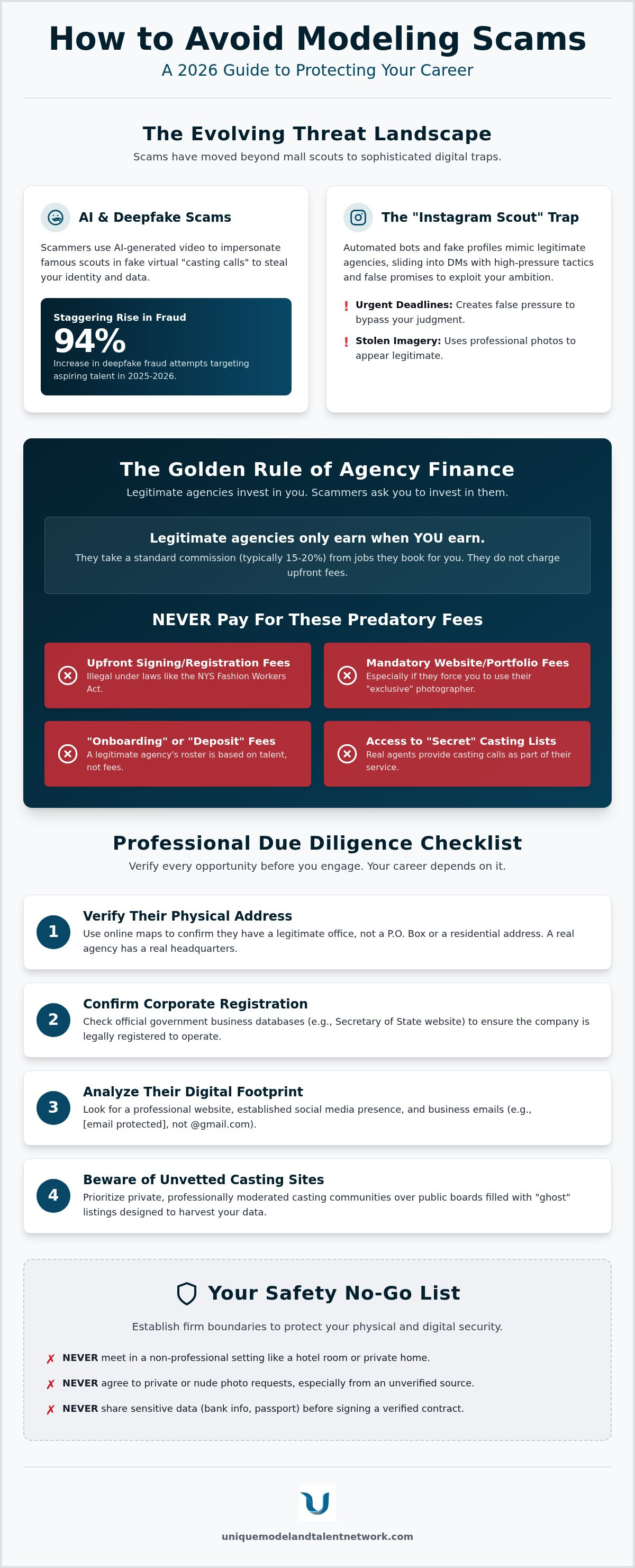
The "Instagram Scout" trap has evolved into a highly automated threat. Bots now use sophisticated scripts to mimic the communication style of legitimate agency scouts, often sliding into your DMs with promises of high-paying campaigns. In 2026, the rise of AI-driven scams has introduced deepfake agencies that host virtual "casting calls." These scammers use synthetic video to impersonate well-known industry figures. Knowing how to avoid modeling scams in this digital environment requires verifying every digital interaction through official channels. If you aren't certain who you're talking to, you're at risk.
Specific red flags of a predatory recruiter include:
- Over-flattery: Claims that you are the "next big thing" without seeing a professional portfolio.
- Financial Pressure: Demands for immediate payment for "registration" or "website fees."
- Lack of Specifics: Vague details about the client, the project, or the usage rights.
Modern Tactics: Beyond the 'Mall Scout'
Scouting has shifted from physical locations to aggressive digital hunting on platforms like TikTok and Instagram. Scammers often use stolen imagery from high-end editorial shoots to build a profile that looks remarkably professional. They rely on an "urgent" deadline, telling you that you have only 24 hours to pay for a portfolio review or sign a contract. Scammers use this pressure to bypass your due diligence. Real agencies don't rush talent. They value your long-term career development and will never demand a signature before you've had time to review the terms.
The Danger of Unvetted Public Casting Sites
Publicly accessible casting websites require a heavy dose of skepticism. Many platforms lack the moderation needed to filter out "ghost" listings, which are fake postings designed solely to harvest your personal information. Sites that operate without professional gatekeeping can expose you to unvetted individuals who have no intention of booking real work. Learning how to avoid modeling scams means prioritizing private, moderated communities over the chaotic noise of public casting boards. Protecting your data is the first step toward building a legitimate career in a competitive market.
The Financial Red Flags: What You Should Never Pay For
The most important rule in professional talent representation is simple: legitimate agencies earn when you earn. This commission-based model ensures your interests are aligned with your representation. If an entity asks for money before they've booked you a single job, you need to know how to avoid modeling scams that prey on your wallet. While industry standard commissions usually range from 15 to 20 percent of your earnings, predatory "agencies" look to profit from you directly rather than from your talent.
Legal protections have significantly strengthened in 2026. Under the New York State Fashion Workers Act, agencies are strictly prohibited from charging models signing fees or deposits just to join their roster. This landmark legislation sets a clear standard for Financial Red Flags that every professional should monitor. If a recruiter insists on an "onboarding fee" or a "registration deposit," they're likely operating outside the law and should be reported immediately.
Hidden Costs vs. Predatory Fees
Distinguishing between legitimate business expenses and "pay-to-play" demands is vital for your career security. Legitimate agencies might deduct marketing fees or the cost of comp cards from your first paycheck. However, they will not demand these funds upfront. Be especially wary of the "exclusive photographer" kickback. If you're told you must use one specific photographer to be signed, the agency is likely receiving a commission from that photographer rather than focusing on your career. You should always have the freedom to choose from a list of approved, high-quality professionals for your portfolio.
The 'Web-Based' Membership Scam
The digital age has birthed a new wave of scams that charge high monthly fees for "access" to casting calls that are often copied from public boards or entirely fabricated. These platforms offer no real advocacy. Contrast this with professional modeling career coaching, which focuses on skill-building and provides tangible educational value rather than empty promises of fame. A legitimate educational community will always have transparent cancellation policies and real human support. If you're looking for a safe environment to grow your skills, joining The Network Membership provides the vetted structure you need to succeed without the risk of exploitation.
Finally, avoid bogus "training packages" that cost thousands of dollars but offer no industry credit. Real training comes from workshops led by verified professionals, not from overpriced "finishing schools" that guarantee a contract. Investing in your education is smart; paying for a promise is a trap.
Professional Due Diligence: How to Verify an Agency or Scout
Verification is your most powerful tool in an industry where anyone can create a digital facade. While scammers rely on speed and emotion, professional success is built on slow, methodical research. Learning how to avoid modeling scams requires you to look past the high-gloss imagery and verify the corporate backbone of every offer you receive. Real agencies have real footprints; they exist in government databases and professional registries, not just in social media comment sections.
Your first step is to verify the physical address and corporate registration. If an agency operates in New York State, they must register with the NYS Department of Labor and display their registration certificate as of December 21, 2025. You should also Verify an Agency through trade organizations that uphold strict ethical standards. Cross-reference any individual who contacts you with the agency’s official website and LinkedIn profile. If a "scout" reaches out via DM but isn't listed on the agency's staff page, call the main office directly to confirm their identity. Legitimate professionals rarely use generic @gmail.com or @yahoo.com addresses for official business; they use dedicated corporate domains.
Analyze the agency's portfolio with a critical eye. Are their models actually working for recognizable, major brands? A legitimate roster shows a consistent track record of bookings with established retailers, designers, and production houses. If the portfolio consists entirely of "test shoots" with no credited commercial work, it may be a front for a photography mill rather than a talent agency.
Reading the Fine Print of a Modeling Contract
Never sign a document under pressure. Scammers often include "perpetual rights" clauses that essentially take ownership of your image forever without additional compensation. You should also be wary of "exclusive" contracts that bind you to an agency without a guarantee of effort or access to work. Before you commit to a long-term representation agreement, ensure you have a professional second pair of eyes on your first acting portfolio contract. Protecting your legal rights early prevents expensive headaches later.
Vetting Industry 'Workshops' and 'Masterclasses'
The education sector of the industry is frequently targeted by scammers selling "fame" rather than craft. To understand how to avoid modeling scams in education, check the instructor's current professional credits on IMDb. Are they active in the industry today, or are they selling outdated advice? Seek out acting workshops online that focus on specific, measurable skills like technical cold reading or commercial auditioning. Independent third-party reviews are far more reliable than the testimonials found on an agency's own promotional landing page.
Physical Safety and Personal Security in the Digital Age
Professional modeling is a business, and legitimate business never happens in a hotel room, a private residence, or at a late-night "casting" call. These locations are absolute non-negotiables on your safety checklist. If a scout or photographer suggests meeting in a non-professional space, they're showing you exactly who they are. Understanding how to avoid modeling scams means trusting your gut when an environment feels off. Real agencies operate out of verified commercial offices during standard business hours; they don't host auditions in living rooms.
Digital privacy is your first line of defense in 2026. You should never send suggestive photos or "digitals" to unverified DMs, regardless of how high-profile the account appears to be. Scammers often use the promise of a major campaign to pressure talent into sending compromising imagery. Once those photos are sent, you lose control over them forever. Always verify the recipient through the agency's official corporate website before hitting send. If they're legitimate, they'll respect your professional boundaries.
For models who are minors, the "Chaperone Rule" is a standard industry practice. Legitimate agencies and casting directors will always welcome, and often require, the presence of a parent or guardian. Be wary of any professional who attempts to isolate you or asks you to keep secrets from your support system. These are classic signs of grooming. A protective mentor will encourage your family's involvement, ensuring that your career growth happens in a safe, transparent environment.
Safe Communication Standards
Professionalism has a specific look and feel. Legitimate casting communication stays on professional platforms and corporate email servers. It doesn't happen over WhatsApp, Snapchat, or Telegram. To keep your personal life secure, use a "work-only" email address and a dedicated phone number for your modeling pursuits. This creates a necessary barrier between your private identity and your professional career. Knowing how to avoid modeling scams involves setting these hard boundaries early. A real casting director will never ask for your home address or personal social security number during an initial digital outreach.
The Role of Vetted Communities
Isolation is a predator's best friend. By joining a managed talent community, you gain a powerful buffer against industry bad actors. These gated spaces prioritize moderation and "gatekeeping" to ensure that only verified experts can interact with talent. Peer-to-peer warnings are incredibly effective; when models talk to each other in a secure environment, scammers find it impossible to operate. If you want to network without the noise of public platforms, join The Network Membership today to connect with pros who value your safety as much as your talent.
The Safe Path Forward: Education vs. Exploitation
Building a legitimate career in 2026 requires a shift in mindset from "waiting to be discovered" to "actively developing a professional craft." While predatory actors sell the illusion of overnight fame, true industry success is built on a foundation of verifiable skills. Understanding how to avoid modeling scams involves realizing that your greatest protection is your own professional standards. When you prioritize education over empty promises, you make yourself a difficult target for exploiters who thrive on the desperation of the uneducated. You aren't just a "look"; you're a business owner managing a professional brand.
Professional mentorship serves as the ultimate barrier against industry chaos. The Unique Model & Talent Network approach focuses on providing a gated, moderated space where experts are vetted and transparency is the default. Unlike "bogus" agencies that demand commissions or provide direct representation under false pretenses, this network focuses entirely on your growth and career security. You gain direct access to live industry workshops and portfolio reviews without the fear of hidden agendas. It's about moving from a "hopeful" amateur to a savvy professional who knows exactly what a legitimate opportunity looks like.
Investing in Yourself, Not a Scam
Investing in your career is a strategic business decision, but you must distinguish between paying for a "dream" and paying for a "skill-building challenge." Predatory fees often promise a guaranteed outcome, whereas legitimate investments provide you with the tools to earn that outcome yourself. Knowing how to avoid modeling scams means recognizing that legitimate career acceleration comes from hard work and accredited guidance, not from paying for a "shortcut" that doesn't exist. Allocate your career budget toward high-ROI assets like professional headshots, which currently average between $250 and $600, and targeted coaching. The "slow build" of a career is always safer than the "overnight success" promise. Real growth takes time, practice, and the right professional bonds.
Your Next Steps in a Protected Environment
Your journey doesn't have to be a solo trek through a predatory landscape. Joining a community that puts your safety and professional standards first allows you to navigate the industry with a collective shield. You can participate in direct Q&A sessions with verified experts, gaining internal industry perspectives that aren't available on public social media. This is the definitive way to clarify your direction in an uncertain field while removing the distractions of unorganized platforms. Join the Unique Model & Talent Network and start your career with confidence.
Launch Your Protected Career Path
You now have the professional framework required to identify predatory tactics and navigate the industry with total clarity. By mastering how to avoid modeling scams, you've shifted from a vulnerable target to an informed professional who values career security over empty promises. Remember that legitimate representation is always built on a commission-based partnership; any demand for upfront signing fees is a clear violation of professional standards. Your safety depends on moving away from the chaos of public social media and into spaces where experts are actually verified.
If you're ready to remove the distractions and focus on tangible success, secure your career and join our vetted professional network today. We provide a private, moderated community hosted on Mighty Networks where you gain direct access to verified casting directors. Our zero-commission educational model ensures that our only goal is your skill development and professional growth. You have the talent and the drive; now you have the shield. Step forward with confidence and let your craft do the talking.
Frequently Asked Questions
Is it normal for a modeling agency to ask for money upfront?
No, it's never normal for a legitimate modeling agency to demand money before they book you work. Professional agencies operate on a commission basis, typically taking 15 to 20 percent of your earnings after a job is completed. If you're asked for signing fees or registration deposits, you're likely dealing with a scam. Learning how to avoid modeling scams starts with rejecting any request for upfront payments.
How can I tell if a modeling scout on Instagram is real?
You can verify a scout by cross-referencing their profile with the agency's official website and LinkedIn staff list. Legitimate scouts use corporate email addresses and will never pressure you for money or suggestive photos in a DM. If their profile seems unorganized or lacks a clear link to a registered business, it's a red flag. Always call the agency's main office directly to confirm the scout's identity.
What should I do if I think I've already been scammed by an agency?
Stop all communication and payments immediately if you suspect you've been targeted. Contact your bank to dispute any recent charges and report the incident to the Federal Trade Commission (FTC) or your local Department of Labor. Document every interaction, including emails and DMs, to provide as evidence. Reaching out to a trusted mentor can help you navigate the emotional fallout while you focus on reclaiming your professional security.
Do I need to pay for professional photos before I get signed?
You don't need expensive professional photos to get noticed by a legitimate agency. Simple, well-lit snapshots or "digitals" taken against a plain wall are often preferred by scouts who want to see your natural look. While an agency might eventually suggest a specific photographer to build your book, they won't force you to pay for a specific "package" as a condition of being signed. Focus on your craft first.
Are modeling schools and modeling agencies the same thing?
Modeling schools and modeling agencies are entirely different entities with different goals. A school is a business that sells classes and training, while an agency is a representative that earns money by booking you for professional jobs. Attending a school doesn't guarantee a contract or industry success. Legitimate agencies often prefer to train their own talent or suggest specific workshops that focus on technical skills rather than vague promises of fame.
Can a legitimate agent contact me via text or DM?
While some scouts use social media for initial outreach, they'll quickly move the conversation to official corporate channels. A professional agent will always provide a corporate email address and invite you to a physical office or a scheduled professional video call. They won't conduct entire business transactions over WhatsApp or Snapchat. If the communication remains informal or unorganized, it's a sign that the individual isn't a verified industry professional.
What is the Fashion Workers Act and how does it protect me?
The Fashion Workers Act is a landmark New York law designed to provide financial protection and transparency for models. As of June 19, 2025, it prohibits agencies from charging signing fees or deposits. It also requires agencies to register with the state and display their certificates starting December 21, 2025. This law is a vital tool in learning how to avoid modeling scams by establishing clear, enforceable standards for the entire industry.
How do I report a modeling scam to the authorities?
You should report modeling scams to the Federal Trade Commission (FTC) through their official website. If the scam occurred in New York, you can also file a complaint with the NYS Department of Labor. Providing specific details, such as the scammer's handle, website, and any payment records, helps authorities track and shut down these operations. Reporting these bad actors protects the entire community and ensures a safer environment for emerging talent.


