

Your model comp card isn't a digital scrapbook or a collection of your favorite social media selfies. It's a high-stakes, five-second sales pitch that determines if you're viewed as a professional or an amateur before you even speak. You've likely felt that sharp sting of uncertainty while learning how to build a model portfolio, wondering if your measurements are formatted correctly or if your photos truly meet the 2026 agency standards. It's common to feel like you're guessing while your career is on the line, but in this industry, guessing is a luxury you can't afford.
We're going to replace that confusion with total confidence. You'll master the exact anatomy of a card that captures casting directors' attention and secures your next booking. We'll walk through the mandatory checklist for the 2026 industry standard, including the shift toward unretouched digitals and the kinetic grace video clips that agencies now demand. By the time you're done, you'll have a clear roadmap to a professional card that stands out in a crowded field and proves you're ready for the professional stage.
Key Takeaways
- Define your comp card as a high-speed marketing utility that uses the "Five-Second Rule" to immediately qualify you for professional opportunities.
- Master the art of selecting a hero headshot and full-body shot that prove your versatility while learning how to build a model portfolio that meets agency expectations.
- Identify the exact 2026 mandatory stats required on your card, including niche-specific additions that prevent casting confusion.
- Leverage minimalist design principles and QR code integration to link your physical card directly to your expanded digital portfolio and reels.
- Gain the confidence to submit your materials by seeking professional validation instead of relying on amateur feedback that could stall your career growth.
What is a Model Comp Card and Why is it Essential?
A composite card, often called a zed card, is a double-sided marketing tool that acts as your professional business card in the fashion and commercial industries. Understanding What is a Comp Card? is the first step toward professional legitimacy. It features your strongest images alongside your vital statistics, providing a snapshot of your capabilities. While social media profiles offer a glimpse into your personality, the comp card serves a specific business function. It proves you understand the industry's rigorous standards and are ready to work. It's a clear signal to agencies that you're serious about your career.
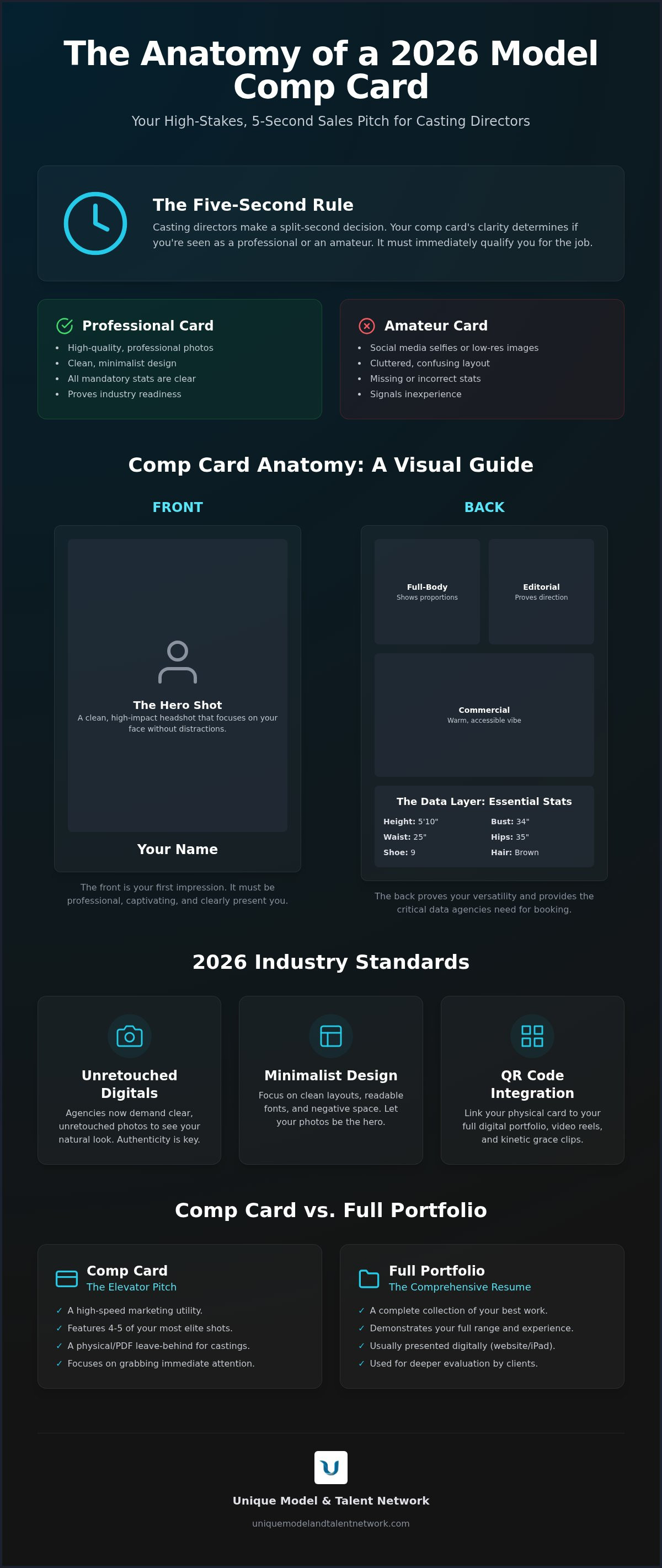
The "Five-Second Rule" dominates the casting process. During high-volume calls, casting directors don't have time to browse through dozens of photos. They use your card to make a split-second decision. If your card is cluttered or lacks clear information, you'll be bypassed. A professional card signals that you aren't a hobbyist. It shows you've invested in your professional development. Even in 2026, where digital presence is king, having a high-quality PDF version of your card is mandatory. It remains the standard utility for agency databases and talent evaluation.
The Anatomy of a Standard Comp Card
A professional card follows a strict layout. The front side features your "hero shot." This is typically a clean, high-impact headshot that shows your face without distractions. It's your primary hook. The back side contains a grid of three to four supporting images. These photos must demonstrate your versatility, such as a full-body shot, a lifestyle image, and a commercial look. Your professional statistics, including height, bust, waist, hips, and shoe size, are placed clearly at the bottom. This standardized placement allows clients to find your measurements instantly for booking purposes.
Comp Card vs. Portfolio: How to Build a Model Portfolio Strategy
Many emerging talents confuse the comp card with the full portfolio. Think of your portfolio as your comprehensive resume, while the comp card is your elevator pitch. When you're learning how to build a model portfolio, you must realize that you should never include every photo you've ever taken. Select only the elite shots for your card. This strategic selection keeps your brand focused and professional. Your card also serves as a critical leave-behind after a successful film industry audition. It ensures that when the casting team reviews their notes at the end of the day, your face and stats are right there. Mastering how to build a model portfolio involves knowing what to leave out just as much as what to include.
Selecting the Right Photos: Proving Your Versatility
Your comp card is a high-impact visual resume. If you're figuring out how to build a model portfolio, you must realize that every photo on your card has a specific job to do. The front of your card belongs to the Hero Shot. This is a clean, professional headshot that focuses on your face without the distraction of heavy jewelry or complex backgrounds. It's the image that stops a casting director's scroll and earns you that crucial first look. On the back, the Full-Body Shot is your next priority. It must clearly demonstrate your proportions, posture, and physique. This isn't the place for artistic shadows that hide your form; clients need to see exactly what they're booking.
When Selecting the Right Photos, you should also include an Editorial Shot and a Commercial Shot. The editorial image proves you can take direction and emote for high-end fashion clients. It's about bone structure, mood, and avant-garde posing. In contrast, the Commercial Shot proves you can sell a product or a relatable vibe with a warm, accessible expression. Showing this range tells a casting director that you're a versatile professional who can handle different brand requirements with ease.
Curating for Your Specific Niche
Understanding how to build a model portfolio requires a strategic approach to your specific niche. If you're targeting high fashion, your images should emphasize lean lines and striking bone structure. Commercial models should focus on a "million-dollar smile" and expressions that feel relatable to everyday consumers. For those in the fitness or swimwear categories, the focus shifts to muscle tone, athleticism, and body confidence. Don't try to be everything to everyone on one card; choose the photos that speak directly to the clients you want to book.
Quality Standards for 2026
Professionalism starts with image quality. Selfie comp cards are an automatic rejection in professional circles because they suggest a lack of investment in your craft. You need consistent lighting and professional retouching that enhances your look without using heavy, deceptive filters. Your photos must be updated every 6 to 12 months to maintain industry legitimacy and ensure your appearance matches your marketing materials. If you're unsure if your current shots meet these standards, getting a Portfolio & Reel Review from an industry expert can provide the clarity you need to move forward.
The Data Layer: Essential Stats and Contact Info
If your photos are the hook that stops a casting director, your statistics are the data that closes the deal. Professionalism in this industry is measured by precision. When you're mastering how to build a model portfolio, you must treat your stats as a non-negotiable contract. Casting directors use these figures to filter talent through digital databases. If your numbers are missing or formatted incorrectly, you're invisible to the system. Accuracy is king here. Lying about your height or waist measurement is a fast track to being blacklisted. If you show up to a set and the wardrobe doesn't fit because you provided "aspirational" stats, you've wasted the client's time and money. Agencies don't give second chances to models who compromise their financial legitimacy through dishonesty.
The mandatory stats for every professional card include your height, bust or chest, waist, hips, shoe size, hair color, and eye color. Depending on your niche, you should also include specific additions that help bookers place you. Men should always list their suit size, while women should include their cup size for commercial or lingerie calls. If you have visible tattoos or piercings, a brief note is helpful to ensure you're a fit for the brand's aesthetic. Standardizing this information allows for rapid outreach during high-volume casting periods.
How to Present Measurements Correctly
To target a global market, it's best to present your measurements in both Imperial (US) and Metric (International) units. This simple step shows you're prepared for international bookings and saves the booker the trouble of doing the math. Follow the standard industry order of operations when listing your stats: Height, Bust/Chest, Waist, and Hips. This sequence matches the input fields in most casting software. For commercial bookings, women should include their dress size, and men should list their jacket size and inseam to help the wardrobe department prepare for the shoot.
Agency vs. Freelance Contact Details
How you present your contact information depends entirely on your representation status. If you're an agency model, your card should only feature the agency's name, logo, and the direct contact info for your booker. Including your personal details on an agency card is a breach of protocol. For freelance models, clarity is just as vital. Include a professional email address and the URL for your dedicated talent website. As you learn how to build a model portfolio, remember this critical safety tip: never put your home address or personal phone number on a card. Your card will be passed through many hands, and maintaining professional boundaries is essential for your career security.
Modern Standards: Layout, Design, and Digital Integration
In 2026, minimalism is the gold standard for comp card design. Clean white space and sans-serif fonts allow your images to speak without visual noise. If you're studying how to build a model portfolio, you must ensure your layout doesn't fight for attention with your face. Physical cards still require the standard 5.5 inch by 8.5 inch cardstock dimensions, but their role has evolved. They now act as a bridge to your digital presence. A cluttered card suggests an unorganized mind, while a clean design signals that you're a professional who understands high-level branding. Your card shouldn't just look good; it must function as a piece of professional business collateral.
Integrating a QR code is a mandatory move for the modern professional. This code should link directly to your comprehensive digital acting portfolio, allowing casting directors to view your reels and additional work with a single scan. When you send your card digitally, your file naming convention is your first impression. A file named "final_v2.pdf" will be lost in the shuffle. Use a clear structure like "FirstName_LastName_CompCard_2026.pdf" to ensure it survives the chaos of a casting download folder. This simple technical detail shows you respect the casting director's workflow and understand how to build a model portfolio that is easy to manage.
Common Design Mistakes to Avoid
A card's effectiveness is often ruined by busy backgrounds that pull the eye away from your form. You want the focus on your features, not a distracting cityscape or a messy studio floor. Limit yourself to two fonts at most. Decorative typography looks amateur and is often hard for casting software to read. Never use low-resolution images. Pixelation on a high-res monitor or a physical print signals a lack of professional standards and can lead to an immediate rejection. Your images need to be sharp, clear, and representative of your actual appearance.
Preparing for Digital Submissions
Optimizing your PDF file size is a technical necessity for modern submissions. You need a file that is small enough for an email attachment, typically under 5MB, but sharp enough to maintain image quality on large screens. Creating a Link-in-Bio version of your card is also essential for social media discovery by scouts and smaller agencies. The Digital Comp Card is the primary tool for 2026 casting professionals to evaluate and book talent. If you want to ensure your materials meet these elite standards, participating in Monthly Skill-Building Challenges can help you refine your presentation skills alongside other serious professionals.
Expert Validation: Getting Your Card Industry-Ready
Before you spend a single dollar on high-quality printing or digital distribution, you need a second pair of expert eyes to audit your work. It's easy to become emotionally attached to specific photos, but a casting director views your card through a cold, commercial lens. They aren't looking for "pretty"; they're looking for "bookable." This is where many beginners fail. They rely on the praise of friends or family who don't understand the 2026 industry standards. While your mother might love a certain smile, an industry professional might see a lack of muscle tension or a dated posing style that signals you're an amateur. Don't guess with your career when the stakes are this high.
Peer networking is another vital tool for staying updated on regional standards. A card that books in New York might look different than one designed for the Miami commercial market. By engaging with other serious creatives, you can observe which layouts and photo styles are currently securing go-sees. This real-time intelligence is far more valuable than static templates found on DIY design sites. As you move from a beginner card to a signed model card with professional backing, this external validation becomes the bridge to your career security. It ensures your branding is aligned with current recruitment trends and financial legitimacy.
The Power of Professional Portfolio Reviews
A professional portfolio review is the most effective way to identify the "weak link" photos that are dragging down your overall presentation. An expert can see if your versatility shots feel forced or if your hero headshot lacks the necessary intensity. They help you rearrange your photo order for maximum psychological impact, ensuring your strongest selling point is seen first. Investing in the right modeling career coaching saves you hundreds in wasted printing and submission costs by ensuring your marketing materials are correct the first time. This is a crucial step in learning how to build a model portfolio that actually converts into paid work.
Join a Community of Serious Creatives
Success in the entertainment industry rarely happens in isolation. Gaining access to live workshops with active casting directors allows you to see exactly which cards they are booking right now. This direct insight removes the guesswork from your professional development. In a gated, elite environment, you can build professional bonds that lead to referral opportunities and shared industry perspectives. If you're serious about your craft, you should Apply for membership in The Network to refine your marketing materials today. This is the ultimate source of direction for those who want to master how to build a model portfolio and achieve long-term career acceleration.
Secure Your Professional Edge in 2026
You now possess the definitive blueprint for a comp card that commands respect in a competitive market. By balancing high-impact visuals with precise data and modern digital integration, you've moved beyond the amateur phase. Understanding how to build a model portfolio is about more than just aesthetics; it's about presenting a functional business utility that makes a casting director's job easier. Your commitment to these professional standards is the first step toward long-term career security and financial legitimacy.
If you're ready to move from guessing to certainty, Join The Network for Professional Portfolio & Comp Card Reviews today. Our private community, hosted on Mighty Networks, provides direct access to Casting Directors and Industry Experts who can provide the validation you need. Take advantage of our monthly skill-building challenges to keep your marketing materials sharp and relevant. You've done the work to understand the standards; now it's time to let the experts help you cross the finish line. Your next booking is waiting.
Frequently Asked Questions
Do I need different comp cards for different agencies?
You don't need a unique card for every agency, but having versions tailored to specific market niches is a smart business move. If you are learning how to build a model portfolio for both high fashion and commercial work, having two distinct cards is strategic. Most agencies prefer a standardized layout that fits their internal databases, so keep your design clean and adaptable for various submissions.
Can I use black and white photos on my model comp card?
Avoid using black and white photos as your primary hero shot. Color images are the 2026 industry standard because casting directors need to see your exact skin tone, hair color, and eye color for lighting and wardrobe planning. While one artistic black and white photo can demonstrate mood on the back of the card, your main marketing images must be in full color to ensure accuracy.
What should I wear for my comp card photos?
Wear simple, form-fitting clothing that doesn't distract from your natural features. Solid neutral colors like black, white, or gray work best for these shoots. Avoid busy patterns, large logos, or trendy accessories that might date the photo quickly. The goal is to show your physique and proportions clearly so the casting director can envision you in their brand's specific aesthetic without visual noise.
How much does it cost to have comp cards printed in 2026?
Printing costs vary based on quantity and turnaround time. You can expect to pay around $55 to $64 for a small batch of 25 cards from reputable providers like Photoscan or Samedayrushprinting. If you need a larger volume, 100 cards typically cost between $75 and $99. High-speed, same-day services can increase these rates significantly, often reaching over $138 for a 100-card order.
Should I include my age or date of birth on my card?
You should not include your age or date of birth on your card unless you are a minor. Adults are categorized by their "age range" or "look" rather than their chronological age. Including a specific birth date can lead to unnecessary filtering by casting software. Let your photos demonstrate your range and allow the casting director to decide if your look fits the specific role requirements.
How many photos is too many for the back of a zed card?
Three to four photos on the back of the card is the ideal number for a professional presentation. Including more than four images creates a cluttered layout that diminishes the visual impact of your best work. When you're determining how to build a model portfolio, remember that quality always beats quantity. Select images that show different expressions and poses rather than repeating the same look.
Is it okay to use professional photos from a shoot I did for a brand?
It is perfectly acceptable to use professional photos from brand shoots if you have the legal right to use the images. These "tear sheets" are highly valued because they prove you have commercial appeal and professional experience. Including a high-quality shot from a recognized brand can boost your credibility and show casting directors that you are already trusted by established industry clients for paid work.
What is the best paper stock for printing physical comp cards?
The best paper stock for physical cards is a heavy 14 pt. cardstock. This weight ensures the card feels substantial and professional in a casting director's hand. Most industry professionals prefer a high gloss UV coating for a vibrant look or a premium matte finish to reduce glare during reviews. Standard US dimensions remain 5.5 inches by 8.5 inches to fit into agency filing systems.


