

Your next agent introduction may come through a casting professional, not a submission form. For major studio, network, and streaming projects, actors generally need an agent to submit on their behalf; in smaller regional markets, actors often submit themselves. To understand how to find a commercial agent, build professional relationships and prepare materials that clearly show your strengths.
It’s easy to assume that finding representation means sending the same package to every agency and waiting for a reply. A more focused approach is to create opportunities for meaningful introductions, including through casting professionals familiar with your work. This guide explains how to meet agents at industry events, build connections that can lead to an introduction, understand commission arrangements, and distinguish an agent’s role from a manager’s. You’ll find practical steps for approaching representation with clarity and confidence while keeping career decisions grounded in your goals.
Key Takeaways
- Use industry events to build genuine professional connections and create natural opportunities to meet agents.
- Understand how agent and manager commissions can differ, and read the agreement carefully before committing.
- Build relationships with casting professionals so an introduction can connect your work with a potential agent.
- Assess an agent’s experience and reputation, then strengthen your industry knowledge and materials through the right professional learning opportunities.
Meeting agents through industry events
- Start by choosing events that help answer how to find a commercial agent. Look for agent panels, industry workshops, showcases, or networking sessions. Each format offers a different opening: ask a concise question after a panel or introduce yourself briefly during networking. Major studio, network, and streaming projects often require an agent to submit actors. In smaller regional acting markets, actors often submit themselves. Let your market shape how you prioritize representation.
- Prepare a specific introduction before you arrive. State your name, the on-camera commercial work you pursue, and one relevant strength. For example: “I’m Jordan Lee, an actor focused on commercial work, and I’m strongest in natural, conversational reads.” Keep a current headshot and resume accessible, but don’t lead by handing them over. Listen first, respond to the agent’s interests, and follow the event’s submission instructions.
- Use the event to identify agents whose interests match your goals. Note which agencies are represented on panels and what kinds of performers are discussed. If an agent welcomes follow-up, record their preferred submission method and requested materials. Directories list talent agents and modeling agencies in New York, Los Angeles, Atlanta, Chicago, Seattle, Austin, and other US locations. Treat location as a starting point, then narrow your list by the work you want.
- Follow up while the conversation is fresh. Mention the event, your discussion, and why your materials may fit the agent’s roster. Send only requested items, such as a headshot, resume, or reel. If you’re deciding how to find a commercial agent, prepare these materials before approaching agents after an on-camera commercial intensive. A focused message helps the agent connect your name with your work. Generic repeated messages rarely provide useful context.
A commercial agent with experience taking a church or private school through a conditional use permit in San Diego County can help assess a religious-use site. Qualifying religious uses in California may be eligible for a property-tax welfare exemption, which is applied for through the county assessor and is not automatic.
Changing a retail or industrial building to assembly use can trigger an occupancy-classification change and may require fire sprinklers, wider exits, additional restrooms, and accessibility upgrades.
Commission limits and red flags
Read the compensation terms alongside the agent’s services and your career goals. Distinguish agent commissions from manager commissions, then examine how each agreement defines earnings and payment.
-
Identify agent red flags
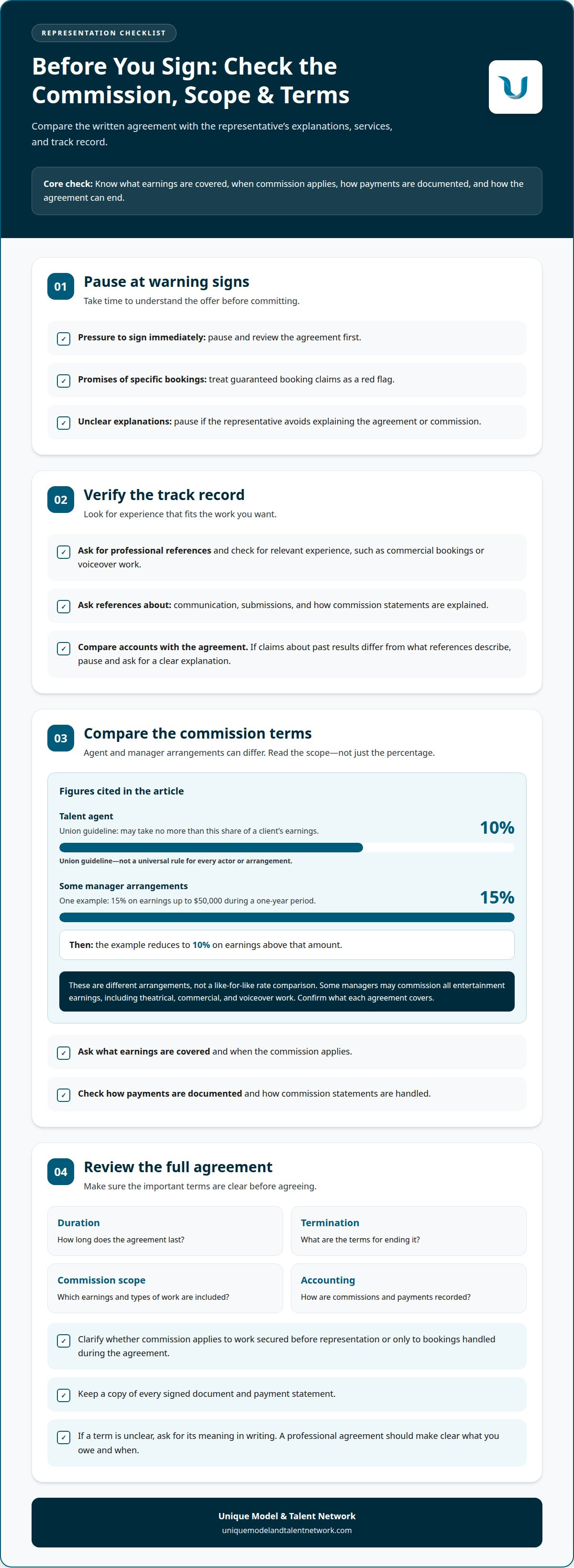
Pause if a representative pressures you to sign immediately, promises specific bookings, or avoids explaining the agreement. Under union guidelines, talent agents may take no more than 10% of a client’s earnings. Treat that figure as a union guideline, not a universal rule for every actor or arrangement. Ask what earnings the commission covers, when it applies, and how payments are documented.
-
Check references and track record
Request professional references and look for a track record that matches your goals, such as commercial bookings or voiceover work. Ask references how the agent communicates, handles submissions, and explains commission statements. Compare their accounts with the written agreement. If an agent’s claims about past results differ from what references describe, pause before signing and ask for a clear explanation.
- Compare the agent’s commission terms with a manager’s proposed terms. These roles can involve different compensation arrangements, so don’t assume a manager’s rate follows an agent’s union guideline. Some managers commission all of an actor’s entertainment earnings, including theatrical, commercial, and voiceover work. Some charge 15% on earnings up to $50,000 during a one-year period, then reduce the commission to 10% above that amount. Confirm which work and earnings each agreement includes.
- Review the full contract before agreeing, including its duration, termination terms, commission scope, and accounting procedures. For example, clarify whether a commission applies to work secured before representation or only to bookings handled during the agreement. Keep a copy of every signed document and payment statement. If a term is unclear, ask for its meaning in writing. A professional agreement should make clear what you owe and when.
The federal Religious Land Use and Institutionalized Persons Act (RLUIPA) limits how much local governments can burden religious land use compared with comparable secular assembly uses.
Before committing to a church property, buyers should ask the local planning department in writing about conditional-use permission, process, timeline, and hearing requirements, and make the offer contingent on obtaining approvals.
Getting introduced to agents by casting professionals
An introduction from a casting professional can connect your work with an agent more directly than a cold submission. Build the relationship around preparation, professionalism, and suitability for the work.
- Make your work easy for casting professionals to remember. Arrive prepared for auditions, follow instructions, and communicate professionally throughout each project. Keep your headshot, resume, and reel current so a casting director can quickly understand your strengths. A useful introduction has context: the professional can describe your work, rather than simply pass along your name. Focus on doing the job well, not asking for representation.
- When a casting professional asks who represents you, answer directly and briefly. If you’re seeking representation, say so without turning the conversation into a demand for an introduction. In May 2024, casting director Mary Egan-Callahan introduced an actor to CESD after asking who represented him. The exchange shows how a conversation about representation can create a natural opening. Keep your response clear, then let the casting professional decide whether an introduction fits.
- Prepare a concise follow-up package before an introduction arrives. Organize your headshot, resume, and reel, making sure each reflects the commercial work you want. If a casting professional connects you with an agent, thank them and send only materials relevant to the agent’s request. Mention the introduction and the casting professional’s name. This gives the agent context and helps them connect your materials with the referral.
- Respond promptly and treat an introduction as the start of a professional conversation, not a promise of representation. In the May 2024 example, the actor met with CESD on Zoom two weeks after the introduction. Use a meeting to describe your goals, listen to the agent’s questions, and understand possible next steps. Afterward, send a brief thank-you that references a specific point discussed. If no meeting follows, continue building relationships through consistent work and thoughtful communication.
How do I check an agent’s references, track record, and client reviews?
- Ask the agent for references from performers whose work resembles yours. A commercial actor can learn more from another commercial performer’s experience than from a reference focused only on theatrical roles. Ask how the agent communicates, discusses auditions, and explains next steps after a booking. Keep questions specific, such as how the agent handles a missed callback or a change to a project schedule.
- Compare the agent’s track record with the work you want to pursue. Look for relevant examples across commercial, voiceover, and theatrical credits rather than treating a long client list as proof of fit. Consider whether the agent’s current roster includes performers with a range of experience and profiles. Ask how the agent sees your materials fitting that roster, then compare the answer with your career goals.
- Read client reviews for repeated, detailed experiences instead of relying on one glowing or negative comment. Note whether reviewers describe concrete interactions, such as clear communication about auditions or understandable commission statements. Compare those details with what references tell you. If public comments and direct references conflict, ask focused follow-up questions rather than assuming either account tells the whole story.
- Separate verifiable work history from promotional claims. Check that named credits match the type of representation discussed, and ask the agent to clarify vague claims about bookings or industry access. For example, “I submit clients for national commercials” describes a specific activity; “I can make you a star” does not. Before signing, consider the agent’s answers, references, and written agreement together.
- Use an objective review of your headshot, resume, or reel to identify what an agent will see first. A focused portfolio and reel review can help you present relevant credits clearly before an introductory meeting. Bring the revised materials into conversations with prospective representatives, so they can assess your current positioning rather than an outdated snapshot.
Unique Model & Talent Network
Unique Model & Talent Network helps aspiring actors build industry knowledge and strengthen their professional materials as they pursue representation. If you’re preparing to approach agents or waiting for an introduction, The Network Membership, Live Industry Workshops, and Industry Expert Q&A Sessions provide opportunities to learn from entertainment professionals. Portfolio & Reel Reviews can help you present your experience clearly, while Monthly Skill-Building Challenges support continued development. These resources complement your search; they don’t replace an agent or guarantee representation. Use them to sharpen your materials, learn how industry relationships work, and make informed decisions about your next steps. Explore career-development support by contacting Unique Model & Talent Network.
Turn your representation goals into a clear next step
Choose one action you can take this week, such as refining your reel, identifying agents who fit your commercial goals, or reconnecting with a casting professional. A focused step can build momentum without turning representation into a race.
As you consider how to find a commercial agent, keep your priorities visible. Think about the work you want, the communication style you value, and the professional relationship you’re ready to build. Let those priorities guide your conversations and decisions, rather than feeling pressured to accept the first opportunity.
Your career develops through preparation, thoughtful relationships, and decisions that reflect your goals. If guidance would help you move forward with greater clarity, contact Unique Model & Talent Network. Keep developing your craft and take the next step with confidence.


