

A casting director’s resource list should be practical, not endless. Useful resources for independent casting directors include industry news and advice, professional organizations and unions, CSA resources, and talent-search tools. Together, they support informed decisions, professional connections, and organized talent discovery.
It can be hard to know which sources serve which purpose, especially when industry updates, professional guidance, and casting tools are scattered across different platforms. A focused mix helps you spend less time sorting through options and more time finding information relevant to your work.
This guide covers where to find industry news and advice, what professional organizations and unions can offer, how CSA resources fit in, and which tools can support talent searches. Use it as a starting point for building a resource toolkit around your independent casting practice.
Key Takeaways
- Build a focused news routine around sources that help you track production activity, regional resources, and practical industry guidance.
- Use professional organizations and labor unions to understand the different communities, standards, and career support available across entertainment.
- Match casting breakdown and talent-research tools to the needs of each project, rather than relying on one source for every search.
- Strengthen your professional practice through targeted learning and industry connection, including workshops and feedback opportunities.
Curated film-industry news and advice
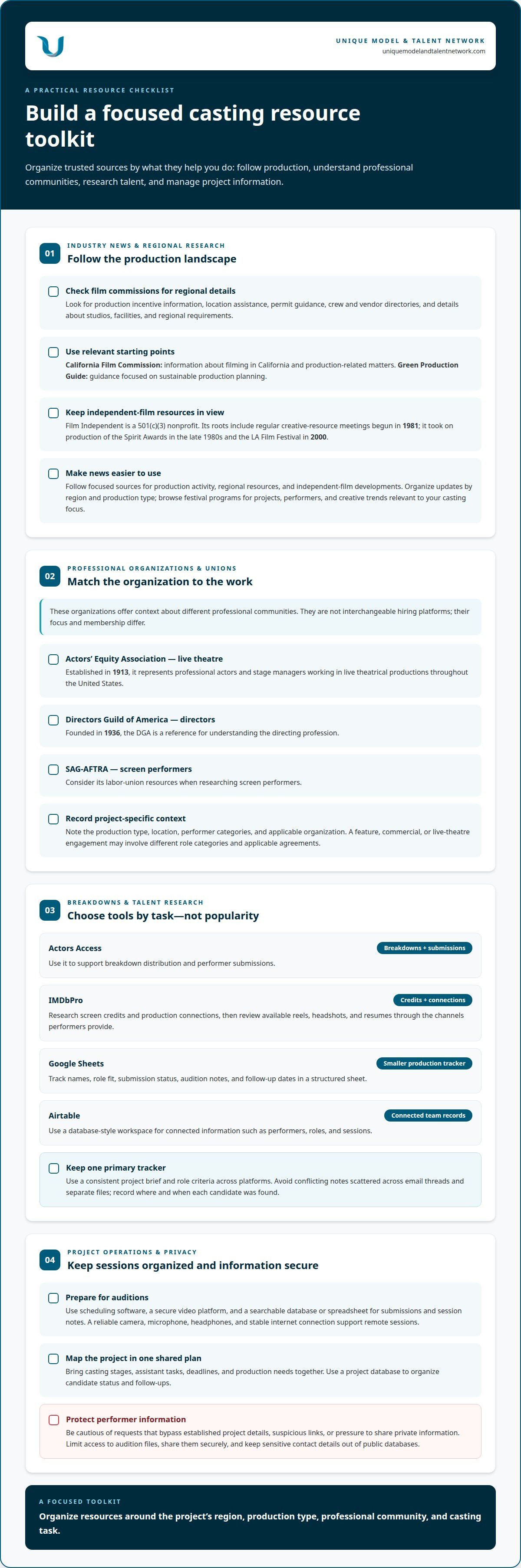
Start curating resources for independent casting directors with a clear purpose: tracking production activity, regional filming information, and independent film developments. Film commissions commonly share production incentive information, location assistance, permit guidance, crew and vendor directories, and details about studios, facilities, and regional requirements. The California Film Commission provides information about filming in California and production-related matters, making it a useful starting point for regional research.
For sustainability guidance, browse the Green Production Guide, which focuses on sustainable production planning. Film Independent offers a different perspective: Gregory Nava and a small group of directors, writers, and producers began meeting regularly in 1981 to share creative ideas and discuss resources for independent filmmakers. Film Independent is a 501(c)(3) nonprofit organization. It took on production of the Spirit Awards in the late 1980s and the LA Film Festival in 2000. These milestones show how independent film communities can develop shared resources.
Film event listings can help you follow emerging work and regional activity. Career-resource entries dated September 1, 2026, include the Three Rivers Film Festival, scheduled for November 4-15, 2026, in Pittsburgh. The Diversity and Inclusion Film Festival is listed for November 13-15, 2026, in New York. Browse festival programs for projects, performers, and creative trends relevant to your casting focus. To keep resources for independent casting directors useful, organize updates by region and production type.
For auditions, use scheduling software, a secure video platform, and a searchable database or spreadsheet to track submissions and session notes. A reliable camera, microphone, headphones, and stable internet connection support remote sessions. Choose equipment that suits the room and audition format.
To budget and manage a project, map casting stages, assistant tasks, deadlines, and production needs in one shared plan. Film commission crew and vendor directories can help identify regional production resources, while a project database keeps candidate status and follow-ups organized.
Be cautious of requests that bypass established project details, suspicious links, or pressure to share performers’ private information. Limit access to audition files, share them securely, and keep sensitive contact details out of public databases.
Entertainment professional organizations and labor unions
Professional organizations help casting directors understand the communities behind different forms of entertainment. Actors’ Equity Association was established in 1913 to represent professional actors and stage managers working in live theatrical productions throughout the United States. It has represented these professionals for more than a century, making it a key reference for live-theatre work.
The Directors Guild of America, founded in 1936, offers another point of reference for understanding the directing profession. For casting, these organizations are useful context, not interchangeable hiring platforms. Their focus and membership differ, so start with the organization whose work aligns with the production and the professionals involved.
Use official union and guild resources to clarify terminology and find relevant materials. Actors’ Equity Association relates to live theatre, while the Directors Guild of America serves directors. SAG-AFTRA is another labor union to consider when researching screen performers. Keep a working directory of each organization’s scope, relevant contacts, and current guidance. This makes future project research easier.
How do casting resources and union rules differ by U.S. city and production type? Match your research to the project’s location and format: a feature, commercial, or live-theatre engagement may involve different role categories and applicable agreements. Local production resources provide location context, while the relevant union’s materials help clarify hiring terms.
For each project, record the production type, location, performer categories, and applicable organization before building a casting plan. Use that information to organize breakdowns, outreach, and questions for production. This keeps a broad professional network useful without assuming every city or project follows the same process.
Independent casting directors can also benefit from structured peer connection. A professional industry network can complement formal organizations by creating space for industry conversations and shared learning.
What are the best resources for casting breakdowns, talent research, and industry news?
Choose tools by task, not popularity. Actors Access can support breakdown distribution and performer submissions. IMDbPro helps research screen credits and production connections. Since each serves a different purpose, keep the project brief and role criteria consistent across platforms.
For a smaller production, a structured Google Sheets tracker can record names, role fit, submission status, audition notes, and follow-up dates. Airtable offers a database-style workspace for teams managing connected records, such as performers, roles, and sessions. Use one primary tracker to avoid conflicting notes across email threads and separate files.
Talent research works best when searchable credits are paired with direct review of available materials. Use IMDbPro to find screen credits, then review performer reels, headshots, and resumes through the channels they provide. Record where and when you found each candidate so colleagues understand why the person entered consideration.
For industry news, follow focused sources instead of relying on a busy social feed. Film commission announcements can highlight local production activity and regional resources. The Green Production Guide focuses on sustainable production planning, while Film Independent provides context on independent film and filmmaker resources. Keep these sources alongside trade coverage in a curated reading list or bookmark folder.
- Breakdowns: Actors Access can organize role notices and submissions.
- Credit research: IMDbPro helps find screen credits and professional connections.
- Project tracking: Google Sheets or Airtable can centralize candidate status and team notes.
- Industry context: Film commission updates, the Green Production Guide, and Film Independent cover distinct production needs.
Before opening a search, define the role requirements, project format, and records the team needs. Choose a platform that supports those tasks, document decisions in one place, and limit access to private audition materials. A disciplined workflow makes comparisons clearer and reduces duplicate outreach.
What training, certifications, workshops, and career resources are available for casting directors?
Build skills around the work itself: interpreting briefs, assessing performances, communicating with production, and organizing auditions. A practical learning plan can combine supervised experience, focused workshops, peer discussion, and regular review of casting decisions. Choose training that addresses a specific gap, such as self-tape review or talent research.
Assess certification programs carefully. Before enrolling, identify the curriculum, instructor experience, assessment method, and relevance to your casting focus. A credential is most useful when it develops skills you can apply to features, commercials, or theatre. Keep examples of completed exercises and feedback in a professional development record.
Workshops offer a structured way to practice. A session on audition direction can help refine instructions and improve the consistency of performer evaluations. A discussion of project workflows can clarify how casting decisions connect with production needs. Explore live industry workshops for practical learning alongside working entertainment professionals.
Use the Casting Society of America (CSA) as a professional resource for learning about casting and industry connections. Pair organization resources with direct practice: after a session, note one technique to test, apply it on a suitable project, and record how your workflow changes. Industry Expert Q&A Sessions can also help you bring focused questions to experienced professionals.
Career listings can help you spot professional development opportunities and track industry activity. Entries dated September 1, 2026, provide a useful date marker when organizing a career-resource calendar. Google Calendar can schedule learning goals and follow-ups, while Notion can hold workshop notes, questions, and examples in one searchable workspace.
Make progress measurable by choosing one skill area, setting a practical learning task, and reviewing the result after applying it. For example, study audition note-taking, then assess whether your next session captures performer choices more clearly. This turns training into a repeatable professional habit rather than a series of disconnected sessions.
Unique Model & Talent Network
Unique Model & Talent Network gives independent casting directors a professional community for connecting with emerging creatives and industry experts. Turn to it for career learning and creative connections alongside your own casting research, rather than relying on another general news feed.
The Network Membership creates a shared space for industry professionals and emerging talent. Live Industry Workshops and Industry Expert Q&A Sessions support practical learning and informed discussion. Portfolio & Reel Reviews help develop a sharper eye for presentation, while Monthly Skill-Building Challenges encourage continued practice.
These resources complement, rather than replace, project-specific breakdowns, union guidance, or talent-search tools. To build professional relationships and keep developing your craft, contact Unique Model & Talent Network.
Make your next professional step intentional
A strong casting practice grows through deliberate choices, not a longer list of bookmarks. Choose one area to strengthen next, such as refining your research process, expanding your industry perspective, or developing clearer ways to evaluate talent. Then make that focus part of your regular professional routine. A dependable set of resources for independent casting directors should support better decisions and stronger working relationships, while leaving room for the distinct needs of each production. Unique Model & Talent Network can complement that work with a professional community centered on learning and creative connection. If you’re ready to continue building your industry relationships and skills, contact Unique Model & Talent Network. Keep moving forward with curiosity, clear standards, and confidence in the value you bring to every casting project.
Frequently Asked Questions
What professional organizations and networks support independent casting directors in the United States?
In the United States, professional organizations and networks serve different needs. Use the Casting Society of America for casting-focused professional connections, and consult Actors’ Equity Association or SAG-AFTRA when a project involves performers in their respective areas. The Directors Guild of America offers a directing-industry perspective. For a specific question, start with the organization most closely connected to the production or role.
What casting platforms and audition tools are available to independent casting directors?
Actors Access can support breakdown distribution and submissions, while IMDbPro helps with credit research. Choose audition tools to suit the session format: a scheduling calendar coordinates availability, a video platform supports remote reads, and a consistent note template helps capture callback decisions. Organize audition links and performer records by project so collaborators can follow the same process.
How do independent casting directors find and reach actors and talent agents?
Start with the role’s requirements, then find performers through casting-platform submissions, screen credits, and available reels or resumes. For agent outreach, use the agency’s professional contact channel and send a concise project description, role details, audition process, and relevant timing. Keep messages specific to the performer or representation, and record replies in the project tracker to coordinate follow-up and prevent duplicate outreach.
What legal rules cover casting notices, auditions, contracts, privacy, and discrimination in the United States?
Record the project type, location, performer categories, and applicable organization, then use the relevant union’s materials to clarify hiring terms. Protect audition files with limited access and secure sharing, and keep sensitive contact details out of public databases.
How much do casting platforms, software, memberships, and other common resources cost?
No costs are specified for casting platforms, software, memberships, or other common resources.
What are the steps for casting a film, television, theater, or commercial project independently?
Define the role requirements, project format, and records needed, then identify the location, performer categories, and applicable organization. Choose tools for breakdowns, research, tracking, and auditions. Distribute notices, review submissions and performer materials, record decisions and follow-ups in one tracker, and protect private audition files.


