

Commercial auditions are prepared, not improvised on the day. Commercial acting classes online can build that preparation through live instruction, script analysis, and practice responding naturally to a scene. One Level 1 format uses four weeks of live training via Zoom.
It’s understandable to wonder how an online class can prepare you for an audition that needs to feel spontaneous. The value comes from working through the copy, making clear character choices, and practicing adjustments with instructor feedback. This guide explains how commercial acting classes online are structured and how they can support audition preparation, script analysis, and improvisation, so you can assess which training best fits your goals.
Key Takeaways
- Prepare commercial auditions by making clear, specific choices that keep your performance natural and responsive.
- Live online instruction gives you a structured way to practice, receive feedback, and build confidence on camera.
- Use a step-by-step script analysis approach to identify the copy’s intention, then let improvisation make your delivery feel spontaneous.
- Choose training that matches your goals, whether you need focused audition practice, skill-building, or professional feedback on your reel.
Commercial audition preparation
Commercial auditions ask actors to make a clear choice while keeping the performance conversational. A useful starting point is to identify who you’re speaking to, what you want, and what changes during the scene. For example, a line about a morning coffee can feel like a personal discovery, not a product announcement. One commercial course examines 16 reasons actors may be cut from commercials, bringing attention to choices that can weaken an audition.
Commercial acting classes teach audition technique, script preparation, and on-camera performance. Actors practice taking direction, adjusting their delivery, and staying present instead of simply reciting copy. These skills help performers make deliberate choices while maintaining a believable connection with a scene partner or the camera.
For a self-taped audition, prepare your space before recording. Set the camera at eye level, frame yourself from the chest up, and choose a quiet background. Position your reader near the camera so your eyeline stays close to the lens. Test the sound and lighting, then record a short sample to catch distractions before performing the full scene.
- Read the copy aloud. Mark the product, the situation, and the words that carry the message.
- Choose a point of view. For a problem-solution script, play the frustration before the relief.
- Practice for camera. Keep gestures readable in frame and let reactions land before speaking.
- Review the take. Check whether the story is clear, the sound is clean, and your delivery feels natural.
Wardrobe should support the character without distracting from the performance. A simple, solid-color top keeps attention on your face; avoid busy patterns and noisy accessories. Follow the casting instructions for slates, file format, and submission. Send a brief follow-up afterward only if invited or if the process calls for one.
Virtual auditions use the same core techniques, with added attention to framing, sound, and timing. Repeated practice helps you respond to adjustments without losing the scene’s central intention. Monthly Skill-Building Challenges offer a structured way to keep your audition skills active between opportunities.
How do online acting classes work?
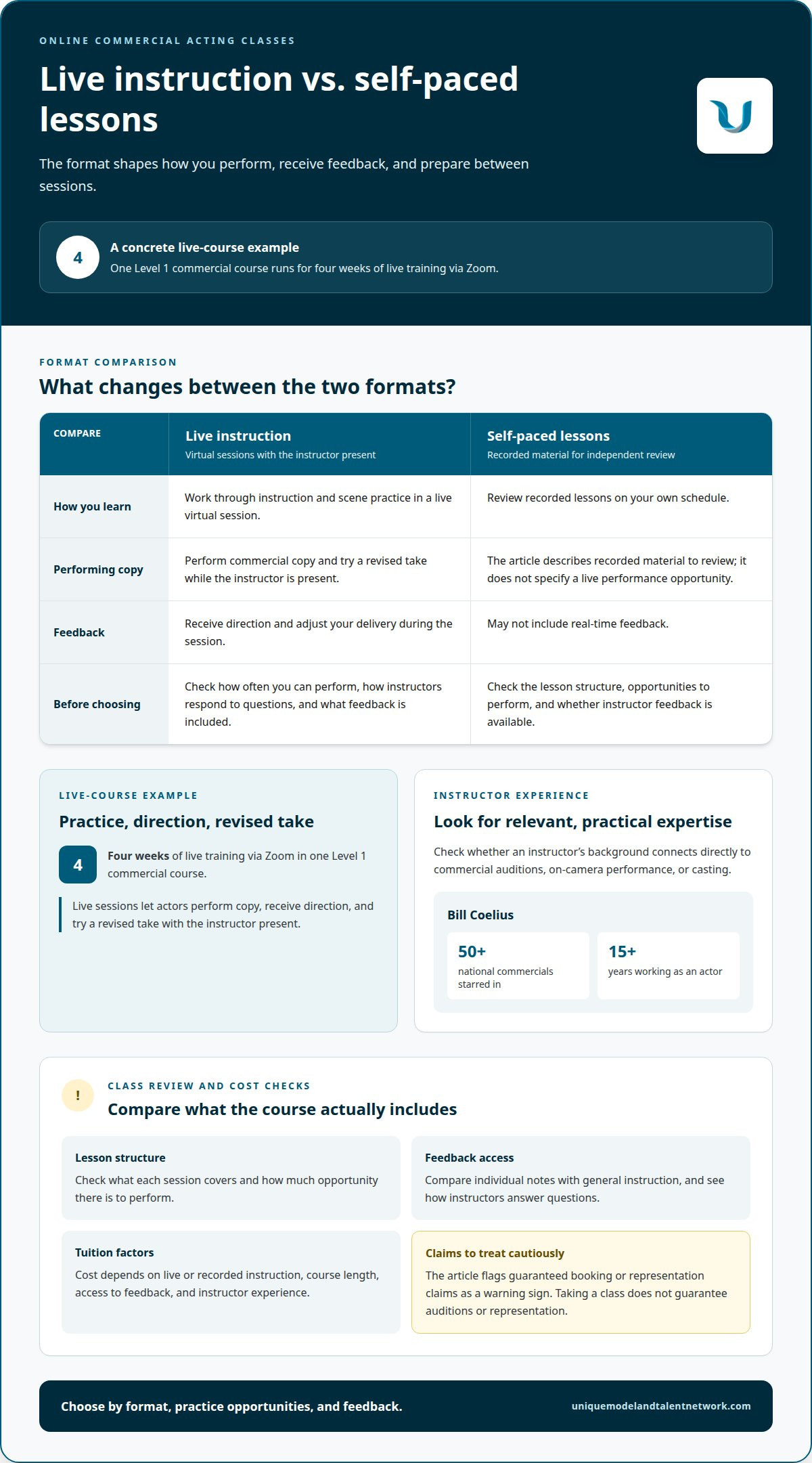
Online classes combine instruction, scene practice, and feedback through live virtual sessions or recorded lessons. The format shapes how you interact with instructors and prepare between sessions.
Instructor Experience
Look for instructors whose professional experience connects directly to commercial auditions, on-camera performance, or casting. Bill Coelius, for example, has starred in over 50 national commercials and worked as an actor for over 15 years. A useful class makes that experience practical through scene notes, performance adjustments, and examples from actual commercial work. If an agent or casting professional joins a session, consider whether their role is clearly described as educational.
Live Instruction and Self-Paced Lessons
A Level 1 commercial course runs as four weeks of live training via Zoom. Live sessions let actors perform copy, receive direction, and try a revised take while the instructor is present. Self-paced lessons offer recorded material that actors can review on their own schedule, but the format may not include real-time feedback. Compare the lesson structure, opportunities to perform, and how instructors respond to questions before choosing.
To compare class reviews and outcomes, look for specific details: what students practiced, what feedback they received, and whether testimonials describe a concrete experience. Treat claims of guaranteed booking or representation as a warning sign. Check that the instructor is identifiable and the curriculum explains what each session covers. Portfolio & Reel Reviews can also help actors assess how their recorded materials present their work.
Class costs depend on factors such as live or recorded instruction, course length, access to feedback, and instructor experience. Compare what tuition covers, including whether performers receive individual notes or only general instruction.
Training can help actors prepare stronger auditions, but taking a class does not guarantee auditions or representation. A guest agent may offer industry perspective, but that educational access is different from talent representation or arranging bookings.
Script analysis and improvisation
A commercial script may use only a few lines, but each choice shapes the story. One workshop teaches actors Margie Haber’s 10-step approach, giving them a structured way to examine copy before performing it. The goal is to understand the situation and relationship, not simply memorize words.
Start by identifying the type of commercial copy. The three types covered are Problem-Solution, Solution-Only, and Slice of Life. Each calls for a different performance focus: a problem-and-solution script needs a clear shift, while a Slice of Life scene depends on believable everyday behavior. A teacher can help you recognize the distinction before making character choices.
- Clarify the moment. Identify who you’re speaking to and what you want from them.
- Mark the turn. Find the line or reaction that changes the scene’s direction.
- Choose a playable action. Decide whether you’re reassuring, persuading, or sharing news.
- Test the choice aloud. Perform the script, then adjust emphasis without changing its meaning.
Practice beyond a single polished read. Try the same copy with different intentions, such as inviting a friend to try a new service or sharing a useful discovery. Each version should still sound like natural conversation, not an actor emphasizing every product name. This kind of improvisation builds flexibility while preserving the script’s core message.
For remote practice, perform a take, watch it back, and note where the thought feels unclear or overly planned. Repeat the scene with one specific adjustment, such as a slower response or a more direct appeal. This focused cycle gives you a practical way to apply feedback and refine your technique.
Script analysis helps actors make deliberate, adaptable choices across different commercial copy. Improvisation builds responsiveness when a teacher gives a new direction or a scene partner reacts unexpectedly. Together, these skills help performers approach each audition as a distinct opportunity instead of relying on one memorized delivery.
Online commercial acting classes
Online commercial acting classes make focused practice accessible without requiring travel to a studio. A listed course runs for five weeks, with one class per week for four consecutive weeks. This structure gives actors scheduled time to practice, review feedback, and apply adjustments between sessions.
Before enrolling, match the class format to your acting career goals. A live session suits students who want to perform scenes and receive direction in real time. A self-paced lesson makes it easier to revisit a technique, but may not offer immediate feedback on a specific performance choice. Review the course outline for the teaching format, practice opportunities, and feedback arrangements.
A class can also help you work on the practical demands of virtual auditions. Prepare a short scene, record a take, and review whether your choices read clearly on camera. Then make one adjustment, such as changing your eyeline or shifting the emphasis in a line. This focused cycle turns feedback into an action rather than a general note that is hard to apply.
Online training works best when the schedule supports consistent practice. Listed start options include Wednesday, Dec. 2nd, from 5pm to 6pm Pacific time, and Saturday, Dec. 5th, from 1pm to 2pm Pacific time. Since those are Pacific times, students in other time zones should convert the session time before committing. The course format and calendar together determine whether regular attendance is realistic.
- Review the curriculum: Look for commercial-specific scenes, technique instruction, and clear learning goals.
- Understand feedback: Find out whether instructors give notes on individual performances or teach through group discussion.
- Check the schedule: Compare session times with your location and existing commitments.
Online classes can strengthen performance skills and help students prepare more deliberately; they don’t guarantee bookings. For continued industry learning alongside class practice, explore professional acting network opportunities.
Unique Model & Talent Network
Unique Model & Talent Network helps actors build on class practice through industry learning, feedback, and a professional community. If you’re refining your commercial audition skills, The Network Membership, Live Industry Workshops, and Industry Expert Q&A Sessions offer opportunities to learn from industry perspectives. Portfolio & Reel Reviews can help you assess how your materials present your on-camera work, while Monthly Skill-Building Challenges support continued practice between auditions.
Turn to these resources when you’re ready to develop your craft beyond individual lessons, strengthen your materials, or clarify your next career steps. The focus is practical development and connection, not a promise of representation or bookings. Choose support that matches your current goal, whether you’re working on performance, presentation, or ongoing skills practice.
Contact Unique Model & Talent Network to explore the next step in your development.
Build your next step with purpose
Choosing commercial acting classes online is one step toward developing a confident, adaptable audition practice. Start by identifying the skill you want to strengthen, then seek feedback you can apply in practical ways. A focused learning plan keeps your work moving beyond a single class and gives you a clearer basis for future audition decisions.
For continued development alongside your training, The Network Membership and Live Industry Workshops offer opportunities to engage with industry learning. Portfolio & Reel Reviews can help you assess how your materials represent your on-camera work. Each option supports a different aspect of professional growth, from ongoing connection to a fresh perspective on your presentation.
Choose the support that fits your current goals, and keep building with intention. Contact Unique Model & Talent Network to explore your next step. Your craft can keep moving forward, one thoughtful choice at a time.
Frequently Asked Questions
What are the best online commercial acting classes in the US?
The best commercial acting classes online in the US are those aligned with your immediate training goal. Compare whether the curriculum focuses on commercial copy, live performance, recorded assignments, or instructor feedback. Review the teacher’s relevant acting experience and the class’s learning structure. If you want professional development beyond instruction, a community-based resource can complement classwork without replacing focused acting training.
Are there online commercial acting classes for beginners, teens, and experienced actors?
Yes, online commercial training can suit actors at different experience levels, though course content and age eligibility vary. Beginners can look for foundational scene work and clear explanations of commercial performance. Experienced actors may prefer advanced direction and nuanced feedback. Teen actors should seek age-appropriate instruction and a learning environment suited to their needs, rather than assuming every adult class is a fit.
Do online commercial acting classes provide audition practice, feedback, or demo reels?
Some classes include audition practice and performance feedback, while demo reel services are separate. Check the course description to see whether students receive individual notes, group critique, or opportunities to revise a performance. Portfolio & Reel Reviews can provide feedback on existing materials, but a review is not the same as filming or editing a finished demo reel.
What equipment and setup do I need for online on-camera acting classes?
A phone or computer with a working camera, reliable internet, and clear audio can support a virtual class. Set your device on a stable surface, close unrelated apps, and silence notifications to reduce interruptions. Use headphones if they improve sound clarity, and test your connection before class. Keep your script within easy reach so you don’t have to look far from the camera during a scene.


