

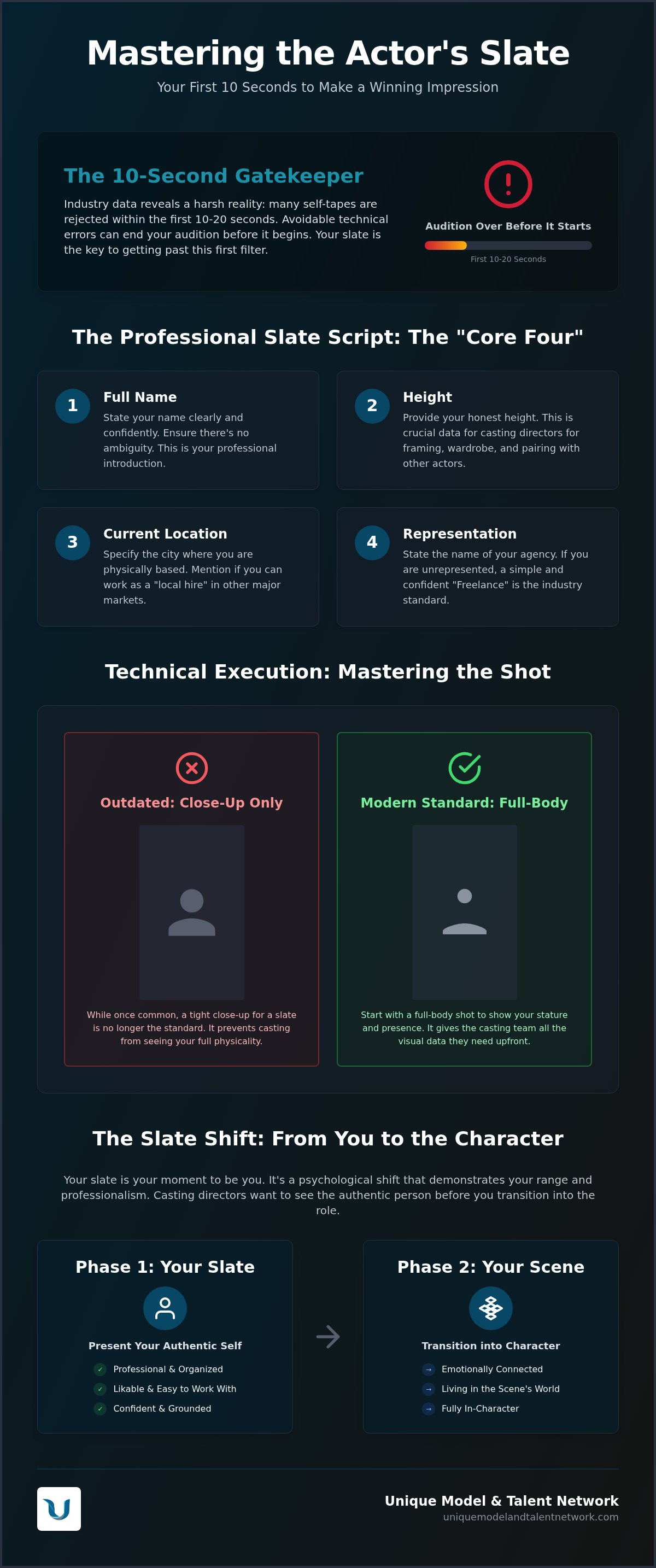
Industry data shows that a significant number of self-tapes are rejected within the first 10 to 20 seconds due to avoidable technical errors. This means your audition might be over before you even deliver your first line of dialogue. If you are asking yourself, "what is an actor's slate and why does it matter so much?" you are not alone. It is your ten-second business pitch; it's the moment where you prove you are a reliable professional who understands the modern 2026 industry standards.
We understand the anxiety that comes with technical requirements like full-body framing or deciding whether to stay in character. It is easy to feel overwhelmed by shifting SAG-AFTRA regulations and platform-specific specs. This guide is designed to replace that confusion with total confidence. You will learn how to master the industry standard for slating so your first moments on camera signal readiness to every casting director who watches your tape.
We are going to break down the exact script you need to use, the technical framing for different shots, and the psychological "why" behind these requirements. We will also look at the latest technical specifications for platforms like Actors Access to ensure your files are never discarded for formatting issues. By the end of this professional guide, you will have a clear roadmap to ensure your first impression is a winning one.
Key Takeaways
- Learn exactly what is an actor's slate and why this digital handshake serves as your critical first 10 seconds of professional evaluation.
- Master the "Core Four" script requirements, including name, height, location, and representation, to provide casting directors with the precise data they need.
- Gain technical confidence by understanding the shift from a close-up introduction to a professional full-body shot without losing your eyeline.
- Understand the psychological shift of slating as your authentic self rather than the character to demonstrate your range and professional maturity.
- Discover how to use the Unique Model & Talent Network to pressure-test your slate in a private community before submitting it to a major casting call.
Defining the Slate: More Than Just Your Name
Think of your slate as a digital handshake. Before you dive into the emotional depths of a scene, you have a few seconds to introduce the professional behind the performer. If you've ever wondered, "what is an actor's slate," it's helpful to look at its history. The term comes from the physical clapperboards, or slates, used on film sets to sync audio and video. While you aren't holding a piece of chalk today, the purpose remains the same: you're providing the casting team with essential data and a glimpse of your natural essence.
Casting directors value the slate because it confirms your identity and technical specifications immediately. They need to know your height, location, and representation before they invest time in your performance. Understanding the purpose of a screen test provides the necessary context; it's a technical evaluation of how you translate to the screen. Your slate is the first chapter of that test, proving you can follow directions and present yourself with professional energy.
The Psychology of the First 10 Seconds
You aren't just reading a list of facts; you're establishing "Brand You." This is your opportunity to show that you are disciplined, organized, and easy to work with. Casting teams are looking for the "Likability Factor." They want to see a warm, authentic version of you before the character takes over. If you appear anxious or disorganized in your slate, a casting director might worry that you'll be difficult to manage on a high-pressure set. A confident, steady introduction signals that you're a seasoned pro who is ready for the job.
Slate vs. Ident: Is There a Difference?
Terminology often shifts based on where you are working and the type of project you're booking. In the United States, we use the term "slate." However, if you're auditioning for a production in the United Kingdom or Europe, you'll likely hear it called an "ident." While the name changes, the goal is identical.
- Commercial Auditions: These often require a higher energy level. You might be asked to show your profiles or your hands to check for suitability for product shots.
- Theatrical Auditions: These are usually more grounded. The focus is on your natural speaking voice and stature.
- Voiceover Projects: A VO slate is typically just your name. It's used to identify the audio file without distracting from the vocal performance.
Regardless of the project type, knowing what is an actor's slate allows you to approach every audition with the technical confidence required to stand out. It's your first chance to win the room by simply being yourself.
The Professional Slate Script: What to Say and When
Once you've grasped what is an actor's slate, the next step is perfecting the script. It's more than just a list of facts. It's a structured piece of professional data that allows a casting director to place you in their mental grid of the project. Efficiency is the mark of a pro. Casting teams are often reviewing hundreds of submissions, so delivering your information with clarity and pace is a sign of respect for their time.
The foundation of every introduction is the "Core Four" requirements:
- Full Name: Say it clearly. Don't let your identity get lost in a mumble.
- Height: Be honest. Casting needs this for framing, wardrobe, and actor pairings.
- Current Location: Specify where you are physically based.
- Representation: Mention your agency or state "Freelance" if you are currently unrepresented.
Handling the age question requires specific legal awareness. If you are a minor, stating your age is a mandatory requirement. For adults, industry standards generally dictate that you should not volunteer your age unless the casting breakdown explicitly requests it. Similarly, your union status is a critical data point. In 2026, the distinction between SAG-AFTRA and Non-Union remains a primary filter for many productions. If you are willing to work as a "local hire" in a specific city, this is the moment to mention it. It tells the producer they won't be responsible for your travel or lodging costs, which can significantly increase your booking potential.
Tailoring Your Slate to the Project
Your energy should match the genre of the project. For commercial slates, aim for high energy and a product-friendly smile. You are selling a vibe of reliability and warmth. Conversely, theatrical slates for Film and TV should be grounded and professional. If a casting director asks for a "fun fact," keep it short. Choose something that reveals your personality without derailing the professional momentum of the tape. It's a test of your ability to be interesting yet concise.
Common Scripting Mistakes to Avoid
The most frequent complaint from casting directors is rushing. If they can't catch your name, the rest of the tape starts on a frustrating note. Avoid "selling" yourself or over-explaining your background. A slate is a technical requirement, not a monologue. If you're unsure how your delivery sounds, you can get a professional portfolio review within our community to ensure your intro hits the right notes. Finally, never forget to mention your agency. It establishes your professional standing and ensures the right people get the booking call.
Technical Execution: Mastering the Full Body Slate
Technical proficiency is the invisible foundation of a professional audition. While your performance is the heart of the tape, technical errors like poor lighting or messy framing act as immediate red flags to casting directors. If you're still perfecting what is an actor's slate, remember that technical execution is just as vital as the words you speak. Start with a neutral, solid-colored background. Avoid busy patterns or household clutter, as these distract from your presence. Your lighting should be soft and front-facing to eliminate shadows under the eyes; your audio must be crisp. Even the best performance won't save a tape with muffled sound.
For the initial close-up portion, frame yourself from the mid-chest to just above the top of your head. Leave a small sliver of head-room so you don't look cramped in the frame. This allows the casting team to see your facial expressions and eye light clearly before you transition to the wider view. Standard video settings for 2026 remain 1080p at 24fps or 30fps. Avoid 4K resolution, as it creates unnecessarily large files that are difficult to upload.
The 'Full Body' Shot Challenge
Casting directors use the full-body shot to understand your physical proportions and posture. This requirement often causes the most anxiety for actors working in tight spaces. You can achieve this in three logical steps:
- Step 1: Start with your verbal introduction in a close-up frame.
- Step 2: Use a camera pan or a second wide shot to capture your entire frame.
- Step 3: For commercial calls, be prepared to turn to each profile and show the back and palms of your hands.
Your full body shot must show your feet to count as 'full body'. If the frame cuts off at your shins, it doesn't provide the scale the production team needs for wardrobe and pairing. Knowing what is an actor's slate involves more than just memorizing a script; it requires a command of the camera and your physical space.
Editing Your Slate into Your Self-Tape
Once you have your clips, you need to assemble them into a cohesive file. Always check the specific casting instructions for placement. While many prefer the slate at the beginning, some offices request it at the end to dive straight into the scene. You can use simple mobile apps like iMovie or CapCut to merge your files. Remember, SAG-AFTRA regulations prohibit producers from mandating expensive or specific editing software.
Finalize your submission with a professional file name. Use a standard convention like FirstnameLastname_Role_Project.mp4. Keeping your file size under 500MB is essential for platforms like Actors Access. By mastering these technical details, you prove that you are an organized professional who respects the workflow of the casting office.
The Slate Shift: Transitioning from Self to Character
A common point of confusion for emerging talent is whether to introduce themselves as the character or as their authentic self. While some older advice suggests staying in character to show commitment, most modern casting directors in 2026 want to see the real you in the slate. They are looking for the professional collaborator they will be spending 12 hours a day with on set. If you are still exploring what is an actor's slate, view it as a demonstration of your range. By slating as your natural, professional self and then transforming into the role, you highlight your ability to inhabit a character completely.
The secret to a high-level transition is the three-second "beat." After you finish your verbal introduction, take a moment to look away from the lens, breathe, and find the emotional starting point of your scene. This reset signals to the viewer that the business portion is over and the performance has begun. It prevents the character's first lines from feeling rushed or attached to your personal introduction, giving your performance the space it needs to breathe.
Finding Your Professional 'Audition Persona'
Your "audition persona" should be a polished, warm, and capable version of yourself. You want to appear as someone who is easy to work with and disciplined. When deciding how to dress, aim to hint at the character without wearing a full costume. If you're auditioning for a lawyer, a structured blazer is appropriate; if the role is a fitness coach, clean athletic wear works well. This subtle branding helps the casting team visualize you in the role while you maintain your professional identity. Remember that looking directly into the lens during your introduction is your digital handshake. It establishes an immediate connection before you shift your focus to your reader.
Mastering the Eye-Line Reset
Technical precision during the transition is what separates amateurs from seasoned pros. During the slate, your focus must be directly into the camera lens. However, once the scene begins, your eye-line should shift slightly to the left or right of the camera where your reader is located. Never look directly into the lens during the scene unless the script explicitly requires it. You can use your acting portfolio to showcase these different looks and transitions, ensuring your digital presence is consistent and professional.
Mastering this shift requires practice and objective feedback. If you want to ensure your transition is seamless, join our Monthly Skill-Building Challenges to get eyes on your work before you hit "send" on a major audition. A clean reset proves you have the technical discipline to handle the fast-paced environment of a professional set.
Perfecting Your Slate with the Unique Model & Talent Network
Sending your first-ever slate directly to a casting director is a high-stakes gamble you don't need to take. While you now know what is an actor's slate in theory, the practical application often reveals small technical or performance hitches that are invisible to the performer. Our Network provides a safe, professional environment to conduct a "dry run" of your introduction. By testing your slate within a private community of peers and mentors, you ensure that your first impression on a real casting call is polished and error-free.
The Power of Professional Feedback
Self-taping in a vacuum is one of the biggest hurdles for emerging actors. Without an objective eye, it's difficult to tell if your lighting is too harsh or if your vocal delivery feels rushed. Our community mentors are dedicated to helping you refine your "Brand You" identity. They provide the specific, constructive feedback necessary to move your presentation from amateur to industry-standard. We've seen numerous success stories where actors booked major roles simply by refining their professional presentation and technical setup based on community reviews.
Refining your craft doesn't stop at recorded feedback. You can participate in acting workshops online to receive real-time guidance from industry experts. These sessions allow you to ask specific questions about your setup and delivery. Additionally, our Monthly Skill-Building Challenges are designed to help you master the technical side of the industry, from framing to file management, ensuring you're always ready for the next request.
Your Next Steps in the Industry
Mastering the slate is just the beginning of your professional development. To truly accelerate your career, you need a comprehensive acting industry networking platform strategy. This involves building meaningful professional bonds and maintaining a consistent presence in gated, high-standard spaces. We invite you to join our supportive, private community on Mighty Networks, where the focus is on tangible success rather than social media vanity.
Don't leave your first impression to chance. Understanding what is an actor's slate is the first step, but execution is what wins the room. Join the Network today for a professional Portfolio & Reel Review and ensure your next submission signals total readiness to every casting director who sees it.
Mastering Your Professional Introduction
Your slate is the foundation of your professional brand. We've covered the technical requirements of framing and the psychological importance of showing your authentic self before the character takes over. By mastering these ten seconds, you eliminate the risk of being discarded for avoidable technical errors or lack of preparation. Understanding what is an actor's slate is about more than just reading a script; it's about signaling your readiness to work at the highest levels of the industry. It's your first opportunity to prove you're a reliable collaborator.
You don't have to navigate this competitive landscape alone. Our managed community of industry insiders provides the mentorship and advocacy you need to thrive in a chaotic field. Whether you're looking for direct access to live casting director workshops or want to sharpen your technical skills through member-only challenges, we're here to open the door. Join the Unique Model & Talent Network today to have your professional materials reviewed by seasoned pros. Take control of your career development and turn every first impression into a lasting connection. You've got the talent; now let's ensure the industry sees your professional best.
Frequently Asked Questions
Should I smile during my slate or stay serious?
You should generally offer a warm, authentic smile during your introduction. This establishes the "Likability Factor" and shows you are a positive professional to have on set. While your scene might be dark or serious, your slate is about you as a person. Avoid a forced or "salesy" grin. Aim for the natural energy you would bring to a professional meeting with a director.
What if the casting director doesn't ask for a slate in the instructions?
If the instructions don't explicitly request one, you should generally omit it to follow directions precisely. Some modern casting platforms automatically pull your data from your profile, making a verbal intro redundant. However, if you are unsure and the project is for a major network, it is safer to check the specific agency's standard. Following instructions is the first test of your professional readiness.
Do I need a professional camera to film my slate in 2026?
You do not need a dedicated professional camera to film your slate in 2026. Most high-end smartphones now capture 1080p video at 24fps or 30fps, which is the industry standard. Focus your budget on clear audio and front-facing lighting instead. A clean, stable image from a modern phone is perfectly acceptable; just ensure you use a tripod to avoid camera shake.
What should I wear for my audition slate?
Wear solid, neutral colors that complement your skin tone and hint at the character's world. Avoid busy patterns, logos, or neon colors that distract the eye. If the role is a professional, choose a clean shirt or blazer. If it is a casual role, a well-fitted t-shirt works. Your clothing should help the casting director visualize you in the role without looking like a costume.
How long should a professional actor's slate be?
When considering what is an actor's slate in terms of duration, aim for 10 to 15 seconds. Efficiency is a sign of respect for the casting team's time. State your name, height, location, and representation clearly without rushing. If you find yourself talking for 30 seconds or more, you are likely over-explaining. Keep it punchy and move directly into the "beat" before your scene starts.
Can I use the same slate for every audition?
You should not use the same slate for every audition. While your name and height don't change, your energy and wardrobe should align with the specific project's genre. A high-energy commercial introduction feels out of place for a gritty crime drama; additionally, specific instructions regarding location or availability often change between projects. This requires a fresh recording for every submission to show you are paying attention.
What is a 'slate' in the context of a voiceover audition?
In a voiceover audition, a slate is typically just a clear recording of your name at the beginning of the audio file. It identifies the talent without the need for visual data like height or location. This helps the sound engineer and casting director organize files quickly. Keep it natural and use your standard speaking voice to provide a baseline for your vocal range before the performance begins.
Is it okay to slate my name if it's already on my digital profile?
Yes, you should still slate if the instructions request it, even if the data is on your digital profile. The verbal introduction allows casting to hear your natural speaking voice and see your personality. If you've been wondering what is an actor's slate in the age of digital profiles, think of it as a personality check. It proves you can follow directions and present yourself professionally.


