

A character backstory isn't a creative writing exercise; it's a strategic tool used to justify the bold performance choices that get you booked. If you've ever felt stiff in an audition or worried about making the "wrong" choice when a script is thin on detail, you're experiencing a common hurdle in professional development. Learning how to create a character backstory is the only way to bridge the gap between a flat page and a living, breathing human being. It's difficult to feel confident when you're playing a surface-level version of a person.
By mastering this craft, you transform your readings from generic recitations into booking-ready performances. This 2026 guide offers a repeatable framework for character preparation that replaces uncertainty with authority. We will explore how to identify given circumstances, define hidden motivations, and use expert-level research to ensure your choices stand out to casting directors. You're about to move past the distractions of amateur habits and step into the disciplined practice of a high-level talent.
Key Takeaways
- Understand the "unseen 7/8ths" rule to ensure your performance has the depth casting directors demand.
- Master the 4 Pillars of a professional backstory, including the "Secret" and the "Wound," to create immediate character stakes.
- Learn a 5-step framework on how to create a character backstory that balances script-based facts with justified imagination.
- Discover how to scale your preparation from a 15-minute audition prep to a comprehensive "Series Bible" for lead roles.
- Refine your character choices with expert feedback through live workshops to ensure your work is booking-ready.
What is Character Backstory for Actors and Why Does it Matter?
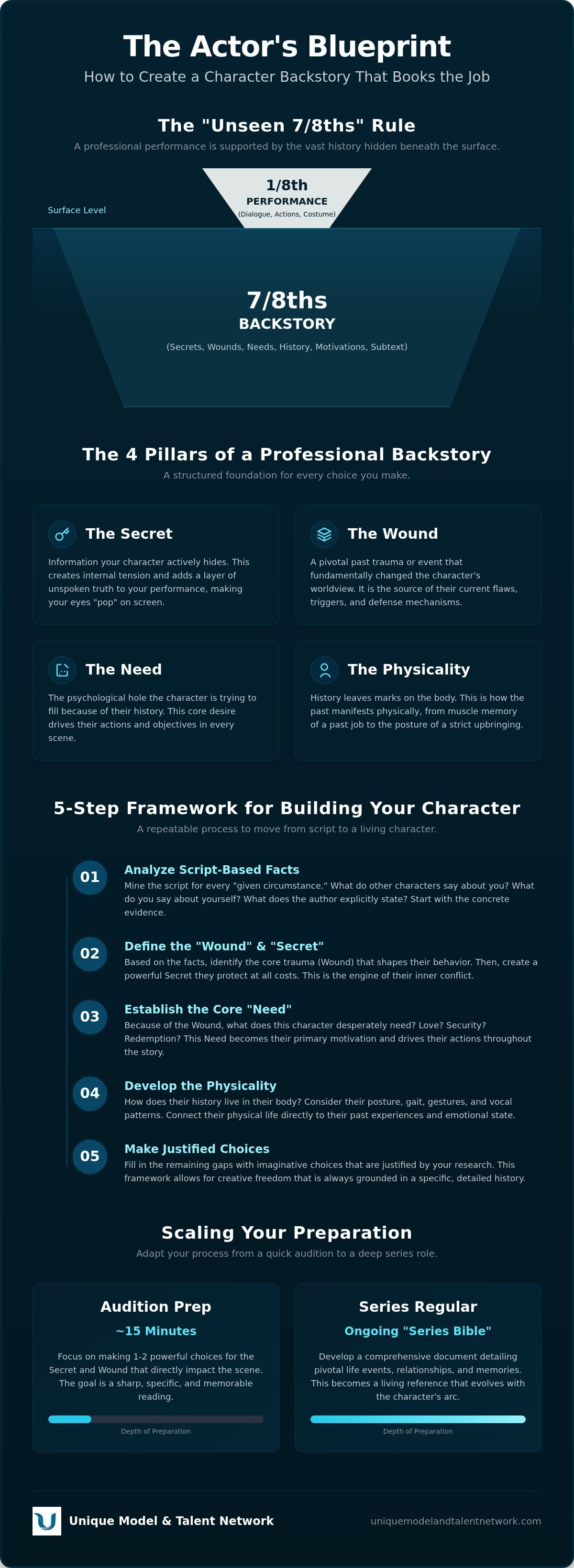
Think of your character as an iceberg. The audience only sees the "one-eighth" that appears on the screen or stage; the dialogue, the costume, and the physical actions. However, a professional performance is supported by the "seven-eighths" hidden beneath the surface. This hidden mass is your backstory. While a writer uses history to drive the plot, an actor uses it to drive intent. Understanding What is a backstory? from a craft perspective allows you to move beyond simply reciting lines. It gives you a reason to breathe, blink, and react in ways that feel inevitable rather than rehearsed.
Casting directors have a trained eye for this unspoken depth. They can tell within seconds if an actor is just "playing the scene" or if they are inhabiting a person with a lifetime of experiences. When you master how to create a character backstory, you stop guessing what the "right" choice is. Instead, you make specific, justified choices that reflect a complex inner life. This level of preparation is what separates a hobbyist from a professional who is ready to be trusted with a multi-million dollar production.
The Psychology of Subtext in Performance
Every human has a "default" emotional state dictated by their past triumphs and traumas. A character who grew up in a household where they had to fight for attention will listen to others differently than a character who was always the center of the room. Your backstory provides the "Why" behind every word you speak. It informs your character's defense mechanisms, their triggers, and their private desires. Subtext is the emotional current beneath the written word. Without it, your performance lacks the friction that makes human interaction interesting to watch.
Why 'Generic' is the Enemy of Booking
A lack of history leads to safe, boring, and ultimately unbookable choices. If you don't know where your character came from, you'll likely fall back on acting clichés. You might play "the angry guy" or "the sad girl" instead of a specific person who is using anger to mask a specific fear. Casting directors aren't looking for a generic archetype; they're looking for a unique soul that fits the world of the story. Developing a rigorous history makes you memorable in a sea of identical auditions. When you bring this level of psychological detail to the room, it naturally accelerates your acting industry networking because you're presenting yourself as a disciplined, high-value collaborator who understands the demands of the job.
The Anatomy of a Professional Backstory: The 4 Pillars
A professional backstory isn't a random collection of facts. It's a structured foundation designed to support every choice you make in front of a camera. When you're learning how to create a character backstory, you must focus on four specific pillars that provide immediate utility for your performance. These elements ensure your work remains grounded in the script while allowing for the creative spontaneity that casting directors love. Without these pillars, your character remains a two-dimensional sketch rather than a living, breathing human being.
- The Secret: This is a piece of information your character actively hides. It creates an internal tension that makes your eyes "pop" on screen. Even if the audience never learns the secret, they will sense the weight of it in your performance.
- The Wound: A pivotal past event that fundamentally changed how the character views the world. It is the source of their current flaws and defense mechanisms.
- The Need: Because of their history, what is the character missing? This is the psychological hole they are trying to fill through their actions in every scene.
- The Physicality: History leaves marks. Whether it's the muscle memory of past labor or the rigid posture of someone raised in a strict environment, the past must manifest in your body.
Identifying the 'Ghost' or Core Wound
In literary theory, the "Ghost" is the past trauma that haunts your character's present. To find this in your audition sides, look for what the character avoids talking about or where they overreact. If a script mentions a character's "estranged father," your job is to define the exact moment that estrangement became permanent. Differentiate between helpful history and distracting fluff; if a detail doesn't change how you play the scene, it's probably fluff. If you're struggling to find these nuances, attending Live Industry Workshops can help you see how experts dissect a script for these hidden psychological clues.
Translating History into Physical Choices
Your character's past labor or social upbringing should dictate how they occupy space. A character who spent a decade in manual labor will have a different weight in their step than a corporate executive. These choices must be consistent with the range shown in your acting portfolio representation. If your portfolio brands you as a "gritty detective," your backstory should justify the weary posture and guarded eye contact that such a life entails. Mastering how to create a character backstory means ensuring your physical life is a direct consequence of your character's lived experience, making your performance feel authentic and deeply lived-in.
Audition Prep vs. Series Regulars: Scaling Your Backstory
Efficiency is a hallmark of the professional actor. In a fast-paced industry, you won't always have a week to live with a script before a self-tape is due. Learning how to create a character backstory requires knowing when to go deep and when to keep it lean. If you're auditioning for a co-star or "under-5" role, your backstory should be functional. It exists to justify your character’s presence in the scene and your relationship to the lead. You don't need a twenty-page biography for a character who delivers three lines of medical jargon; you need a clear "Moment Before" and a professional objective.
Conversely, lead roles and series regulars require a "Series Bible." This is a comprehensive document where you track your character’s evolution, secrets, and long-term desires. However, even with extensive preparation, you must remain flexible. Over-preparing can lead to rigid performances that can't adapt to a director's notes. Your history should be a springboard, not a cage. If a director asks for a completely different tone, your backstory should be robust enough to justify that new direction without crumbling.
The 'Quick-Fire' Backstory for Commercial Auditions
Commercial casting moves at the speed of light. In this environment, casting directors value immediate, clear archetypes over deep psychological trauma. Your focus should shift to the environment and the immediate relationship. Ask yourself: "What happened 30 seconds before the camera started rolling?" Using this "Moment Before" technique allows you to enter the scene with a high level of energy and a specific point of view. It makes your choices pop instantly, which is essential when you only have fifteen seconds to make an impression.
Building a Living Document for Long-Term Roles
When you book a recurring or lead role, your backstory becomes a living document. You'll need to keep a character journal to track growth across episodes and ensure your choices remain consistent as the plot evolves. This often involves collaborating with writers and showrunners to align your imagined history with their future plans for the character. Many professionals use acting workshops online to test these long-term character arcs in a safe, expert-led environment before they reach the set. Understanding how to create a character backstory that can grow with the production is what ensures your character feels like a real person throughout an entire season.
A 5-Step Framework for Building Your Character’s History
Professional character development requires a disciplined, repeatable process that moves from the objective facts of the script to the creative depths of your imagination. If you're wondering how to create a character backstory that actually informs your acting, you must follow a logical sequence. This framework ensures your choices are grounded in the writer's world while allowing you the freedom to bring a unique perspective to the casting room. Follow these five steps to build a history that supports every beat of your performance.
- Step 1: Scour the script for 'Fact-Based' evidence. Identify everything the writer explicitly states about your character, including their age, occupation, and history. Pay close attention to what other characters say about you, but remain skeptical of their biases.
- Step 2: Fill the gaps with 'Justified' imagination. Use the facts as a springboard for logical leaps. If the script says you're a doctor, your justified imagination might decide you grew up in a family of high achievers where failure wasn't an option.
- Step 3: Define the 'Primary Relationship'. Identify the one person from your character's past who most influenced their current behavior. Whether it's a supportive mentor or a neglectful parent, this relationship dictates how your character seeks or avoids connection.
- Step 4: Choose one 'Physical Anchor'. Select a physical habit that stems directly from your history. This could be a specific way you hold your hands when nervous or a slight limp from a childhood injury.
- Step 5: Test your choices against the scene's objective. Ensure your backstory actually helps you achieve what your character wants in the scene. If a choice makes you "stiff" or gets in the way of the dialogue, discard it.
Script Analysis: Fact vs. Fiction
Success begins with a rigorous reading of the text. You must distinguish between objective truths provided by the writer and the subjective claims made by other characters. If a rival character calls you "untrustworthy," that is a subjective claim you can choose to play against. However, if the stage directions state you are "shaking with rage," that is an objective requirement. Script analysis is the foundation of all professional acting. By identifying these "givens," you create a safe container for your creative risks. To refine this skill under professional guidance, consider joining our Live Industry Workshops to see how casting directors evaluate these choices.
The Character Questionnaire for Actors
Once you have the facts, use a targeted questionnaire to flesh out the details. Focus on questions that prompt action rather than just reflection. Ask your character: What is your greatest fear? What was the last lie you told? What do you want most from the person you're speaking to? These questions transform abstract history into immediate emotional stakes. This level of preparation is just as vital for commercial talent as it is for theatrical actors. Many professionals use modeling career coaching to learn how to bring this same character depth to high-end brand campaigns and commercial spots. Understanding how to create a character backstory ensures you're never just a "face" in the frame; you're a person with a story to tell.
Refining Your Craft within the Unique Model & Talent Network
Theory alone won't book the job. While understanding the mechanics of how to create a character backstory is essential, true mastery comes from testing those choices in a professional environment. The entertainment industry can often feel like a vacuum where actors receive little to no feedback on why a specific choice didn't land. We solve this by providing a structured platform where you can refine your craft alongside seasoned industry professionals. This isn't just about practice; it's about professional calibration.
Our Monthly Skill-Building Challenges offer a dedicated sandbox for you to apply the 5-step framework discussed earlier. These challenges push you to move beyond your comfort zone and explore character histories for genres you might not typically encounter. Additionally, networking with peers within the network allows for collaborative backstory development. When you work with other serious actors on scene preparation, you gain a deeper understanding of how your character's history interacts with the histories of those around them. This creates a more cohesive and believable world for the camera.
Access to Decision-Makers
The most direct way to elevate your performance is to hear how a Casting Director interprets the same script you've been dissecting. In our Live Industry Workshops, you don't just perform; you receive direct feedback on the effectiveness of your character's unspoken depth. You'll learn if your "Secret" is reading on camera or if your "Wound" is manifesting as a specific, justified choice. Our Industry Expert Q&A Sessions allow you to ask targeted questions about character development on professional sets. This moves you past the informal advice of hobbyist forums and into the standards of elite industry professionals.
Ongoing Mentorship and Career Growth
A managed community provides the career security that general social media platforms lack. By removing the noise of unorganized communication, we allow you to focus entirely on your professional business development. Your Network Membership acts as a bridge between your current skill level and the high standards required by top-tier recruitment and talent evaluation teams. We advocate for your growth by providing the tools, accreditation, and internal perspectives necessary to accelerate your career. It's time to step away from the distractions and join a community that values integrity, efficiency, and the disciplined craft of acting. Start refining your process today and ensure every character you create is booking-ready.
Elevate Your Performance Standards for the 2026 Season
Professional success in a competitive industry requires more than just talent; it demands a disciplined approach to your craft. You now have the framework to move beyond generic auditions by using the 4 Pillars and the 5-step analysis process. Remember that a great history is only useful if it justifies bold, specific choices on camera. Mastering how to create a character backstory is the definitive step toward professional legitimacy and career security.
Don't refine these choices in isolation. Our private, moderated community provides a protective environment where you can grow without the distractions of public social media. You gain direct access to industry decision-makers through live workshops led by guest casting directors. These sessions provide the clarity you need to ensure your character prep meets the high standards of modern recruitment. It's time to stop guessing and start booking with confidence.
Join The Network Membership and get expert feedback on your character prep today. We are ready to help you bridge the gap between emerging talent and established professional success.
Frequently Asked Questions
How long should a character backstory be for an actor?
Backstory length is determined by the complexity of the role and the time you have to prepare. For a co-star role, a single page of bullet points is often sufficient to ground your performance. For a series regular, you might build a comprehensive "Series Bible" that grows throughout the season. The goal is utility; if a detail doesn't influence a specific choice in the scene, it shouldn't be part of your active prep.
Can I change my character backstory if the director asks for a different choice?
You absolutely can and should change your backstory to accommodate a director's vision. A professional actor uses their preparation as a foundation, not a rigid script. If a director gives a note that contradicts your imagined history, adjust your backstory immediately to justify the new direction. This level of flexibility is a key marker of a booking-ready professional who is easy to work with on set.
What if the script provides absolutely no information about my character's past?
When a script is thin on detail, you must use "Justified Imagination" to fill the gaps. Look for what other characters say about you and how your character reacts to their immediate environment. These clues provide the logic for your creative leaps. Learning how to create a character backstory from minimal information is a skill that separates elite talent from amateurs who feel "stiff" without explicit instructions.
Is it possible to over-prepare a character backstory?
Over-preparation occurs when your backstory makes you rigid or unresponsive to direction. If you find yourself thinking "my character wouldn't do that" during a workshop or on set, you've become too attached to your homework. Your history exists to support the scene, not to hinder the collaborative process. Use your preparation as a springboard for spontaneity rather than a set of rules you can't break.
Should I tell the casting director about my character's backstory during the audition?
Never explain your backstory to a casting director during an audition. Your preparation should be visible in the nuance of your performance and the specificity of your physical choices. If your work is grounded and detailed, the "unspoken depth" will be clear without you saying a word. Casting directors are looking for actors who can inhabit the role, not actors who can talk about it.
How do I make my character backstory feel real instead of made up?
To make a backstory feel authentic, connect it to physical anchors and emotional triggers. Don't just invent a list of facts; identify how those facts manifest in your body today. A childhood injury or a specific social upbringing should dictate your posture, eye contact, and vocal volume. This physicalization turns an abstract idea into a lived reality that the camera can capture.
What are the best acting exercises for developing backstory?
Character journaling and the "Moment Before" technique are the most effective exercises for building a history. Write from your character's perspective about a pivotal past event to find their unique voice. Then, define exactly what happened thirty seconds before the scene starts to ensure you enter with immediate, justified energy. These exercises keep your history active and useful for the performance at hand.
Does every role need a backstory, even a background or commercial role?
Every role requires some level of backstory, but you must scale your effort to the specific job. Background actors need a simple reason for being in the space to avoid looking like a "prop." Commercial actors should focus on the relationship and the immediate environment. Mastering how to create a character backstory for any role size ensures you always bring a professional level of detail to the frame, regardless of your screen time.


