

Did you know that only 12.08% of SAG-AFTRA members earned more than $1,000 last year? It's a staggering reality that proves why simply "wanting it" isn't enough to build a sustainable career. You've likely felt the frustration of walking into an audition only to feel stiff, robotic, or completely unsure of how to handle a product without looking like a caricature. It's exhausting to invest your hard-earned money into commercial acting workshops that promise "exposure" but leave you with nothing but a lighter wallet and the same old questions about how to read copy effectively.
We believe your training should be a business investment, not a gamble. You deserve a professional strategy that turns your talent into a booking machine. This guide will teach you how to master the tactical skills needed to dominate the commercial market; we'll cover everything from perfecting your commercial slate to understanding the 2026 SAG-AFTRA AI regulations. We'll explore how to secure direct access to casting directors and transform your performance into a high-value business service that brands are eager to hire.
Key Takeaways
- Learn why modern technical precision is required to master the 30-second storytelling format in the 2026 commercial market.
- Master the "anatomy" of a professional audition by perfecting your five-second camera slate and identifying the emotional "hook" in any commercial script.
- Evaluate the tactical advantages of online commercial acting workshops to align your training with an industry that has moved primarily to digital casting.
- Identify five critical red flags to avoid "pay-to-play" scams and ensure your coach offers active industry experience rather than outdated advice.
- Discover how to leverage live skill-building challenges and industry feedback to transform your workshop notes into a professional booking strategy.
Why Commercial Acting Workshops are Essential in 2026
In an industry where approximately 90% of actors are unemployed at any given time, you can't afford to treat your career like a hobby. Commercial acting workshops are focused training sessions designed to help you master the 30-second storytelling format. By 2026, the commercial market has shifted toward extreme technical precision. Brands no longer look for "theatrical" performances; they want professionals who can navigate digital-first formats and short-form content with ease. These workshops provide the specific environment needed to bridge the gap between being a performer and being a professional solution for a brand.
Mastering essential acting skills is only the first step. In the commercial world, you must learn the delicate balance of "selling" without losing your authenticity. If you look like you're pitching a product, the audience disconnects. If you're too focused on your own "craft," the brand's message gets lost. Successful actors use these workshops as scouting grounds. It's a rare chance to get in front of casting directors who are looking for talent that is set-ready, disciplined, and capable of taking direction on the fly.
Commercial vs. Theatrical Acting: The Key Differences
Theater and film allow for a slow emotional build, but commercials demand immediate characterization. You often have less than five seconds to establish a believable relationship with the viewer. You're acting as a brand ambassador, which means your performance must align with a company's specific identity. This requires a high level of discipline when working with strictly timed 15, 30, or 60-second scripts. Every beat and every look must serve the clock and the product simultaneously.
The ROI of Specialized Commercial Training
Think of your training as a business investment rather than a cost. A single national commercial booking can pay for your entire year of workshops and coaching several times over. Beyond the financial legitimacy of the work, you're building a professional "commercial vocabulary." When you understand industry-specific terms and expectations, you gain the respect of agents and casting directors. You'll also find yourself networking with a private community of peers who are actively booking in your market. Applying the feedback you receive to your acting portfolio ensures you're presenting a version of yourself that the 2026 market actually wants to hire.
The Anatomy of a Professional Commercial Workshop
A professional environment is defined by its focus on the technical mechanics that happen before the director even calls "action." High-quality commercial acting workshops don't just teach you how to read lines; they train you to understand the camera as a storytelling partner. You'll spend significant time on copy analysis to find the "hook," which is the specific moment the brand's solution meets the consumer's need. This requires a shift from emotional indulgence to technical efficiency. You must also master product handling to ensure the "hero shot" remains unobstructed while maintaining a natural, believable performance.
Mastering the Commercial Slate
Your slate is often the most critical part of your audition because it's the first time a casting director sees your true personality. A slate is a 5-second professional introduction. If you're too theatrical, you come across as "fake"; if you're too robotic, you lack the charisma needed to sell a brand. You want to present a version of yourself that is accessible, confident, and set-ready. Mastering this brief window of time shows that you're a professional who understands the industry's pace.
Technical Eye-Lines and Camera Awareness
Engaging in professional development for actors through targeted workshops allows you to master technical nuances like eye-lines. You'll learn when to talk directly into the lens and when to address an off-camera reader. In a tight frame, your energy must remain high without your physical movements becoming distracting. Successful actors use an "internal monologue" to keep their eyes active during silent shots, ensuring they don't look vacant when the camera lingers on their reaction.
Product Interaction Tactics
Handling props is a specialized skill that separates amateurs from pros. You must learn to hold a product so the logo is visible without blocking your face or looking staged. Techniques like the "bite and smile" for food spots require practice to look effortless rather than forced. Your physicality should convey comfort and excitement with the brand through subtle body language. If you're looking to sharpen these specific skills, participating in Live Industry Workshops can provide the real-time feedback needed to perfect your technique.
Finally, you'll practice improvisation to handle the common "now do one for fun" direction. This isn't an invitation to be wild or off-brand; it's a test of your ability to stay within the script's world while offering a fresh, spontaneous perspective. It shows you're adaptable and can provide the production team with variety during the editing process.
Choosing the Right Format: Online vs. In-Person Workshops
The decision between digital and physical training is a strategic business choice. By 2026, the "industry is now digital" is not just a trend; it is the standard operating procedure. Most initial commercial auditions are now handled via self-tape or virtual casting rooms. Choosing the right format for your commercial acting workshops depends on your current career stage and your specific technical needs. You must evaluate which environment will best help you master the 30-second storytelling format while maintaining your professional momentum.
The Rise of the Digital Commercial Workshop
Virtual training offers a distinct tactical advantage because it forces you to master the environment where you actually work. When you attend acting workshops online, you are simulating the exact conditions of a high-stakes self-tape. You learn to manage your own lighting, sound, and framing while receiving real-time feedback from industry experts. This format also provides global access. You can connect with top-tier casting directors from NYC or LA without the financial burden of travel and temporary housing. For busy professionals, the efficiency of digital commercial acting workshops allows for consistent skill-building without the distractions of a commute.
When to Invest in In-Person Intensive Training
Physical studios still offer unique benefits that are difficult to replicate on a screen. If you need to build physical chemistry with scene partners or practice complex product handling in a group setting, an in-person intensive is invaluable. These "bootcamp" style weekend sessions often provide access to studio-grade equipment and professional lighting setups. This environment is ideal for actors who thrive on high-intensity, immediate energy. It helps you prepare for the reality of a busy commercial set where you must maintain focus amidst a full crew and multiple moving parts. These sessions are excellent for building deep professional bonds with local peers.
Weighing the costs is essential for maintaining career security. A digital membership often provides better long-term ROI by offering year-round access for the price of a single weekend in-person intensive. To ensure high-quality feedback in a virtual setting, look for programs that prioritize small group sizes and live interaction. You want a coach who focuses on your specific technical adjustments rather than generic advice. By choosing a format that aligns with your professional goals, you turn your training into a legitimate booking strategy rather than a hobbyist expense.
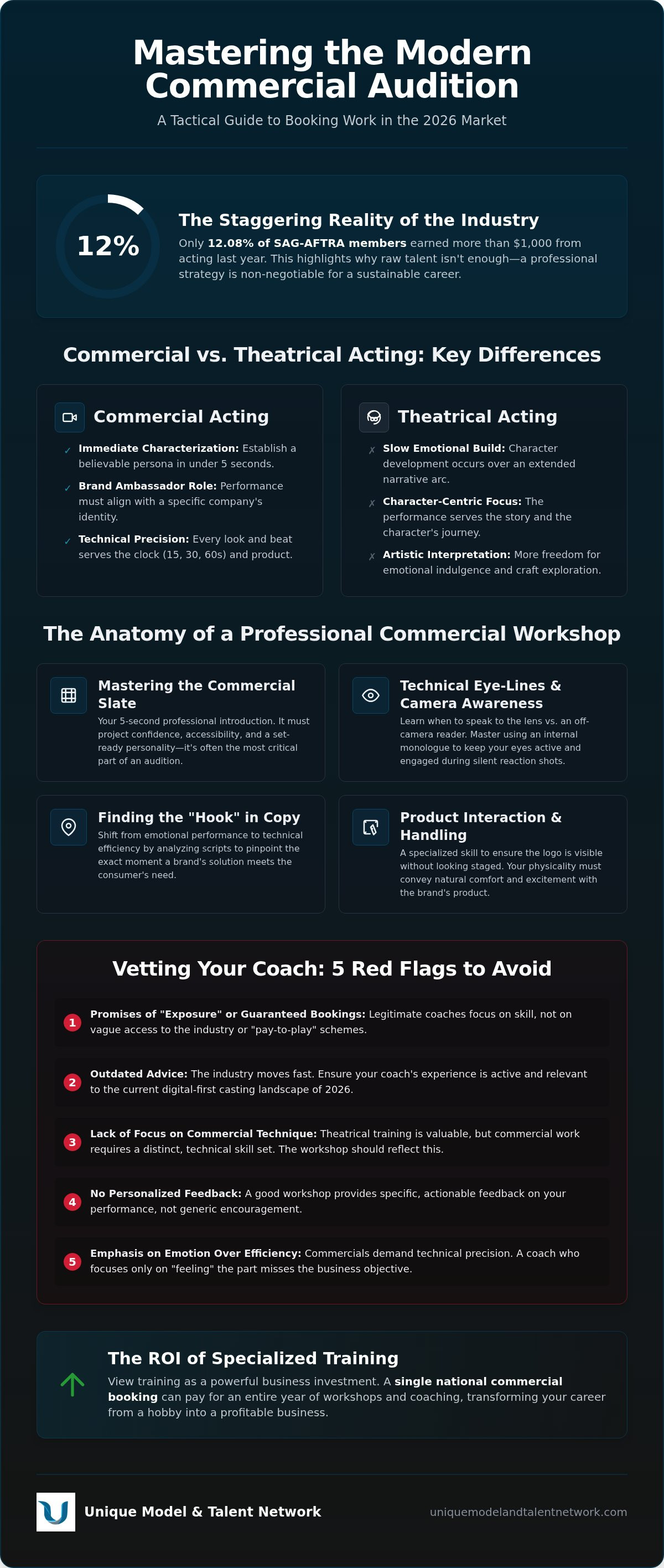
Vetting Your Coach: 5 Red Flags to Avoid
Protecting your career from predatory practices is a fundamental part of your professional development. In an industry that is often unorganized, you must act as your own gatekeeper. While many commercial acting workshops offer genuine value, others thrive on the uncertainty of emerging talent. Vetting a coach isn't just about checking a resume; it's about ensuring their teaching methods align with the financial legitimacy of the 2026 market. If a workshop feels more like a high-pressure sales pitch than a training session, it's time to walk away.
Avoiding the "Agent Guarantee" Scam
Legitimate training centers never guarantee representation or bookings. This is a major red flag. If a studio claims that attending their session will lead directly to a contract, they are likely operating a "diploma mill" that sells worthless certificates instead of tactical skills. You should also be wary of "talent searches" that charge high fees for the chance to be seen. A professional workshop is a business service designed to improve your craft, not a back door into an agency. Your focus should be on building a sustainable strategy, not chasing empty promises of fame.
Vetting Guest Casting Directors
When a workshop features a guest casting director, do your homework. Use IMDbPro to verify their recent commercial credits from 2025 and 2026. If their most recent project was five years ago, their advice on current technical standards—like the new SAG-AFTRA AI regulations—may be outdated. Ensure the workshop strictly follows Casting Society of America (CSA) guidelines, which state that workshops are for educational purposes and do not constitute an audition. For those transitioning from other areas of the industry, seeking modeling career coaching can provide additional clarity on how to vet crossover opportunities effectively.
Before you invest, look for these specific red flags:
- No Audit Policy: If you can't watch a class or see a sample of the teaching style before paying, the studio may be hiding a lack of substance.
- "Retired" Advice: Avoid coaches who haven't worked in the industry since the shift to digital-first casting.
- Pay-to-Play Myths: Any implication that paying for the class is a requirement for future employment is illegal in many jurisdictions.
- Lack of Technical Focus: If the class doesn't cover self-tape mechanics or camera awareness, it isn't preparing you for 2026.
- Vague Feedback: Professional growth requires concrete, actionable critiques, not generic praise.
Choosing the right mentor is about finding an advocate who values your professional growth over your tuition check. If you want to train in a moderated environment with verified experts, consider joining The Network Membership to access high-standard educational resources.
From Workshop to Booking: Leveraging The Network
The most common mistake actors make is treating commercial acting workshops as isolated events rather than catalysts for their business strategy. Once the cameras are off and the coach has given their final notes, your real work begins. You must translate that professional feedback into tangible assets that casting directors can see. This transition is where many talented performers stall, yet it's the exact moment where elite professionals pull ahead by refining their digital presence and strengthening their industry bonds. Training is a business investment; it only pays off when you apply it to your public-facing materials.
Applying Feedback to Your Commercial Reel
Workshop critiques provide a clear mirror to how the industry perceives your "type" and energy. If multiple coaches identify you as the trustworthy neighbor or the high-energy tech expert, use that data to refine your acting portfolio. You should update your profiles on casting websites with new footage that reflects these specific types immediately after your training. You should list specific workshop completions or specialized technical accolades from industry guests as notable credits on your professional resume to signal your commitment to growth.
Why a Managed Community Beats Social Media Groups
Public forums are often filled with misinformation and unorganized noise that can distract you from your professional goals. A private, moderated community on Mighty Networks removes these distractions, allowing you to focus on career acceleration. Within the Unique Model & Talent Network, you gain direct access to vetted industry experts who provide clarity in an often chaotic field. Peer accountability plays a vital role here. Seeing your colleagues tackle Monthly Skill-Building Challenges keeps you audition-ready and disciplined. This gated environment ensures that every interaction is a step toward professional growth rather than a vanity exercise.
Bridging the gap between a training session and a booking requires consistent engagement. Use Industry Expert Q& Sessions to ask the tactical questions that weren't covered in the heat of a scene. These interactions help turn brief workshop encounters into lasting professional relationships. By treating every skill-building challenge as a mock audition, you ensure that when the real call comes, your performance is a natural extension of your daily practice. This disciplined approach turns your participation in commercial acting workshops into a legitimate booking strategy that stands out in the 2026 market.
Dominate the 2026 Commercial Market
The 2026 commercial landscape demands more than just charisma; it requires a tactical approach to performance as a business service. By mastering the 30-second storytelling format and refining your technical camera awareness, you transition from a hopeful performer to a professional brand ambassador. The true value of commercial acting workshops lies in how you leverage the feedback to update your reel and portfolio. Don't let your training become a hobbyist expense. Instead, treat every session as a direct step toward financial legitimacy in an industry that rewards precision and authenticity.
If you're ready to remove the distractions of public forums and focus on career security, it's time to find your professional home. You can Join The Network Membership to access live workshops and industry experts today. You'll gain direct access to guest casting directors, participate in live monthly skill-building challenges, and join a private community on Mighty Networks. Your path to booking starts with the right mentorship and a disciplined strategy. We're here to help you turn your talent into a sustainable professional career.
Frequently Asked Questions
Do I need professional headshots before taking a commercial acting workshop?
You don't need professional headshots to begin your training. You just need a clear, well-lit photo for identification. Many actors find that taking commercial acting workshops first helps them identify their specific "commercial type" and marketability. This insight ensures your future headshot session actually aligns with the roles you're likely to book. Focus on your technical skills first. Let those skills dictate your professional branding later.
Are online commercial workshops as effective as in-person classes?
Online commercial acting workshops are highly effective. They simulate the modern digital casting environment perfectly. Since most initial auditions in 2026 are handled via self-tapes or virtual rooms, training on-camera from your own space is a tactical advantage. You'll master technical eye-lines, lighting, and sound while receiving live feedback. This format removes geographical barriers. It allows you to connect with top-tier casting directors from anywhere in the world without travel costs.
How much do commercial acting workshops typically cost in 2026?
Tuition for commercial acting workshops varies significantly based on several factors. Costs depend on the instructor's expertise, the session's duration, and the specific technical equipment provided. You'll find that introductory classes often have different price points compared to advanced on-camera intensives or private coaching sessions. Most reputable studios will list their registration fees clearly on their websites. It's best to evaluate these costs as a business investment in your professional development and long-term career security.
Can a commercial workshop really help me get an agent?
Workshops help you get signed by making you a "set-ready" professional. Agents want talent they can confidently pitch to clients. While a workshop isn't a direct talent representation service, it provides the technical precision and industry vocabulary that agents respect. When you demonstrate that you can handle copy and camera mechanics effectively, you become a lower risk for an agency. This professional polish often leads to stronger referrals and a more impressive acting portfolio.
What should I prepare for my first commercial acting class?
Arrive with a notebook, water, and a professional, set-ready attitude. Wear comfortable clothing that reflects a "casual professional" look. You'll likely be moving and interacting with products on camera. If the instructor provides copy in advance, familiarize yourself with it. However, stay flexible enough to take new direction. Most importantly, be prepared to listen. The goal of your first class is to understand the technical pace and the brand-ambassador mindset.
Is it better to take a general acting class or a commercial-specific workshop?
General acting classes build foundational craft. However, specialized commercial acting workshops are essential for mastering the tactical demands of the 30-second storytelling format. Commercials require immediate characterization and specific technical skills, such as product handling and talking to the lens. These are rarely covered in theatrical classes. If your goal is to generate income and build professional bonds, targeted training provides the specific skills you need to turn auditions into bookings.
How do I know if a casting director workshop is legitimate?
A legitimate workshop will always follow Casting Society of America (CSA) guidelines. They must state clearly that the session is for educational purposes. Verify the legitimacy by checking:
- Recent commercial credits on IMDbPro.
- Compliance with current 2026 market trends.
- Clear audit policies for new students.
Will taking a workshop guarantee that I will book a commercial?
No workshop can guarantee a booking. Any claim to the contrary is a major red flag. Training provides you with the competitive tools and technical confidence needed to succeed. However, the final casting decision rests with the client and director. Think of workshops as a way to increase your "booking ratio." They ensure you're the most prepared person in the room. Consistent training and peer accountability are what lead to long-term career success.


