

Professionalism is a language. If a casting notice doesn’t speak it fluently, you aren’t looking at a career breakthrough; you’re looking at a predatory trap. You’ve likely felt that familiar knot of anxiety when you spot potential red flags in casting notices, yet the pressure to "pay your dues" makes you hesitate to hit delete. It’s a common struggle in an industry where the line between a scrappy indie project and a financial scam often feels dangerously thin. You deserve to pursue your craft without the constant fear of being exploited or physically compromised.
This guide empowers you to vet every opportunity with the clinical precision of a seasoned talent agent. We’ll move past the vague warnings and dive into the specific markers of unprofessionalism, from illegal upfront fees to the subtle linguistic shifts that signal a lack of industry accreditation. You’ll learn exactly how the 2026 regulatory landscape, including the latest protections under the Krekorian Act, serves as your professional shield. By the end of this guide, you’ll have a clear vetting checklist and the renewed confidence to say no to anything that falls below the standards of a true professional. We’re here to help you navigate the noise and focus on legitimate, high-value opportunities that actually accelerate your career.
Key Takeaways
- Identify the essential components of a professional breakdown to ensure every opportunity includes transparent pay rates and clear usage terms.
- Master the ability to spot common red flags in casting notices involving upfront fees or mandatory referrals to protect your finances from predatory "pay-to-play" tactics.
- Distinguish between industry insiders and amateurs by evaluating the grammar, tone, and specific communication channels used for talent outreach.
- Establish firm safety boundaries by recognizing warning signs in audition locations and protecting your sensitive data from collection attempts.
- Discover how moving from public casting sites to a moderated, gated community provides a protective layer through expert-led vetting and professional standards.
Understanding the Anatomy of a Legitimate Casting Notice
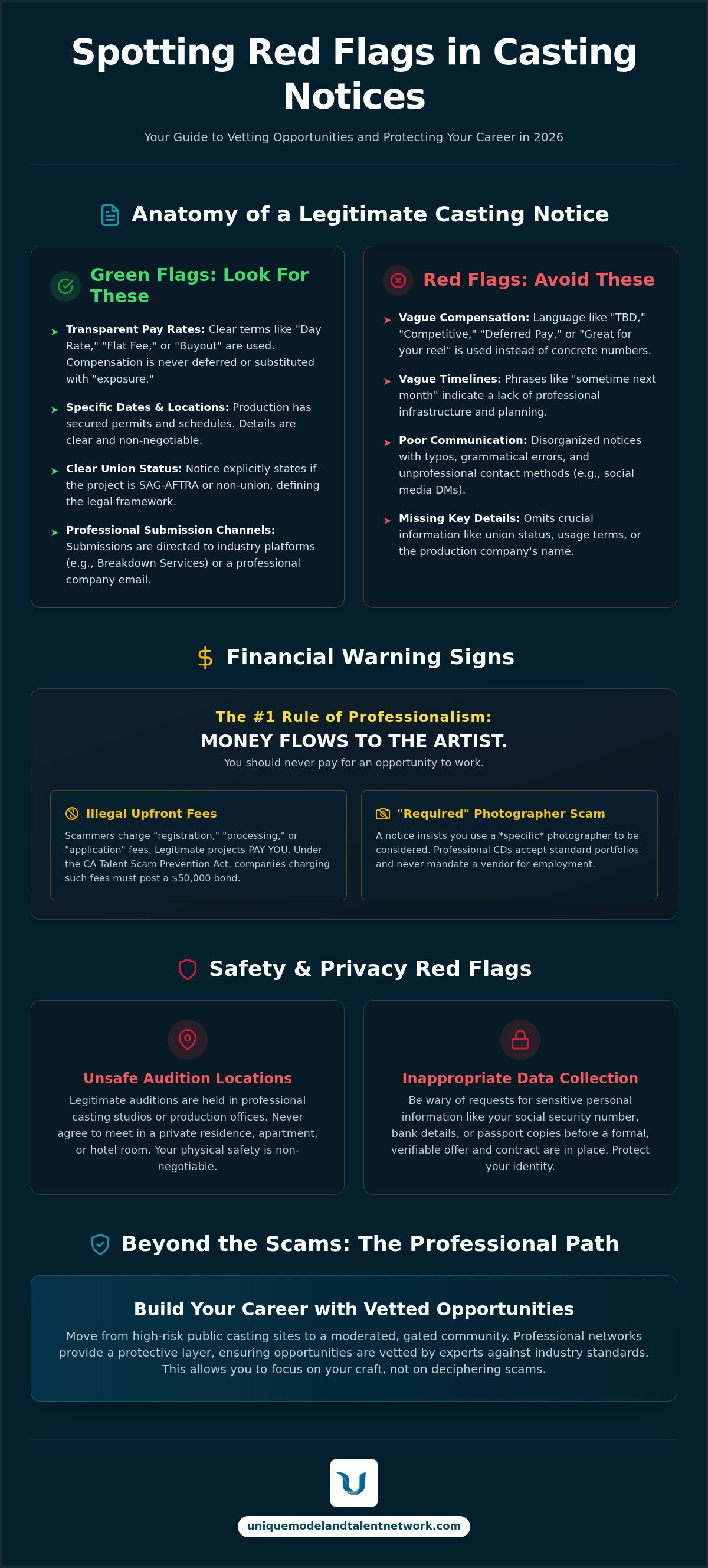
Professionalism isn't a guess; it's a standard. In 2026, a legitimate casting notice follows a strict architectural blueprint designed to protect both the production and the performer. Think of the Casting Director as the professional gatekeeper. Their role is to provide a transparent bridge between the creative vision and the talent pool. If a notice feels vague or disorganized, you're likely looking at one of many red flags in casting notices that signal an amateur or predatory operation.
Transparency regarding production dates and locations is a non-negotiable industry standard. Legitimate productions have secured permits, booked stages, and finalized schedules before they ever look for talent. If a notice omits these details or offers a vague "sometime next month" timeline, it's a sign that the project lacks the necessary infrastructure to be considered a professional opportunity.
The Standard Breakdown Format
A professional breakdown provides a granular view of the character. It includes specific age ranges, relevant physical traits, and a clear personality arc. It also dictates a specific submission path. You'll see instructions to submit via recognized industry platforms or a professional company email address rather than a generic social media DM. Professional notices also clearly state the project's union status. Whether it's a SAG-AFTRA theatrical production or a non-union commercial, this designation determines the legal framework of your workday. For example, a professional union breakdown will account for current 2026 standards, such as the 22% Pension & Health contribution rate for theatrical performers.
Usage and Compensation Clarity
Money is where many common casting scams begin to reveal themselves. A professional notice uses precise financial terminology. You should see terms like "Day Rate", "Flat Fee", or "Buyout". Learning to identify these red flags in casting notices early on protects your time and your career. If the notice uses vague language like "compensation to be discussed," be cautious.
Be wary of "Deferred Pay." In a professional context, this means you only get paid if the project makes a profit. For a developing talent, this is often a significant red flag. Legitimate notices also address logistical costs. They'll explicitly mention travel stipends or per diem rates if the shoot is out of town. If the compensation section is missing or uses "great for your reel" as a substitute for currency, it’s time to move on to vetted opportunities.
Financial Warning Signs: When a Job Costs You Money
Professionalism in the entertainment industry is defined by a simple, unbreakable rule: the money flows to the artist. If a notice requires you to pay for the privilege of auditioning, you've encountered one of the most blatant red flags in casting notices. Legitimate projects pay you for your skill and time; they don't charge you for the "opportunity" to be seen. Scammers often hide behind the guise of "registration fees" or "processing costs." Under the California Talent Scam Prevention Act, any company charging upfront fees for talent services must post a $50,000 bond. If a representative cannot provide proof of this bond or demands payment before you've even booked the job, walk away immediately.
The "Required" Photography Scam
Scammers frequently use fake casting notices to funnel talent into expensive, low-quality photo shoots. A common tactic involves a notice that claims you are "perfect for the role" but insists your current materials are "not the right style." They will then mandate that you use a specific photographer to be considered for the project. Professional Casting Directors (CDs) focus on your essence and ability. They accept standard acting portfolios regardless of who took the photos. While a legitimate agent might suggest photographers to help your branding, a casting notice should never make a specific vendor a requirement for employment.
Vague or Missing Pay Rates
Transparency is a hallmark of a professional production. If a public notice lists pay as "Competitive" or "TBD," it's often a sign of an amateur production that hasn't secured its budget, which is one of the key red flags in casting notices to watch for. You should also be wary of "Copy, Credit, Meal" (CCM) offers. While acceptable for student films or very low-budget indie projects where you are intentionally building your reel, CCM should never be the standard for commercial work. Always verify that listed rates align with industry standards, such as the 2026 SAG-AFTRA theatrical rate of 22% for Pension & Health contributions.
The most dangerous financial fraud involves check-cashing or wire transfer scams. A "producer" sends you a check for "travel expenses" or "wardrobe" that exceeds the actual cost, asking you to wire the excess back to a "stylist." The original check eventually bounces, leaving you liable for the full amount. Professional productions handle their own vendor payments and would never ask a performer to act as a middleman. Protect your career by joining a vetted talent community that prioritizes financial legitimacy and professional standards.
Professionalism in Casting: Spotting Red Flags in Communication
Communication is your first line of defense. A professional casting notice is a legal business document, not a sales pitch. When you analyze the linguistic markers of a breakdown, look for clinical, descriptive language rather than emotional hype. If a notice feels like it's trying to sell you a dream instead of describing a job, you've identified one of the most common red flags in casting notices. Scammers often use "urgency" as a psychological weapon, creating fake deadlines to pressure you into bypassing your vetting process. If a sender insists you must respond within the hour or lose the role, they're likely trying to prevent you from researching their credentials.
Email and Domain Verification
Verify the source before you click "submit." Professional casting directors use dedicated production domains or established agency emails. An address ending in @gmail.com or @yahoo.com for a supposedly "major studio" project is a massive warning sign. Use tools like IMDbPro or LinkedIn to verify the sender’s identity and professional history. A legitimate signature should include an office address and a verifiable phone number. If these are missing, or if the "office" turns out to be a residential apartment, proceed with extreme caution.
The Tone of the Notice
Identify the "hype" trap immediately. Professional notices use specific character descriptions and technical terminology. They don't use excessive exclamation points or vague promises like "Become a star overnight" and "No experience needed." These phrases are designed to cast a wide net for vulnerable talent. You should also be wary of any outreach that occurs exclusively via social media. Direct messages on Instagram or Facebook are not industry-standard communication channels. Always refer to established casting websites or gated networks where identities are moderated and vetted. If a project isn't listed on a recognized platform, it’s a significant red flag.
Finally, respect your own privacy boundaries. Inappropriate requests for detailed measurements, swimsuit photos, or personal "vibe" videos before an initial audition are red flags in casting notices that signal a lack of professional boundaries. A legitimate casting process is segmented and respectful. It starts with your headshot and reel, only moving to more specific requirements once a professional connection is established. You are the CEO of your career; don't let an amateur's unorganized communication compromise your professional standards.
Safety and Privacy: Red Flags That Compromise Boundaries
Your physical and digital safety is the non-negotiable baseline of your career. While the excitement of a new role can be distracting, you must remain vigilant against red flags in casting notices that compromise your personal boundaries. Professional casting is conducted in transparent, public, or commercially zoned environments. If a notice lists a residential address, a hotel room without a casting suite, or a secluded "private studio" for an initial meeting, do not attend. Legitimate casting directors value your safety and will always provide a professional setting for auditions.
Digital safety is equally critical. Scammers often use legitimate-looking submission forms to harvest sensitive data. If a notice asks for your Social Security number, driver’s license scan, or bank details during the initial submission phase, it is a fraudulent attempt at identity theft. Professional productions only collect this information during the formal onboarding process after you've signed a contract and been officially hired. Additionally, be wary of any notice that forbids you from bringing a "reader" or a friend to the audition site. A professional environment never requires you to be isolated from your support system.
Verifying the Production Company
Don't just analyze the text of a notice; vet the person and the company behind it. Research the production company’s digital footprint by examining their official website, social media presence, and past project history on industry databases. Use talent forums and the Better Business Bureau to check for recurring complaints or safety reports from other performers. Due diligence is the systematic verification of a production's legal standing and professional reputation before you commit your time or personal data to their project.
Intimacy and Nudity Protocols
Transparency regarding sensitive content is a mandatory professional standard in 2026. Any requirement for nudity or simulated intimacy must be explicitly stated in the initial casting notice so you can make an informed decision. The absence of a designated Intimacy Coordinator on a set involving these elements is a major warning sign. You should also watch for "creep" language in character descriptions. Phrases like "must be comfortable with adventurous scenes" or "seeking uninhibited talent" are often used to test if you'll push your personal boundaries. These are significant red flags in casting notices that suggest a lack of professional oversight and safety protocols.
Protecting your personal boundaries is easier when you have a team of experts vetting the opportunities for you. To ensure every project you pursue meets these rigorous safety standards, join the moderated community at The Network Membership today.
Beyond the Scams: Building a Career with Vetted Opportunities
The "Wild West" of public casting sites often leaves you vulnerable to the red flags in casting notices we've discussed throughout this guide. While these platforms offer a high volume of listings, they lack the critical layer of human moderation required to keep predatory actors at bay. Transitioning your career strategy toward a managed talent network shifts the burden of vetting from your shoulders to a dedicated team of industry experts. This proactive approach allows you to stop playing detective and start focusing on the creative work that actually moves your career forward.
Peer feedback serves as an invaluable asset within these gated spaces. If you encounter a notice that feels slightly off, you can immediately ask the community, "Has anyone worked with this production company before?" This access to real-time intelligence provides a level of security that public forums simply cannot match. This collective vigilance ensures that you only commit your energy to projects with a proven track record of professional standards and financial legitimacy. You aren't just looking for work; you're building professional bonds with others who value integrity as much as you do.
The Power of a Gated Community
The Unique Model & Talent Network acts as a strategic filter, ensuring that every opportunity presented to our members has been scrutinized for professional compliance. We don't just host notices; we moderate them to remove distractions and hobbyist-level noise. Our live workshops and expert Q&As are specifically designed to sharpen your "BS Detector," helping you recognize the subtle red flags in casting notices that others might miss. By participating in these skill-building sessions, you move from the exhausting cycle of searching for work to a position where you are discovered by vetted professionals who value your specific expertise and commitment to high standards.
Next Steps for Your Professional Development
Your first move is to perform a rigorous audit of your current submission sources. If a platform doesn't provide a layer of protection or consistently hosts unprofessional breakdowns, remove it from your daily routine. Focus your resources on skill-building through workshops, portfolio reviews, and coaching rather than chasing "star-seeking" shortcuts that rarely lead to sustainable success. Legitimate career acceleration comes from preparation and access to the right rooms, not from luck or unverified public boards.
If you are ready to leave the uncertainty of public boards behind, join the Unique Model & Talent Network. Access a professional, gated environment where your safety is prioritized and your growth is supported by a community of serious industry insiders who are committed to your success.
Own Your Career with Professional Confidence
Mastering the ability to identify red flags in casting notices is more than a safety measure; it's a declaration of your professional standards. You now have the tools to distinguish between predatory scams and the high-value opportunities that build a sustainable career. Remember that legitimate productions prioritize transparency in pay, safety in audition locations, and respect for your personal data. By refusing to settle for amateur communication or "pay-to-play" traps, you position yourself as a serious talent who understands the business of entertainment.
The path to consistent success shouldn't feel like a dangerous gamble. You deserve a workspace where your focus remains on the craft rather than the vetting process. Our private, moderated community offers a red-flag-free environment where you can connect directly with industry experts who value your growth. Stop navigating the unorganized noise of public boards and start building your legacy in a space designed for elite standards.
Join the Unique Model & Talent Network for Vetted Industry Access and gain the career security you've been working for. Your talent is too valuable to risk on unverified opportunities. We're here to help you step into the light of legitimate, professional success.
Frequently Asked Questions
Is it normal for a casting notice to ask for my phone number?
It's standard for a casting notice to request contact information like your phone number or email for scheduling purposes. However, professional notices usually ask for this through a secure submission form or a verified agency email. If a notice requests your personal number via a public social media comment or an unverified DM, treat it as a potential security risk. Always verify the platform's security before sharing your data.
What should I do if I suspect a casting call is a scam?
Trust your instincts and cease all communication immediately. You should report the listing to the platform where you found it and check industry forums for similar experiences. Vetting red flags in casting notices is easier when you cross-reference the production company on IMDbPro. If the "opportunity" requires upfront payment or wire transfers, it is a fraud attempt. You should alert your peers to prevent others from being targeted.
Can a legitimate casting director ask for photos in my underwear?
Legitimate casting directors only request "lifestyle" or "body" shots in swimwear or undergarments if the role specifically requires it, such as for a lingerie campaign. Even then, these requests must follow strict industry safety protocols and should be explicitly stated in the breakdown. A professional notice will be clinical and never suggestive. If a project asks for these photos without a clear, role-specific reason, it is a major boundary violation.
Why do some casting notices not list the pay rate?
While some student films or ultra-low-budget indie projects might omit pay rates, professional notices almost always list compensation. If a commercial project doesn't list a rate or uses vague terms like "competitive pay," it often indicates a lack of secured funding. This transparency is a hallmark of professional standards. You should prioritize projects that are clear about day rates, buyouts, and union status to ensure you are fairly compensated for your craft.
Is it a red flag if a casting director contacts me on Instagram?
Receiving an unsolicited message on Instagram is a significant red flag. Professional Casting Directors (CDs) use established casting platforms, agency databases, or official production emails to reach talent. While some scouts might use social media to find "looks," they will quickly transition the conversation to a professional channel. If the entire casting process happens in your DMs, you are likely dealing with an amateur or a scammer who lacks industry accreditation.
How can I verify a production company if they don’t have a big website?
You can verify smaller production companies by researching their credits on IMDbPro or checking the professional history of the producers on LinkedIn. Even a small boutique firm should have a digital footprint, including past projects or mentions in trade publications. If you can't find any verifiable work history or professional bonds within the industry, it's best to wait for a more established opportunity within a gated, moderated talent community.
What is the difference between a "Casting Call" and a "Casting Notice"?
A casting notice is the written advertisement or "breakdown" that describes the project and roles. A casting call refers to the actual event or period when auditions are held. While people often use the terms interchangeably, the notice is what you analyze for red flags in casting notices before you ever attend the call. Understanding this distinction helps you manage your submission workflow with the organized and disciplined mindset of an industry insider.
Should I ever pay for a background check for a role?
You should never pay for your own background check, insurance, or "on-boarding" fees. If a production requires a background check, they are legally and professionally responsible for covering that cost. Any request for you to pay an upfront fee for "clearance" or "processing" is a financial scam. Legitimate employers pay the talent; you don't pay them to work. Always walk away from projects that demand your financial information before a contract is signed.


