

What if the reason your submissions are ignored isn't your talent, but the digital "black hole" of cold emails? You've likely felt the frustration of sending your best work into a void, wondering why your profile on major industry platforms isn't triggering a callback. Learning how to connect with casting directors in 2026 requires more than just a "submit" button. It demands a professional protocol that moves you from being a random applicant to a trusted solution for a production's specific needs.
We understand the anxiety of feeling like a nuisance when you're just trying to be proactive. It's exhausting to guess which social media trends matter and which are just distractions from legitimate industry standards. This guide provides the exact strategies to bridge that gap. We'll explore the impact of the 2026 SAG-AFTRA agreement on casting accessibility, including the ban on "pay-to-play" barriers for union projects. You'll gain the confidence to present your portfolio effectively and the knowledge to secure warm introductions that lead to consistent bookings. It's time to move beyond the uncertainty of cold submissions and start building a sustainable career through genuine professional relationships.
Key Takeaways
- Shift your mindset from seeking favors to becoming a reliable solution for casting directors who prioritize risk mitigation and vetted talent.
- Optimize your "Big Three" professional materials to ensure your headshot, reel, and resume pass the critical six-second industry review.
- Master a value-first outreach protocol to learn how to connect with casting directors through specificity and professional relevance rather than generic cold emails.
- Discover why private, gated communities and acting workshops online offer a more effective "warm" introduction than the chaotic noise of general social media.
- Leverage live industry workshops and portfolio reviews to receive real-time feedback and bridge the gap between your craft and consistent bookings.
Understanding the Casting Director’s Role: Why 'Who You Know' Still Matters
A casting director is a specialized service provider hired by directors and producers to solve a specific business problem: finding the right talent while minimizing production risk. While many actors view the audition process as a personal hurdle, the role of a casting director is actually to serve as a high-level talent curator. They aren't looking for reasons to say "no." Instead, they're looking for the professional who makes them look like heroes to their clients. Understanding this business relationship is the first step in learning how to connect with casting directors effectively.
In 2026, the industry has shifted away from the chaos of open calls. Professionals now rely heavily on curated databases and private networks to identify reliable performers. This isn't about exclusion; it's about efficiency. A casting office has limited time to fill roles, so they prioritize talent who has already been vetted for professional standards. Networking in this context isn't about "pestering" someone for a favor. It's about demonstrating that you're a prepared, reliable professional who understands the stakes of a high-budget production.
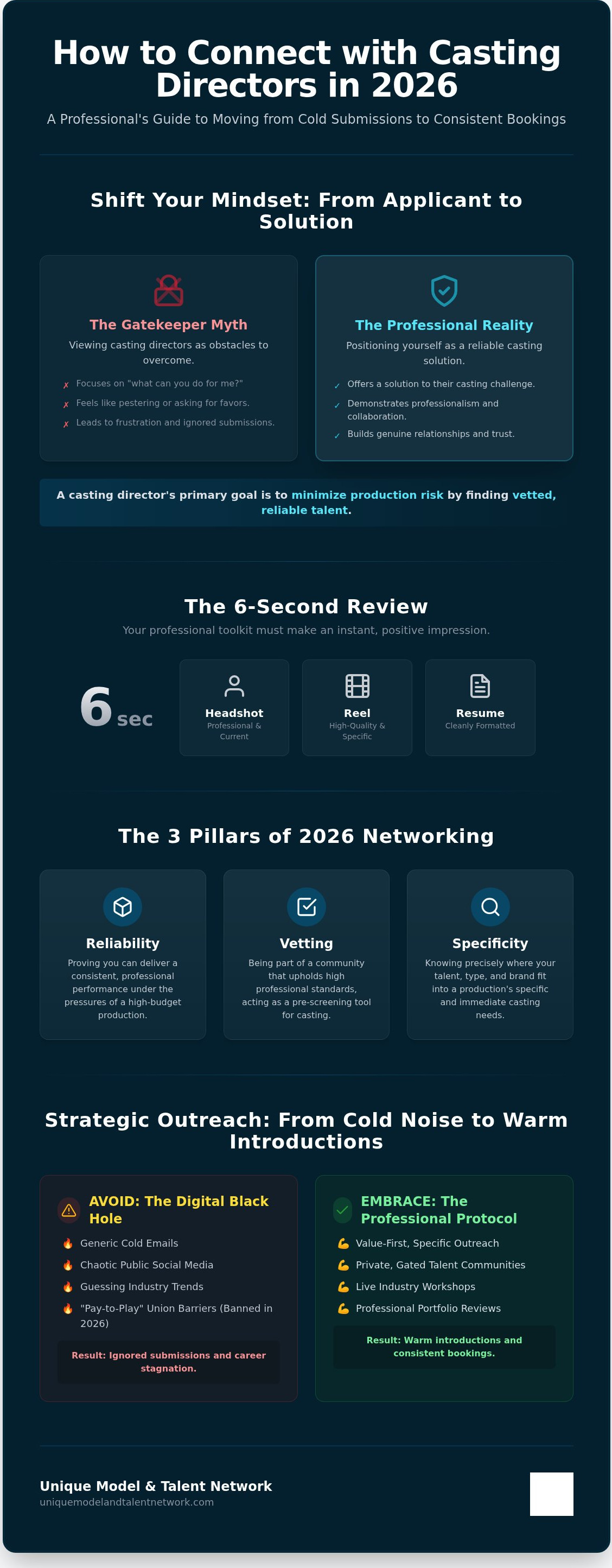
Professional networking in 2026 focuses on three core pillars:
- Reliability: Proving you can deliver a consistent performance under pressure.
- Vetting: Being part of a community that maintains high professional standards.
- Specificity: Knowing exactly where your talent fits into a production's current needs.
The Gatekeeper Myth vs. The Professional Reality
A casting director is a talent curator rather than a gatekeeper. They're actively searching for new faces because discovering a breakout star or the perfect character actor validates their expertise to producers. Fame-seekers often approach these professionals with a "what can you do for me" attitude, which feels like pestering. In contrast, professional talent approaches the relationship as a collaboration. When you show up with high-quality materials and a clear understanding of your brand, you're offering a solution to the CD's current casting challenge.
Vetted Talent: The Industry's New Gold Standard
Being part of a dedicated talent network significantly reduces the perceived risk for a casting office. In an era where social media "clout" is often confused with professional skill, CDs are retreating to gated professional platforms. These communities act as a pre-screening tool, ensuring that the talent they review has the training and materials necessary for a legitimate set. If you're wondering how to connect with casting directors, the answer lies in moving away from public noise and toward these focused, professional spaces. By joining a vetted environment, you signal that you take your career development seriously and are ready for the financial legitimacy of professional bookings.
Optimizing Your Professional Toolkit for Casting Director Reviews
A casting director's workflow is fast-paced and high-volume. When they open your submission, you have exactly six seconds to make an impression before they move to the next candidate. This is why learning how to connect with casting directors begins with a flawless professional toolkit. If your headshot is outdated or your resume is poorly formatted, you've lost the opportunity before it even started. You must present yourself as a polished professional who is ready to step onto a legitimate set tomorrow.
The "Big Three" remain the foundation of your career: your headshot, your reel, and your resume. These aren't just creative expressions; they're business documents. For models transitioning into commercial acting, a modern Comp Card is also vital to showcase versatility across different looks and commercial "types." To ensure your materials meet elite standards, a professional portfolio review for actors is the most effective way to identify and remove amateur red flags that scream "inexperienced" to a busy office.
The 2026 Standard for Self-Tapes and Reels
Modern casting workflows have moved away from the traditional three-minute demo reel. In 2026, casting directors prefer short, high-quality clips that show you in a specific role or "type." If you haven't type-cast yourself, the CD will do it for you, often incorrectly. Your first 10 seconds must establish your presence immediately. Technically, your lighting must be clean and your sound must be crisp; poor audio is the fastest way to get a tape rejected. Focus on naturalism and ensure your performance feels conversational rather than rehearsed. This level of technical discipline shows you're a serious professional rather than a hobbyist.
Digital Presence: Clean, Professional, and Accessible
Consistency is your best friend in a digital-first industry. You must audit your casting websites profiles to ensure your stats, photos, and contact info match across every platform. A busy assistant should be able to find your phone number or agent's email with a single click. Simultaneously, perform a "credibility audit" of your public social media. Remove any unprofessional content that might distract a decision-maker from your craft. If you want to ensure your digital footprint is optimized, consider getting Portfolio & Reel Reviews from industry experts who can help you refine your presentation. Mastering how to connect with casting directors requires this level of meticulous attention to detail.
Strategic Outreach: Moving from Cold Emails to Genuine Relationships
Once your professional materials are optimized, the next step is initiating contact. Most actors fail here because they treat outreach as a transactional request for a job. To stand out, you must adopt a "Value-First" framework. This means reaching out without an immediate "ask." When you provide value—whether it's a genuine compliment on a recent project or a specific insight from a workshop—you transform from a stranger into a professional peer. Mastering how to connect with casting directors requires this shift from a solicitor mindset to a collaborator mindset.
Specificity is your most valuable currency in 2026. Generic emails that say "keep me in mind" are immediately deleted. Instead, reference a specific project the office recently handled or a piece of advice they shared in a public forum. This shows you've done your homework and respect their time. However, respect also means observing professional boundaries. Follow the "No-Weekends" rule; never send professional correspondence on Saturdays or Sundays. While LinkedIn is an excellent tool for tracking career moves, keep direct messages brief and professional. Avoid DMs on personal platforms like Instagram unless the casting director has explicitly invited them.
To maintain your professional reputation, follow the "Rule of Three." You may follow up on an initial outreach up to three times, spaced several weeks apart. If you don't receive a response after the third attempt, stop. Continuing beyond this point moves you from "proactive" to "pestering," which can damage your long-term career prospects.
The Art of the Specific 'Thank You' Note
A well-crafted thank-you note is one of the most underutilized tools for building "warm" industry leads. It shouldn't be a generic platitude. Follow this three-step protocol to ensure your note is remembered:
- Step 1: Identify a specific project the casting director managed or a specific piece of advice they gave during a workshop.
- Step 2: State exactly how that information helped your craft or career development. For example, "Your insight on naturalism in commercial self-tapes helped me refine my latest submission."
- Step 3: Close with a professional signature. Do not ask for an audition or a meeting. The goal is to leave a positive impression, not to demand a favor.
Tracking Your Industry Connections
Success in this field isn't accidental; it's organized. You should treat your career like a business by using a simple CRM or spreadsheet to manage your connections. Track the dates of your outreach, the specific topics discussed, and any feedback received. This system allows you to know exactly when to send a "career update." Valid reasons for an update include booking a significant role, releasing a new reel, or debuting a drastically new look. Even during industry "dry spells," maintaining this log ensures you're ready to restart how to connect with casting directors with a warm history of interaction rather than starting from zero every time.
Leveraging Private Communities and Vetted Industry Platforms
Cold outreach is no longer the primary gateway to a casting office. In 2026, decision-makers are increasingly filtering out the noise of unsolicited emails and social media pings in favor of gated, professional environments. If you want to master how to connect with casting directors, you must move into these private spaces where the industry actually operates. These closed talent networks offer a level of "peer-vouching" that public platforms can't replicate. When you're part of a vetted community, your presence alone signals a baseline of professional competence that a random follower count never will.
The 'Educational Loophole' for Direct Access
Participating in acting workshops online is often the most direct "shortcut" to a casting director's desk. It's a common misconception that CDs only host these sessions for the fee. In reality, they're constantly scouting for fresh, reliable talent to solve their future casting needs. They want to find you as much as you want to find them. If you're looking for how to connect with casting directors without the friction of cold emails, these sessions are your best opportunity. To leave a lasting impression during a live Q&A, you must behave like a professional peer. Instead of asking generic questions about how to get famous, ask about their specific workflow or their perspective on a current industry trend. This elevates your status from a novice to a serious contender. Converting a single workshop interaction into a long-term contact requires referencing a specific takeaway from the session to keep the connection "warm."
Choosing the Right Managed Community
Not every online group provides legitimate value. You must be vigilant against "pay-for-audition" schemes or groups that feel more like hobbyist hangouts than professional accelerators. A high-quality community should be moderated and distraction-free, focusing on tangible growth rather than industry gossip. Look for platforms that offer "Monthly Skill-Building Challenges" to ensure your craft stays sharp for high-level film industry auditions. These environments provide the structure you need to remain "booking-ready" at all times. If you are serious about bypassing the "black hole" of cold submissions, consider joining The Network Membership to gain direct access to the experts who are currently shaping the industry.
Accelerating Your Access via the Unique Model & Talent Network
Most casting platforms focus on sheer volume, encouraging you to apply to thousands of jobs without ever meeting a decision-maker. This "spray and pray" method rarely works because it ignores the fundamental need for trust in the casting process. The Network Membership provides a strategic alternative by shifting the focus from quantity to quality. By hosting our private community on Mighty Networks, we've created a distraction-free environment where serious talent can bridge the gap between their home studio and a professional set. This is the savvy insider's choice for 2026, offering a level of career security that open platforms simply cannot match.
From Aspiring to Vetted: The Member Journey
If you've struggled to get your materials noticed, it's often because you lack a "warm" introduction. The Network serves as that bridge. We prioritize financial legitimacy and high professional standards, ensuring that every opportunity discussed within our community is a genuine step forward for your career. Our Industry Expert Q&A Sessions allow you to receive strategic advice directly from those who sign the checks. This transition from an aspiring performer to a vetted professional is what changes the dynamic of how to connect with casting directors. You no longer approach them as a stranger; you approach them as a member of a respected professional network that values integrity and results.
Your Next Steps: Building Your Connection Strategy
Access is only half the battle; you must be market-ready the moment the door opens. Before you step in front of a CD, use our Portfolio & Reel Reviews to ensure your materials are beyond reproach. These reviews catch the technical errors and "amateur" red flags that often lead to immediate rejection in a busy office. Once your toolkit is optimized, join our next Live Industry Workshops to receive real-time feedback on your performance. This sequence ensures you don't waste your first impression on a preventable mistake. To begin your transition into a professional environment, follow these steps:
- Audit your headshots and reels using our specialized Network resources.
- Join our next Live Industry Workshop to put your face and talent in front of a CD.
- Engage with our Monthly Skill-Building Challenges to ensure you're booking-ready at all times.
If you're ready to stop guessing and start building a sustainable career, Join the Unique Model & Talent Network today to start building real industry connections. Mastering how to connect with casting directors is a professional discipline, but the right community makes the path clear and the results tangible.
Take Command of Your Industry Access
The entertainment landscape in 2026 demands a shift from passive submission to active, strategic engagement. You've learned that mastering how to connect with casting directors isn't about luck; it's about professional readiness and intentional access to the right circles. By optimizing your professional toolkit and prioritizing "warm" introductions over cold emails, you position yourself as a reliable solution for busy casting offices. This professional discipline replaces the anxiety of the unknown with the confidence of a seasoned industry professional.
Success requires moving away from the noise of public social media and into gated spaces where your talent is actually seen. Our private, moderated community provides the structure you need to maintain elite standards and build lasting bonds. Through Live Industry Workshops with active Casting Directors and detailed Portfolio & Reel Reviews, we ensure you're market-ready before the audition even begins. It's time to stop sending your work into a digital void and start building the relationships that define a sustainable career. You have the craft; now you need the connection.
Start Connecting with Industry Insiders—Join The Network Membership
Frequently Asked Questions
How do I find a casting director's email address without being creepy?
Use professional resources like IMDbPro or the Casting Society (CSA) directory to find official office contact information. Avoid digging for personal addresses or using "leak" sites, as this violates professional boundaries. If you find an official submission email, ensure your subject line is specific and professional. Remember that finding the address is only half the battle; your outreach must provide value to avoid being ignored.
Is it okay to message a casting director on Instagram or Facebook?
You should avoid messaging casting directors on personal platforms like Instagram or Facebook unless their profile explicitly invites professional submissions. Respecting digital boundaries is a hallmark of a serious professional. While social media is great for research, it isn't the place for unsolicited pitches. Stick to official office emails or professional networking sites like LinkedIn to keep your interactions within an appropriate business context.
What should I include in a 'keep in touch' email to a casting director?
A "keep in touch" email should be a brief, professional update rather than a request for work. Include a specific career milestone, such as booking a significant guest spot or releasing a new reel. You might also send a specific thank-you note if their previous advice helped you. Always include a professional signature with a direct link to your portfolio so they can view your latest work with one click.
Do casting directors actually watch unsolicited reels sent via email?
Most casting offices receive hundreds of unsolicited emails daily, and many go directly to a "black hole" without being opened. Success in learning how to connect with casting directors usually involves moving beyond cold submissions. They are much more likely to watch a reel if it comes through a trusted recommendation or if they've already met you in a vetted environment like a live workshop.
How often should I follow up with a casting director I've met at a workshop?
Adhere to the "Rule of Three" by sending a thank-you note immediately after the workshop and then following up only when you have a legitimate career update. This might happen every few months. Avoid the trap of "checking in" without providing new information. Each interaction should remind the casting director of your professionalism and your specific "type" without feeling like a burden on their schedule.
Can I connect with casting directors if I don't have an agent yet?
You don't need an agent to begin building industry relationships. Many casting directors actively look for unrepresented talent through private networks and educational workshops to find fresh faces for their projects. However, you must ensure your materials are polished and competitive. Without an agent to vouch for you, your headshot and reel must prove that you are a reliable, "market-ready" professional who understands the business.
What is the biggest mistake actors make when trying to network with CDs?
The most common error is being transactional and asking for a job before establishing a professional rapport. Casting directors prefer to work with talent they trust, so focusing on "getting" rather than "giving" value is a major red flag. Another mistake is sending unvetted materials. If your reel has technical flaws, you've wasted your first impression. Use a portfolio review to ensure your toolkit meets current industry standards.
Are paid workshops with casting directors considered 'pay-to-play'?
Legitimate workshops are educational masterclasses where you pay for instruction and feedback, not for a specific role or audition. Under the 2026 SAG-AFTRA agreement, performers cannot be charged to view casting notices or submit for union projects. However, investing in your craft through workshops is a recognized way to learn how to connect with casting directors. These sessions provide a professional environment to showcase your skills and receive expert guidance.


