

The most talented actor in the room rarely gets the job if their instrument is locked behind a wall of physical tension or mental static. You've likely felt that frustrating disconnect where your preparation is solid, yet you're stuck in your head or struggling with vocal clarity the moment the camera rolls. It's a common barrier that separates hobbyists from professionals who consistently deliver high-stakes performances. Mastering a sequence of professional actor warm-up exercises isn't just about vocalizing; it's about shifting your mindset into a state of readiness that impresses industry decision-makers the moment you walk into the room.
In this guide, you'll discover the reliable, repeatable routines used by industry insiders to sharpen your instrument and eliminate performance-ruining nerves. We're moving beyond basic stretches to focus on the specific physical fluidity and vocal resonance required for the 2026 casting landscape. You'll learn how to build a professional foundation that ensures you're prepared for our Monthly Skill-Building Challenges. By the end of this article, you'll have a clear roadmap to transform your pre-show anxiety into a grounded, booking-ready presence for our Live Industry Workshops.
Key Takeaways
- Establish a reliable physical and vocal foundation using professional actor warm-up exercises that eliminate chronic tension and unlock diaphragmatic power.
- Transition seamlessly into character by utilizing sensory awareness and "Blank Slate" techniques to clear mental distractions before the camera rolls.
- Discover how to adapt your preparation for any environment, including high-energy self-tape techniques and discreet routines for live casting offices.
- Build a psychological anchor that signals to your brain that professional work has begun, ensuring consistent performance quality under pressure.
- Leverage professional feedback and live workshops to refine your instrument and ensure your readiness meets the high standards of 2026 industry leaders.
Why Professional Actor Warm-Up Exercises are Non-Negotiable
Your instrument is a complex synthesis of body, voice, and mind. Professionals don't view these as separate entities; they're a unified tool that requires precise calibration before every use. When you skip actor warm-up exercises, you're essentially walking onto a high-stakes set with an out-of-tune piano. Industry veterans understand that the physical act of warming up triggers a vital psychological shift. It signals to your brain that the personal day is over and the professional work has begun. This mental gate is what allows you to leave your domestic worries at the door and fully inhabit the character's needs.
Casting directors often decide on a talent's suitability within the first ten seconds. They aren't just looking at your face; they're assessing your energy, the lack of physical static, and the ease of your breath. If you're physically tight, your performance lacks the naturalism required for modern screen work. Technical readiness provides the safety net required to take bold, creative risks. Without that foundation, you're too busy managing your own discomfort to truly listen and respond to your scene partner.
Amateur Nerves vs. Professional Presence
Physical tension acts as a thick barrier to authentic emotional connection. When the autonomic nervous system senses a high-pressure environment, it often triggers a fight-or-flight response, leading to shallow breathing and rigid muscles. This physiological reaction effectively locks your emotions away where the camera can't find them. The performance state is a state of relaxed readiness. By using targeted routines, you bypass these survival instincts and regain control over your physical expression, turning nervous energy into focused presence.
The Business Case for Being Prepared
In a professional environment, time is quite literally money. If a director has to wait three takes for you to find your rhythm because you didn't warm up, you're costing the production valuable resources. Being ready to deliver on the first take establishes your brand as a disciplined, reliable talent. This level of preparation significantly improves your hit rate for acting industry networking. When you consistently demonstrate that you're a "plug-and-play" professional, industry decision-makers are far more likely to trust you with high-value opportunities. Consistent use of actor warm-up exercises ensures that your reputation for excellence is backed by tangible, repeatable results.
Physical and Vocal Fundamentals: Tuning the Instrument
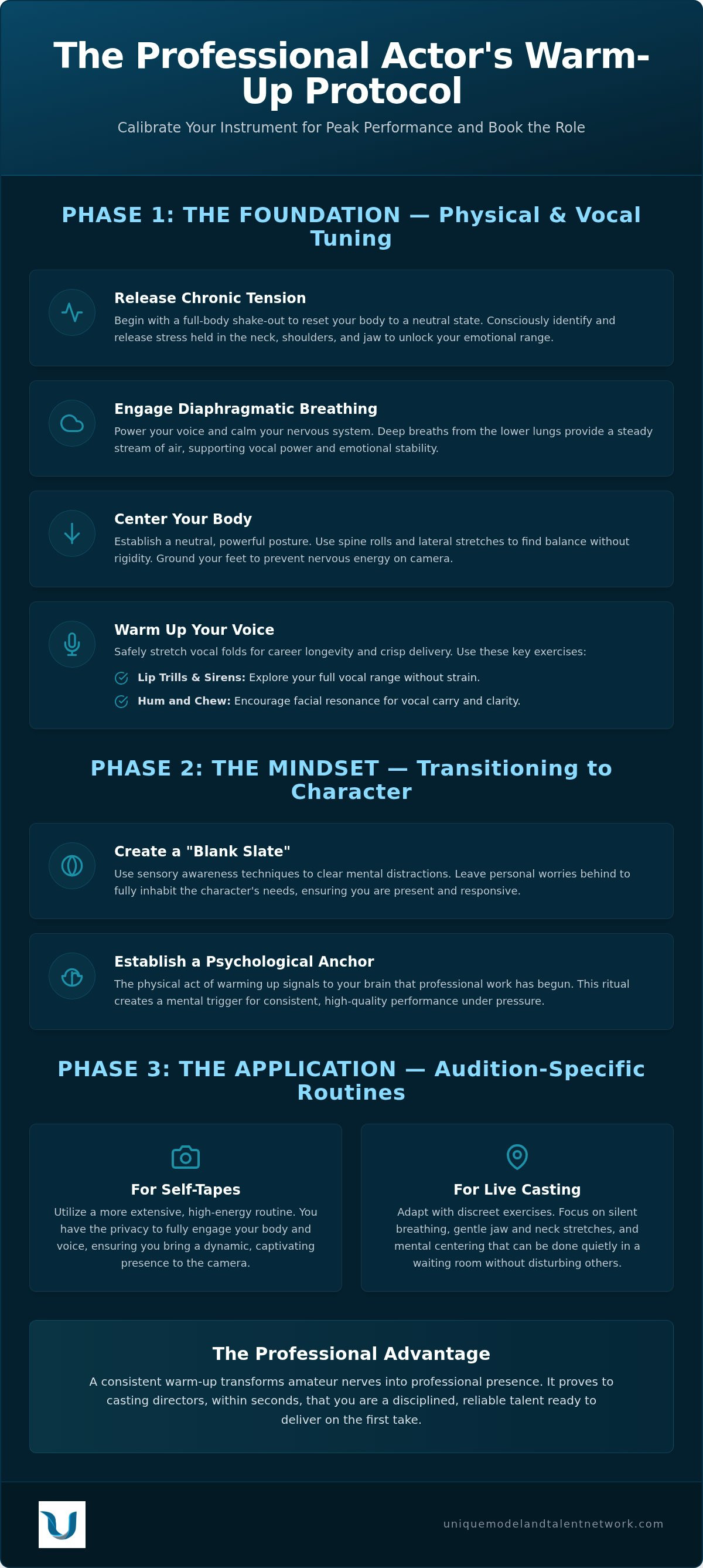
Before you can layer on character choices, you must return your body to a neutral state. Chronic tension often hides in the neck, shoulders, and jaw, acting as a physical mute on your emotional range. A full-body shake-out is the most effective way to reset. Start with your hands, move to your arms, and eventually involve your whole torso. This process isn't just about movement; it's about identifying where you hold stress so you can consciously release it before starting your actor warm-up exercises.
Diaphragmatic breathing is the engine of both vocal power and emotional stability. By engaging the lower lungs, you provide a steady stream of air that supports your voice and calms your nervous system. Once the breath is flowing, move into resonance work. Transition your voice from the back of the throat to the mask of the face. This forward placement ensures your voice carries without strain, making your performance feel intimate yet audible even in large spaces.
Body Alignment and Centering
Professional presence begins with a neutral, powerful posture. Incorporating Alexander Technique basics allows you to find balance without unnecessary rigidity. Use spine rolls to articulate each vertebra and lateral stretches to open the ribcage, creating the physical space required for deeper breath. Grounding exercises, such as focusing on the weight distribution in your feet, prevent the floating or nervous energy that often betrays an actor's lack of confidence on camera.
Vocal Placement and Clarity
Safely stretching your vocal folds is critical for career longevity. Use lip trills and sirens to explore your full range without adding pressure to the larynx. The Hum and Chew method is another industry standard that encourages facial resonance by combining a gentle hum with the physical motion of chewing. These techniques ensure crisp, professional delivery during film industry auditions, where every vocal nuance is captured by sensitive microphones.
Articulation drills are about more than just speed; they're about clarity of thought. Tongue twisters and consonant precision drills train the muscles of your mouth to handle complex dialogue with ease. When your consonants are sharp, your character's intent becomes clearer to the audience. If you're looking to refine these techniques under professional supervision, consider joining the community at Unique Model & Talent Network to get expert feedback on your progress and ensure your instrument is truly booking-ready.
Mental and Emotional Readiness: Transitioning into Character
Once you've tuned the physical instrument, the next layer of actor warm-up exercises focuses on the psyche. You can't inhabit a character's life while still carrying the weight of your own morning. The "Blank Slate" exercise is a professional standard for this transition. Imagine your personal baggage as a coat you're hanging on a hook. This mental clearing creates the necessary space for the character's needs to take root. Sensory awareness further grounds you in the present moment. By identifying three things you can hear, two you can see, and one you can feel, you anchor yourself in the "now," which is the only place true acting happens.
High-stakes scenes require more than just technical precision; they demand emotional elasticity. Use visualization techniques to mentally rehearse the environment of the scene before the director calls "action." This isn't about planning your performance. It's about familiarizing your nervous system with the high-pressure environment so you don't freeze. Try quick-fire emotional drills to access different "colors" of feeling. Moving rapidly from joy to irritation to grief builds the flexibility needed to take unexpected direction during a high-stakes callback.
The Focus Anchor
Maintaining concentration in a chaotic audition room is a hallmark of a professional. Stanislavski’s "Circle of Attention" technique is invaluable here. Start by focusing on a small object close to you, then gradually expand your awareness to the room, and finally pull it back to your immediate surroundings. This process forms a mental focus anchor. You can also use a physical trigger, like pressing your thumb and forefinger together, to signal to your brain that it's time for deep concentration. Incorporating these mental shifts into your actor warm-up exercises keeps you centered regardless of the distractions around you.
Improvisational Spark
Spontaneity is the lifeblood of a booking-ready performance. Solo improv games help you find that spark by encouraging a sense of play and discovery. Try breaking your habitual patterns by deliberately changing your physical tempo or vocal rhythm during a rehearsal. This forces you out of a pre-planned read and into a state of active listening. Play is the antidote to performance stiffness. When you embrace the uncertainty of the moment, you invite the kind of naturalism that casting directors are looking for in 2026.
Audition-Specific Routines: Self-Tapes vs. Live Casting
Professional actors don't use a one-size-fits-all approach. The energy required for a massive soundstage differs wildly from the intimacy of a self-tape shot in your bedroom. Mastering actor warm-up exercises means knowing how to adapt your instrument to the specific technical demands of the medium. If you're in a live casting office, you need a "stealth" routine that prepares you without making you the center of attention in the lobby. Conversely, the isolation of a home studio requires high-energy bursts to overcome the lack of an audience or scene partner. Stealth is key in public, while explosive energy is your best friend when working alone.
The 10-Minute Waiting Room Routine
In a public waiting room, you can't perform a full vocal siren or a vigorous shake-out. Instead, focus on subtle jaw releases and gentle facial massages that look like natural movements. Use isometric tension release by squeezing your leg or glute muscles tightly while seated and then letting them go. This releases physical static without drawing eyes. Box breathing, inhaling for four counts, holding for four, exhaling for four, and holding for four, is a powerful tool for immediate heart-rate regulation. Finish with a mental walkthrough of your scene's first three beats to ensure your focus is sharp the moment you're called into the room.
Self-Tape Energy Management
The camera lens has a way of absorbing energy, often making a natural performance look flat or "dead" on screen. You generally need about 10% more life behind the eyes when filming at home to compensate for the lack of live interaction. Before the camera rolls, engage in brief physical explosions like star jumps or high knees to wake up your body. This is especially vital if you've been sedentary while setting up lights or equipment. Reviewing your acting portfolio before you start helps align your current energy with your professional brand, ensuring consistency in your submissions.
Adapting your volume is equally critical for a professional result. For a microphone, you must prioritize resonance and clarity over theatrical projection. You're speaking to someone inches away, not at the back of a gallery. Use a "Pre-Flight" checklist five minutes before the camera rolls: check your eye-line, verify your framing, and do one final articulation drill. This ritual creates a boundary between the technical setup and the creative performance. If you want to test these specific routines in a professional setting, join our network today to participate in workshops where you can receive direct feedback on your audition readiness from industry experts who understand the nuances of modern casting.
Elevating Your Craft through Community and Feedback
Mastering your instrument in isolation only takes you halfway to a professional career. While solo practice builds the foundation, the true test of your preparation occurs when you step into a communal environment. Engaging in acting workshops online provides a vital mirror for your progress that a bedroom studio simply cannot replicate. It's about moving from the internal comfort of your own space to the external reality of a professional set. In our Monthly Skill-Building Challenges, you take the actor warm-up exercises you've refined and put them to work under the observation of peers and mentors. This transition ensures your routine is actually serving your performance rather than becoming a hollow ritual.
Professional vetting is the bridge between being a talented hobbyist and a working professional. Getting direct feedback on your "readiness" from casting directors allows you to identify blind spots in your preparation. They see things you don't, such as subtle physical habits or vocal inconsistencies that only emerge under pressure. By using a gated, professional network, you ensure that the advice you receive is grounded in the current standards of the 2026 industry. This level of accountability transforms your daily routine into a high-stakes business asset that guarantees you're ready to deliver when the financial stakes are highest.
The Power of Peer Networking
The entertainment industry is often portrayed as a cutthroat competition, but savvy insiders know that community is a catalyst for growth. Participating in communal warm-ups helps break down the artificial barriers of rivalry, replacing them with a shared culture of excellence. Within the Unique Model & Talent Network, you have the opportunity to find a dedicated "warm-up buddy" to maintain your discipline. These professional bonds often lead to referral opportunities, as casting directors frequently rely on trusted talent to suggest prepared and reliable actors. Building a reputation as a talent who is consistently grounded and focused makes you a preferred choice for high-value projects.
Direct Access to Industry Experts
There is no substitute for applying your techniques in a live, high-pressure setting. Our Live Industry Workshops are designed to let you test your actor warm-up exercises in front of active industry pros who make hiring decisions every day. During our expert Q&A sessions, you can ask casting directors exactly what they look for in those first few seconds of an audition. They can often tell if an actor is "cold" or fully present before a single line is spoken. This direct access provides the clarity you need to stop guessing and start booking. To put your training into practice and join a community focused on tangible success, Join the Unique Model & Talent Network today and secure your place among the industry's most prepared talent.
Master Your Readiness for the 2026 Casting Season
Professional success in the entertainment industry isn't accidental; it's the result of a disciplined, repeatable routine that ensures you're ready to perform the moment the camera rolls. You've learned that consistent actor warm-up exercises are the foundation of a booking-ready instrument, allowing you to bypass nerves and inhabit your character with authenticity. Whether you're adapting your energy for the intimacy of a self-tape or maintaining focus in a crowded waiting room, your preparation is what signals your professional standards to casting directors.
Consistency is easier to maintain when you have a moderated, private community of serious professionals to support your growth. You don't have to navigate this journey alone. Our Monthly Skill-Building Challenges are specifically designed to help you build your resume while receiving direct access to casting directors and photographers who can vet your progress. If you're ready to test your skills, join the Unique Model & Talent Network today and start putting these techniques into practice. Your next high-stakes performance starts with the work you do before you ever step into the room. We're here to help you turn that preparation into a sustainable, thriving career.
Frequently Asked Questions
How long should a professional actor's warm-up take?
A comprehensive session typically requires 20 to 30 minutes to fully engage the body, voice, and mind. Professionals often break this down into ten minutes of physical release, ten minutes of vocal placement, and ten minutes of mental grounding. If you're short on time, a condensed five minute version can work for immediate focus. You can practice these timing variations during our Monthly Skill-Building Challenges to see what best prepares your instrument for high-stakes work.
Can I warm up my voice without making too much noise in an apartment?
You can effectively engage your resonance through low-volume techniques like lip trills and humming. These actor warm-up exercises focus on vibration and placement rather than volume. Another professional method involves vocalizing through a narrow straw into a glass of water; this provides back-pressure to stretch the vocal folds safely without disturbing neighbors. This ensures you're ready for our Live Industry Workshops even if you live in a shared space with thin walls.
What are the best tongue twisters for actors to improve diction?
Focus on drills that target specific articulators like the lips, teeth, and tongue. Classic choices include "The lips, the teeth, the tip of the tongue" for general clarity or "Unique New York" for shifting resonance. For plosive precision, try "Peter Piper picked a peck of pickled peppers." These aren't just games; they're essential tools for crisp delivery in film industry auditions. We frequently vet these articulation skills during our Portfolio and Reel Reviews.
Should I warm up differently for a comedy vs. a drama audition?
Your physical preparation should reflect the tempo-rhythm of the genre. Comedy often requires a higher physical energy and faster mental reflexes, so focus on explosive movements and rapid-fire improv games. Drama might require more grounding and deep diaphragmatic breathing to access emotional depth. Regardless of the genre, the goal is to reach a state of relaxed readiness. You can test these different energetic approaches in our expert Q&A sessions with casting directors who specialize in various genres.
How do I warm up my emotions without feeling drained before the scene?
Focus on emotional elasticity rather than deep immersion. Instead of trying to feel the full weight of a tragedy, use quick-fire drills to touch on different colors of feeling for a few seconds each. This builds a pathway to the emotion without exhausting your psychological reserves. This method keeps you fresh for multiple takes or long workshop sessions. It's a professional technique we emphasize to prevent burnout in our gated community of serious talent.
Is it possible to over-warm up and lose my spontaneity?
Spontaneity is lost when your routine becomes a mechanical ritual rather than a tool for presence. If you feel like you're performing the warm-up, you've gone too far. The goal is to reach a neutral state, not a pre-planned read. Keep your actor warm-up exercises varied to prevent your brain from going on autopilot. Spontaneity comes from being fully grounded in the moment, which is exactly what we practice during our live, interactive workshops.
What should I do if I feel a panic attack coming on before an audition?
Immediate physiological intervention is necessary to reset your nervous system. Use the 5-4-3-2-1 sensory grounding technique: identify five things you see, four you can touch, three you hear, two you smell, and one you can taste. Combine this with box breathing to lower your heart rate. These tools provide clarity in an uncertain field and are a core part of the professional development we advocate for within our private, moderated network of industry professionals.
How often should I change my warm-up routine?
Keep your core physical and vocal fundamentals consistent, but rotate the specific drills every few weeks to keep your mind engaged. If a routine feels stale, your body will stop responding to the "work has begun" signal. Introducing new tongue twisters or improv games ensures you stay sharp and adaptable. Our members often share new techniques and accountability tips within the Network Membership to ensure their preparation remains elite and effective for current industry standards.


