

Does your current resume command respect, or does it signal that you're still learning the basics? In a field where first impressions happen in a heartbeat, your credits need to do more than just exist; they must perform. If you've ever worried that your lack of professional credits makes you look like an amateur, or if you've struggled to reconcile the formatting differences between the New York and LA markets, you aren't alone. Most performers feel that same uncertainty when they try to fit their unique journey into a rigid box. Using a professional actor resume template 2026 ensures your document meets the high standards of modern casting directors while keeping the focus on your craft.
We're here to provide the clarity you need to move from "aspiring" to "established." This guide will show you how to master the "6-second casting director test" and leverage your training to build immediate trust, even if your resume is currently light on major roles. We'll explore the essential shift toward digital optimization and provide a clean, industry-standard layout that grows as your career accelerates. By the end of this article, you'll have a roadmap to create a high-conversion marketing document that turns digital scans into real-world auditions.
Key Takeaways
- Understand the mandatory shift from physical headshot staples to digital PDF attachments to align with modern casting workflows.
- Select an actor resume template 2026 that prioritizes industry-standard formatting over superficial design to ensure your credits remain the focus.
- Master the professional three-column grid for your credits to pass the critical "6-second test" used by top talent evaluators.
- Integrate tech-forward features like QR codes and clickable links to connect your training directly to your digital performance reel.
- Learn how to identify "resume blindness" and why professional feedback is necessary to transform a basic template into a booking tool.
The Evolution of the Actor Resume in 2026
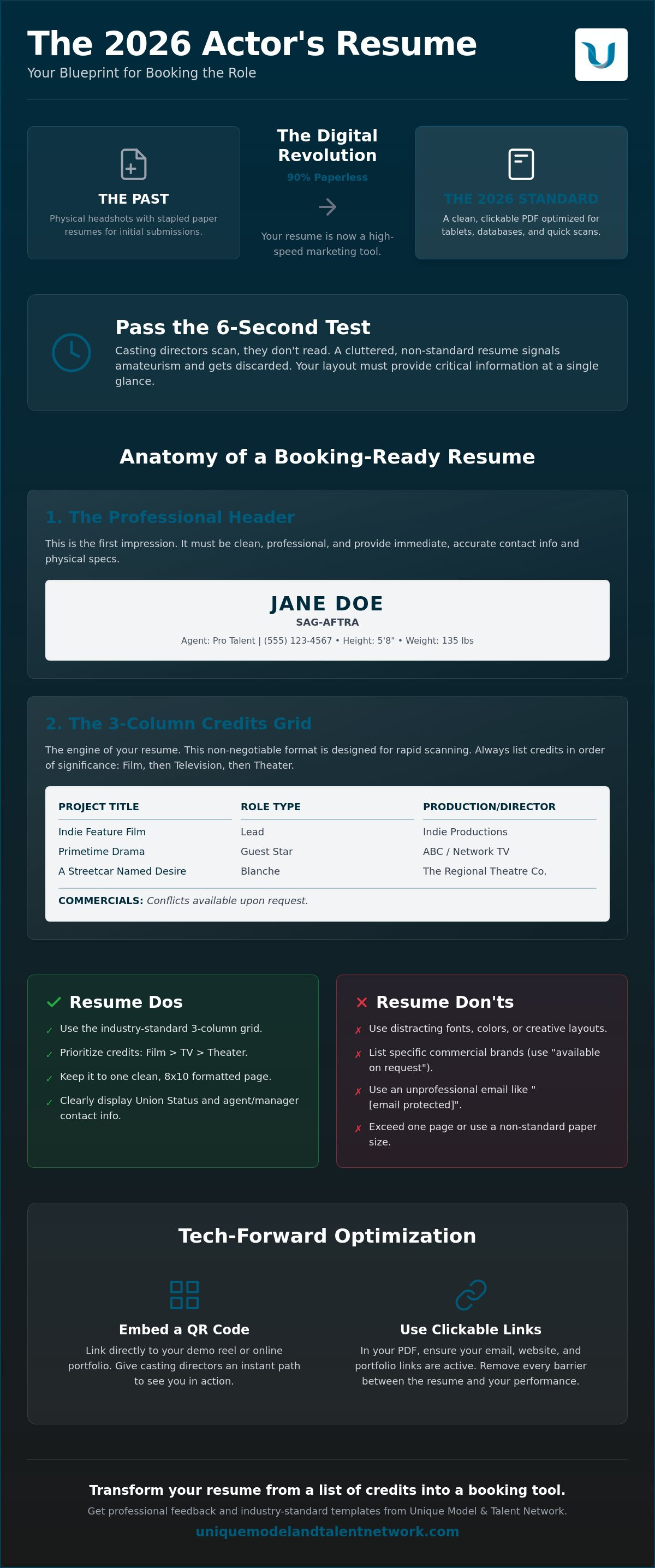
In 2026, your resume isn't just a list of jobs; it's a high-speed marketing tool designed to convert interest into auditions. By definition, a professional actor's resume is a concise, one-page summary of your physical specs, credits, and training. The evolution of the modern resume has moved us decisively away from the era of stapling paper to the back of 8x10 headshots. Today, your primary document is a digital PDF attachment optimized for database searches and tablet viewing. This shift demands a specific type of actor resume template 2026 that remains legible on mobile devices while maintaining the classic professional aesthetic casting directors expect.
Casting offices are processing more submissions than ever before. This high-volume digital environment has made the "6-second rule" more critical than it was a decade ago. If your layout is cluttered or uses non-standard fonts, you'll likely lose your shot before they even click on your reel. Think of this document as the essential bridge to your digital portfolio. It acts as the high-level summary that earns you a deeper look, providing the technical validation that you have the training and experience to handle the demands of a professional set.
Digital vs. Physical: Do You Still Need a Hard Copy?
Even though 2026 casting workflows are 90% paperless, you can't abandon the "printable" mindset. Casting professionals often view your PDF on tablets during a session, and they expect the document to conform to the traditional 8x10 format. If a producer decides to print your materials for a final selection meeting, a non-standard size or messy layout will immediately signal a lack of industry knowledge. You should still carry physical copies for theater auditions, network callbacks, and episodic guest spots. In these high-stakes environments, having a tactile reference for a director can still make a significant difference in the room.
The 2026 Industry Standard Layout
A professional actor resume template 2026 follows a strict hierarchy of information to ensure efficiency. Your header must include your name, union status, and professional contact info. If you have an agent or manager, their branding and contact details should be the most prominent way to reach you. Physical specs like height and weight remain vital; they inform costuming departments and camera framing before you ever step on set. Organize your credits using this prioritized order:
- Film: List the project title, your role type (Lead, Supporting), and the production company or director.
- Television: Distinguish clearly between Series Regular, Guest Star, and Co-Star roles.
- Theater: Include the play, your character name, and the venue or theater company.
- Commercials: These are generally listed as "Available upon request" to avoid potential conflicts of interest with competing brands.
By sticking to these established standards, you show casting directors that you are a disciplined professional who values their time and understands the business of acting.
Anatomy of a Booking-Ready Resume: Section-by-Section
A professional resume is more than a list; it's a technical specification sheet that tells a casting director exactly where you fit in their production. Your contact header must prioritize efficiency and clarity. If you're using a personal email address like "[email protected]," you're signaling a lack of professional awareness. Use a clean, name-based email or, ideally, your agency's contact information. Agency branding acts as a seal of approval, but until you have it, your own professional presentation must carry that weight. Ensure your union status is clearly visible next to your name to help recruiters immediately categorize your submission.
The credits grid is the engine of your resume. While you might be tempted to use creative layouts found in Backstage's acting résumé templates, you must adhere to the three-column standard: Project Title, Role Type, and Production Company or Director. This structure allows a casting director to scan your history in seconds. If you find yourself struggling to organize these columns or need a second pair of eyes on your layout, participating in Portfolio & Reel Reviews can provide the professional feedback necessary to ensure your document meets elite standards. Training and education should follow your credits, highlighting reputable studios and specific teachers to validate your technical foundation.
Categorizing Credits Like a Pro
Precision in your credit descriptions builds immediate trust with talent evaluators. In film, distinguish clearly between Lead and Supporting roles. "Featured" roles should be used sparingly, and background work should never appear on a professional resume once you've moved beyond the entry level. For television, the industry relies on specific designations: Series Regular, Guest Star, and Co-Star. Mislabeling a Co-Star role as a Guest Star is a major red flag for casting directors. In the theater section, list the production, your character name, and the venue or theater company to provide context for the scale of the performance.
The Special Skills "Secret Weapon"
In 2026, casting directors use digital filters to find specific abilities. Avoid the "Canva Trap" of using progress bars or star ratings to show your skill level; these are meaningless to a recruiter. Instead, list concrete abilities like "Fluent Spanish," "Advanced Stage Combat," or "Professional Horseback Riding." For performers who also maintain backgrounds in healthcare, noting specialized knowledge from PharmEDU can provide a unique edge for technical medical roles. Your most valuable assets are often your "Valid Passport" and "Driver’s License," as these have direct financial implications for production travel and insurance. Never pad this section with hobbies like reading or hiking. If you can't perform the skill on camera today without a rehearsal, it doesn't belong on an actor resume template 2026.
Design vs. Function: Choosing the Right Actor Resume Template
Your resume is a professional marketing tool, not a graphic design project. Many performers fall into the "Canva Trap" by selecting templates with distracting borders, progress bars, or colorful icons. While these might look impressive on a social media feed, they often signal a lack of industry experience to a seasoned casting director. In 2026, the most effective actor resume template 2026 is one that prioritizes function over fashion. If a recruiter has to hunt for your training or struggle to read your credits because of a background texture, they'll move to the next candidate without hesitation.
Readability is the cornerstone of a booking-ready document. You must choose fonts that are universally compatible across all PDF viewers and mobile devices. San-serif options like Helvetica, Arial, or Calibri are industry favorites because they remain crisp even when viewed on a smartphone during a busy production day. Adhering to the "Clean Space" rule is equally vital. A crowded resume with tiny margins and microscopic text suggests you're trying to hide a lack of experience behind a wall of words. Embracing white space demonstrates confidence and shows that you value the casting director's time by making your key achievements easy to scan.
The Argument for Plain Text and Minimalism
Casting professionals overwhelmingly prefer a traditional aesthetic: black text on a crisp white background. This isn't just about tradition; it's about technical efficiency. Modern casting databases use optical character recognition (OCR) to scan your materials. If your PDF isn't searchable for keywords like "Spanish Speaking" or "Stage Combat," you'll miss out on filtered searches. You should also avoid placing a photo on the resume itself. Your headshot is a separate, high-resolution file; putting a low-quality thumbnail on your resume only takes up valuable real estate and looks amateurish.
When (and How) to Use a Visual Template
There are rare instances where a subtle visual flare is acceptable. If you're primarily pursuing voiceover or high-end commercial work, a slightly more modern layout can reflect your personal brand. You might use a single accent color for your name or section headers that matches the tone of your "type." However, even in these creative markets, your contact info must remain the most prominent element on the page. If you're moving between theatrical and commercial markets, consider maintaining two versions of your actor resume template 2026. This allows you to tailor the hierarchy of your credits to match the specific expectations of each field without compromising your professional standing.
Tech-Forward Optimization: QR Codes, AI, and Links
AI-friendly formatting is another critical component of the modern submission process. Many casting websites now use automated parsing tools to extract data from your resume and populate your profile. If your document uses complex tables, images, or unusual fonts, these systems will fail to read your experience correctly. Stick to clean, text-based layouts that prioritize clarity over decoration. Additionally, pay close attention to your file naming conventions. Sending a file named "Resume_Final_2.pdf" suggests a lack of organization. Use a professional format like "Firstname_Lastname_Resume_2026.pdf" to ensure your name is always associated with your talent in a recruiter's downloads folder.
The QR Code Strategy for 2026
While digital submissions are the norm, QR codes provide a vital link when your resume is printed or viewed on a secondary device. Place your QR code in the top right corner or near your contact information for maximum visibility. This code must lead to a mobile-optimized landing page, such as your professional website or a direct link to your reel on YouTube or Vimeo. The optimal QR code size is 0.75 inches for print readability. This ensures the code is large enough to scan easily without cluttering your layout or distracting from your credits.
Syncing with Casting Databases
Your resume shouldn't exist in a vacuum. It must be perfectly synchronized with your profiles on Actors Access and other major industry databases. Consistency in your "Type" branding across all digital platforms builds a reliable professional identity that casting directors can trust. If your resume lists you as a "Leading Man" but your digital profiles show "Character Actor" headshots, you create confusion that leads to missed opportunities. Include a "Last Updated" date in small text at the bottom of your document. This simple addition proves to casting directors that your materials are current for the 2026 season.
If you're ready to elevate your digital presence and ensure your materials are truly industry-ready, consider joining The Network Membership for exclusive access to advanced career strategies.
Beyond the Template: Getting Your Resume Reviewed by Pros
Even the most polished actor resume template 2026 is only fifty percent of the battle. The remaining half depends entirely on your strategy and how you position your unique value within the market. Many performers suffer from "resume blindness," a common condition where you've looked at your own credits for so long that you can't see the structural weaknesses or missed opportunities. You might think your layout is clear, but a casting director sees a missed credit or a confusing training entry. This is why an outside, professional perspective is non-negotiable for those serious about booking. Your resume serves as the ultimate tool for both modeling career coaching and acting growth. It's the technical document that proves you're ready for the opportunities you're chasing.
The Power of the Unique Model & Talent Network
Our community is designed to provide the gatekeeper feedback that is usually impossible to find on your own. Members get direct access to active industry experts who review their materials with a professional eye. If you have "empty" sections on your resume, our Monthly Skill-Building Challenges help you gain the specific experience needed to fill those gaps. Unlike public social media groups where advice is often unverified or toxic, our vetted community offers a protective space focused on tangible success and professional bonds. We act as a reliable bridge between emerging talent and established industry professionals, ensuring your career development is grounded in reality rather than vanity.
Your Next Steps: From Template to Booking
If you're ready to move from a static template to a dynamic career, your next step is to join the Network. This gives you exclusive access to acting workshops online where you can sharpen your craft and update your training section in real-time. Before your next major submission, take advantage of our Portfolio & Reel Reviews. Having an expert verify your actor resume template 2026 ensures you're sending out a high-conversion document every time. Your resume is a living document. Keep it growing, keep it accurate, and keep yourself surrounded by those who want to see you succeed. The door is open for those who are serious about their craft; it's time to step through it.
Command the Room Before You Enter It
Mastering your professional presentation is the first step toward career security in an increasingly digital industry. You've learned that a successful actor resume template 2026 must balance technical optimization with industry-standard minimalism. By prioritizing searchable text, mobile-ready layouts, and tech-forward features like QR codes, you ensure that your credentials are seen and respected by high-level recruiters. Your resume is a living document that should evolve alongside your training and your booking history.
Don't let "resume blindness" or outdated formatting hold you back from the roles you deserve. If you're ready to move beyond the template and receive direct feedback from the gatekeepers themselves, Join the Unique Model & Talent Network for Professional Resume Reviews. Our members enjoy direct access to Casting Directors and thrive within a private, moderated community on Mighty Networks. You'll also have the opportunity to tackle monthly skill-building challenges designed to grow your credits and build professional bonds that last. Your craft deserves a platform that matches your ambition. We're here to provide the clarity and access you need to turn your potential into tangible success.
Professional Actor Resume FAQs
How do I list experience on my acting resume if I have no credits yet?
Focus on your training and education sections to demonstrate your technical foundation. If you lack professional credits, move your Training section to the top of your actor resume template 2026 to showcase your preparation. List specific studios, renowned teachers, and the duration of your studies. This signals to casting directors that you're disciplined and ready for a professional set despite a light credit list.
Should I include background or "extra" work on my professional acting resume?
Omit background or extra work from your professional credits list to avoid signaling an amateur status. While background work is a great way to learn how a set functions, it doesn't count as a professional acting credit. If you're just starting, focus on student films or independent projects instead. Once you've secured your first principal role, any remaining background references should be removed immediately.
Do I need a different resume for commercials and theatrical film/TV?
Maintain two distinct versions of your resume to cater to different market expectations. A theatrical resume focuses on your character types in film, television, and stage productions. In contrast, a commercial resume often lists "Commercials available upon request" to prevent conflicts with competing brands. This strategy keeps your document clean and professional while protecting your eligibility for future high-paying campaigns.
Can I use a two-page resume if I have a lot of experience?
Adhere to the strict one-page limit regardless of your career length or volume of experience. Casting directors process hundreds of submissions daily and won't flip to a second page. If your experience is extensive, prune older or less relevant credits to make room for your most impressive recent work. A high-impact, single-page document is always more effective than a multi-page biography.
Should I list my home address on my acting resume for safety?
Never list your full home address on your resume for both safety and professional reasons. In the digital age, your city and state are sufficient for residency requirements. Professional communication should always flow through your talent agent or a dedicated professional email address. This practice protects your privacy while maintaining a clean, industry-standard header that focuses on your contact details.
How often should I update my acting resume in 2026?
Refresh your document immediately following any new booking, training milestone, or significant change in your physical appearance. Even if you haven't added a new credit, update the "Last Updated" date at the bottom of the page every few months. This small detail proves to casting directors that you're an active, engaged professional who is consistently working on their craft and professional development.
What is the best file format to send my resume to a casting director?
Utilize the PDF format as your absolute standard for digital submissions to ensure your actor resume template 2026 retains its layout. Word documents and other editable formats can shift or lose formatting when opened on different devices or tablets. A PDF guarantees that your columns stay aligned and your fonts remain legible, providing a consistent experience for every casting professional who views your file.
Do I need to include my high school or college GPA on an acting resume?
Exclude academic metrics like GPA from your professional acting materials. Casting directors are interested in your ability to perform and your technical training, not your classroom grades. List your degree or certificate and the institution where you studied, but keep the focus on performance-related achievements. Your resume is a marketing document for your talent, not an academic transcript.


