
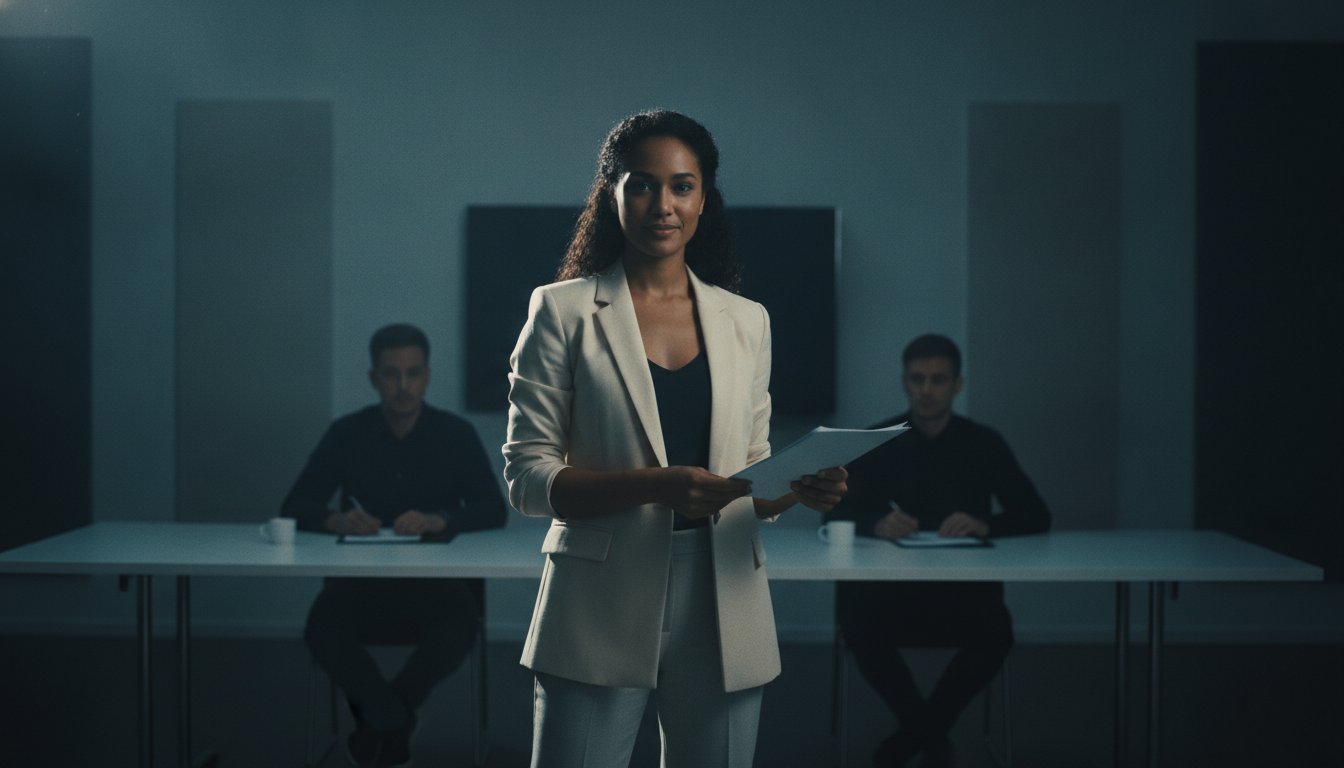
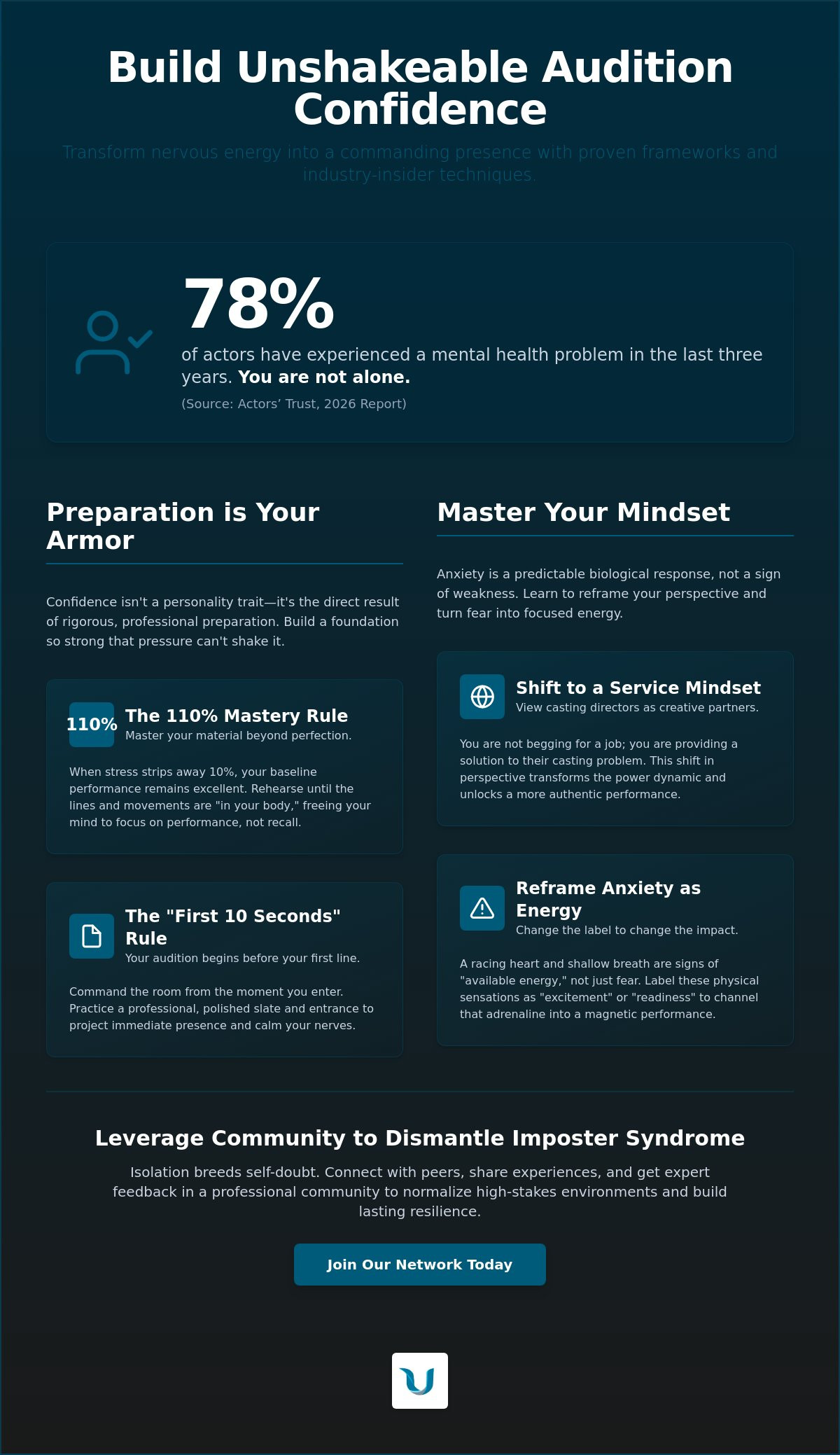
Did you know that a 2026 report from the Actors’ Trust found that 78% of actors have experienced a mental health problem in the last three years? If you've ever felt your hands shake while holding a script or watched your lines vanish the moment you stepped into the spotlight, you aren't alone. It's easy to feel like an imposter when you're overthinking every look from a casting director, but these physical symptoms don't have to define your career.
Learning how to build confidence for auditions isn't about waiting for the fear to disappear; it's about replacing uncertainty with professional preparation. This guide will show you how to transform that nervous energy into a commanding presence through proven mental frameworks and industry-insider techniques. We'll walk through establishing a repeatable pre-audition routine and shifting your perspective so you can finally see casting directors as your creative partners rather than judges. You're about to discover how to maintain total control over your physical and vocal performance every time you enter the room.
Key Takeaways
- Replace situational nerves with competence-based confidence by mastering your material at 110% to ensure your performance remains steady under pressure.
- Discover how to build confidence for auditions by adopting a service mindset that positions you as the solution to a casting director's problem.
- Master the "First 10 Seconds" rule to command the room through a professional entrance and a polished slate that projects immediate presence.
- Leverage community feedback and Industry Expert Q&A Sessions to dismantle the feeling of being an outsider and normalize high-stakes environments.
- Shift your perspective to view decision-makers as creative partners rather than judges to unlock a more natural and authentic performance.
Understanding Audition Anxiety: Why We Lose Confidence
Audition anxiety isn't a sign that you lack talent or belong elsewhere. It is a predictable biological response to social evaluation. When your heart rate spikes, your body is simply flooding your system with the energy required for a high-stakes task. By Understanding Performance Anxiety, you can stop viewing these sensations as a threat. Learning how to build confidence for auditions begins with accepting that these feelings are a natural part of the professional landscape.
Imposter syndrome tends to thrive in the vacuum of isolation. When you work alone, it's easy to believe that every other actor has it figured out while you're just faking it. This self-sabotaging narrative is a common side effect of the "spotlight effect." You feel like your flaws are being magnified under a microscope. Actually, casting directors are your allies; they want you to be the solution to their casting problem. They're looking for a professional who can handle the pressure of a set, and showing up despite your nerves is the first step in proving you're that person.
It's vital to distinguish between situational nerves and a lack of professional readiness. If you're shaking because you haven't mastered your sides, that's a signal that your preparation needs work. However, if you've done the work and still feel the buzz of adrenaline, that's "available energy." You can learn to channel that intensity into your character's objectives or a model's pose. This shift turns a potential distraction into a magnetic performance tool.
The Biology of the Audition Room
Adrenaline is a double-edged sword. It can sharpen your focus, but it can also tighten your vocal cords and shorten your breath. This physical tension often stems from the fear of judgment. Cognitive reframing allows you to label these sensations as "excitement" or "readiness" rather than "fear." When you change the label, you change the physical impact. To master these mental shifts and achieve professional growth, you can discover Toby and Kate McCartney for expert NLP training. Practicing deep, diaphragmatic breathing also helps override the fight-or-flight response, giving you back control over your instrument before you even speak your first line.
Identifying Your Personal Anxiety Triggers
Identifying your specific triggers is the first step toward neutralizing them. Some performers feel unshakeable until they see a camera lens; others find the silence of a waiting room unbearable. I recommend keeping a "confidence journal" to track your successful auditions and the specific techniques that worked. This record serves as tangible proof of your competence, which is the most effective way to build confidence for auditions over the long term. Distinguishing between a lack of talent and a temporary gap in technique ensures that you address the right problem without damaging your self-esteem.
Preparation Techniques for Building Audition Confidence
Confidence is often mistaken for a personality trait, but in this industry, it's a byproduct of rigorous preparation. When you understand how to build confidence for auditions, you realize it's less about "feeling brave" and more about being so prepared that your performance becomes bulletproof. Professional Preparation Techniques for Auditions emphasize that mastery of the material is the only true cure for the "blanking" that happens when adrenaline hits. If you only know your lines 90%, the stress of the room will strip away that remaining 10%. You need to aim for 110% mastery so that your baseline performance remains excellent even under extreme pressure.
The "First 10 Seconds" rule is a game changer for mastering the room. Your audition begins the moment you enter the space or click "record" on a self-tape. Casting directors often make an initial assessment during your slate; that brief introduction where you state your name and agency. By practicing your entrance and your slate until they are effortless, you project a professional presence that settles both your nerves and the expectations of the room. For models, this translates to "blind" confidence in your walk and posing. You shouldn't have to think about where your hands go; muscle memory should handle the mechanics while your mind focuses on the energy you're projecting.
The 110% Rule for Script and Pose Mastery
Rehearsing until the words are "in your body" means moving beyond passive reading. Active rehearsal involves saying the lines while doing chores, walking, or dealing with distractions. This builds the muscle memory required to prevent memory loss during high-pressure scenes. Many professionals use acting workshops online to test their material in front of a live audience before the actual casting date. This "stress-testing" of your material ensures that your choices are bold and sustainable.
Self-Tape Confidence: Mastering the Digital Room
Psychological Shifts to Boost Confidence for Auditions
Confidence in the audition room isn't a feeling you wait for; it's a mental posture you adopt. Most performers walk into a room asking themselves, "Do they like me?" This question is a trap that immediately hands your power to the people behind the table. Realizing Building Confidence in the Audition Room starts with a fundamental shift in perspective. You aren't there to be judged; you're there to collaborate. When you stop seeking approval, you start projecting authority.
One of the most effective ways to understand how to build confidence for auditions is to view casting directors as creative partners rather than judges. They're actually your biggest fans before you even speak. Every time a new person walks through that door, the casting team is thinking, "Please be the one." They're exhausted and want their search to end. When you show up as a professional peer who is ready to work, you relieve their stress. This partnership mindset removes the "us vs. them" dynamic that fuels performance anxiety.
Authority also comes from the "Power of the Choice." Indecision is the enemy of presence. If you're trying to guess what they want, your performance will be hesitant and vague. A bold, specific choice signals that you trust your instincts and your craft. Even if they ask for a redirection, your initial commitment proves you can lead a scene. This is why a pre-performance ritual is so vital. Whether it's a specific breathing exercise or a power pose in the hallway, you need an anchor to transition from the "waiting room" mind to the "creative" mind.
The Problem-Solver Mentality
Casting directors have a vacancy in their project, and your job is to fill it. Identifying the "gap" in the script that your unique essence fills turns you into a solution. If you focus on "trying to be right," you'll end up being forgettable. Professionals don't try to be right; they try to be specific. The Service Mindset is the ultimate audition hack, shifting your focus from seeking approval to providing a professional solution.
Visualizing Success vs. Visualizing the Process
Don't just imagine the booking or the fame. Instead, visualize the perfect execution of your routine. Imagine yourself handling a technical glitch or a sudden distraction with grace. In the five minutes before you enter, use grounding exercises to stay present. Feel your feet on the floor and focus on the rhythm of your breath. By focusing on the process of the performance rather than the outcome of the job, you keep your nervous system regulated and your mind sharp.
The Role of Community and Feedback in Resilience
Isolation is the fastest way to lose perspective in this industry. When you work in a vacuum, your inner critic becomes the only voice you hear, often magnifying minor mistakes into career-ending flaws. Building a "resilience network" is a strategic necessity for surviving the inevitable rejection cycles of film industry auditions. By connecting with a vetted community of peers, you realize that your struggles aren't unique. This shared experience strips away the "outsider" feeling and replaces it with a sense of professional belonging.
One of the most effective strategies for how to build confidence for auditions is to engage in "exposure therapy" within a safe space. Performing for a supportive group of professionals before you face decision-makers allows you to desensitize your nervous system. You learn to handle the heat of the room without the stakes of a real booking on the line. This environment provides the clarity you need to refine your craft, ensuring that you walk into your next casting with a proven, battle-tested performance.
Networking with industry insiders further removes the intimidation factor of the business. When you speak with professionals who have seen thousands of auditions, you begin to understand the "Business of Casting." You'll quickly learn that a "no" is often about logistics, such as height requirements or scheduling conflicts, rather than your worth as an artist. This objective reality is the ultimate shield against the emotional drain of the industry. If you're ready to stop guessing and start growing, join the Network Membership today to connect with mentors who can guide your path.
The Power of Peer Review
Seeing others struggle and succeed humanizes the industry. It’s easy to put top-tier talent on a pedestal, but peer review shows you the work that goes on behind the scenes. For those in the fashion sector, modeling career coaching provides the objective, non-emotional feedback required to sharpen your presence. This type of professional critique is far more valuable than the vague praise of friends or the unorganized comments found on social media.
Demystifying the Casting Director
Q&A sessions with real casting pros take the "teeth" out of the audition room. These interactions reveal that casting directors are simply people trying to do their jobs well. They value efficiency, integrity, and talent. Understanding their needs helps you present yourself as a reliable solution to their problems. Additionally, maintaining a professional acting portfolio serves as a badge of legitimacy. It signals to everyone in the room that you are a serious professional who respects the standards of the craft.
Leveraging Unique Model & Talent Network for Unshakeable Confidence
Mastering the room requires more than just reading about techniques; it requires a structured environment where you can practice without the fear of public failure. The Network Membership provides exactly that. By offering a private, moderated space away from the chaotic noise of general social media, we allow you to focus entirely on your professional business development. This is where the theory of how to build confidence for auditions meets the reality of consistent, high-level practice. You need a gated community that prioritizes your growth over vanity metrics.
Direct access to Industry Expert Q&A Sessions is one of the most powerful tools for dismantling the "intimidation factor" mentioned in previous sections. When you regularly interact with casting directors and veteran talent in a professional setting, you realize they're partners in your success. This familiarity breeds a quiet authority. You stop walking into rooms as a supplicant and start walking in as a colleague. Additionally, our Monthly Skill-Building Challenges are designed to turn "scary" tasks into routine habits. Whether it's mastering a new technical setup for a self-tape or practicing a difficult cold read, these challenges provide the repetition needed to build true muscle memory. By the time you face a real decision-maker, the task feels familiar because you've already conquered it within our supportive environment.
From "Aspiring" to "Professional" through Accreditation
Participating in Live Industry Workshops isn't just about learning; it's about building a resume of confidence. There is a profound psychological shift that occurs when you join a vetted community. It signals to yourself and the industry that you're serious about your craft and your career security. In 2026, acting industry networking platforms have become the modern standard for career growth. They provide a level of concentrated focus and professional bond-building that general platforms simply cannot match.
Your Next Steps to Audition Mastery
To achieve total audition mastery, you must integrate the triad of preparation, mindset, and community. Preparation ensures your material is bulletproof even under the highest pressure. Mindset ensures your focus remains on solving the casting director's problem rather than seeking their approval. Community ensures you have the resilience and feedback loop required to stay in the game. Remember that knowing how to build confidence for auditions is a continuous process. Confidence is a muscle, not a gift. It must be trained, tested, and reinforced through expert mentorship and peer support. Join the community that builds careers through high standards and start your journey toward unshakeable professional presence today.
Master Your Next Audition with Professional Authority
Confidence isn't a personality trait you're born with; it's a professional skill you build through rigorous preparation and the right mental frameworks. By mastering the first ten seconds of your entrance and shifting your focus to becoming a problem-solver for the casting team, you reclaim your power in the room. Understanding how to build confidence for auditions requires moving beyond isolation and into a space where your craft is tested and validated by experts. You've learned that preparation is the only true cure for nerves and that a service mindset turns a judge into a creative partner.
You don't have to navigate this complex industry alone. Join The Network Membership to build your career with expert guidance. Our members gain exclusive access to live workshops with Casting Directors, participate in monthly skill-building challenges, and thrive within a private, moderated professional community designed for tangible success. Step out of the noise of social media and into a gated network that prioritizes your career security and professional growth. Your next breakthrough is waiting for the version of you that walks in with unshakeable authority.
Frequently Asked Questions
How can I stop my voice from shaking during an audition?
Focus on deep diaphragmatic breathing and physical grounding to stabilize your vocal cords. A shaking voice is usually a result of shallow, upper-chest breathing triggered by a sudden spike in adrenaline. Stand with your feet shoulder-width apart and imagine your weight dropping into the floor. If you focus on the physical sensation of your feet, you can redirect nervous energy away from your throat and back into your core.
Is it okay to tell the casting director I am nervous?
You should generally avoid announcing your nerves to the casting team. While it might feel like an honest moment, it can inadvertently signal that you aren't ready for the professional pressure of a high-stakes set. Instead of verbalizing the anxiety, use the "Service Mindset" to focus on the work at hand. Show them your professional readiness through your preparation rather than your internal state.
How do I build confidence for a "cold reading" audition?
Confidence in cold reading comes from mastering the technical skill of keeping your eyes off the page. Practice holding the script at chest level so you can glance down with your eyes without dropping your head. If you learn how to build confidence for auditions by practicing with random texts daily, the surprise factor of a cold read disappears. It's about trusting your ability to make a quick, bold choice.
Can I build confidence if I don’t have an agent yet?
Yes, you can build significant professional confidence before securing representation by focusing on your craft and accreditation. Agents look for talent who already possess a booking mindset and a polished portfolio. By joining a vetted community and participating in skill-building challenges, you prove your legitimacy to yourself first. This internal validation is what eventually attracts top-tier agents who want to work with prepared, confident professionals.
What is the best way to handle rejection without losing confidence?
Reframe rejection as objective data rather than a personal failure. In the entertainment industry, a "no" is frequently based on logistical factors like height, hair color, or chemistry with other actors. If you maintain a consistent routine of preparation and community feedback, one individual casting decision won't shake your foundation. Professionals view each audition as a chance to build a relationship with a casting director for future projects.
Does professional coaching actually help with audition nerves?
Professional coaching provides the objective feedback and technical tools that dismantle the fear of the unknown. A coach helps you identify specific triggers and provides repeatable routines to manage them. This structured guidance is a key part of how to build confidence for auditions because it replaces guesswork with proven industry standards. It's much easier to stay calm when you know your technique is backed by an expert.
How do I project confidence in a modeling "go-see" or casting?
Projecting confidence in a modeling environment is about posture, eye contact, and physical economy. Walk into the room with a clear purpose and maintain a relaxed but upright power pose. Avoid fidgeting or looking for approval from the clients. If you treat the casting like a professional business meeting where you are the product expert, your body language will naturally signal authority and high-value status.
What should I do if I make a mistake during the audition?
Stay in character and keep moving forward without acknowledging the slip-up. Professionals make mistakes on set all the time; what matters to a casting director is how you recover under pressure. If you drop a line but stay emotionally connected to the scene, you demonstrate the resilience needed for a real production. Never apologize or ask to start over unless the casting director specifically invites you to do so.


