
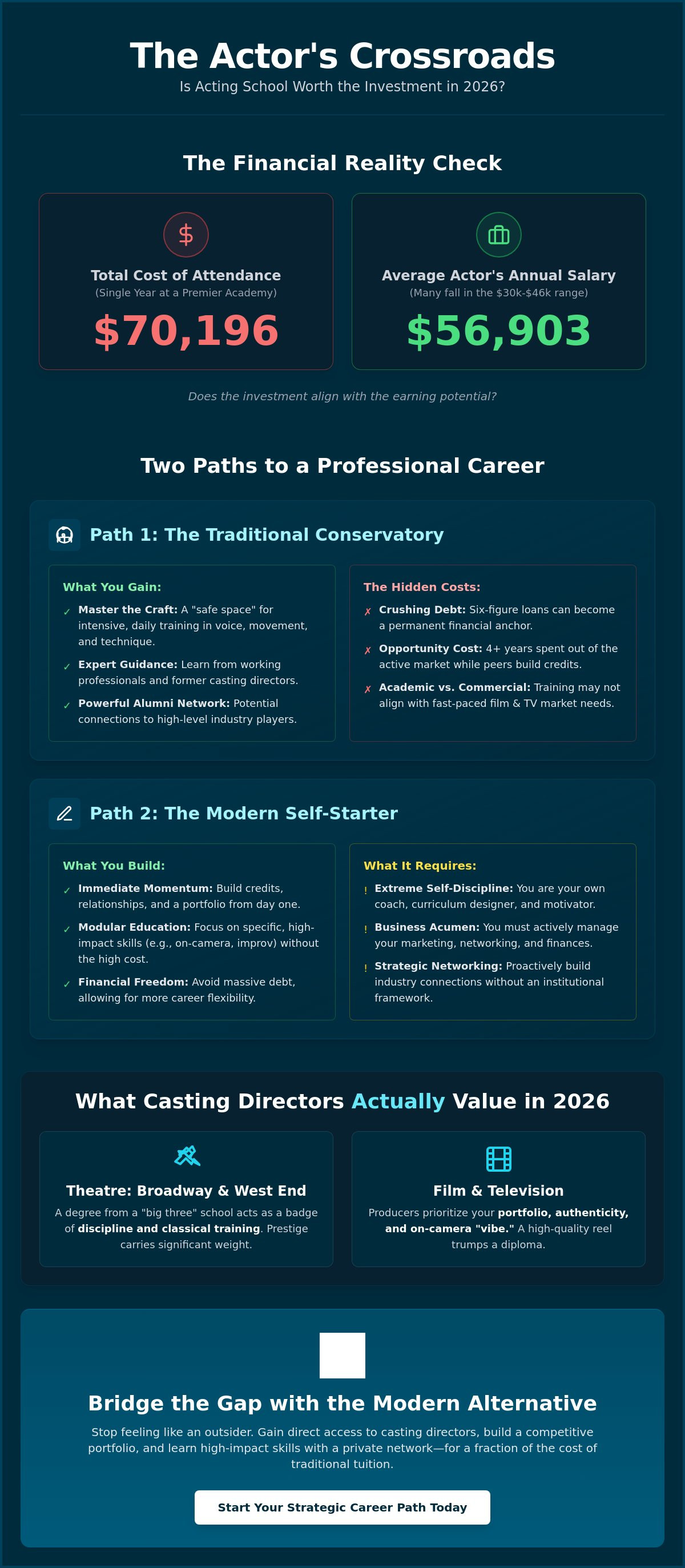
If you are looking at a $70,196 total cost of attendance for a single year at a premier academy, you have to ask: is acting school worth the cost when the average actor earns $56,903 annually? It's natural to feel the pressure to secure prestigious training just to feel legitimate in this field. You want the validation of a formal degree, but you also fear the crushing weight of student loan debt. We know the anxiety that comes with trying to bridge the gap between your passion for the craft and the cold reality of professional business development.
This guide will provide the clarity you need by comparing the actual ROI of traditional programs against modern, high-impact networking alternatives. You will gain a clear understanding of how casting directors evaluate talent in 2026 and why a digital presence often matters more than a diploma. We'll explore current tuition data, actionable strategies to get noticed, and ways to build industry connections without the six-figure price tag. It is time to stop feeling like an outsider and start making informed, strategic moves toward your professional success.
Key Takeaways
- Understand why the prestige of a four-year degree carries significant weight in traditional theatre but often holds less influence in the fast-paced film and television market.
- Determine is acting school worth the cost by weighing the intensive "safe space" of a conservatory against the immediate career momentum of a self-taught professional path.
- Learn how to implement a modular education strategy, focusing on specific on-camera and improv skills to build a competitive resume without incurring massive debt.
- Identify the critical role of industry-specific networking and portfolio reviews in securing representation and booking professional work in 2026.
- Discover how savvy insiders use targeted workshops and private networks to gain direct access to casting directors for a fraction of the price of traditional tuition.
Evaluating the Value: Is Acting School Worth the Cost in 2026?
Deciding whether to invest years of your life and six figures of capital into a formal program is a high-stakes business decision. As of July 2026, the financial barrier to entry has never been higher, with top-tier tuition rates climbing steadily. While traditional institutions promise a refined mastery of the craft, the central question for every aspiring professional remains: is acting school worth the cost in a market that increasingly values digital visibility and immediate marketability? You must distinguish between the artistic value of an education and its actual return on investment.
To understand the baseline, you might ask, What is a Drama School? At its core, it is an intensive conservatory designed to strip away bad habits and build a technical foundation; however, it often fails to provide a roadmap for the commercial reality of the industry. To determine if is acting school worth the cost for your specific goals, you must evaluate three key factors:
- Alumni Network: Does the school have a proven track record of placing graduates in current, high-paying productions?
- Location: Are you training in a major hub like Los Angeles, New York, or Atlanta where you can build local industry ties?
- Showcase Opportunities: Does the program culminate in a direct introduction to reputable agents and casting directors?
The "Prestige" Factor vs. Market Reality
Casting directors in major hubs still glance at the school name when casting for Broadway or the West End. In these environments, a degree from a "big three" school acts as a badge of discipline. In contrast, film and television casting has shifted toward "type" and "vibe." Producers are looking for authenticity and a specific look that fits their project's world. They prioritize your acting portfolio, including high-quality reels and headshots, over a formal pedigree. If your portfolio doesn't demonstrate on-camera charisma, a master's degree won't save the audition.
Defining the "Hidden" Costs of Acting School
The financial burden extends far beyond the bursar's office. You must account for the opportunity cost of spending four years out of the active market while your peers are already building credits and relationships. The estimated total cost of attendance for elite programs like the American Academy of Dramatic Arts is $70,196 for the 2026-2027 academic year. When you consider that the average actor earns $56,903 annually and many fall into the $30,000 to $46,000 range, student loan debt can become a permanent anchor. We want to ensure you aren't just buying a piece of paper; you are investing in a sustainable future.
The Tangible Benefits of Formal Training (What You’re Actually Paying For)
While the financial burden of a degree is heavy, acting schools offer an environment that is difficult to replicate independently. You are essentially paying for a four-year incubation period. This "safe space" allows you to fail, experiment, and rebuild your technique without the pressure of a professional set. When evaluating if is acting school worth the cost, consider the value of intensive, daily repetition under the guidance of experts who have already navigated the paths you wish to take. Faculty members are often working professionals or former casting directors, providing you with a direct line to current industry standards.
Mastering the Craft in a Controlled Environment
Daily voice and movement work isn't just about performance; it is about athletic discipline. Classical training in Shakespeare or Chekhov provides the structural tools needed to break down complex modern scripts with ease. This rigor creates a psychological shift. You leave the program feeling like an accredited professional rather than a hobbyist. To understand the full pros and cons of drama school, you must weigh this technical foundation against the time spent away from the professional circuit. The discipline learned here serves as a lifelong toolkit for your career development.
The Alumni Network: The "Secret" Value
The most significant asset you buy is your cohort. Your classmates are the future directors, producers, and writers who will be hiring in a decade. This internal "nepotism" is a major driver of success in hubs like New York and Los Angeles. Alumni groups often provide a safety net for housing and survival jobs that outsiders simply don't have access to. It's a built-in community that understands the unique struggles of the entertainment industry.
However, this exclusive access is no longer gated solely by university walls. While schools offer a traditional path, a modern acting industry networking platform can provide similar connective tissue for those who choose a different route. If you want to build these bonds without the four-year commitment, joining a professional talent network can accelerate your industry integration. Ultimately, deciding if is acting school worth the cost depends on whether you value the structured conservatory experience over a more agile, market-first approach.
The Cost-Benefit Analysis: Degree vs. Professional Experience
When you evaluate the financial landscape of 2026, the divide between the traditional academic route and the modular, professional path is stark. A standard four-year BFA program can easily exceed $150,000 in total costs when accounting for tuition, housing, and materials. In contrast, a savvy actor can piecemeal a world-class education for a fraction of that price. By leveraging high-level acting workshops online, private coaching, and specialized intensives, you can maintain your financial agility while building the exact skill set the market demands right now.
The time it takes to "break in" also varies significantly between these two paths. A student in a conservatory is often contractually prohibited from seeking professional work for three to four years. A modular actor, however, starts building their resume on day one. By the time a BFA student graduates, the self-taught professional may already have several union credits, a seasoned agent, and a deep understanding of how to navigate the business. If you are asking is acting school worth the cost, you must factor in the years of lost professional momentum.
The Financial Breakdown
To provide clarity, let's look at the estimated investment over a four-year period. Financial freedom is your greatest competitive advantage; debt often forces talented actors to quit the industry prematurely because they cannot afford the "starving artist" phase of a breakthrough.
| Investment Category | Traditional BFA Degree | Private Coaching & Network Path |
|---|---|---|
| Total Tuition/Fees | $120,000 – $200,000+ | $8,000 – $15,000 |
| Time to Market | 4 Years | Immediate |
| Industry Access | End-of-year Showcase | Ongoing Industry Workshops |
| Financial Risk | High (Student Loans) | Low (Pay-as-you-go) |
The Experience Gap
There is a fundamental difference between performing for a live audience in a 500-seat university theater and hitting your marks for film industry auditions. Many graduates find themselves technically proficient in stage projection but completely lost when faced with the technical nuances of a high-definition camera. Getting "set life" experience while you are young allows you to learn the unspoken etiquette of a professional production, from understanding call sheets to working with a director of photography. While classroom theory provides a philosophical foundation, the immediate ROI of on-set experience is measured in credits, connections, and the practical mastery of technical performance.
Building a Competitive Resume Without the Four-Year Debt
If you want to bypass the massive financial commitment of a traditional degree, you must adopt a business-first mindset. You don't need a four-year institution to validate your talent or your professional status. By choosing a modular approach, you can curate your own education based on the specific needs of the 2026 market. This strategy allows you to answer "is acting school worth the cost" with a definitive no, as you reinvest those saved thousands into high-quality marketing materials and specialized training. Successful actors today are often those who treat their careers like a startup, focusing on agility and direct market access; you can discover Business Systems & Solutions to help automate your professional workflows and grow your income instead of relying solely on academic prestige.
The Modular Training Strategy
A modular education is built in stages, allowing you to pay as you grow. If you follow this path, you maintain total control over your schedule and your budget. This method ensures your skills remain relevant to what casting directors are actually looking for right now. We recommend a three-step progression:
- Step 1: Foundational Technique. Master a core method like Meisner or Adler at a reputable private studio. This provides the "craft" without the overhead of a university.
- Step 2: Specialized Proficiency. Take targeted on-camera workshops. Technical proficiency in front of a lens is a non-negotiable requirement for modern screen work.
- Step 3: Continuous Skill-Building. Engage in monthly challenges to keep your craft sharp. An actor who isn't practicing is an actor who isn't ready when the big call comes.
You should also consider the crossover potential of the commercial market. Leveraging modeling career coaching can help you understand how to market your "look" and "vibe" to a broader range of clients. This diversification creates multiple income streams while you build your theatrical resume.
Direct Expert Access
One of the greatest myths in the industry is that you must wait for a graduation showcase to meet decision-makers. In reality, direct Q&A sessions with casting directors are often more valuable than a full semester of abstract theory. These sessions provide real-time feedback on your brand and your "type," allowing you to adjust your marketing materials instantly. While many actors wait for opportunities on standard casting websites, savvy professionals use live workshops to build a reputation for reliability and talent. Deciding is acting school worth the cost becomes easier when you realize that direct networking often leads to representation faster than a diploma ever will.
To protect your career, you must join a vetted community that filters out predatory "schools" and industry scams. If you are ready to stop guessing and start building a legitimate career, join the Unique Model & Talent Network to gain access to the workshops and expert reviews you need to succeed.
The Modern Alternative: Bridging the Gap with Unique Model & Talent Network
If you have concluded that the traditional university path is too slow or too expensive, you need a high-impact alternative. The Unique Model & Talent Network provides the "Savvy Insider" route for those who prioritize immediate career acceleration over a piece of paper. When you evaluate the market, is acting school worth the cost if it doesn't give you direct, daily access to decision-makers? We bridge this gap by offering you the same introductions to casting directors and professional photographers that top-tier graduates spend years trying to secure. You get the elite industry exposure you need at a fraction of the traditional investment.
Our private, gated community eliminates the noise and distractions typical of public social media groups. You won't find hobbyists here; you'll find serious professionals engaged in Monthly Skill-Building Challenges and Portfolio & Reel Reviews. This concentrated environment ensures that every interaction moves you closer to being booking-ready. By removing the external chaos, we allow you to focus on the high-level professional standards that recruitment experts demand in 2026. Choosing our network means you've answered the question of is acting school worth the cost by opting for a faster, more efficient route to the industry's gatekeepers.
A Community Focused on Career Results
We help you move from an aspirational mindset to an operational one. Through our Industry Expert Q&A Sessions and Live Industry Workshops, you receive the same elite mentorship and advocacy found in a conservatory. The Network Membership provides a sense of community belonging that mirrors the traditional alumni network, ensuring you have a support system as you build your professional bonds. You gain the clarity and direction needed to navigate an industry that is often perceived as predatory. It's about providing a reliable bridge between your emerging talent and established industry professionals.
Your Next Steps to Professional Legitimacy
Serious talent chooses managed communities to streamline their growth and protect their career integrity. We act as a protective authority, vetting opportunities and resources so you don't have to worry about the legitimacy of your path. This disciplined approach values your integrity and professional growth over the superficial vanity of social media. If you are ready to take control of your career without the crushing burden of student debt, it is time to make a decisive move toward your success. Join the Unique Model & Talent Network today to start building your professional connections.
Take Control of Your Professional Path
The decision of whether is acting school worth the cost ultimately depends on your personal financial goals and your desired timeline for entering the market. While a four-year degree offers a deep dive into the craft, it often leaves emerging talent with significant debt and zero professional momentum. You don't have to wait for a graduation showcase to start building your career. By choosing a modular education and a focused networking strategy, you can develop the same technical proficiency and industry connections for a fraction of the traditional investment.
Your success in 2026 relies on your ability to bypass the noise and connect directly with decision-makers. Our private, moderated community on Mighty Networks provides the structure you need without the university price tag. You gain direct access to casting directors and photographers, along with monthly skill-building challenges and portfolio reviews to ensure you're always booking-ready. It's time to stop second-guessing your path and start operating like the professional you are. Elevate your career without the debt—join the Unique Model & Talent Network. We are here to advocate for your growth every step of the way.
Frequently Asked Questions
Is it possible to become a successful actor without a degree?
Yes, it's entirely possible to build a successful career without a formal degree. Many working actors prioritize studio training and on-set experience over academic credentials. Casting directors care about your ability to deliver a performance and your professional reliability. If your reel demonstrates high-level craft, your lack of a BFA won't stop you from booking work.
Do casting directors prefer actors with BFA or MFA degrees?
Casting directors generally prioritize talent and suitability for the role over formal degrees. While a BFA or MFA might open doors in the theatre world, the film and television sectors focus on your "type" and on-camera charisma. A strong portfolio and professional network often carry more weight than a diploma in a fast-paced audition environment.
How much does private acting coaching cost compared to university tuition?
Private coaching is a fraction of the cost of university tuition. While elite acting schools can cost over $42,000 per year, private sessions allow you to pay as you go. This modular approach lets you target specific skills like on-camera technique or cold reading without the burden of massive student loans. It's a strategic way to manage your budget while building your craft.
Can I get a SAG-AFTRA card without going to acting school?
You don't need acting school to qualify for a SAG-AFTRA card. Union eligibility is earned by working on union-sanctioned projects as a principal performer or through accumulated background work days. Focus on booking professional jobs and building your resume rather than waiting for a degree. The union recognizes professional credits, not academic certificates.
What are the best alternatives to traditional acting conservatories?
The best alternatives include private conservatory-style studios, online industry workshops, and specialized networking communities. These paths offer flexible schedules and direct access to working professionals. By joining a vetted network, you can gain mentorship and peer support without the four-year commitment of a traditional school. This agile strategy keeps you active in the market while you learn.
Is acting school worth the cost if I only want to do film and television?
Determining is acting school worth the cost for film and television often leads to a "no." Most four-year programs focus heavily on stage projection and classical theatre. If your goal is screen work, you're better off investing in on-camera intensives and high-quality reels. Technical proficiency in front of a lens is best learned through practical application and specialized workshops.
How do I know if an acting workshop is a scam or a legitimate investment?
Legitimate workshops are led by vetted industry professionals with verifiable credits. Avoid programs that promise guaranteed representation or use high-pressure sales tactics. A legitimate investment will focus on skill-building and provide transparent information about the instructor’s background. Researching reviews within a private community can help you identify which opportunities is acting school worth the cost for your specific career stage.
What is the average starting salary for an actor with a degree?
There is no standard starting salary for actors, regardless of their education level. As of June 2026, the average annual pay for an actor in the United States is $56,903. However, the majority of performers earn between $30,000 and $46,000 annually. Your income will depend on your ability to book consistent work rather than the degree listed on your resume.


