

What if your modeling portfolio isn't actually a gallery of your favorite photos, but a high-stakes business pitch that wins or loses a contract in under three seconds? In an industry that's increasingly digital, simply having "good" pictures isn't enough to secure a booking. If you're struggling with which shots to include or worrying that your current layout looks amateur to elite agencies, you're facing a common professional hurdle. Learning how to build a modeling portfolio online requires a shift from vanity to strategy. It's about transforming your digital presence into a professional business asset that communicates your marketability instantly.
You deserve a career path built on clarity rather than guesswork. This guide provides the blueprint to master digital curation and secure the professional recognition you've been working toward. We'll explore how to select high-impact images, organize your site for maximum conversion, and use industry-standard formatting to gain confidence during agency submissions. By the end of this guide, you'll have the strategic foundation needed to move from a hobbyist to a serious contender in the competitive professional market.
Key Takeaways
- Shift your perspective to view your digital presence as a strategic business asset that functions as a global calling card.
- Learn how to build a modeling portfolio online using the essential combination of a "Hero Image" and raw digitals to establish immediate trust with casting directors.
- Categorize your talent into specific archetypes like commercial or editorial to ensure your range matches what the industry is currently hiring for.
- Streamline your professional workflow with digital Zed cards and QR codes that make your portfolio instantly accessible during high-stakes industry interactions.
- Recognize why professional curation is superior to self-selection when preparing your final assets for high-standard agency submissions.
The Digital First Impression: Why Your Online Portfolio is a Business Asset
Your online portfolio is no longer just a collection of your favorite photos. In 2026, it functions as your primary digital resume and global calling card. Casting directors operate in high-volume markets where they must categorize hundreds of faces in minutes. Without a structured digital asset, you remain invisible to the decision-makers who matter most. Learning how to build a modeling portfolio online is the first step in moving from a hobbyist mindset to a professional career strategy. It signals that you understand the business side of the industry and are ready for high-standard opportunities.
Moving Beyond Instagram Metrics
Social media presence is often mistaken for professional viability. While a large following might offer temporary visibility, it rarely translates to the legitimate, financial opportunities found in vetted networks. Followers don't equal bookings. Professional casting requires a space free from social media noise where your work can be evaluated on its technical merits alone. You must maintain a clear digital boundary between your public persona and your professional business assets. Your online portfolio serves as the centralized hub for your professional identity, providing a curated environment that filters out the distractions of general platforms.
The Three-Second Rule in Digital Casting
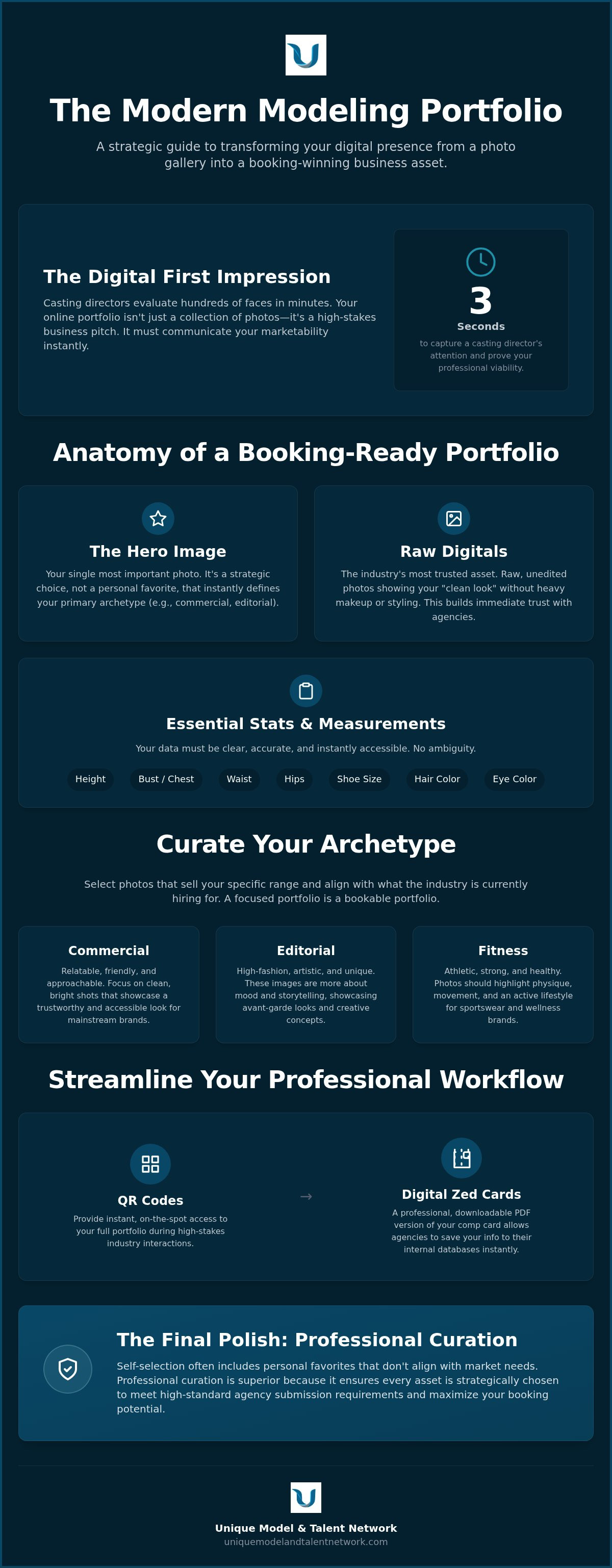
Casting directors often make a preliminary decision about your marketability in under three seconds. This is why your hero image must be a strategic choice rather than a personal favorite. This single shot needs to communicate your specific industry archetype immediately, whether you're targeting commercial, editorial, or fitness markets. If you're also pursuing film or television work, integrating your Acting Portfolio into your digital presence allows for seamless cross-platform talent marketing. A professional digital structure separates serious talent from those who are simply testing the waters.
Your site should act as a bridge between your current experience and your career goals. To ensure your portfolio demands attention, it needs to include:
- Verified Certifications: Clear proof of training and specialized workshops you've completed.
- Strategic Navigation: A layout that allows a recruiter to find your measurements and contact info instantly.
- Professional Memberships: Indicators that you're part of elite, gated communities that value professional standards.
When you understand how to build a modeling portfolio online with this level of precision, you signal to agencies that you're a business asset worth their investment. This disciplined approach removes the uncertainty from your submissions and provides the clarity you need to grow.
Anatomy of a Booking-Ready Digital Portfolio: Essential Components
Your digital presence needs a structural backbone that speaks the language of professional recruiters. When you're learning how to build a modeling portfolio online, you must prioritize industry-standard components over artistic flair. A booking-ready site is an organized data set that allows a casting director to verify your physical attributes and marketability in seconds. This begins with your "Hero Image," the front-page shot that demands attention and clearly establishes your current look. This single image determines whether a viewer scrolls down or clicks away.
Beyond the visuals, your portfolio must house your professional stats in a clear, accessible format. Include your height, bust or chest, waist, hips, shoe size, and hair and eye color. Pair these details with a digital comp card. In 2026, providing a downloadable PDF version of your zed card is essential. It allows agencies to save your information to their internal databases without manual data entry. If you're unsure if your current assets meet these high standards, getting a professional portfolio review can provide the clarity needed before you begin submissions.
What are Digitals? The Standard for Agency Submissions
Digitals, often called polaroids, are the most trusted assets in a recruiter's toolkit. These are raw, unedited photos that show your "clean look" without the distraction of professional styling or heavy makeup. Agencies prioritize these over high-fashion editorial shots because they need to see your natural canvas. To meet industry requirements, your digitals must include a full-body shot, a profile view, and a tight headshot. Use natural lighting and wear simple, form-fitting clothing to ensure your proportions are clearly visible. This transparency builds immediate trust with talent evaluators.
Strategic Video Reels for 2026
The industry has shifted toward video-first evaluation. A 15-second personality clip is now a standard requirement for most digital portfolios. This isn't a high-budget production; it's a simple video showing your movement, your walk, and a brief introduction to your personality. Showing range through video helps you stand out in high-volume markets. This approach also streamlines your transition into other entertainment sectors. Integrating video naturally into your Film Industry Auditions workflow ensures you're marketing yourself as a multi-faceted professional. Mastering how to build a modeling portfolio online with these video elements gives you a decisive edge in a competitive digital landscape.
Curating Your Archetype: Selecting Photos That Sell Your Range
Selection strategy is the difference between a portfolio that looks like a hobbyist's album and one that functions as a professional pitch. When you're determining how to build a modeling portfolio online, your primary goal is to curate images that define your market archetype. Casting directors don't just look for "good" photos; they look for talent that fits a specific commercial or editorial need. If your portfolio lacks a clear direction, you risk confusing the very people who are looking to book you. You must lead with your strongest market identity to ensure your marketability is undeniable within the first few seconds of a review.
Commercial Market Selection
The commercial market values relatability, warmth, and mass-market appeal. Your selection here should focus on the "Commercial Clean" look, featuring catalogue-ready lighting and genuine, approachable expressions. These images need to speak to both brand managers and casting directors by showing you can represent a product effectively. If you're unsure which market fits your physical attributes, utilizing Modeling Career Coaching can help you identify your most profitable look. This strategic alignment ensures your portfolio appeals to high-volume industries like lifestyle, fitness, and consumer goods.
Editorial and High-Fashion Selection
High-fashion curation requires a different approach, emphasizing bone structure, high-concept posing, and artistic lighting. Unlike commercial shots, editorial images often tell a cohesive story rather than just selling a specific product. Non-traditional beauty and a strong, focused gaze often take precedence here. When you understand how to build a modeling portfolio online for this niche, you lead with images that showcase your "Editorial Edge." These shots demonstrate your ability to collaborate with creative directors on artistic, high-stakes campaigns. Your digital presence should feel like a curated gallery of characters rather than a repetitive series of selfies.
Every professional portfolio must demonstrate emotional and physical versatility to avoid the "same face" trap. This occurs when a model uses the same expression in every single shot, regardless of the wardrobe or lighting. To prove your range to an agency, your curation should include:
- Commercial Warmth: A genuine, approachable smile that feels authentic.
- Editorial Intensity: A focused, high-fashion gaze that showcases bone structure.
- Lifestyle Movement: Natural, candid-style action shots that feel unposed.
- Character Depth: Images that suggest different moods, from playful to sophisticated.
By selecting photos that sell a specific range, you provide the clarity that elite agencies require. This disciplined approach to curation removes the guesswork for recruiters and positions you as a serious professional who understands the business of talent evaluation.
Building the Workflow: Platforms, QR Codes, and Digital Zed Cards
Establishing a professional workflow is just as critical as the images you select. When you're determining how to build a modeling portfolio online, you must consider how an agent or casting director interacts with your data. A private portfolio website offers a gated, professional environment that removes the distractions of social media, while casting platforms provide the accessibility needed for high-volume submissions. You don't have to choose one over the other; you should use both to create a comprehensive digital footprint. Efficiency is the hallmark of a serious professional.
Technical precision ensures your assets actually reach their destination. Agencies receive thousands of submissions, and your files must be optimized for easy indexing. Use clear naming conventions like "FirstName_LastName_Height.jpg" so your data is searchable even after it's downloaded. You must also manage your file sizes carefully. High-resolution images are essential for quality, but files that are too large will bounce from an agent's inbox. Aim for a balance where clarity is maintained without exceeding standard email attachment limits. To ensure your workflow meets these elite industry standards, consider joining The Network Membership for direct feedback on your digital setup.
Digital Submission Etiquette
In the digital space, you are creating a "Clickable Gateway" for talent evaluators. Every link you send must be functional and lead directly to your most relevant work. Many models use established Casting Websites as hosting hubs for their reels and digitals because these platforms are already integrated into the recruiter's daily workflow. An ideal digital card acts as a frictionless bridge to your full professional presence. If a casting director has to hunt for your contact info or your height, you've already lost their interest.
Managing the Digital-to-Physical Hybrid
Even in a digital-first market, the physical "Go-See" still exists. QR codes have become the essential tool for bridging the gap between a physical interaction and your online assets. Placing a QR code on your physical zed card allows a recruiter to scan and view your full video reel or updated portfolio instantly. You should also maintain a high-resolution PDF version of your portfolio for offline viewing. This ensures you're prepared even when internet access is unreliable. Keep your digital presence pristine by performing regular skill-building updates. Never use handwritten stat corrections on a digital asset; it looks amateur and suggests a lack of attention to your professional business development. Your digital materials must always reflect your current look with absolute accuracy.
The Final Polish: Professional Review and Network Access
Launching your digital presence is a significant milestone, but submitting your site without an external audit is a common professional oversight. Self-curation remains one of the biggest mistakes emerging talent makes during their career journey. It's nearly impossible to remain objective about your own image; you might favor a photo because of a personal memory from the shoot, while a recruiter sees a technical flaw or a dated aesthetic. Learning how to build a modeling portfolio online effectively means knowing when to hand the final edit over to a professional eye. A professional portfolio review ensures your assets align with current recruitment standards before you risk your reputation with a major agency submission.
The transition from owning a website to building a career requires a shift in environment. You need a space where your work is evaluated by standards of excellence rather than vanity metrics. Leveraging the Unique Model & Talent Network allows you to get expert eyes on your digital presence, providing the clarity you need to move forward with confidence. This protective authority helps you avoid the predatory traps of the open market and focuses your energy on legitimate business development. By moving your professional identity into a vetted space, you signal that you're a disciplined professional ready for high-level opportunities.
The Power of the Managed Talent Community
To stay competitive in 2026, you must understand the evolving needs of the industry. Participating in Acting Workshops Online helps you recognize what casting directors are currently seeking in cross-platform talent. These managed environments remove the social media noise that often distracts from real professional growth. Within a gated network, you can focus on legitimate, paid opportunities while building professional bonds with peers in a moderated setting. This community support transforms your digital presence from a static gallery into a dynamic business asset that grows with you.
Next Steps: From Design to Booking
Your portfolio is a living document that requires consistent maintenance. Stagnation is a red flag to agencies who want to see your current range and development. To keep your materials fresh, you should engage in the following professional activities:
- Monthly Skill-Building Challenges: Participate in structured tasks designed to generate new, relevant imagery for your portfolio.
- Expert Q&A Sessions: Use direct access to industry insiders to troubleshoot submission rejections and refine your market archetype.
- Peer Networking: Collaborate with other serious professionals to share insights on digital submission success.
Transitioning from a simple site to a flourishing career requires the right mentorship and a commitment to high standards. Don't leave your professional first impression to chance. Join The Network Membership today to refine your professional materials, access expert reviews, and start booking real work in a vetted, high-standard environment. Mastering how to build a modeling portfolio online is only the beginning; the network provides the bridge to your professional future.
Secure Your Professional Future in the Digital Market
Transforming your digital presence from a gallery into a high-conversion business asset requires discipline and a commitment to industry standards. You've learned that strategic curation, raw digitals, and a streamlined workflow are the foundations of a booking-ready presence. Mastering how to build a modeling portfolio online is your first step toward professional legitimacy; however, the final polish comes from expert evaluation. Don't let your career progress stall due to the uncertainty of self-curation. You deserve the clarity that only an industry insider can provide.
If you're ready to move beyond social media noise and access legitimate, high-standard opportunities, it's time to join a gated community that prioritizes your growth. Join the Unique Model & Talent Network to get your portfolio reviewed by industry experts today! Our private community on Mighty Networks provides direct access to casting directors and monthly skill-building challenges designed to keep your assets sharp. By choosing a professional environment, you ensure your talent is seen by the right eyes at the right time. Your career is a business, and we are here to help you manage it with confidence.
Frequently Asked Questions
What is an online modeling portfolio?
An online modeling portfolio is a strategic digital business asset that serves as your primary resume and global calling card. Unlike a standard photo gallery, it's a curated collection of high-standard assets designed to prove your marketability to recruiters in seconds. It typically features your hero image, raw digitals, and industry-standard measurements. Learning how to build a modeling portfolio online correctly ensures you present a vetted, professional image that separates you from unorganized hobbyists.
How much does it cost to build a professional modeling portfolio online?
Costs vary based on your choice of hosting and the quality of your existing assets. While basic website platforms provide low-cost entry, your primary investment should focus on professional photography and expert curation. You don't need a massive budget immediately, but you should prioritize professional portfolio and reel reviews. Many models find that joining a professional community is more efficient, as it offers continuous access to expert Q&A sessions for a recurring membership fee.
Can I use my Instagram profile as my modeling portfolio?
You should not use Instagram as your primary professional portfolio. While social media provides visibility, it's filled with distractions and "noise" that can dilute your professional identity. Casting directors require a structured, gated environment where they can evaluate your work without the interference of vanity metrics. A dedicated online portfolio acts as a centralized hub for your business, allowing you to maintain the high standards and clear boundaries expected by elite agencies.
How many photos should be in a beginner modeling portfolio?
A beginner portfolio should prioritize quality over quantity, generally featuring 6 to 12 high-impact images. You need enough variety to demonstrate your range without including "filler" shots that look amateur. Your selection should include a strong hero image, market-specific editorial or commercial looks, and your essential raw digitals. Focusing on a tight curation proves that you understand your archetype and helps casting directors categorize your talent quickly during high-volume recruitment cycles.
What are 'digitals' and why do I need them for my online portfolio?
Digitals, sometimes called polaroids, are raw and unedited photos taken in natural light with minimal makeup and simple clothing. They are the industry's most trusted asset because they show your natural canvas without the distraction of professional styling. Agencies use these to verify your current proportions and look before offering a booking. Every professional digital presence must include these high-standard assets to build immediate trust with talent evaluators who value transparency and legitimacy.
Do I need a professional photographer for my first online portfolio?
You don't strictly need a professional photographer for your initial digitals, as these can be captured on a high-quality smartphone. However, your hero image and market-specific shots benefit greatly from professional lighting and direction. To be seen as a serious professional, your marketing images must meet elite industry standards. Many models use monthly skill-building challenges within a gated network to help them generate the right type of imagery before investing in high-end private shoots.
How often should I update my online modeling portfolio?
You should update your portfolio at least every six months or whenever your physical appearance changes. Stale imagery is a red flag to agencies who need to see your current look and professional development. Regular updates show that you are disciplined and active in your career. Participating in live industry workshops and skill-building challenges is an excellent way to ensure you always have fresh, relevant content that reflects what casting directors are currently seeking.
What is the difference between an acting reel and a modeling video clip?
An acting reel focuses on performance, dialogue, and character range through edited scenes from films or commercials. Conversely, a modeling video clip is typically a 15-second personality reel that showcases your movement, walk, and natural presence. Both are essential for cross-platform talent marketing in 2026. Understanding how to build a modeling portfolio online with these video assets helps you stand out to casting directors who increasingly rely on video-first evaluations to vet talent.


