

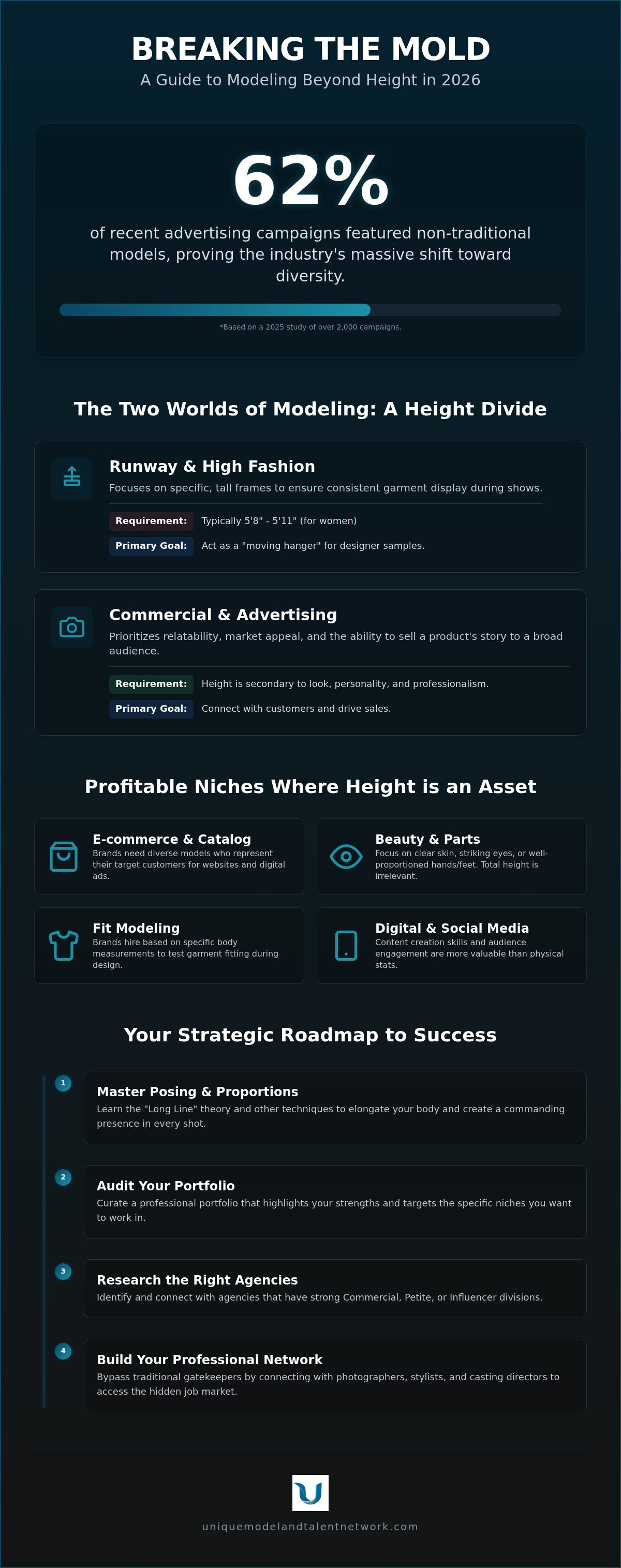
In 2025, a study of over 2,000 advertising campaigns revealed that 62 percent featured at least one non-traditional model, proving that the old gatekeepers are losing their grip on the industry. If you have spent hours staring at a tape measure and asking yourself, "am I too short to be a model," you are not alone in your frustration. It is easy to feel excluded when high fashion standards still push a 5'9" baseline, but that narrow view ignores the massive demand for diversity in the modern market.
We understand the fear of wasting time on a career that feels out of reach. This guide will show you how to identify the specific niches where your height is an asset rather than a hurdle. You will learn professional posing techniques to maximize your proportions and discover how to connect with insiders who value talent over a specific measurement. From identifying legitimate opportunities to avoiding predatory scams, we are providing the clear roadmap you need to build a profitable modeling career on your own terms.
Key Takeaways
- Understand why the 2026 modeling landscape favors diversity, with a significant shift toward representative casting in over 60 percent of major advertising campaigns.
- Stop asking "am I too short to be a model" and identify profitable niches like e-commerce and beauty modeling where your proportions take precedence over your height.
- Master the "Long Line" theory and professional posing techniques to elongate your body and create a commanding presence in every shot.
- Learn to audit your portfolio for maximum impact and research agencies that specifically champion petite and commercial talent.
- Build a strategic network of industry insiders to bypass traditional height gatekeepers and access the hidden job market where relationships drive bookings.
The Reality of Height Requirements in the 2026 Modeling Industry
If you have ever stood in front of a mirror wondering, "am I too short to be a model," you have likely been looking at the industry through a very narrow lens. For decades, the "standard" was dictated by the high-fashion runway, where height is less about beauty and more about technical garment display. Designers create sample pieces for a specific frame, usually between 5'8" and 5'11" for women, to ensure consistency during a show. This logistical requirement created a psychological barrier for thousands of talented individuals who didn't hit the vertical mark. However, a "no" from a high-fashion agency isn't a rejection from the entire industry. It's simply a sign that your "look" belongs in a different, often more profitable, sector.
Runway vs. Commercial: Understanding the Height Divide
The divide between runway and commercial modeling is where most shorter talent finds their footing. On the runway, models act as moving hangers; the focus is on how the fabric drapes and moves on a tall, lean frame. Commercial clients, however, prioritize relatability and market appeal. They want models who look like their customers, which is why commercial casting is far more inclusive. In 2026, the demand for authenticity has never been higher. Understanding different modeling career types is essential for targeting the right clients. While a runway scout might demand 5'10", a commercial director for a global skincare brand is looking for a captivating face and professional energy. They don't care if you are 5'4" or 6'0" as long as you sell the product's story.
The Rise of the Petite Modeling Category
The petite category has evolved from a niche afterthought into a powerhouse sector. Generally defined as 5'2" to 5'6" for women, petite modeling targets the massive consumer base that doesn't fit high-fashion proportions. Brands like ASOS, SKIMS, and various fitness labels now have dedicated petite divisions. If you are questioning if you are too short to be a model, consider these facts:
- Proportions over inches: Agencies look for a "long line" where your limbs appear proportional to your torso rather than just a total height number.
- Specialized Divisions: Many top-tier agencies now have "Commercial" or "Influencer" boards where height is secondary to personality and branding.
- Market Demand: With 62 percent of 2025 ad campaigns featuring non-traditional models, the data proves that the "standard" look is no longer the only way to book paid work.
Where Height Doesn't Matter: Profitable Modeling Niches
If you're still asking "am I too short to be a model," you might be looking at the wrong job boards. While the average model height for the runway remains high, the commercial market operates on entirely different rules. High fashion is a tiny sliver of the industry; the real volume of work exists in sectors where your relatability and "look" are the primary selling points.
E-commerce and catalog work form the backbone of the industry. Brands like Amazon, Target, and various boutique labels need a constant stream of images for their websites and digital ads. They prioritize models who look like their target demographic, meaning they value energy and movement over vertical inches. Beauty and parts modeling offer even more specialized paths. If you have clear skin, striking eyes, or well-proportioned hands, your total height is often irrelevant. Fit modeling is another hidden gem where brands hire models based on specific measurements to test how clothes fit during the design phase. To see which of these paths fits your look, consider getting a portfolio review from a seasoned industry professional.
Digital and Social Media Modeling
The rise of the influencer-model hybrid has shifted the power dynamic in 2026. Brands now prioritize engagement and content creation skills over traditional physical stats. If you can produce high-quality video content and build a community, you can attract brand deals directly regardless of your height. Being a digital asset means bringing an audience and a unique voice to a campaign, which provides measurable value that a traditional runway model simply can't offer. Mastering your own lighting and editing is now just as important as mastering your walk.
Commercial Acting and Modeling Crossovers
Commercial casting directors are searching for a "vibe" that resonates with viewers. They want the friendly neighbor, the professional executive, or the relatable parent. Having a versatile look and the ability to take direction on camera opens doors in TV commercials and lifestyle print ads. In commercial casting, your ability to deliver an authentic performance and fit a specific "type" will always beat your height.
Proportions and Branding: The Secret to Looking 'Model Tall'
Height is often treated as a fixed technicality, but looking "model tall" is actually a developed skill. If you are asking "am I too short to be a model," you should shift your focus toward the "Long Line" theory. This concept emphasizes the visual length of your limbs relative to your torso. Casting directors often care more about how you fill a frame than the specific number on a tape measure. A model with a smaller head-to-body ratio and a long neck often appears much taller on camera than someone with shorter limbs, regardless of their actual height. It's about the silhouette you create in a still image.
Styling plays a massive role in maximizing your physical strengths. High-waisted garments, monochromatic color palettes, and specific footwear choices can significantly elongate your frame. You aren't trying to trick the industry; you're simply presenting your best professional version. Current modeling industry standards are shifting to recognize that a striking, proportional presence often outweighs a specific vertical measurement. When you understand your own geometry, you can command the camera's attention in a way that makes height irrelevant.
Technical Posing for Shorter Models
Mastering your angles is the most effective way to address concerns about being under the traditional height threshold. Shooting from a low angle naturally adds perceived height by elongating the legs and creating a more dominant presence. You must also learn to avoid "foreshortening," which is the visual distortion that happens when limbs are pointed directly at the camera lens. Instead, keep your limbs at slight angles to the camera to maintain their full visual length. It's vital to work with photographers who understand how to light and frame petite talent to ensure your proportions remain the star of every shot.
Developing a Unique Brand Identity
Your brand identity should be built on your unique aesthetic rather than a set of measurements. Whether you possess an edgy, high-fashion face or a relatable "commercial" vibe, your specific look is your most valuable currency. When your branding is cohesive and professional, height becomes a secondary detail for many modern clients. If you feel stuck trying to identify your specific niche or maximizing your current portfolio, seeking out modeling career coaching can provide the clarity needed to navigate the 2026 market. A strong, well-defined look makes you a specialist who fills a specific market need.
Strategic Steps to Launching Your Petite Modeling Career
Launching a career when you don't meet traditional runway height requires a shift from passive hoping to active business development. If you are still questioning, "am I too short to be a model," it is time to stop looking for permission and start building your brand. The 2026 market values specialized looks and professional reliability over a specific vertical measurement. To succeed, you must audit your current materials with the eye of a casting director. Do your photos highlight a "long line" and balanced proportions, or do they make you look smaller than you are? Persistence is your greatest asset here; commercial modeling is a numbers game where your "type" eventually finds its perfect client match.
Creating a High-Impact Acting and Modeling Portfolio
Your portfolio is your primary sales tool. For shorter talent, the goal is to prove that you can hold a frame and sell a product without height being a distraction. You need a specific set of images to be taken seriously by top agencies:
- The Clean Headshot: A high-resolution shot focusing on your facial features and skin quality.
- The Proportional Full Body: A shot in form-fitting clothing that clearly defines your silhouette and limb length.
- The Movement Reel: A short video showing how you walk, turn, and interact with the camera.
Navigating Agency Submissions as a Petite Model
When submitting to agencies, transparency is your best policy. Being dishonest about your measurements is the fastest way to burn a professional bridge during an in-person go-see. Instead, lead with your strengths, your professional experience, and your unique look. Research agencies that have established commercial or lifestyle divisions, as these teams are far more likely to represent diverse heights. Your "digitals," which are simple, unretouched photos in form-fitting clothing, must be updated every few months to reflect your current look. To ensure your materials are hitting the mark, you can get a Portfolio & Reel Review from our team of industry experts. Direct networking with photographers who specialize in petite or commercial work can also bypass traditional gatekeepers, allowing you to build a body of work that proves your value before you even sign a contract. If you're wondering "am I too short to be a model" in a specific market, look at the agency's current roster to see if they already champion shorter talent.
Why Professional Networking Beats Traditional Gatekeepers
In the high-stakes environment of 2026, the most successful models aren't always the tallest; they're the best connected. If you're still stuck wondering, "am I too short to be a model," you're likely focusing on the gatekeepers who manage agency boards rather than the people who actually sign the checks. The hidden industry operates through established professional relationships. When a casting director knows your work ethic and your specific look, your height becomes a footnote. Direct access allows you to bypass the automated filters that often reject shorter talent before they even have a chance to show their value.
Public social media groups are often cluttered with predatory scouts and unorganized communication that leads to dead ends. Moving your career into a private, gated environment provides a layer of security and professional standards that general platforms simply can't match. Having a mentor to guide you through the "too short" objection in real-time is the difference between a stalled career and a booked job. You need to be in the digital rooms where the decisions are made, surrounded by professionals who value integrity and efficiency over outdated vanity metrics. Building these professional bonds is the most reliable way to ensure career longevity.
The Power of The Network Membership
Our private digital community is designed to remove the noise of the open market and provide a clear path to success. Through The Network Membership, you gain immediate career clarity by participating in Live Industry Workshops with actual casting directors and photographers. These sessions allow you to show your personality and professional energy directly to the people who book talent. Peer networking within the community also helps you identify short-friendly casting calls that never make it to public job boards. It's a structured environment where you can receive Portfolio & Reel Reviews to ensure your materials meet elite professional standards.
Taking Action: From Uncertainty to Professionalism
Your transition from aspiring talent to working professional begins when you stop asking "am I too short to be a model" and start asking "who is my specific client?" This shift in mindset requires continuous growth and a commitment to your craft. Engaging in Monthly Skill-Building Challenges and attending Industry Expert Q&A Sessions ensures your skills remain sharp and your industry knowledge stays current. The modeling landscape is evolving, and those who prioritize networking and professional development will always outpace those who rely solely on physical stats. Stop waiting for an agency to choose you and start building the access you've been missing. Join The Network Membership today and take control of your professional development in a community that values your unique potential.
Your Career Beyond the Tape Measure
The industry standard has evolved from a rigid measurement to a diverse spectrum of opportunity. By identifying your profitable niche and mastering technical posing, you can turn your unique proportions into a professional asset. If you have been asking, "am I too short to be a model," remember that your value is defined by your brand and your network rather than a tape measure. Success in 2026 requires moving away from the noise of social media and into a space where serious talent meets verified opportunity.
To gain a competitive edge, you need direct access to the decision-makers who are actively seeking representative talent. Join The Network Membership to connect with industry experts and book your next job. Our community offers live workshops and professional portfolio reviews designed to accelerate your growth in a private, scam-free environment. You deserve a clear roadmap and a protective mentor to help you navigate this field with confidence. Your professional journey is just beginning; it's time to build the bonds that lead to real success.
Frequently Asked Questions
Is 5'4" too short to be a model?
No, 5'4" is not too short, especially for the thriving petite and commercial sectors. While high fashion runway typically demands a minimum of 5'8", the commercial market values relatability over height. If you're wondering "am I too short to be a model" at this height, focus on e-commerce and catalog work where your proportions and energy matter more than vertical inches.
Do commercial models have height requirements?
Commercial modeling has no strict height requirements. Clients in this sector prioritize your "type" and how well you represent their target customer. Whether you're 5'0" or 6'0", your ability to deliver an authentic performance is what books the job. This makes commercial work the most accessible and profitable path for shorter talent who possess a professional look.
Can I do runway modeling if I'm short?
High fashion runway modeling remains difficult for shorter talent because designers cut sample garments to fit a specific tall frame. However, you can still find opportunities in local fashion shows or with brands specifically targeting the petite market. Success in runway for shorter models often requires a very strong personal brand or a significant digital presence to override traditional stats.
What is the minimum height for a petite model?
The standard height for the petite category is generally between 5'2" and 5'6" for women. Agencies look for models within this range who possess striking facial features and well balanced proportions. If you fit this description, you're a prime candidate for specialized petite divisions that cater to the massive market of consumers who don't fit high fashion standards.
How can I look taller in my modeling photos?
You can create the illusion of height by using low camera angles and monochromatic styling. Focus on the "Long Line" theory by extending your limbs and avoiding poses that "break" your silhouette at the joints. Working with a photographer who understands how to frame shorter talent will ensure your proportions look maximized in every digital shot you submit.
Are there agencies specifically for short models?
Many top tier agencies now feature dedicated petite divisions or commercial boards that don't enforce traditional height standards. You should research agencies that represent talent for lifestyle, fitness, and beauty brands. These agencies prioritize your professional portfolio and unique "look" over a specific measurement, providing a legitimate path to paid bookings without the runway gatekeepers.
Can I be a model if I'm 5'2"?
Yes, you can absolutely be a model at 5'2", particularly in the beauty, skincare, and parts modeling sectors. In these niches, your face, hair, or hands are the primary focus. If you're asking "am I too short to be a model" at 5'2", remember that your height is irrelevant when the client is only filming a close up of your smile or your skin.
How do I get noticed by casting directors without being tall?
You get noticed by casting directors through strategic networking and a high impact professional portfolio. Instead of relying on height, lead with your unique "type" and your technical skills. Participating in live workshops and building direct relationships with industry insiders allows you to bypass the digital filters used by traditional agencies and show your value directly to decision makers.


