

The most effective way to get a casting director's attention in 2026 has nothing to do with your social media follower count or the number of cold emails you blast out each Monday. While most actors are busy screaming into the digital void, the industry's most successful performers are quietly building professional bridges. If you've ever felt like your submissions are disappearing into a black hole, you're not alone. The reality is that learning how to connect with casting directors requires a shift from being a petitioner to becoming a professional solution.
It's frustrating to feel like a gatekeeper is standing between you and your career goals, especially when you're worried that reaching out might come across as pestering. You want direct access without the anxiety of being unprofessional. This guide provides the exact protocol you need to move beyond the noise of generic platforms and into genuine, high-value industry relationships. You'll learn how to audit your professional materials, master the art of the warm introduction, and utilize vetted communities to ensure your work actually reaches the decision-makers. We'll show you how to turn cold outreach into a structured system for consistent bookings.
Key Takeaways
- Understand that casting directors act as risk managers for productions, meaning your primary goal is to present yourself as a reliable, vetted solution.
- Audit your headshot, reel, and resume to ensure they communicate your professional value within the six seconds a decision-maker typically spends on a first look.
- Learn the exact protocol for how to connect with casting directors using a value-first approach that prioritizes specificity over generic requests.
- Move beyond the "black hole" of cold submissions by joining private networks that facilitate warm introductions through live workshops and expert feedback.
- Prioritize financial legitimacy and professional standards to differentiate yourself from hobbyists in an increasingly crowded digital landscape.
Understanding the Casting Director’s Role: Why 'Who You Know' Still Matters
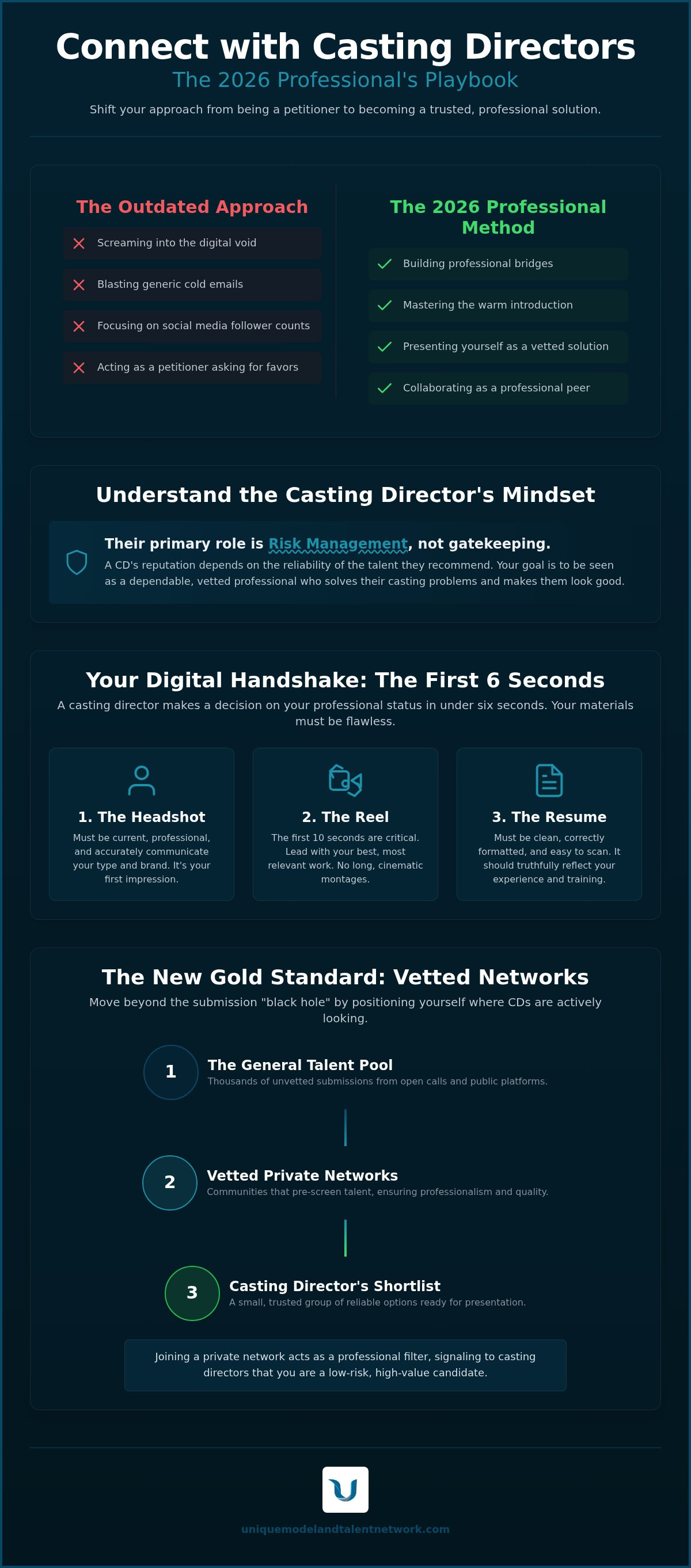
A casting director isn't just a person who watches tapes; they're a service provider hired by directors and producers to solve a specific problem. Their job is to find the right talent while minimizing professional risk. In the high-stakes world of Casting (performing arts), a CD's reputation depends entirely on the reliability of the actors they suggest. If an actor arrives on set unprepared or unprofessional, it reflects poorly on the office that recommended them. This is why "who you know" in 2026 is less about nepotism and more about established trust.
The industry has shifted toward a "Risk Mitigation" mindset. Casting offices now rely heavily on curated databases and private networks rather than open calls that invite thousands of unvetted submissions. They want to know that you can deliver under pressure before they ever present your reel to a producer. Understanding this business pressure is the first step in learning how to connect with casting directors without being seen as a nuisance. You aren't asking for a favor; you're auditioning to be a reliable partner in their workflow.
Success requires a clear distinction between networking and pestering. Professional networking is the act of building a bridge through demonstrated competence and shared industry standards. Pestering, on the other hand, is demanding attention without regard for the office's schedule or project needs. When you approach a CD, you should aim to be the answer to their current casting dilemma.
The Gatekeeper Myth vs. The Professional Reality
A casting director is a talent curator rather than a gatekeeper. They don't want to keep you out. They're actually desperate to find the perfect performer so they can look like heroes to their production team. Fame-seekers often focus on what the industry can give them, but professional talent focuses on what they can contribute to a project. If you treat the relationship as a professional collaboration, you move from being a petitioner to a valued peer.
Vetted Talent: The Industry's New Gold Standard
Being part of a talent network significantly reduces a CD's perceived risk. These professional communities act as a pre-screening tool for busy offices that need high-quality options immediately. While public social media is often cluttered with distractions and informal communication, gated professional platforms offer a focused environment where talent is already verified. This shift means that knowing how to connect with casting directors in 2026 starts with positioning yourself within these managed spaces where your materials are organized and ready for professional evaluation.
Optimizing Your Professional Toolkit for Casting Director Reviews
A casting director makes a decision about your professional status in less than six seconds. If your headshot is outdated or your resume is formatted incorrectly, you've lost the room before you've even opened your mouth. Your toolkit serves as your digital handshake. To master how to connect with casting directors, you must first ensure your materials speak the language of a working professional. Many industry leaders are devoted to help change who gets to tell stories, but they can only do so if your "Big Three"—the headshot, the reel, and the resume—meet current standards.
Amateur red flags can stall a career before it starts. Investing in a professional portfolio review for actors ensures your materials are vetted by experts who understand what offices are looking for today. For models transitioning into commercial work, a high-quality Comp Card is essential to bridge the gap between high-fashion aesthetics and relatable character work. These materials must be polished, truthful, and immediately accessible.
The 2026 Standard for Self-Tapes and Reels
The first 10 seconds of your reel are the most important. In 2026, long, cinematic montages have been replaced by specific, high-quality clips that show your range instantly. Casting offices want to see your "type" immediately. Don't wait for them to figure out where you fit; show them exactly how you solve their casting problem. High-quality lighting and clear sound aren't optional extras; they're the baseline for entry. If you're unsure if your reel hits the mark, getting a professional Portfolio & Reel Review can provide the clarity you need to move forward with confidence.
Digital Presence: Clean, Professional, and Accessible
Your digital footprint is your resume's shadow. Audit your profiles on major casting websites to ensure total consistency in credits and contact information. Remove any social media distractions that might compromise your professional image. A busy assistant should be able to find your contact details in a single click. Efficiency is a form of respect in this industry. When you make a CD's job easier, you significantly improve your chances of learning how to connect with casting directors on a recurring basis.
Strategic Outreach: Moving from Cold Emails to Genuine Relationships
Outreach is a business protocol. It's not a lottery. If you treat every email as a transaction where you demand a favor, you'll find yourself ignored by the very people you're trying to impress. Learning how to connect with casting directors requires a "Value-First" framework. This means reaching out to provide information or professional gratitude rather than asking for an audition. When you position yourself as a peer who understands the industry's demands, you stop being a "cold submission" and start becoming a professional contact.
Specificity is your most valuable currency. Instead of a generic "I'd love to work with you" message, reference a specific project the office recently completed or a piece of advice they shared in a workshop. This shows you've done your homework. For a deeper dive into these professional standards, you can study How To Network, According to a Casting Director. This perspective confirms that CDs value talent who respect their time and understand the business side of the craft.
The "Rule of Three" is a helpful guide for maintaining boundaries. You can reach out up to three times over a six to nine month period without being considered intrusive, provided each touchpoint offers new value. Timing also matters. Respect the "No-Weekends" rule and avoid sending professional inquiries on Saturdays or Sundays. While LinkedIn is an excellent tool for research, keep your primary outreach to professional email or vetted industry platforms. Direct messages on personal social media accounts are generally seen as a breach of professional etiquette.
The Art of the Specific 'Thank You' Note
A well-crafted thank you note is one of the most effective ways to build a bridge without an immediate "ask." First, identify a specific piece of advice or a project the casting director handled that resonated with you. Second, state exactly how that information helped your craft or influenced your career trajectory. Finally, close with a professional signature that includes links to your updated materials. By removing the request for an audition, you eliminate the pressure on the CD and leave them with a positive impression of your professionalism.
Tracking Your Industry Connections
Using a simple CRM or spreadsheet is the best way to manage your warm leads. Track when you last contacted an office, what you discussed, and any specific feedback you received. You should send a career update only when you have significant news, such as booking a recurring role, releasing a new reel, or debuting a drastically new look. Maintaining these relationships during industry dry spells is equally vital. A brief, professional check-in that acknowledges their recent work keeps you on their radar without appearing desperate for a job.
Leveraging Private Communities and Vetted Industry Platforms
Cold emails and generic submissions are increasingly ignored in 2026. As casting offices face a deluge of unvetted digital files, they've retreated into "closed" talent networks where they can interact with professionals in a managed environment. While open social media platforms are cluttered with distractions and hobbyists, a private community provides a focused space where you can demonstrate your craft and professional standards. Learning how to connect with casting directors in this new environment means moving away from public shouting and toward private, high-value interactions.
One of the most powerful tools in a professional's arsenal is "peer-vouching." Within a moderated community, your reputation is built on your daily interactions, your preparation for workshops, and your support of fellow members. When a casting director sees you consistently showing up with professional-grade materials and a disciplined attitude, you're no longer a stranger. You've become a known quantity. This internal credibility is worth more than a thousand cold emails because it removes the element of risk for the casting office.
The 'Educational Loophole' for Direct Access
Casting directors often host acting workshops online because they are looking for fresh talent just as much as you're looking for work. These sessions aren't just classes; they're professional auditions in disguise. To make a lasting impression, you must prepare questions that reflect a deep understanding of the industry. Instead of asking generic questions about how to get an agent, ask about their specific creative process or how they handle "Context Intelligence" in self-tapes. This level of specificity marks you as a pro and makes the CD more likely to remember you when a relevant role crosses their desk.
Choosing the Right Managed Community
Not all talent groups are created equal. You must be vigilant against "pay-for-audition" schemes and hobbyist groups that lack professional standards. A legitimate community should focus on financial legitimacy and career growth rather than empty promises. Look for platforms that offer "Monthly Skill-Building Challenges" to ensure you're always prepared for high-level film industry auditions. By surrounding yourself with serious professionals, you elevate your own status and gain access to "warm" introductions that aren't available to the general public. If you're ready to stop guessing and start growing, The Network Membership provides the vetted environment you need to succeed.
Accelerating Your Access via the Unique Model & Talent Network
The entertainment industry is often perceived as chaotic or predatory, but the right infrastructure provides a shield of career security. The Network Membership serves as this protective framework, bridging the gap between emerging talent and decision-makers. While other platforms focus on the volume of job postings, we prioritize the quality of access. Our private community on Mighty Networks is designed for the savvy insider who values efficiency over vanity. It is a disciplined space where professionals gather to refine their craft and build legitimate bonds with casting directors.
Success in 2026 requires more than just a headshot; it requires being market-ready before you ever step into a room. Our Portfolio & Reel Reviews serve as the essential first step in this process. By receiving professional feedback within our gated community, you ensure that your materials meet the high standards of a working office. This preparation is the key to mastering how to connect with casting directors. When you finally join our Live Industry Workshops, you aren't just another face on a screen. You are a vetted professional presenting polished work to a guest CD who is actively seeking solutions for their next project.
From Aspiring to Vetted: The Member Journey
The journey from aspiring talent to a vetted professional is built on clarity and direction. The Network provides the "warm" alternative to the frustration of cold emailing. Instead of hoping a busy assistant opens your attachment, you gain direct access through Industry Expert Q&A Sessions and live workshops. We maintain a strict focus on financial legitimacy and professional standards, ensuring that every opportunity within our community is a paid, legitimate industry job. This commitment to accreditation sets our members apart from hobbyist groups and positions them for long-term career acceleration.
Your Next Steps: Building Your Connection Strategy
Building a professional bridge to casting offices is a step-by-step process that requires discipline. You don't need luck when you have a protocol. Follow these steps to begin your transition:
- Audit your professional materials using our dedicated Network resources and reviews.
- Engage in Monthly Skill-Building Challenges to keep your performance sharp and relevant.
- Participate in the next live workshop to put your work directly in front of a guest casting director.
- Use the community forum to exchange "warm" insights with peers who are working on the same level.
The door to the industry is open for those who take their craft seriously. Join the Unique Model & Talent Network today to start building real industry connections.
Take Command of Your Casting Connections
Transitioning from a cold submission to a vetted professional requires a strategic shift in how you present your craft. You've learned that casting directors are looking for reliable solutions, not just faces, and that your toolkit must be market-ready before you reach out. By mastering a value-first outreach protocol and utilizing private, moderated environments, you can finally bypass the noise of open social media. Learning how to connect with casting directors is a professional discipline that rewards consistency over intensity.
If you're ready to move beyond the "black hole" of cold emails, we provide the infrastructure you need to succeed. Our members gain direct access to live workshops with active Casting Directors and receive professional Portfolio & Reel Reviews to ensure they're always ready for the next call. This private, moderated community is built for serious talent who are ready to treat their career development with the respect it deserves.
Start Connecting with Industry Insiders—Join The Network Membership
Your talent deserves a professional stage. It's time to stop guessing and start building the relationships that define a lasting career.
Frequently Asked Questions
How do I find a casting director's email address without being creepy?
Use professional databases like IMDbPro or CastingAbout rather than scraping personal social media. These platforms provide official office emails specifically for professional inquiries. If you use verified industry directories, you're following standard business protocol. Avoid guessing email formats or using personal addresses found through non-professional searches. This immediately marks you as an amateur who doesn't respect professional boundaries or the office's workflow.
Is it okay to message a casting director on Instagram or Facebook?
You should generally avoid using personal social media platforms for professional outreach. Direct messages on Instagram or Facebook are often seen as an invasion of personal space and can damage your reputation. Stick to official office emails or vetted industry networks. If a casting director explicitly invites DMs in their bio, you can proceed; otherwise, keep your communication within established professional channels to maintain your credibility.
What should I include in a 'keep in touch' email to a casting director?
Include a specific, high-value update such as a new booking, a refreshed reel, or a significant change in your look. Keep the message concise and focus on how this update makes you a better solution for their future projects. Learning how to connect with casting directors effectively involves providing new information without an immediate ask. Always include your contact details and links to your updated materials in your professional signature.
Do casting directors actually watch unsolicited reels sent via email?
Most offices only watch reels that are attached to a specific submission or come from a trusted source. If you send an unsolicited email, your subject line must be clear and your materials must be immediately accessible. Busy offices rarely have time to discover talent through random emails. This is why being part of a vetted community is vital; it provides the professional context needed for a CD to actually press play on your work.
How often should I follow up with a casting director I've met at a workshop?
You should follow up once immediately after the workshop with a specific thank-you note and then again every three to six months with a significant update. Avoid the trap of checking in without new information. If you've met them in a professional educational setting, they expect a follow-up, but it must be disciplined. Respect their workflow by ensuring every touchpoint adds value to their internal talent database and your professional profile.
Can I connect with casting directors if I don't have an agent yet?
Yes, you can absolutely build these relationships independently by utilizing workshops and private talent networks. Many casting directors are looking for fresh talent and are happy to connect with unrepresented actors who demonstrate professional standards. Focus on perfecting your materials and learning how to connect with casting directors through educational loops. Once you've built a few warm connections, you'll be in a much stronger position to secure high-level representation.
What is the biggest mistake actors make when trying to network with CDs?
The biggest mistake is lead-generating with a me-first attitude rather than a service-first mindset. Actors often ask for favors, auditions, or representation before they've established any professional trust. Another common error is sending unpolished or hobbyist materials that don't meet 2026 industry standards. If you treat the relationship as a transaction rather than a professional collaboration, you'll likely be ignored by top-tier decision-makers who value efficiency and reliability.
Are paid workshops with casting directors considered 'pay-to-play'?
Legitimate workshops are educational environments, not guaranteed auditions or pay-to-play schemes. You're paying for professional feedback and industry insight, which is a standard business expense for career development. These sessions are highly regulated to ensure they don't promise employment. View these workshops as a strategic way to get your work in front of experts while refining your craft alongside other serious, vetted professionals who are serious about their career growth.


