

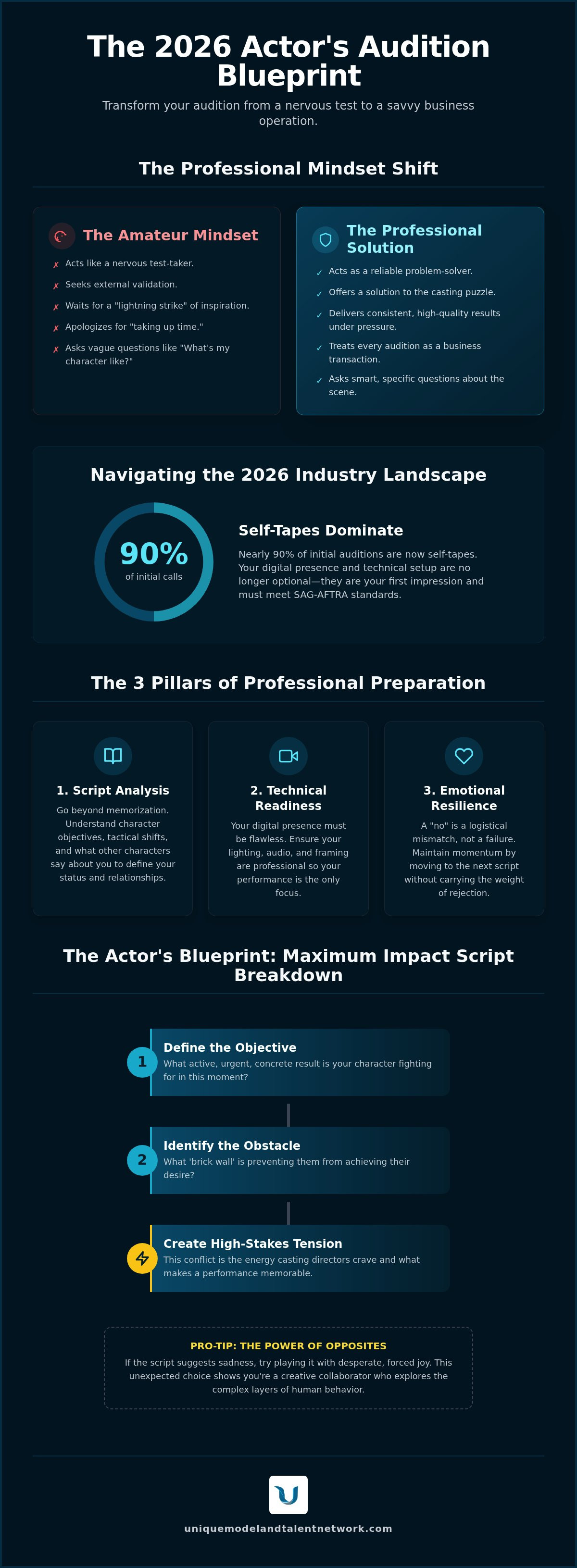
What if the person on the other side of the camera isn't actually looking for the "best" actor, but rather the most reliable solution to their production problem? It's a subtle shift in perspective that separates the hobbyist from the seasoned professional. You likely feel the weight of 2026 industry standards, where nearly 90% of initial calls are self-tapes and technical expectations have never been higher. It is frustrating to send your work into a digital void without receiving feedback or knowing if your setup meets current SAG-AFTRA regulations.
We know that feeling like an outsider is the biggest hurdle to your career growth. This guide delivers the specific acting audition tips you need to reclaim your power and move beyond the nervous test-taker mindset. You will gain a clear preparation checklist, the confidence to showcase your true personality, and a strategy to stay on a casting director's radar. By the end of this article, you'll understand how to leverage the latest AI-assisted tools and professional standards to transform your audition approach into a savvy business operation.
Key Takeaways
- Adopt a professional mindset that moves you from being a nervous test-taker to a savvy industry solution.
- Master the objective and obstacle framework to deliver the specific, high-stakes tension that grabs attention in seconds.
- Implement updated acting audition tips to navigate 2026 technical standards, from AI readers to home studio lighting.
- Build long-term industry rapport by treating every audition as a general meeting for your next ten potential roles.
- Stop acting in a vacuum and learn how vetted feedback identifies the blind spots holding back your booking rate.
Mastering the Pro Mindset: Why Preparation Beats Inspiration in 2026
Professional auditioning isn't about waiting for a lightning strike of inspiration. In 2026, the industry defines it as the consistent ability to deliver vetted, high-quality results while under extreme pressure. You aren't there to "test" your talent; you're there to prove you're a reliable asset. This requires a psychological pivot. Stop entering the room needing a job. Instead, enter the room offering a solution. Casting directors are under immense pressure to find the right fit; they're looking for a collaborator who can solve their casting puzzle, not a "wannabe" seeking external validation. Understanding the audition process as a professional business transaction changes how you carry yourself.
Your audition starts the second you appear on camera or walk through the door. These first 10 seconds are critical. Your slate and initial presence establish your professional status immediately. If you look like you belong in the room, the casting team can relax and focus on your work. Treating your career as a business means showing up with the same discipline as a high-level executive. These acting audition tips start with the realization that your craft is the product, and you are the CEO managing its distribution.
The 3 Pillars of Professional Preparation
- Script Analysis: Memorization is the bare minimum. You must move beyond the lines to understand character objectives and the tactical shifts used to achieve them.
- Technical Readiness: Your digital presence must match your in-person energy. If your self-tape lighting is distracting or your audio is thin, your performance won't save the tape.
- Emotional Resilience: A "no" isn't a failure of your craft. It's often a logistical mismatch. Maintain professional momentum by moving to the next script without carrying the weight of the last rejection.
Overcoming the 'Wannabe' Stigma
Amateurs often signal their insecurity through over-apologizing for "taking up time" or avoiding direct eye contact. These behaviors suggest you're difficult to direct or unprepared for a fast-paced set. Replace these habits with smart questions that show you've done the work. Instead of asking "What's my character like?", ask "How does the pacing of this scene shift when the second character enters?" This signals you're a peer in the creative process. It shows you're a savvy professional who understands the mechanics of storytelling. Audition readiness is the precise intersection where high-level performance skill meets impeccable professional etiquette.
The Actor's Blueprint: Breaking Down the Script for Maximum Impact
A character without a clear goal is just a talking head. In the context of 2026 acting audition tips, you must identify exactly what your character wants in this specific moment. This is your "north star." If you aren't fighting for something, the audience isn't rooting for you. Your objective must be active and urgent. It shouldn't be a vague feeling; it should be a concrete result you're trying to get from the other person in the scene. This clarity is what separates a professional performance from an amateur reading.
Once you have your objective, you must identify the obstacle. Tension arises when a character's desire hits a brick wall. Identifying this wall creates the high-stakes energy casting directors crave. To stand out, experiment with the "power of opposites." If the script suggests sadness, try playing the scene with a desperate, forced joy. This unexpected choice proves you're a creative collaborator who brings unique value to the project. It shows you aren't just reading lines, but are instead exploring the complex layers of human behavior.
Script Analysis Techniques for 2026
Deep analysis requires looking beyond your own dialogue. Pay close attention to what other characters say about you. These are the clues that define your status, your reputation, and your relationships within the story. You also need to master the "moment before." The scene has a life that began long before the first line of dialogue is spoken. Establishing this history ensures you aren't just "starting" a scene but are instead caught in the middle of a life already in progress. For those looking to sharpen these analytical skills, using acting industry networking platforms is a great way to find vetted scene partners for remote or in-person practice.
Handling the Redirect
If a casting director asks for a second take, don't panic. It's rarely a sign of failure. It's actually a test of your directability and professional flexibility. They want to see if you can drop your prepared performance and respond to new information in real-time. Listen to the feedback with your whole body. Don't anticipate your next line or worry about your previous choice. Adopt a "yes, and" mentality. If they ask you to play the scene like you're hiding a secret, embrace it fully without losing your character's core objective. This level of professional agility is exactly what we cultivate within The Network Membership, where talent learns to treat every redirect as a chance to showcase their range. Being ready to take a redirect without crumbling signals that you're prepared for the fast-paced nature of a professional set.
Navigating the Technical Shift: In-Person vs. Self-Tape Excellence
The transition from a physical lobby to a home studio represents a massive shift in how talent manages their professional space. In the lobby, you manage your nerves; in the home studio, you manage the entire production. By 2026, self-tapes have become the primary gateway for 80% to 90% of all initial casting calls. This means your technical proficiency is now just as important as your emotional range. If your technical setup is amateur, your performance will be disregarded before you even speak your first line. These acting audition tips focus on creating a broadcast-quality environment that lets your talent shine without distraction.
Consistency is your greatest currency in this digital landscape. It's vital that your acting portfolio matches your current live appearance exactly. Casting directors often report frustration when a performer's self-tape or in-person arrival doesn't align with their submitted materials. Additionally, punctuality has been redefined. In 2026, meeting a digital submission deadline is the absolute equivalent of being "early" to an in-person call. Missing a window by even five minutes signals a lack of professional reliability that casting offices won't tolerate.
The Self-Tape Checklist for 2026
- Lighting: A basic three-point lighting setup is the industry standard. Use a key light, a fill light, and a back light to create depth and separate yourself from the background.
- Sound: Never rely on your phone's internal microphone. A $50 lavalier mic provides the clarity needed to capture subtle vocal choices that phone mics often muffle.
- The Reader: While a live professional reader is ideal, 2026 has seen the rise of AI scene partners. Apps like Acting Pal or Rafy are acceptable for the first round, provided the AI voice doesn't distract from your performance.
In-Person Etiquette: The Lobby and the Room
When you are called for an in-person session, your wardrobe should be "suggestive" of the character. Avoid full costumes; instead, choose colors and styles that hint at the role's world without looking like a theme park character. Once in the room, establish a polite connection with the reader, but avoid "staring them down" during the scene unless it's a specific character choice. Finally, master the "Thank You" exit. Regardless of how you feel about the take, leave with professional grace. This ensures you remain a viable candidate for future projects, even if this specific role isn't the right fit.
The Business of the Room: Building Long-Term Industry Rapport
Every audition is a business development opportunity. You shouldn't view a single call as a pass/fail test for one role. Instead, treat it as a general meeting for the next ten roles that office will cast. Casting Directors maintain detailed vetting files on talent. They track your punctuality, your preparation, and your ability to take direction. Even if you aren't right for the lead in a current pilot, a professional showing ensures you stay on the radar for future projects. These acting audition tips emphasize that your reputation in the room is your most valuable asset.
Certain behaviors guarantee a spot on the industry "No-Go" list. Unpreparedness is an obvious disqualifier, but rudeness to casting assistants or lobby staff is equally damaging. The industry is smaller than it appears; word of unprofessional conduct travels fast. If you want to build rapport, focus on legitimate follow-up. A concise, professional "Thank You" note sent via email or through your representative is appropriate. Avoid over-familiarity or sending unsolicited gifts, which often signals desperation rather than professional courtesy.
Networking Without the 'Cringe'
Professional networking in 2026 prioritizes financial legitimacy over the superficial pursuit of social media fame. Savvy actors use casting websites to track which offices are currently active and what types of projects they handle. This data-driven approach allows you to tailor your submissions and build a reputation as an actor who understands the market. Being "easy to work with" means arriving with your technical requirements met and your creative choices ready to be molded.
Staying on the Radar
Maintaining visibility requires more than just talent. You must update your reel and headshots every six months to ensure they reflect your current look and skill level. Many professionals participate in acting workshops online to keep their craft sharp and stay top of mind with industry decision-makers. Vetted communities provide a filter that bypasses the noise of public casting calls, placing you directly in front of those who can move your career forward. These acting audition tips are only the beginning of your professional development. To ensure you are consistently seen as a vetted professional, join a community of vetted professionals today.
Accelerating Your Booking Rate through Expert Feedback
Acting in a vacuum is the single most common career killer for emerging talent. You can spend thousands on equipment and hours on script analysis, but without an external perspective, you're likely repeating the same technical or emotional errors in every tape. In the 2026 market, the competition is too fierce to rely on guesswork. These acting audition tips focus on the final, most critical stage of professional development: the feedback loop. A Savvy Industry Insider doesn't just tell you if a performance was "good"; they identify the specific blind spots that are preventing you from being vetted by top-tier casting offices.
The Unique Model & Talent Network serves as the missing link between your initial training and your first major booking. We move away from the superficiality of social media and focus on the grounded reality of professional business standards. Our community provides the clarity you need to understand why you might be getting "close but no cigar" in the room. By receiving direct input from those who actually hire talent, you can make the necessary professional adjustments to turn callbacks into contracts. This is how you transition from a nervous test-taker to a savvy industry solution.
The Power of the Portfolio Review
An objective eye is essential when evaluating your primary marketing materials. Your reel and headshots are your business cards, and they must align with current 2026 standards. A portfolio review helps you see your work through the lens of a recruiter rather than a fan. Interestingly, many of our most successful members find that modeling career coaching provides valuable cross-pollination for their acting careers. It teaches you how to manage your physical presence and brand identity with the precision required for high-stakes commercial and theatrical work.
Your Path Forward with the Network
Success in this industry requires more than just a one-time set of acting audition tips; it requires a sustained commitment to growth. Membership in our gated community gives you direct access to live workshops with guest casting directors who provide the real-world feedback usually missing from the process. You can also engage in monthly skill-building challenges designed to keep your skills sharp and your resume growing. These challenges ensure you remain a "vetted" choice for professionals who value reliability and high standards over vanity. If you're ready to stop guessing and start growing, Join the Unique Model & Talent Network to start booking paid work today.
Take Command of Your Professional Future
The shift from a nervous performer to a savvy industry insider begins when you realize you're the solution to a casting director's problem. By mastering script analysis through the lens of objectives and obstacles, and adhering to the strict technical standards of 2026 self-tapes, you position yourself as a reliable, high-level professional. These acting audition tips help you bypass common amateur pitfalls and build long-term industry rapport that leads to consistent bookings.
No actor can truly excel while acting in a vacuum. You need a community that prioritizes financial legitimacy and professional standards over the hollow pursuit of social media fame. Through our gated network, you gain direct access to live workshops with real Casting Directors, portfolio reviews that meet 2026 standards, and a vetted community of professional talent.
Ready to turn auditions into bookings? Join the Network today.
Your craft deserves a platform that matches your ambition. We're here to bridge the gap between your training and your next major contract.
Frequently Asked Questions
How do I handle extreme nerves before an acting audition?
You can manage extreme nerves by reframing them as professional energy and focusing on your character's objective. High-stakes preparation is the best antidote to anxiety. When you view yourself as a solution to a casting director's problem, the focus shifts away from your ego and onto the work. Practice deep diaphragmatic breathing and arrive early enough to ground yourself in the physical space before your name is called.
What should I wear to an audition if there is no dress code?
Wear clothing that is suggestive of the character's world without crossing into a full costume. Choose solid, jewel-toned colors that complement your skin tone and don't distract the camera. Avoid busy patterns, logos, or noisy jewelry. Your goal is to provide a visual hint of the character while remaining a professional, blank canvas that the casting team can easily imagine in the final production's wardrobe.
Is it okay to ask the casting director questions during the audition?
It is absolutely appropriate to ask smart, tactical questions that show you've analyzed the script. Focus on the tone of the project or the specific relationship between characters in the scene. Avoid asking for information already provided in the breakdown or character bio. Asking an insightful question about a scene's pacing signals that you're a creative peer who understands the mechanics of storytelling and professional set environments.
What are the technical requirements for a professional self-tape in 2026?
Professional self-tape standards in 2026 require a three-point lighting setup, a neutral backdrop, and high-quality audio. Using an external lavalier microphone is non-negotiable for capturing vocal nuances. Ensure your file is exported in 1080p or 4K and follows the specific naming conventions requested in the breakdown. These technical acting audition tips ensure your tape meets the vetting standards of major network offices and streaming platforms.
Should I memorize the script for a 'cold read' audition?
You don't need to be fully off-book for a cold read, but you must be familiar enough to maintain consistent eye contact with your reader. Keep the script in your hand as a reference point. This allows you to stay connected to the scene's emotional truth without the fear of dropping a line. The casting team is looking for your ability to make strong, immediate choices rather than perfect memorization.
How do I follow up with a casting director after an audition without being annoying?
Follow up with a concise, professional email or a standard "Thank You" note sent through your representative. Keep the message brief; thank them for the opportunity and mention the specific project. Avoid sending gifts, social media direct messages, or over-familiar updates. Respecting a casting director's time and digital boundaries is a key part of maintaining a professional reputation and staying on their long-term vetting radar.
What do I do if I make a mistake during my performance in the room?
If you make a mistake, stay in character and continue the scene unless the error completely breaks the narrative. Casting directors value your ability to recover with professional grace. If the mistake is significant, you can politely ask to take it again, but be ready to accept a "no" and move on. Handling a slip-up without crumbling proves you have the emotional resilience required for a fast-paced professional set.
Do I need an agent to get noticed by major casting directors?
You don't always need an agent to be noticed, especially with the rise of vetted talent communities and professional workshops. These platforms provide direct access to casting directors that was previously gated by traditional representation. While an agent is necessary for negotiating major union contracts, building your own industry rapport through these acting audition tips and networking platforms can help you secure the work that eventually attracts high-level representation.


