
What if the barrier between your daily gym routine and a professional contract isn't your physique, but your lack of an insider roadmap? You've likely felt the frustration of scrolling through public casting sites only to find vague requirements or, worse, predatory scams that lead nowhere. It's exhausting to put in the physical work without knowing how to become a fitness model who actually gets booked for high-value campaigns. You deserve a career that rewards your discipline with professional standards and financial legitimacy.
I'm here to bridge that gap by providing a clear, business-focused strategy for 2026. This guide promises to strip away the confusion over portfolio requirements and give you direct access to the technical standards industry decision-makers demand. We'll explore the shift toward strength-focused aesthetics, the reality of agency commissions, and how to build a network that bypasses the chaos of social media. From mastering your digital presence to understanding the $50 to $150 hourly rates for freelance talent, you're about to transition from a fitness enthusiast to a respected professional with a clear path to paid jobs.
Key Takeaways
- Define your specific market niche by distinguishing between commercial catalog work and luxury editorial fitness to align your career with the right brands.
- Discover how to become a fitness model by prioritizing high-value technical assets like unretouched digitals and professional reels over vanity social media metrics.
- Learn why high-end retouching is often a red flag for casting directors and how to present an authentic, athletic image that builds professional trust.
- Master a five-step roadmap to audit your professional presence and perfect the self-tape techniques required for modern fitness auditions.
- Bridge the gap between aspiring and professional status by leveraging direct access to industry experts and live workshops within a gated community.
Beyond the Gym: What it Actually Means to Become a Fitness Model in 2026
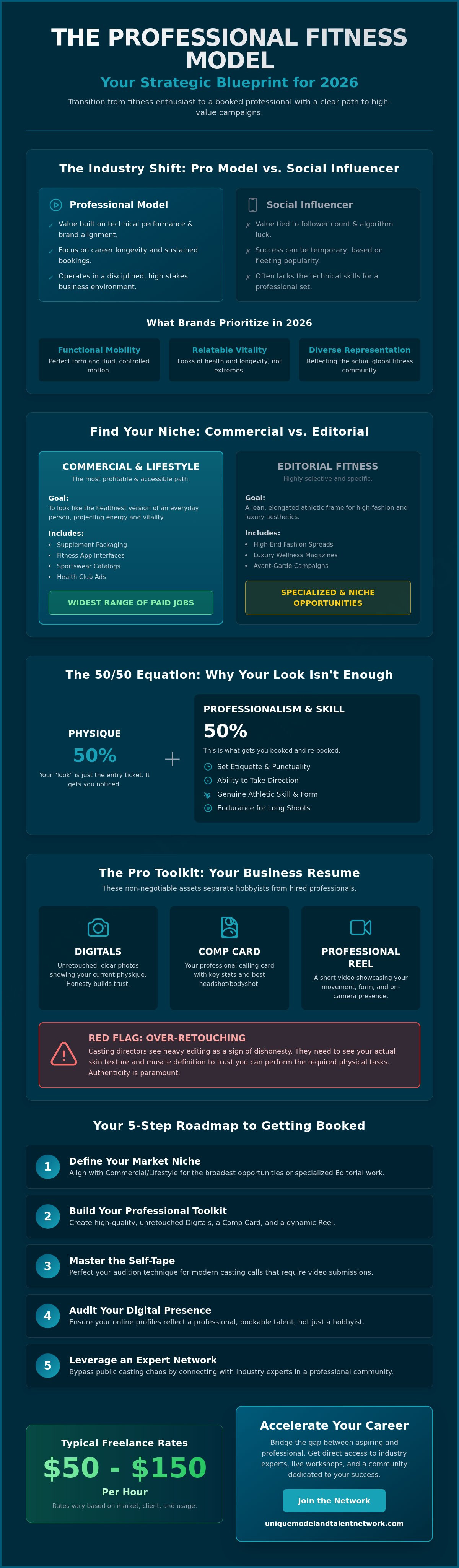
A professional Fitness model is a specialized talent operating within a highly disciplined business environment. Many beginners confuse the fleeting popularity of a social media influencer with the sustained career of a professional commercial model. While an influencer's value is often tied to their current follower count and algorithm luck, a model's value is built on their ability to sell a product through technical performance and brand alignment. If you're serious about how to become a fitness model, you're looking for career longevity rather than a temporary spike in likes. In 2026, the industry has moved decisively toward functional fitness. Brands now prioritize:
- Functional Mobility: The ability to perform exercises with perfect form and fluid, controlled motion.
- Relatable Vitality: A look that suggests health and longevity rather than extreme caloric restriction or unsustainable mass.
- Diverse Representation: A focus on various body types and backgrounds that reflect the actual global fitness community.
This shift means that looking the part is only your entry ticket. To stay booked, you must demonstrate that you can take direction, handle the pressure of a high-budget set, and move with the grace of a professional athlete.
The Distinction Between Fitness and Bodybuilding Models
Success in this field requires you to identify your specific market niche early. Editorial fitness modeling often targets high-end fashion and luxury wellness magazines, requiring a lean, elongated athletic frame. On the other hand, the commercial sector remains the most profitable and accessible path for emerging talent. This includes everything from supplement packaging to fitness app interfaces and local health club advertisements. Lifestyle fitness has become the dominant trend in 2026, where the goal is to look like the healthiest version of an everyday person. If you can project energy and vitality without looking like a professional bodybuilder, you're positioned for the widest range of paid opportunities.
Why Your "Look" is Only 50% of the Equation
Casting directors are looking for more than just a low body fat percentage. They need professionals who understand set etiquette and the high stakes of a commercial production. If you can't arrive on time, take direction, or maintain your energy through a ten-hour shoot, your look won't save your reputation. You must also possess the actual athletic skill required for the specific campaign. If a brand hires you to model yoga gear, you need the flexibility and form of a practitioner, not just the outfit. A Professional Fitness Model is essentially a hybrid of a high-level athlete and a commercial actor who can perform under pressure.
The Professional Toolkit: Essential Assets for Every Aspiring Fitness Model
Transitioning from the gym floor to a paid set requires more than just a great physique; it demands a standardized set of professional assets. In 2026, casting directors filter through thousands of submissions. Your primary assets, specifically Digitals, the Comp Card, and the Professional Reel, are what separate the hobbyists from the pros. If you are researching how to become a fitness model, you must understand that these tools aren't just photos. They're your business resume. Unlike general modeling, the fitness industry has a low tolerance for high-end retouching. Over-editing is often a red flag because brands need to see your actual skin texture and muscle definition to ensure you can perform the physical tasks required for the job.
A successful model understands that their portfolio must reflect their current physical state with absolute honesty. This transparency builds the professional trust necessary for long-term bookings. While you focus on your athletic assets, don't overlook the crossover skills that can expand your marketability. For instance, learning how to present yourself for the camera can be found in the ultimate guide to building an acting portfolio that books in 2026, which offers deeper insights into technical standards.
Mastering Your Digitals (Polas)
Digitals are the industry-standard "no-makeup, no-filter" baseline for talent evaluation. Agencies need to see your raw physique without the advantage of a "pump," professional studio lighting, or strategic shadows. To meet the 2026 standard, follow this checklist:
- Lighting: Use flat, natural daylight from a window.
- Attire: Wear form-fitting athletic wear or simple swimwear that clearly shows your silhouette.
- Poses: Include a straight-on headshot, a profile shot, and a full-body athletic stance.
Designing a High-Impact Fitness Comp Card
Your comp card is your physical and digital business card. The layout should lead with a high-energy headshot on the front, while the back showcases a full-body athletic shot and a variety of "movement shots." These movement shots prove you can actually perform, whether you're mid-sprint or holding a difficult yoga pose. Accuracy in your measurements is a matter of professional integrity. If you show up to a set with different proportions than those listed on your card, you risk being sent home and blacklisted by that casting office. Showcase your versatility by including images that highlight different disciplines, such as weightlifting alongside functional mobility work. Building these assets can feel overwhelming without expert feedback. If you want to ensure your materials meet professional standards, consider getting Portfolio & Reel Reviews from those who know exactly what casting directors are looking for.
Commercial vs. Editorial Fitness: Finding Your Specific Market Niche
Identifying your market niche is the difference between a busy booking calendar and a dormant phone. When you explore how to become a fitness model, you'll find that the industry is divided into two primary categories: commercial and editorial. The commercial niche is the backbone of the industry, encompassing catalog work, fitness app interfaces, and supplement branding. It values relatable, healthy physiques that appeal to a broad consumer base. Editorial fitness is more exclusive, focusing on high-fashion fitness layouts, magazine covers, and luxury activewear campaigns. This niche often requires a more "aspirational" or high-fashion look with leaner proportions.
Your current physique and athletic background largely dictate which path is most viable. A former collegiate sprinter might thrive in high-energy commercial campaigns for performance brands, while a yoga practitioner with a lean, elongated frame might find more success in luxury editorial spaces. If you're unsure where your physical assets align with current demand, seeking professional modeling career coaching provides the strategic clarity needed to target the right agencies. Understanding your "look" early prevents you from wasting resources on a portfolio that doesn't match your most bankable market.
The Rise of the "Athleisure" Market
The 2026 market heavily favors talent who can seamlessly transition from "street to gym." This athleisure dominance means brands are looking for models who look natural in functional, stylish activewear outside of a workout setting. Leading brands in this space prioritize a posing style that feels candid and effortless rather than overly muscular or rigid. To succeed here, you must master "lifestyle posing," which involves subtle, relaxed movements that showcase the garment's fit and comfort during everyday activities.
Specialized Fitness: Yoga, CrossFit, and Beyond
Having a verified athletic specialty significantly increases your booking rate. Whether it's marathon running, Pilates, or CrossFit, niche skills allow you to market yourself to specific casting directors looking for authenticity. Professional sets are demanding; you may be asked to replicate a complex athletic movement for 50 or more takes to get the perfect shot. This requires genuine stamina and technical precision. When you can prove your ability to maintain perfect form under the heat of studio lights for hours, you become an invaluable asset to any production team, especially when you maintain your physical integrity through specialized resources like Upper Cervical Care.
The 5-Step Roadmap to Booking Your First Professional Fitness Job
Booking your first paid job requires a shift from passive hoping to active business development. If you've been wondering how to become a fitness model who actually earns a paycheck, you must treat your career like a startup. The process isn't about luck; it's about positioning yourself where the decision-makers are already looking. In 2026, the market is saturated with "influencers," but it's starved for reliable, professional talent who understand the technical demands of a commercial set. Follow this roadmap to move from the gym floor to a professional production.
- Step 1: Audit your "Professional Presence." Ensure your social media supports your brand without overshadowing your professional portfolio. While Instagram shows your lifestyle, your portfolio proves your technical utility.
- Step 2: Master the "Self-Tape." This is your 2026 audition room. You must be able to record yourself performing athletic movements with perfect form and high energy in a home setting.
- Step 3: Target fitness-specific casting directors. Don't blast every agency. Research those who specifically handle athletic brands like Nike, Peloton, or emerging recovery tech companies.
- Step 4: Leverage professional casting websites. Use vetted platforms to find opportunities that have been screened for legitimacy and fair pay.
- Step 5: Network within private communities. Skip the noise of public calls by joining moderated networks where industry experts share internal opportunities.
Acing the Fitness Audition
Your audition starts the moment you choose your outfit. Wear the "Athletic Professional" look: clean, brand-neutral, form-fitting gear that allows casting directors to see your muscle engagement. In a 30-second self-tape, you must demonstrate explosive energy and sustained stamina. Since strength training is the top priority for gym-goers in 2026, show movements that highlight functional power. Avoid the common mistake of over-acting; the camera needs to see a focused athlete, not a theatrical performance. If you can replicate a clean squat or a precise sprint for multiple takes while maintaining a positive "set personality," you'll stand out immediately.
The Importance of Vetted Opportunities
The fitness industry can be predatory, making it vital to distinguish between real jobs and scams. Legitimate agencies typically earn a 15-20% commission on your earnings rather than demanding large upfront fees for "representation." Always avoid calls that ask for inappropriate photos or provide vague details about the brand. Professional networks act as a protective layer, ensuring you only apply for jobs with financial legitimacy. In 2026, professional casting requires legitimacy over volume when applying for jobs. You'll find much more success by applying for five high-quality, vetted roles than fifty unverified public postings. To gain access to these protected opportunities and expert guidance, consider joining The Network Membership to accelerate your professional growth.
Accelerating Your Career with the Unique Model & Talent Network
The transition from an enthusiast to a professional is often the most difficult phase of your career. While you now understand the technical assets and market niches, the final piece of the puzzle is professional access. The Network Membership serves as the definitive bridge for those serious about how to become a fitness model with a legitimate, long-term trajectory. In an industry frequently disrupted by disorganized communication and predatory "scouting" on social media, this gated community offers a protective, moderated environment. It's designed to remove external distractions so you can focus entirely on the business of your career development.
You gain the opportunity to participate in Live Industry Workshops where you interact directly with active casting directors and photographers. These sessions move beyond theory and place you in a simulated professional environment. Our Monthly Skill-Building Challenges are specifically engineered to prepare you for the physical rigors of a professional shoot. They ensure you have the stamina and technique to handle fifty takes without losing form or energy, which is a standard expectation on a high-budget set.
Direct Access to Industry Decision-Makers
Industry Expert Q&A Sessions provide the strategic clarity that public platforms simply cannot offer. Instead of guessing what a specific agency wants, you hear it directly from the sources who evaluate talent daily. When you submit your work for Portfolio & Reel Reviews, you receive feedback from experts who understand current market demands. This direct line of communication streamlines your development. It helps you avoid the common pitfalls that stall emerging talent for years and ensures your materials are ready for high-level submissions.
Joining a Community of Serious Professionals
The psychological benefit of surrounding yourself with peers who share your discipline cannot be overstated. Peer networking within a moderated space fosters a sense of professional security and mutual growth. You're no longer navigating the industry alone; you're part of a community that values integrity and efficiency. Treating your career as a business means investing in the right infrastructure rather than treating it as a side hobby. Join the Unique Model & Talent Network today to start booking the work you deserve.
Own Your Professional Future in Fitness Modeling
The landscape of fitness modeling in 2026 has moved beyond simple aesthetics to prioritize athletic utility and professional reliability. You now have the roadmap to audit your presence, master your technical assets, and target the specific market niche that fits your physique. Understanding how to become a fitness model is no longer about luck or social media engagement; it's about the discipline of business development. By focusing on functional movement and unretouched authenticity, you position yourself as a high-value asset for commercial and editorial brands alike.
Don't let your career stall in the chaos of unverified casting calls. You can Elevate your fitness modeling career with The Network Membership and gain the professional security you deserve. This gated environment provides direct access to casting directors, live portfolio reviews, and a private, moderated industry community designed for serious professionals. It's time to stop guessing and start booking paid work with the guidance of experts who understand the current market. Your journey from enthusiast to booked model is ready for its next professional leap.
Frequently Asked Questions
Do I need a modeling agent to become a fitness model in 2026?
You don't need an agent to begin your career, though representation can provide access to higher-budget national campaigns. Many professionals start as freelance talent, booking their own jobs through vetted casting platforms and private networks. If you eventually sign with an agency, expect them to charge a commission of 15% to 20% of your earnings in exchange for their negotiation expertise and brand connections.
How much do fitness models typically make per shoot?
Earnings depend heavily on your experience and the type of project. Freelance models typically earn between $50 and $150 per hour, while agency-represented talent for e-commerce shoots can command day rates between $800 and $1,500. For major global campaigns, the day rate can increase significantly, ranging from $2,000 to $5,000, reflecting the high commercial value of professional athletic talent.
What is the minimum height requirement for fitness modeling?
There is no strict height requirement for the majority of fitness modeling roles, especially in the commercial and lifestyle sectors. While editorial high-fashion fitness might favor taller frames, most brands prioritize a lean, toned, and athletic physique over specific measurements. Your ability to move well and demonstrate perfect exercise form is far more important to casting directors than your height.
Can I be a fitness model if I have tattoos or piercings?
Tattoos and piercings are increasingly accepted in 2026, particularly as brands move toward more authentic and relatable marketing. While some conservative commercial clients may prefer a "clean" look, many activewear and functional fitness brands embrace body art as part of a modern athletic aesthetic. Always ensure your tattoos are visible in your digitals so casting teams can make an informed decision for their specific campaign.
How often should I update my fitness modeling portfolio?
You should refresh your portfolio every six to twelve months or whenever your physique changes significantly. Because the industry relies on your current physical state, keeping your digitals and movement shots up to date is a matter of professional integrity. Regular updates ensure that you are presenting an accurate version of yourself to casting directors, which helps prevent issues on set.
What is a "movement reel" and do I really need one?
A movement reel is a short video that showcases your athletic skills and how you take direction while in motion. It's an essential asset for anyone researching how to become a fitness model because it proves you can actually perform the exercises required for a shoot. In 2026, brands prioritize talent who can replicate complex movements for multiple takes, and a reel is the best way to demonstrate that capability.
How do I know if a fitness casting call is a scam?
Scams often involve requests for upfront fees for "representation" or inappropriate, highly sexualized photos. Legitimate casting calls will provide clear information about the brand and the specific project requirements without asking for money before you've booked a job. Joining moderated industry communities provides a protective layer, as these platforms vet opportunities to ensure they meet professional and financial standards.
Do I need a massive social media following to get signed by a fitness agency?
You don't need a large following to get signed or book professional work. While a strong social media presence can be a helpful secondary asset, agencies and brands prioritize your professional toolkit, including your comp card and movement reel. Technical skill, reliability, and athletic form are the primary factors that lead to paid bookings in the professional commercial and editorial sectors.


