

Your website is no longer just a digital resume; it's a high-speed conversion tool designed to make a Casting Director’s job effortless. In an industry where virtual casting calls and self-tapes are the baseline standard, creating an actor website that gets noticed is the primary way to signal you're a professional ready for high-level work. You probably feel the weight of tech overwhelm or the fear that a clunky interface makes you look like an amateur. It's exhausting to waste money on flashy tools that never actually translate into a booking.
We believe your digital presence should work as hard as you do. This article provides a clear roadmap to building a 2026-standard digital headquarters that captures attention and simplifies the hiring process for your future employers. You'll learn how to prioritize your best footage, avoid common financial pitfalls, and create a centralized hub that establishes your credibility the moment an agent clicks your link. Let's turn your site into a streamlined engine for your career growth.
Key Takeaways
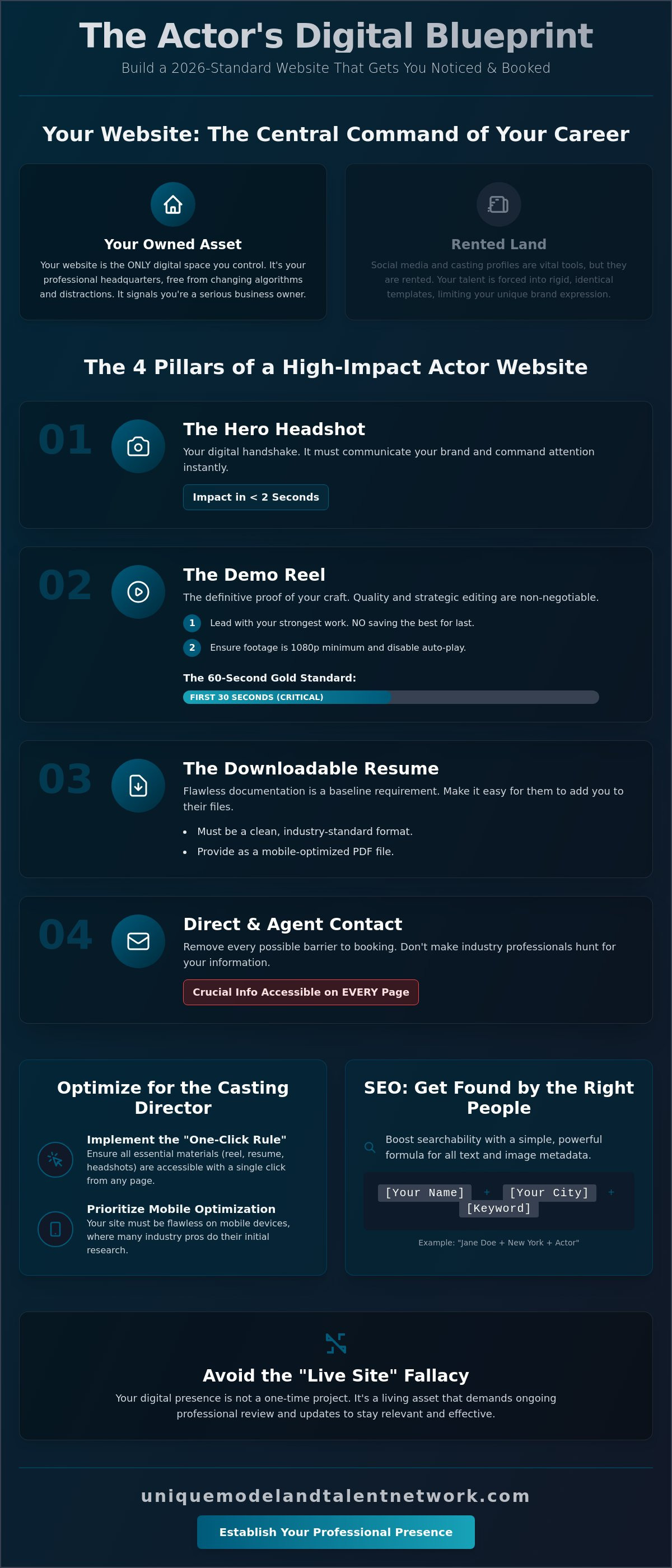
- Master the "4 Pillars" of high-impact design by prioritizing a hero headshot that commands attention in under two seconds and a demo reel that hits the 60-second gold standard.
- Respect a casting director's time by implementing the "One-Click Rule" and ensuring your professional materials are flawlessly optimized for mobile devices.
- Boost your searchability when creating an actor website that gets noticed by using our specific name-city-keyword formula for all text and image metadata.
- Avoid the "Live Site" fallacy by acknowledging that your digital presence is a living asset that demands ongoing professional review rather than risky self-editing.
Why a Professional Actor Website is Non-Negotiable in 2026
Think of your website as the central command center for your entire career. It's your professional digital headquarters; the only corner of the internet where you possess absolute control. While social media platforms offer fleeting visibility, they are ultimately rented land. Algorithms change without warning, and your content is often buried under a sea of distractions. A dedicated site ensures you own your narrative from the moment a Casting Director searches your name. By creating an actor website that gets noticed, you transition from a passive participant in the industry to a proactive business owner. This shift signals a level of maturity that casting offices respect. It shows you aren't just waiting for permission to be seen; you're building a legacy.
To further develop this professional mindset and see how structured firms manage their growth, you can visit Ledger and Lot to explore high-level pipeline management.
The psychological impact of a personal site cannot be overstated. In an industry often cluttered with amateurism, a clean, high-performance website acts as a badge of legitimacy. It separates you from the thousands of hobbyists who rely solely on free profiles. When a producer sees a custom URL, they see a performer who understands the business of acting. They see someone who has invested in their infrastructure, making it easier for them to justify the financial risk of hiring you for a major production.
The Actor Website vs. Casting Profiles
Casting platforms like Actors Access and Backstage are vital tools for daily submissions, but they are inherently rigid. They force your unique talent into standardized templates that look identical to every other performer in the database. Your website serves as the "closer" for big-budget projects where the competition is elite. It allows you to showcase non-traditional media that these sites often reject. This might include high-production-value stunt reels, specialized movement clips, or behind-the-scenes footage that proves your professional conduct on a professional set. You aren't limited by their file sizes or layout constraints; you have the freedom to curate an experience that reflects your specific artistic value.
Establishing Your Professional Brand Identity
Casting directors need to identify your "type" within seconds of landing on your page. Your homepage should use visual storytelling to communicate exactly where you fit in the current market. This starts with professional actor headshots that align with the roles you're actually targeting. Brand consistency is the precise alignment of your headshots, demo reels, and site design to present a unified professional image. When your digital presence is cohesive, you make it easy for industry pros to trust your talent. Creating an actor website that gets noticed requires this level of disciplined organization, ensuring your brand is the first thing they remember when a role opens up. It's about removing friction and providing clarity in an uncertain field.
The 4 Pillars of a High-Impact Actor Website
A high-conversion website relies on a specific architecture. When creating an actor website that gets noticed, you must move beyond aesthetic appeal and focus on four non-negotiable pillars that serve the casting director's workflow. These elements are the engine of your digital headquarters, designed to provide immediate answers to the industry's most pressing questions. They act as a filter, quickly identifying you as a prepared professional.
Pillar 1 is the Hero Headshot. This is your digital handshake. If it doesn't command attention in under two seconds, the viewer has already clicked away. Pillar 2 is your Demo Reel; it serves as the definitive proof of your craft. Pillar 3 is the Downloadable Resume. It must be a clean, mobile-optimized PDF. Data from the Bureau of Labor Statistics highlights the intense competition in the field, making flawless documentation a baseline requirement for any working professional. Finally, Pillar 4 is your Direct Contact and Agent Info. You must remove every possible barrier to the booking by making this data accessible on every single page.
The 30-Second Demo Reel Strategy
While 60 seconds is the industry gold standard for a full reel, your first 30 seconds are the most critical. You must lead with your strongest, most recognizable work. Don't save the best for last. Technically, your footage must be 1080p minimum. Disable auto-play; it's a universal frustration for casting offices. Ensure each clip is clearly labeled with the project title and your role. If you're struggling to curate your footage, a professional portfolio review for actors can help you identify which scenes actually move the needle for your specific type.
Crafting a Bio That Actually Gets Read
Professionalism in creating an actor website that gets noticed also extends to your written copy. Use a "Short Bio" for your homepage to highlight recent wins and unique skills like martial arts or motion-capture proficiency. Save the "Long Bio" for a secondary page. Always write in the third person. This allows press outlets and agencies to copy and paste your information directly into their own materials without needing to rewrite it. Focus on your professional trajectory rather than personal life stories. If you want to refine your digital presence further, consider joining The Network Membership to connect with mentors who understand these evolving standards.
Optimizing for the Casting Director UX
Casting directors work under extreme time pressure. When they land on your page, they aren't looking for an artistic statement; they're looking for a solution to a casting problem. Creating an actor website that gets noticed requires you to prioritize the "Casting Director UX" over personal aesthetic preferences. Efficiency is the ultimate goal. If your site takes five seconds to load or hides your contact information behind a "Read More" button, you've already lost the opportunity. Every second of friction is an invitation for a busy professional to click away and move to the next candidate.
The "One-Click Rule" is the foundation of a professional site. Every vital asset, including your headshot, demo reel, resume, and contact details, must be reachable in exactly one click from your homepage. If a CD has to hunt through a "Gallery" to find your reel, your site has failed its primary mission. Speed is also a critical feature. High-resolution images must be optimized for the web to ensure near-instant loading. Avoid auto-play music or heavy background animations. These elements are not professional; they're obstacles that drain mobile data and distract from your talent.
A significant majority of industry professionals now access talent portfolios via mobile devices while on set or in transit. If your site isn't perfectly responsive, you're effectively invisible to a large portion of the market. Creating an actor website that gets noticed means ensuring your resume PDF scales correctly on a small screen and your navigation buttons are large enough for "thumb-friendly" interaction. A site that breaks on a mobile browser suggests a lack of attention to detail that casting offices will assume extends to your work on set.
Navigation Secrets of Pro Websites
Professional sites use "sticky" headers that keep your name and navigation menu visible as the user scrolls. This ensures that your contact info is always a split-second away. Use clear, industry-standard labels for your menu items. Use "Reel" instead of "Watch Me" and "Media" instead of "My Journey." CDs prefer commands and clarity over cleverness. Keep your "Media" tab as a dedicated space for your reel and clips; don't bury these essential tools inside a generic photo gallery.
Mobile Performance and Accessibility
Test your site on both iOS and Android platforms across multiple browsers like Safari and Chrome. Check that your resume PDF opens in a clean, native viewer rather than forcing a download that clutters a professional's phone. Pay close attention to font sizes. Text that looks perfect on a desktop can become unreadable on a mobile device. Every interaction should feel productive and efficient, mirroring the high-level professional environment you're aiming to enter.
SEO for Actors: Getting Found by the Right People
Visibility is the lifeblood of your career. While you may have a stunning aesthetic, it remains irrelevant if casting directors cannot find you through a simple search. Creating an actor website that gets noticed requires a disciplined approach to Search Engine Optimization (SEO). Most performers treat their site like a static brochure, but savvy professionals treat it like a beacon. To rank effectively, you must adopt the Actor Keyword Formula: [Full Name] + [City] + [Actor/Model]. If a producer searches for your name, your website should be the first result they see, followed closely by your profiles on high-authority acting industry networking platforms.
Image SEO is a frequently neglected opportunity for performers. Google’s crawlers cannot "see" your face; they read the data attached to it. Naming your primary file "headshot1.jpg" is a wasted chance to build authority. Instead, use a descriptive string like "Jane-Doe-New-York-Commercial-Actor-Headshot.jpg." This ensures your face appears in Google Image results when industry pros search for specific types in your region. Your metatag descriptions should be equally strategic. Craft a concise snippet that summarizes your brand, location, and most recent credits to entice the click before they even land on your page.
On-Page SEO Essentials
Your technical structure signals your relevance to search engines. Use your H1 tag exclusively for your name and your primary H2 tags to define your location and professional category. This hierarchy tells Google exactly who you are and where you work. Writing descriptive alt-text for every image is also essential for accessibility and indexing. Additionally, maintaining a "Press" or "News" section provides the fresh content that search crawlers crave. Even a short update about a project wrap or a new training certification keeps your site active and relevant in the eyes of the algorithm.
Linking Your Ecosystem
Your website does not exist in a vacuum. It shares a symbiotic relationship with your profiles on various casting websites. You should link from these high-traffic platforms back to your "Digital HQ" to build backlink authority. Use social media as a funnel rather than a destination. Your Instagram and TikTok should drive traffic toward your website where the real booking happens. When you include external links to IMDb or agency pages, ensure they always open in a new tab. This keeps the user on your site even as they explore your external credentials. If you are ready to refine your professional presence among peers who value this level of career business, consider joining The Network Membership today.
Beyond the Website: Feedback and Continuous Growth
Your digital presence is a living asset. Many performers fall into the "Live Site" Fallacy, believing that once the domain is active, the work is finished. In reality, creating an actor website that gets noticed requires ongoing refinement to match the speed of the industry. As your career evolves, your site must evolve with it. Stagnation is a signal to casting directors that you aren't currently active or invested in your professional development. A site that looks exactly the same as it did two years ago suggests a career that has stalled.
Self-editing is a dangerous path for any serious professional. You are too close to your own materials to judge them with the cold objectivity required by a casting office. Seeking professional feedback is the only way to identify the subtle friction points that might be costing you auditions. This is why integrating your digital headquarters into your modeling career coaching sessions is so effective. A seasoned coach provides the high-level perspective needed to ensure your site reflects the 2026 professional standard, helping you avoid the "amateur" markers that you might otherwise miss.
The Quarterly Website Audit
Broken links and outdated credits are silent killers of professional credibility. We recommend a full audit every three months to maintain your competitive edge. Use this time to perform the following checks:
- Review every link on your site to ensure it still functions correctly.
- Update your resume PDF with your most recent credits and training.
- Swap in new headshots to ensure you look exactly like the person who will walk into the audition room.
- Re-test your page load speeds after adding any new video clips or high-resolution images.
Leveraging the Unique Model & Talent Network
The Unique Model & Talent Network serves as a protective community where you can access definitive direction. Within our gated network, you can have your site reviewed by casting directors during our live workshops. This direct access removes the guesswork from creating an actor website that gets noticed. You will also find a community of vetted collaborators, including specialized photographers and web designers who understand the specific technical needs of the entertainment industry. Using the network for site audits ensures you aren't building in a vacuum. Instead, you are building a tool that has been stress-tested by industry experts. Join the Unique Model & Talent Network to get professional feedback on your actor website today.
Take Control of Your Digital Career Narrative
Your website is the most powerful employee you have. By focusing on the four pillars of high-impact design and prioritizing the casting director's user experience, you move beyond the limitations of third-party platforms. You now understand that creating an actor website that gets noticed requires more than just aesthetics; it demands technical precision, strategic SEO, and a commitment to regular audits. This digital headquarters is where your professional brand becomes undeniable and your career security begins.
Don't build your career in isolation. You deserve a community that values your ambition and protects your professional standards. Join the Unique Model & Talent Network for Professional Portfolio Reviews to gain direct access to casting directors and participate in our live reel workshops. Our vetted community of industry professionals is ready to help you stress-test your materials before they reach a major production office. The industry is evolving, and you're now equipped to lead that change. Your craft is your art, but your website is your business. Treat it with the respect it deserves.
Frequently Asked Questions
Do I really need a website if I have an Actors Access profile?
Yes, a personal website is essential for professional branding and narrative control. While casting profiles are necessary for submissions, they don't allow for the deep storytelling or SEO control required for creating an actor website that gets noticed. Your site acts as the "closer" for major roles, providing a centralized hub for materials that platforms like Actors Access might restrict or compress.
What is the best website builder for actors in 2026?
Squarespace and Wix are the most reliable choices for performers in 2026. As of June 2026, Squarespace offers plans starting at $16 per month, while Wix provides robust templates for approximately $17 per month. These platforms prioritize the mobile-responsive design and fast loading speeds that casting directors demand. Pick the one that feels most intuitive for your specific workflow.
Should I put my personal phone number on my actor website?
You should never post your personal phone number on a public-facing website. Protect your privacy by using a professional contact form or directing all inquiries to your representative's office. If you don't have an agent yet, a dedicated professional email address is a safer and more organized way to manage booking requests without exposing your private data to the general public.
How much does it cost to maintain an actor website annually?
Annual maintenance costs generally range from $190 to $350 for basic hosting and domain registration. Based on 2026 market rates, a standard Squarespace or Wix subscription covers the bulk of this expense. Remember that professional headshots and reel editing are separate investments. Budgeting for these recurring digital costs is a fundamental part of running your acting business with a professional mindset.
Can I build my own actor website without tech experience?
You can absolutely build a professional site without any coding knowledge. Modern website builders use drag-and-drop interfaces that allow you to focus on content rather than technical hurdles. The key to creating an actor website that gets noticed is simplicity. Stick to industry-standard navigation and avoid cluttered layouts that might distract or confuse a busy casting professional during a search.
What should I do if I don't have a professional demo reel yet?
Lead with high-quality self-tapes or workshop clips if you lack a traditional reel. Ensure the lighting is professional and the audio is crisp. Casting directors want to see how you move and hear your natural voice. A well-executed 30-second scene that showcases your specific "type" is more valuable than a poorly edited reel filled with background work or low-quality footage.
How often should I update my actor website?
Perform a comprehensive audit of your site every three months. This quarterly check ensures all links are functional and your resume reflects your latest credits and training. You should also update your headshots immediately if your physical appearance changes significantly. Keeping your content fresh signals to the industry that you are an active, working professional who is invested in their career.
Should I include my modeling work on my acting website?
Include modeling work only if it enhances your overall brand identity. If you have a strong commercial modeling portfolio, house it in a separate tab clearly labeled "Modeling." Avoid mixing these images with your theatrical headshots. Keeping these categories distinct helps casting directors stay focused on the specific role they are trying to fill without getting distracted by unrelated materials.


