

What if the script you just received two minutes ago isn't a hurdle, but your biggest competitive advantage? It's a scenario every professional faces: you're handed three pages of fresh dialogue and expected to deliver a nuanced performance in ten minutes. You might feel that familiar rush of performance anxiety or worry that you're too rusty to command the room. When you lack a consistent partner to practice with, it's easy to feel isolated and unprepared for the high stakes of a modern audition.
We understand that your readiness is your most valuable professional asset. You can transform that panic into poise by integrating a specific framework of cold reading exercises for actors into your daily routine. Mastering these drills ensures you're the most prepared person in the casting room, not just someone who is rehearsing. This guide provides a structured set of professional exercises designed to sharpen your instincts, accelerate script analysis, and build the confidence needed to impress casting directors in 2026. From solo character work to rhythm drills, you'll build a routine that turns unexpected script changes into moments of career acceleration.
Key Takeaways
- Adopt a "Stay Ready" mindset by treating acting exercises as tactical maintenance for your emotional and vocal flexibility.
- Sharpen your script analysis with solo cold reading exercises for actors that help you pinpoint character objectives and active verbs in seconds.
- Enhance your listening and reaction skills through collaborative drills designed to reveal the subtext beneath the written word.
- Build a sustainable high-performance routine that integrates daily alignment drills with deep-work technique sessions.
- Accelerate your professional growth by participating in structured skill-building challenges and accessing expert feedback within a private network.
The Professional Actor’s 'Stay Ready' Strategy: Why Exercises Matter in 2026
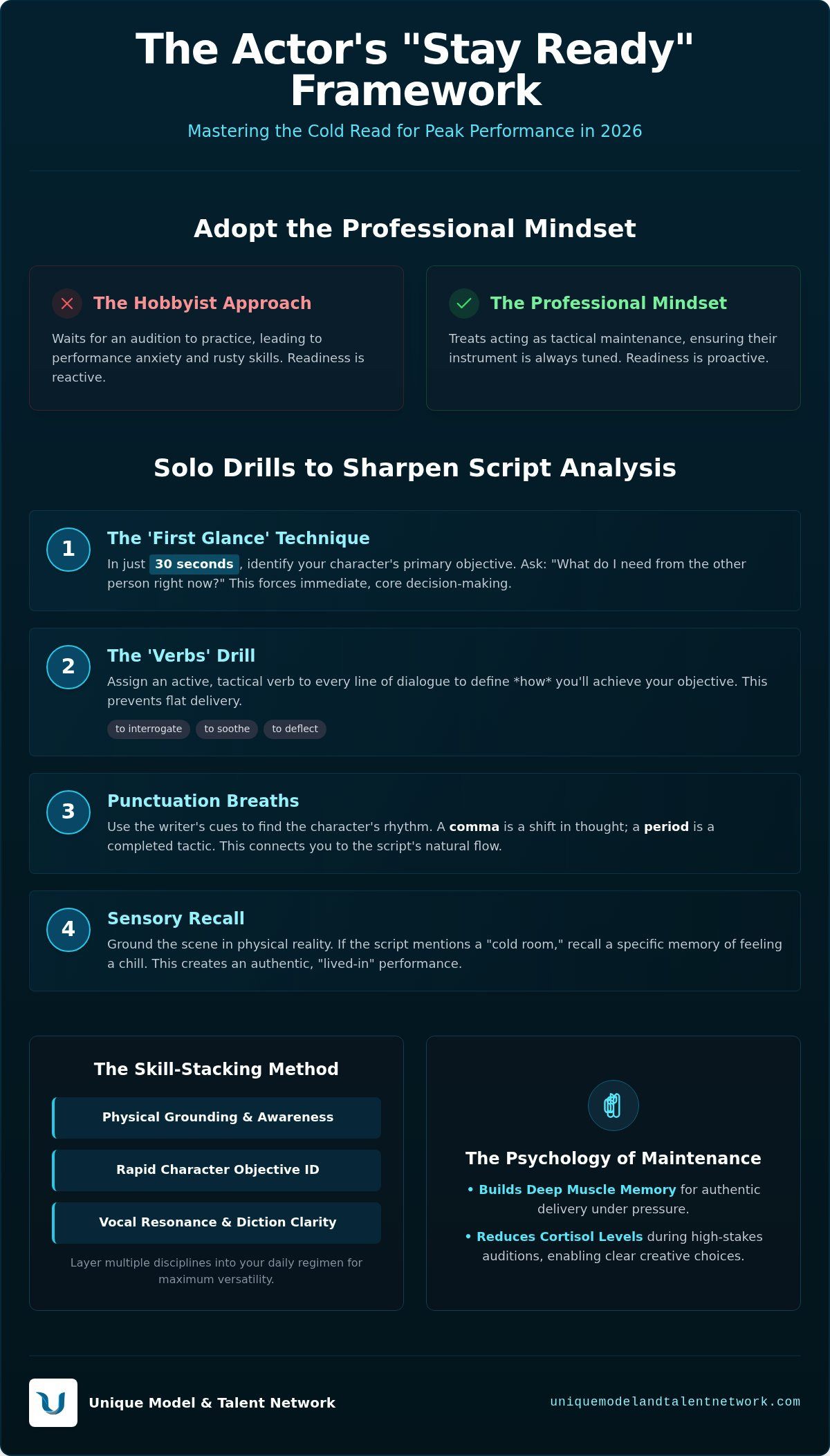
Top-tier talent doesn't wait for an agent's email to start working. They understand that acting exercises aren't just academic tasks; they're tactical drills designed to maintain peak emotional and vocal flexibility. Integrating specific cold reading exercises for actors into your professional routine is the fastest way to bridge the gap between training and booking. If you treat your craft like a professional athlete treats their body, you'll adopt the 'Stay Ready' mindset. This approach ensures your instrument is always tuned, regardless of how long it's been since your last booking.
The difference between a hobbyist and a professional is often found in their preparation schedule. While a hobbyist practices only when an audition is confirmed, the professional follows a performance maintenance model. In the 2026 market, success relies on 'skill-stacking', which involves layering multiple disciplines into your daily regimen:
- Vocal resonance and diction clarity
- Rapid character objective identification
- Physical grounding and spatial awareness
By layering these skills, you remain relevant and versatile in an industry that demands immediate, high-quality results. Performance maintenance isn't about perfection; it's about being ready to deliver a nuanced performance at a moment's notice.
The Psychology of Performance Maintenance
Consistent drills do more than just improve your acting; they fundamentally change your physiological response to stress. Performance maintenance is the foundational habit of working actors. When you engage in daily practice, you build deep muscle memory that allows for authentic emotional delivery even when your nerves are high. These repetitions help reduce cortisol levels during high-stakes moments, ensuring your brain stays clear for creative choices. If you've already done the work at home, your body knows how to respond when the camera starts rolling.
Bridging the Training-to-Casting Gap
Casting directors can tell within seconds if an actor is 'warm' or 'cold'. An actor who has been practicing consistently brings a vibrant, immediate energy to the room that is impossible to fake. This readiness is vital for navigating the unpredictability of film industry auditions, where directions can change in an instant. When you regularly utilize cold reading exercises for actors, you develop the ability to interpret scripts at a professional speed. A cold reading isn't just about saying the words; it's about making bold, defensible choices under pressure. Mastering this gap ensures you're providing the solution a production needs right now.
Solo Cold Reading Exercises to Sharpen Your Script Analysis
Solo practice is the secret weapon of the consistently booked actor. While many wait for a scene partner to begin their work, the professional utilizes specific cold reading exercises for actors to refine their analysis skills in isolation. The 'First Glance' technique is your starting point. Give yourself exactly 30 seconds to identify your character's primary objective. Ask yourself: what do I need from the other person right now? Once you have the 'what', use the 'Verbs' drill to find the 'how'. Assign a specific, active verb to every line of dialogue. You aren't just speaking; you are 'interrogating', 'soothing', or 'deflecting'. This prevents a flat delivery and ensures every word has a tactical purpose.
Don't ignore the writer's cues. Punctuation breaths allow you to find the character's natural rhythm. A comma is a shift in thought; a period is a completed tactic. Combine this with sensory recall to ground the scene. If the script mentions a cold room, recall a specific time you felt a chill. This link between memory and immediate emotion creates the 'lived-in' quality casting directors crave. If you want to see how your solo progress stacks up against industry standards, consider joining The Network Membership for expert insights.
Mastering the 60-Second Script Breakdown
When you face cold reading in auditions, you often have zero prep time. You must find the 'hook', which is the one element that makes the scene unique, almost instantly. Always identify the 'Moment Before'. What happened ten seconds before the first line? This provides an immediate emotional trajectory and prevents you from starting the scene 'cold'. If you're looking for more ways to showcase this readiness, you can record these solo sessions to enhance your acting portfolio.
Emotional Fluency Drills
Emotional range is a muscle requiring progressive overload. The 'Emotion Ladder' drill helps you scale intensity from a 1 to a 10 on command. Start a line at a whisper of frustration and end it at a boiling point of rage. Trigger work allows you to access these reservoirs safely by using personal substituted memories. By practicing these rapid shifts, you avoid emotional burnout and maintain professional control in the room. This discipline ensures you can take any direction a casting director throws your way without losing your grounding.
Collaborative Improv and Reaction Drills for Dynamic Performance
While solo prep builds your foundation, collaborative drills transform a static script into a living conversation. Acting is fundamentally a series of reactions. If you're only focused on your own lines, you're missing the cues that make a performance authentic. Meisner's 'Repetition' exercise is the gold standard for developing this awareness. By repeating a simple observation about your partner, you force yourself to truly listen and respond to their behavior rather than your internal monologue. This ensures that every choice you make is rooted in the reality of the moment.
The 'Gibberish' drill takes this a step further by removing the distraction of language. When you perform a scene using nonsense sounds, you're forced to rely entirely on subtext and body language. This is one of the most effective cold reading exercises for actors because it proves that what you say matters far less than why you're saying it. You'll quickly find that your physical presence and vocal tone convey the character's truth even without literal words. Mastering this drill allows you to find the emotional core of a script before you even fully memorize the dialogue.
Meisner Technique in a Digital Environment
Modern casting often happens through a screen, which requires a specific adaptation of classical techniques. Maintaining a genuine connection through a camera lens is a skill that must be practiced. During acting workshops online, you should focus on detecting micro-expressions within the virtual window. Listening becomes even more critical in a virtual audition because the technology can strip away subtle energy. If you can stay present and reactive despite the digital barrier, you'll stand out as a professional who understands the medium and its unique technical demands.
The Status Game for Character Relationships
Every relationship has a power dynamic. Status games involve varying your vocal volume and physical levels to shift these dynamics in real-time. If you play a 'high status' character, you might take up more space and speak with a steady, unhurried rhythm. Conversely, a 'low status' character might avoid eye contact and use smaller, more frantic gestures. Applying these status drills helps you navigate the difference between commercial calls, which often require a relatable 'peer' status, and theatrical calls that demand clear hierarchies. These cold reading exercises for actors improve your chemistry with unknown scene partners by giving you a clear tactical framework for every interaction.
Building a High-Performance Acting Routine: A Weekly Framework
Structure beats inspiration every time. If you want to book work in 2026, you need a high-performance routine that treats your craft like a professional business. A haphazard approach leads to inconsistent results. Instead, implement a five-step weekly framework that keeps your instincts sharp and your instrument tuned. This routine ensures you aren't just "practicing," but actively developing the tactical skills required for elite performance.
Step 1 is your 15-minute daily warm-up. Focus on vocal resonance and physical alignment to ensure your body is ready to respond. Step 2 involves 45 minutes of deep work. This is where you apply specific cold reading exercises for actors, such as the 'Verbs' drill or character objective identification, to fresh material. By rotating different cold reading exercises for actors throughout the week, you prevent your technique from becoming stale and predictable.
Steps 3 and 4 are the recording and review phases. Use your phone to record self-tapes of your drills. Auditing your own progress is the only way to catch technical habits, like repetitive gestures or vocal fry, that might be distracting a casting director. Finally, Step 5 is networking integration. Don't work in a vacuum. Share your progress with peers and mentors to get an external perspective on your growth. To get professional feedback on your weekly progress and connect with industry pros, join The Network Membership today.
The 20-Minute 'Emergency' Audition Prep
Sometimes you don't have a week; you have twenty minutes. When an emergency audition arrives, use the 'Speed Through' technique. Say your lines as fast as possible without emotion to lock in the sequence. Then, use cold reading drills to find the emotional arc of the scene in minutes. Finish with three minutes of physical grounding to eliminate last-minute nerves. This ensures you enter the room with a clear, focused presence rather than a frantic one.
Auditing Your Own Progress
When you watch your playback, look for specific markers: stillness in the eyes, consistent breath, and physical economy. Use the "Mute Test" to evaluate your performance. If you turn the sound off, does your body language and facial expression still tell the story? If the answer is no, your internal work isn't reaching the surface. These self-audits are equally valuable when preparing for modeling career coaching, as they build the same level of physical awareness and camera comfort required for high-fashion work.
Scaling Your Craft: How Masterclasses and Community Challenges Accelerate Growth
Solo drills provide the essential foundation, but talent is only half the equation in a competitive market. While you can master cold reading exercises for actors in your living room, you eventually need to test those skills against professional standards to ensure you aren't developing bad habits in a vacuum. Professional feedback is the catalyst that turns a "good" reading into a "booked" job. Without an external eye, it's difficult to recognize when your choices have become repetitive or when your pacing has lost its edge. You need a feedback loop that mirrors the high-pressure environment of a real casting office.
Monthly Skill-Building Challenges provide the necessary structure and accountability to maintain your professional momentum. These challenges force you to apply your cold reading exercises for actors to diverse materials, from high-stakes procedural drama to fast-paced commercial copy. By participating in these structured events, you move beyond the comfort of your favorite monologues and into the reality of the industry's varied demands. Additionally, Industry Expert Q&A Sessions allow you to align your daily practice with current casting trends. If casting directors are currently favoring a more understated, naturalistic style for 2026 television projects, your practice routine should reflect that shift immediately to remain competitive.
From Bedroom Practice to Industry Masterclasses
Live Industry Workshops with casting directors and seasoned photographers bridge the gap between the safety of home and the pressure of a professional set. It's one thing to perform a drill for a mirror; it's another to have your work vetted by the professionals who actually hire. These masterclasses provide a reality check that public social media platforms simply cannot offer. A private, moderated community is safer and more effective than general social networks, which are often filled with unorganized communication and distractions. In a gated environment, the focus remains entirely on career security and professional business development rather than vanity metrics.
Your Next Step: Joining the Professional Circuit
Serious, career-minded actors understand that their environment dictates their success. If you're ready to transition from casual practice to a managed professional routine, the Unique Model & Talent Network provides the definitive solution. By becoming a member, you gain access to a reliable bridge between your emerging talent and established industry professionals. You'll receive the clarity and direction needed to navigate an uncertain field with confidence. Join a community that values your craft as much as you do by securing The Network Membership today and start turning your drills into professional milestones.
Step Into the Casting Room with Unshakable Confidence
Mastering the art of the audition requires more than raw talent; it demands a disciplined commitment to your professional development. By integrating solo script analysis and collaborative reaction drills into your weekly routine, you eliminate the uncertainty that often leads to performance anxiety. These cold reading exercises for actors are the tactical tools that ensure you remain "warm" and ready to deliver a nuanced performance even with zero preparation time. When you move beyond the hobbyist approach and adopt a maintenance model, your readiness becomes your greatest competitive advantage.
Don't let your craft stagnate in isolation. Real growth happens when you subject your work to professional evaluation and connect with a dedicated community of peers. Take your craft to the next level-Join The Network Membership today! You'll gain direct access to live workshops with Casting Directors, participate in Monthly Skill-Building Challenges to keep your instincts sharp, and join a private community built for high-level professional networking.
Your career acceleration depends on the standards you set for yourself today. We're here to provide the clarity and access you need to navigate the industry with confidence. Keep refining your instrument, and we'll see you in the network.
Frequently Asked Questions
What are the best acting exercises for beginners to do at home?
Beginners should start with objective identification and "verb-ing" their scripts. Take a short monologue and decide exactly what you want from your imaginary partner. Then, assign an active verb to every sentence to keep your delivery dynamic. These foundational cold reading exercises for actors help you move away from just reading lines and toward playing specific, tactical actions that capture a casting director's attention immediately.
How can I practice cold reading if I do not have a scene partner?
You can practice effectively by recording your reads and playing them back to audit your performance. Use the "Verbs" drill to assign different tactics to your lines, then record several versions to see which choice feels most authentic. This solo work builds the script analysis speed required for high-stakes auditions. Additionally, using a recording app to play back the other character's lines allows you to practice timing and reactive listening alone.
Are online acting workshops as effective as in-person classes?
Online acting workshops are exceptionally effective because they mirror the current industry standard of virtual auditions and self-taping. While in-person classes offer physical presence, virtual sessions teach you to project energy and maintain connection through a camera lens. At Unique Model & Talent Network, our live workshops focus on these digital nuances. You'll learn to detect micro-expressions and manage your frame, which are critical skills for booking work in 2026.
How often should a professional actor perform acting exercises?
Professional actors should treat their craft like an athlete treats their body, aiming for a daily "performance maintenance" routine. Devote 15 minutes each morning to vocal and physical alignment, followed by 30 to 45 minutes of deep work on a specific technique or script. This consistency prevents you from feeling "rusty" when a sudden audition arrives. Maintaining a structured weekly framework ensures your instincts remain sharp and your instrument stays responsive under pressure.
What exercises help most with audition nerves and anxiety?
Physical grounding and breathing exercises are the most effective tools for managing audition-day anxiety. Try the "Box Breathing" technique to lower your heart rate and center your focus before entering the room. Additionally, engaging in Meisner-style observation drills helps you get out of your own head by focusing entirely on your environment or partner. When you shift your attention outward, your body's "fight or flight" response naturally begins to subside.
Can cold reading exercises help me improve my self-tape auditions?
Yes, cold reading exercises for actors are essential for improving self-tape quality and speed. These drills teach you to find the "hook" and emotional arc of a scene within minutes, which is vital when you have a short turnaround time. By practicing rapid script breakdown, you can deliver a nuanced, "lived-in" performance on the first few takes. This prevents you from over-rehearsing and losing the spontaneous energy that makes a self-tape stand out.
What is the Meisner repetition exercise and why is it important?
The Meisner repetition exercise involves two actors repeating a simple, truthful observation about each other to build presence and reactive listening. It's important because it forces you to stop "acting" and start responding to the actual behavior of your partner. This drill breaks the habit of waiting for your turn to speak. By focusing on the other person, your reactions become instinctive and authentic, which is exactly what casting directors look for.
How do I know if I am doing acting exercises correctly without a coach?
Recording your sessions and performing a "self-audit" is the best way to monitor your progress without a coach. Watch your playback and look for physical habits like wandering eyes or repetitive gestures. However, the most effective way to ensure you're on the right track is to seek professional feedback. Joining a private, moderated community like The Network Membership allows you to have your work vetted by industry experts who understand current casting standards.


