

Did you know that most self-tapes are rejected within the first 10 to 20 seconds because of avoidable technical mistakes? It's a harsh reality in 2026. As audition volumes double, casting directors have less time than ever to look past poor production quality. You might feel invisible on public casting sites or overwhelmed by the technical demands of lighting and sound. If you've ever felt that your talent is being overshadowed by anxiety over file formatting or the slate, you're not alone. It's frustrating to put in the work only to receive zero feedback on why a tape didn't land.
This professional guide provides the self tape audition tips you need to eliminate technical friction and let your unique brand shine. We'll move beyond basic advice to explore the technical secrets, performance nuances, and submission strategies that transform a standard tape into a booking-ready audition. You'll learn how to navigate the latest SAG-AFTRA regulations and file requirements with total ease. We're providing a repeatable workflow designed to help you win more callbacks and build the career security you deserve.
Key Takeaways
- Learn how to meet 2026 technical standards so your work clears AI-vetting and catches a casting director's eye in seconds.
- Discover why a dedicated external microphone is your most critical investment for creating a professional, booking-ready audition room.
- Master performance nuances like the "Three-Second Rule" and strategic eye lines to create an immediate emotional connection on camera.
- Apply these professional self tape audition tips to vet casting calls effectively and ensure you're only submitting for legitimate, high-quality projects.
- Move beyond the chaos of social media by joining a vetted network that offers direct access to expert portfolio reviews and live industry workshops.
The Self-Tape Revolution: Why Your Home Studio is the New Audition Room in 2026
A self-tape is a digital audition recorded by the actor and submitted remotely to casting directors. While it began as a convenience, The Self-Tape Revolution has solidified this format as the industry's primary gatekeeper. In 2026, over 90% of first-round auditions for film, television, and theatre occur in your own home studio. This shift has changed the stakes. Because the volume of submissions has exploded, casting offices now utilize AI-vetting tools to scan for technical compliance before a human even views the footage. If your lighting is dim or your audio is muffled, your performance might never reach the decision-makers.
Your self-tape is your digital handshake. It tells the production team that you are a disciplined professional who understands the modern landscape. We've moved past the era of "open calls" in physical offices. Today, casting is digital-first, meaning your career momentum depends on your ability to deliver a high-quality product under tight deadlines. These self tape audition tips aren't just suggestions; they are the blueprint for survival in a remote-first industry where technical friction can end a booking before you speak your first line.
The Hybrid Casting Landscape: Theatrical vs. UGC
The 2026 market is split between traditional theatrical roles and the surging User Generated Content (UGC) sector. Theatrical tapes for film and TV require a cinematic, "invisible" production style that keeps the focus entirely on your acting. UGC casting calls, however, often look for "real people" who can produce polished, relatable content for brands. Brands are increasingly leveraging casting platforms to find talent capable of high-level self-production. Digital-first casting for the 2026 actor means being a performer, a cinematographer, and a sound engineer all at once.
Union Standards and SAG-AFTRA Guidelines
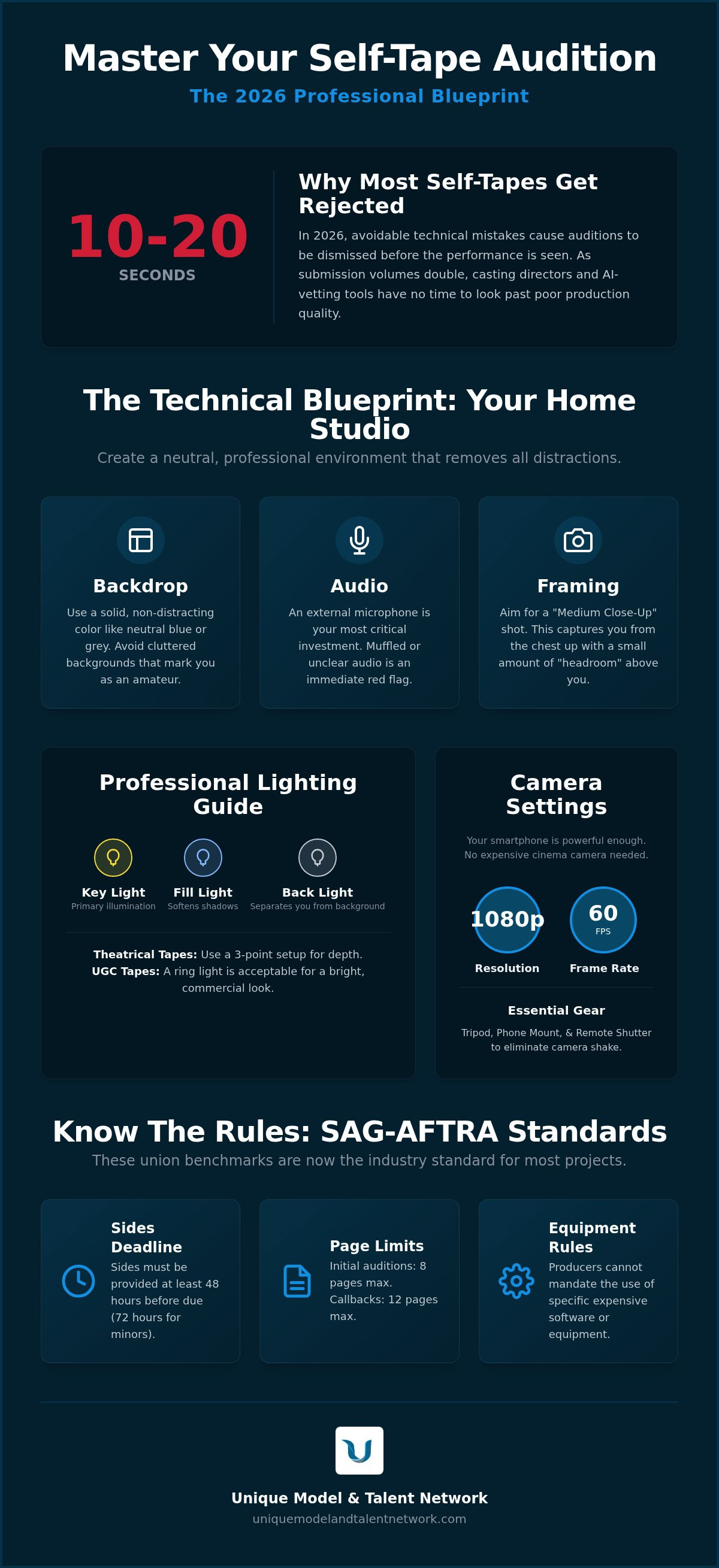
Navigating the 2026 technical requirements is easier when you understand the legal protections provided by SAG-AFTRA. Under current contracts, producers must provide audition sides at least 48 hours before the tape is due, or 72 hours for minors. Initial auditions are limited to 8 pages, and callbacks to 12. Crucially, they cannot mandate that you use specific expensive software or equipment. While these rules protect union members, non-union projects are rapidly adopting these same benchmarks. High standards for your self tape audition tips workflow will ensure you're prepared for any project, regardless of its union status.
The Technical Blueprint: Professional Lighting, Audio, and Backdrop Standards
Technical quality isn't about vanity; it's about removing distractions so your performance can take center stage. These self tape audition tips focus on creating a neutral environment that mimics a professional studio. Your backdrop should be a solid, non-distracting color like neutral blue or grey. Avoid the "cluttered bedroom" mistake that immediately marks you as an amateur. Casting directors in 2026 expect a clean, professional frame where you are the only focus.
Lighting has evolved beyond the basic ring light. While high-output ring lights are convenient for quick UGC tapes, theatrical auditions often require the depth of a three-point lighting setup. This involves a key light for primary illumination, a fill light to soften shadows, and a back light to separate you from the background. Proper framing is equally vital. You should aim for a "Medium Close-Up," which captures you from the chest up with just a small amount of "headroom" above your hair.
Smartphone vs. Professional Camera
You don't need a $5,000 cinema camera to book work. Most modern smartphones are more than capable if you optimize your settings. Set your camera to 1080p at 60fps. This provides smooth, lifelike motion without the massive file sizes of 4K that often crash submission portals. Use a sturdy tripod and a phone mount to eliminate camera shake entirely. A remote shutter is another essential tool; it lets you start recording without reaching for the lens and ruining your framing. The "commercial look" in self-tape lighting is characterized by bright, high-key illumination that eliminates shadows and keeps the actor's eyes sparkling and clear. If you're unsure if your setup hits the mark, getting professional reel reviews can provide the clarity you need.
Acoustics and Environment
Audio quality is often the deciding factor in whether a tape is watched in full. Casting directors value a "clean" audio track over high-resolution video because muffled lines are impossible to evaluate. You can remove "room ring" and echo by adding soft surfaces like rugs or blankets just out of frame. Choose a recording time when external noise, such as traffic or neighbors, is at a minimum. An external lavalier or shotgun microphone is a far better investment than a new camera body. These professional self tape audition tips ensure your technical foundation is rock solid, allowing your talent to be the star of the show.
Performance Mastery: Acting for the Camera and Nailing the Slate
Your technical setup provides the frame, but your performance fills it. Professional self tape audition tips often focus on the gear, yet the most common reason for a "pass" is a lack of connection with the material. In 2026, casting directors aren't just looking for a good read; they're looking for an actor who understands how to translate intimacy through a digital lens. This requires a shift in how you use your eyes and how you manage the moments of silence between your lines.
Eye lines are the foundation of on-camera intimacy. You should never look directly into the camera lens unless the sides specifically instruct you to do so. Instead, place your reader (or a physical marker like a piece of tape) just to the left or right of the lens. This creates a "three-quarter" view of your face, allowing the camera to capture the nuance in both eyes. If you have multiple characters to address, place them on opposite sides of the lens to clarify the geography of the scene without turning your head too far away from the camera.
The "Three-Second Rule" is a high-level technique that separates professionals from amateurs. Instead of starting your performance the moment you hit record, allow for three seconds of internal life before your first line. This ensures you're already living in the world of the character when the scene begins. It prevents the "actor-waiting-for-a-cue" look that breaks the immersion for a viewer. Similarly, hold the moment for three seconds after your final line before you stop the recording. These "bookends" provide editors with the space they need and show that you're in total control of the character's emotional arc.
Your slate is your professional brand in five seconds. It's often the first thing a casting director sees, so it must be warm, confident, and concise. Don't overthink it; just state your name, height, and location as requested. If you're looking to expand your digital presence beyond the audition room, check out The Ultimate Guide to Building an Acting Portfolio That Books in 2026.
The Art of the Reader
Your reader should be a support system, not a scene-stealer. Choose someone with a neutral, grounded delivery who won't overpower your performance. If a live partner isn't available, digital reader apps are a standard 2026 solution for maintaining your workflow. Just ensure the reader’s volume is slightly lower than yours. This keeps the focus on your voice and prevents the casting director from being distracted by a loud, off-camera performance.
Editing and Post-Production
The 2026 standard for editing is simplicity. Use clean cuts between your slate and your scenes. Avoid transitions like fades or dissolves, as they look amateurish and waste time. For color correction, keep it natural. Your skin tone should look "editorial" and true to life. Finally, name your files using the "Name_Role_Agency" format. This small detail helps casting directors stay organized and marks you as a disciplined professional who understands the logistics of the industry. Following these self tape audition tips will ensure your work is viewed with the respect it deserves.
The Professional Strategy for Finding and Vetting Casting Calls
Technical perfection is meaningless if you're submitting for the wrong roles or falling for industry scams. In 2026, the sheer volume of digital listings requires a disciplined vetting process to ensure your time is spent on legitimate, high-value opportunities. These self tape audition tips focus on the "business" of acting, helping you distinguish between a career-building project and a distracting dead end. Success in a remote-first industry depends on your ability to act as your own talent scout and business manager.
- Step 1: Identify your "Type." Use casting websites to filter roles that align with your current brand. Don't spray and pray; target roles where your specific look and skill set provide a competitive edge.
- Step 2: Vet the production company. Research the producers and director. A legitimate project will have a searchable footprint on professional databases or industry news sites. If a listing lacks a clear production entity, proceed with caution.
- Step 3: Analyze the breakdown for technical specs. Some 2026 breakdowns specifically request vertical (9:16) framing for social-first campaigns, while theatrical work remains strictly horizontal. Missing this detail is an automatic disqualification.
- Step 4: Personalize your submission note. Highlight specific skills requested in the breakdown, such as language fluency or athletic abilities. A concise, professional note can be the bridge that gets your tape viewed.
- Step 5: Confirm union status. Know whether you're submitting for SAG-AFTRA, non-union, or "Financial Core" work. This affects your pay, legal protections, and future eligibility.
Reading the Breakdown: Deconstructing the Character
Breakdowns often use coded language that dictates your performance choices. "Protagonist energy" usually implies a need for traditional leading-man or leading-woman qualities, while "Character face" suggests a search for unique, memorable features. Principal roles involve significant dialogue and story impact, whereas Featured or Background roles have less screen time. Be wary of red flags like "pay-to-play" scams where you're asked to pay a fee just to have your tape viewed. A professional project pays you; it never works the other way around.
The Hidden Job Market and Direct Invites
While public sites are a starting point, the most lucrative self-tape opportunities often circulate within private, vetted networks. Building a reputation within a managed community leads to direct invites from casting directors who trust the platform's standards. This moves you away from the noise of public listings and into a space of career-focused development. For more on this, consult The Ultimate Acting Industry Networking Platform Guide for 2026. If you're ready to stop shouting into the void, you can apply for The Network Membership today to access exclusive, high-level workshops and reel reviews.
Accelerate Your Career with the Unique Model & Talent Network
Recording a scene is only half the battle. Without an objective, professional eye to review your work, you're essentially shouting into a digital void. The Unique Model & Talent Network acts as that essential bridge, providing the "Expert Eye" your tapes have been missing. By joining a managed community, you move away from the unorganized chaos of social media and into a space where high standards are the norm. This environment allows you to apply the self tape audition tips you've learned with the confidence that a professional is watching and evaluating your progress.
One of the most effective ways to refine your craft is through acting workshops online. These sessions offer real-time feedback on your performance and technical setup, ensuring you aren't making habitual mistakes that could cost you a booking. If you're looking to diversify your professional presence, modeling career coaching provides a structured path for transitioning from a beginner to a seasoned pro who understands the business side of the industry.
Professional Portfolio & Reel Reviews
A generic reel often gets ignored because it fails to capture a casting director's attention in the first few seconds. Our experts help you front-load your best work, ensuring your most impactful scenes are seen immediately. You'll receive specific feedback on your self-tape environment from working casting directors who know exactly what current 2026 standards require. Additionally, our monthly skill-building challenges provide a low-stakes environment to test new self tape audition tips and push your on-camera boundaries. This consistent practice ensures that when a major project comes your way, your workflow is already second nature.
Join The Network Membership
The entertainment industry can feel predatory and unorganized, but it doesn't have to be. We position ourselves as a protective mentor, offering a scam-free community where the legitimacy of every opportunity is a priority. Your journey deserves a disciplined and organized foundation. As a member of The Network Membership, you gain access to live industry events, a comprehensive library of resources, and a private network of serious professionals. Stop guessing and start growing your career with the support of people who actually hire talent. Join the Unique Model & Talent Network today to take the next decisive step in your professional development.
Master Your Digital Handshake for 2026
Mastering your home studio and performance nuance is no longer optional. It's the new standard for professional business development in a remote-first industry. By applying these self tape audition tips, you remove the technical friction that often stops a booking before it begins. You've learned how to optimize your technical blueprint and deconstruct character breakdowns; now it's time to move from isolation into a managed professional community.
You don't have to navigate this high-stakes landscape alone. Our private, gated network provides the clarity and career security you need to thrive. Members gain direct access to live workshops with real-world casting directors and receive professional reel and portfolio reviews to ensure their work hits the mark every time. Your talent deserves a platform that matches your level of dedication. Secure your professional edge-Join the Unique Model & Talent Network. It's time to stop shouting into the void and start building the professional bonds that lead to lasting success. Your next big callback is waiting.
Frequently Asked Questions
How do I find legitimate casting calls without an agent?
You can find legitimate work by using verified casting portals like Actors Access or specialized industry databases. Always research a production company's professional footprint before submitting your materials. A more secure strategy is joining a private, vetted community like the Unique Model & Talent Network. This provides direct access to casting directors and protects you from the predatory scams often found on public social media platforms.
What is the best lighting for a self-tape audition at home?
A three-point lighting setup is the professional standard for theatrical auditions. This requires a key light for primary illumination, a fill light to soften shadows, and a back light to separate you from the background. If you're on a budget, a high-output ring light works for commercial or UGC-style tapes. Ensure your lighting is soft and even to avoid harsh shadows that can distract from your performance.
Do I need a professional camera for self-tape auditions?
No, you don't need an expensive cinema camera to book high-level roles. Most modern smartphones are perfect for recording as long as you optimize the settings to 1080p at 60fps. Focus your investment on a dedicated external microphone instead. Casting directors prioritize clear, crisp audio over high-resolution video because muffled lines make a performance impossible to evaluate. Professional sound quality immediately marks you as a disciplined creative.
How long should a self-tape slate be?
Your slate should be concise and professional, typically lasting between 5 and 10 seconds. State your name, height, and location clearly as requested by the casting breakdown. This is your chance to show your natural personality and professional brand before the scene begins. Keep it warm and confident. Unless the instructions specifically ask for profiles or hand shots, stay focused on a friendly, direct introduction to the camera lens.
Where should I look when recording a self-tape?
You should look just off-camera to either the left or right of the lens. Place your reader or a physical marker near the camera to create a natural eye line. This "three-quarter" view allows the camera to capture the nuance in both of your eyes simultaneously. Never look directly into the lens unless the sides specifically instruct you to break the fourth wall. Proper eye lines help create the required intimacy.
How do I send a self-tape file that is too large for email?
Use dedicated file-sharing services like WeTransfer or Dropbox for large video submissions. Most casting portals have specific upload tools with file size limits, typically requiring files to be under 500MB. If your file exceeds these limits, use compression software to reduce the size without sacrificing visual quality. Always follow the naming conventions requested in the breakdown, such as "Name_Role_Project," to keep the casting team organized.
Can I use a virtual background for my self-tape?
Avoid using virtual backgrounds for professional auditions because they often create distracting digital glitches around your hair and shoulders. Instead, use a solid, neutral wall or a professional fabric backdrop in grey or soft blue. A physical, non-distracting background ensures the casting director stays focused entirely on your acting. These self tape audition tips prioritize a clean, cinematic look that mimics the environment of a professional casting studio.
What should I wear for a self-tape audition?
Wear solid colors that complement your skin tone and suggest the character's world without being a literal costume. Avoid busy patterns, large logos, or bright white, as these can distract the camera's auto-exposure settings. If you're auditioning for a professional role, a simple, well-fitted top works best. The goal is to look like a polished version of the character. Following these self tape audition tips helps you present a cohesive professional brand.


