

The casting director isn't looking for the "best" actor in the room; they're looking for the professional who poses the least amount of risk to the production. If you've ever felt invisible after sending a "perfect" self-tape or wondered why your strongest performances aren't resulting in offers, you're experiencing a common industry frustration. It's easy to feel lost in a crowded market when the criteria for success seem to change daily. To break through, you must master what do casting directors look for beyond just a great monologue. It's about shifting your mindset from being a performer to being a reliable, vetted business partner.
This guide provides the clarity you need by revealing the specific professional traits, performance choices, and updated 2026 standards that define today's booking talent. You'll discover how to leverage the latest industry shifts to your advantage while building a sustainable reputation. We'll explore the psychology behind casting decisions, the technical expectations for your digital package, and the unspoken business habits that turn "good" auditions into consistent bookings. By understanding the casting director's perspective, you can stop guessing and start building a career based on tangible results and professional security.
Key Takeaways
- Shift your perspective to see casting directors as professional problem-solvers who prioritize talent capable of mitigating production risk and delivering consistent results.
- Master the "First 10 Seconds" rule by optimizing your slate and energy to command attention before you even deliver your first line of dialogue.
- Gain definitive clarity on what do casting directors look for regarding creative choices, helping you avoid safe, neutral performances that fail to leave a lasting impression.
- Identify the logistical markers of a professional, such as reliability and communication, which serve as the foundation for a sustainable career in a competitive market.
- Learn how to bridge the gap between aspiring and vetted talent through direct access to industry experts and real-time feedback on your portfolio and reels.
The Psychology of the Casting Room: Why CDs are Problem-Solvers
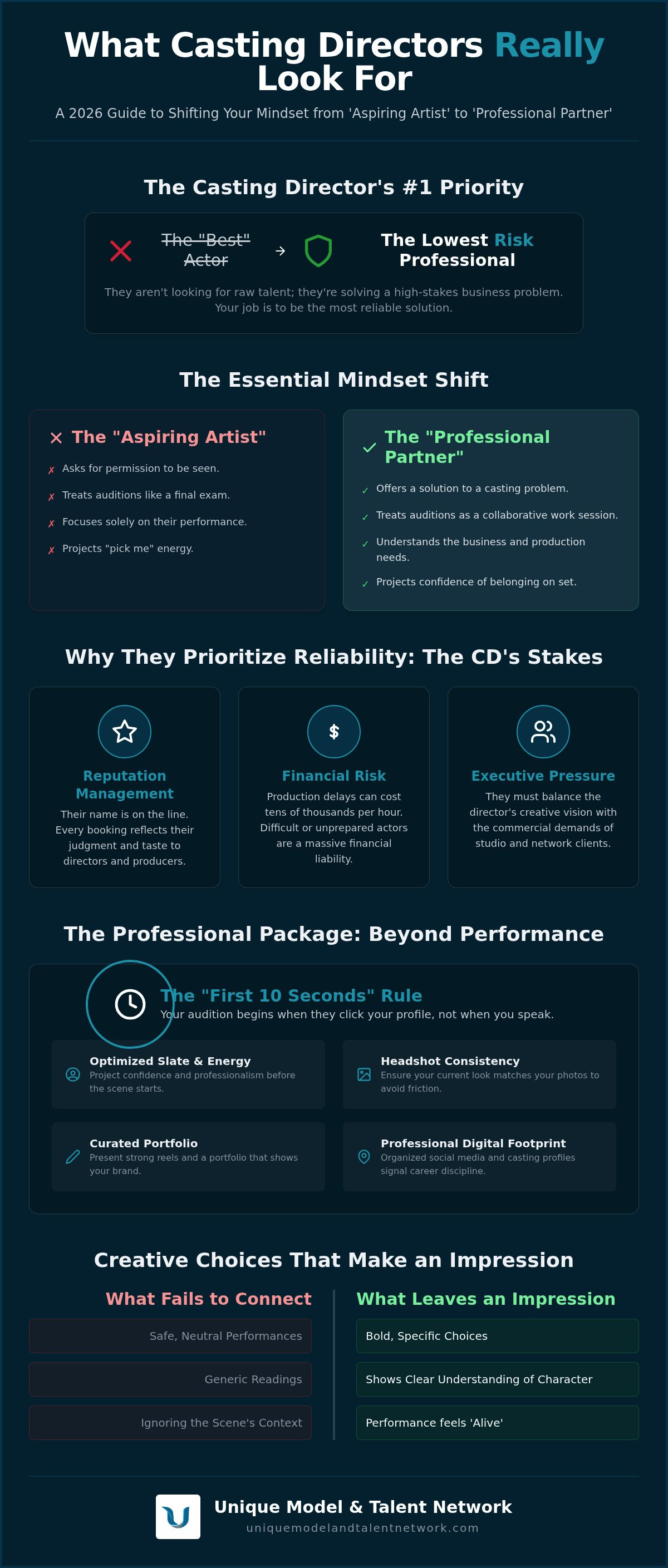
Casting directors are the ultimate gatekeepers, but they are also the people most desperate for you to succeed. They are hired to solve a complex puzzle under tight deadlines. When you submit a tape or walk into a room, their primary question isn't just "Are they talented?" It is "Can I trust this person with the producer's money?" Understanding the casting process means recognizing that every role is a potential liability. If a CD recommends you, they are putting their professional reputation on the line.
Most performers approach an audition with an "aspiring" mindset, essentially asking for permission to be seen as an artist. A professional, however, understands that the CD is under fire from directors, studio executives, and network clients who all have conflicting demands. These stakeholders want a specific look, a certain level of experience, and a guarantee that the actor won't cause delays. When asking what do casting directors look for, the answer is often "the path of least resistance." They want the actor who makes their recommendation look like a stroke of genius rather than a gamble.
Understanding the CD's Stakes
A single bad casting choice can derail a CD's career and future contracts. If an actor shows up late, forgets their lines, or creates a toxic environment on set, the casting director is the person who answers for it. In 2026, production delays can cost tens of thousands of dollars per hour in union overtime and equipment rentals. Because of these stakes, CDs often prioritize reliability and business acumen over raw, unpolished talent. They need to know you are "set-ready" and capable of handling the high-pressure environment of a professional production without constant hand-holding.
- Reputation Management: Every booking is a reflection of the CD's taste and judgment.
- Financial Risk: Difficult actors increase insurance premiums and production costs.
- Executive Pressure: CDs must satisfy the creative vision of the director while meeting the commercial requirements of the studio.
Moving from 'Pick Me' to 'I’m the Partner'
Stop treating the audition like a final exam and start treating it like a collaborative work session. You are there to show how you would function as a member of the creative team. This shift in energy is palpable; it moves you away from the "pick me" desperation and toward the confidence of an established professional. When you analyze what do casting directors look for, you'll see they need a bridge between the script and the screen. You aren't just looking for a job; you're offering a solution to their specific casting problem. Projecting the energy of someone who already belongs on set helps the CD visualize you in the final cut.
The problem-solver mindset is the commitment to arriving fully prepared, technically proficient, and emotionally flexible so that the casting director can stop searching and start producing.
The Professional Package: Beyond the Performance
In the digital-first environment of 2026, your audition begins the moment a casting director clicks on your profile, not when you deliver your first line. This makes the "First 10 Seconds" rule more critical than ever. Casting directors often determine your level of professionalism based on your slate and the energy you project before the scene even starts. If you appear hesitant, technically unprepared, or visually different from your headshot, you've already created a friction point. When examining what do casting directors look for, it is clear they prioritize talent who present a "vetted" package that suggests they are ready for the fast-paced nature of a professional set.
Building a professional acting portfolio is no longer about just having a few decent photos; it is about curated evidence of your brand. This includes your social media presence and casting site profiles, which now function as a digital extension of your resume. CDs frequently cross-reference your online presence to gauge your marketability and "likability" within a cast. If your digital footprint is unorganized or unprofessional, it signals a lack of career discipline. Your marketing materials must be cohesive, high-quality, and reflective of the roles you are actually capable of booking today.
The Anatomy of a Booking-Ready Headshot
Specificity is the currency of the current market. Generic "pretty" shots are being replaced by character-driven looks that tell a specific story. Casting directors need to see exactly where you fit in their current breakdown. This means your wardrobe should reflect current 2026 trends without being distracting, and your expression must convey a clear "type." Most importantly, you must adhere to the "Look-Like-Your-Photo" mandate. Heavy retouching is a breach of professional trust. If you show up to a callback looking significantly different than your submission, you've wasted the production's time and damaged your reputation.
Optimizing Your Casting Site Profiles
Industry-standard platforms are searchable databases. To stand out, you must treat your profile like an optimized landing page. Use specific keywords in your bio and special skills sections that align with high-demand roles. For instance, being "fluent in Spanish" or having "certified stage combat training" can filter you into smaller, more competitive pools. Regarding your reel, a 30-second high-quality clip that showcases your current "type" is far more effective than a three-minute montage of outdated work. If you want a second pair of eyes on your materials, our Portfolio & Reel Reviews provide the expert feedback necessary to align your package with industry standards.
- Technical Standards: Ensure all video clips are at least 1080p with professional lighting and sound.
- Skill Verification: Only list special skills you can perform on camera today without a rehearsal.
- Digital Cohesion: Your headshot, reel, and social media should all tell the same professional story.
Creative Choices: What Makes a Performance 'Alive'?
Playing it safe is the fastest way to remain anonymous in a casting database. Many actors fall into the "Neutral Performance" trap, delivering a technically proficient but emotionally flat read because they are afraid of making the "wrong" choice. If your goal is to book, you must understand that casting directors are searching for a spark of life, not a perfect recitation of lines. When you analyze what do casting directors look for, you'll find they prioritize actors who take creative risks that reveal a unique point of view. A messy, authentic moment that feels human will always beat a polished performance that feels manufactured.
To succeed in film industry auditions, you must interpret sides with an eye for conflict and subtext. This requires more than just memorization; it requires a deep dive into the character's immediate needs. You want to make a choice so specific that the CD feels they are seeing the character for the first time. However, this boldness must be balanced with directability. If you are called back, the director will test your flexibility. They want to know you can take a note and pivot without losing the core of your performance.
Script Analysis for the Modern Actor
Your scene is won or lost in the first three lines. This is where you establish the "hook" that keeps the viewer from hitting the stop button. Identify your character's primary objective and pinpoint exactly where that objective shifts during the scene. A bold choice should always remain grounded in the world of the project. If you're auditioning for a gritty procedural, your "boldness" looks different than it would for a multi-cam sitcom. Focus on the truth of the situation rather than the theatricality of the performance.
The Self-Tape Technical Edge
In 2026, technical errors are no longer excusable. High-quality video, clear audio, and balanced three-point lighting are the non-negotiable baselines for any professional submission. A distracting background or poor framing can kill even the most brilliant performance by pulling the CD's attention away from your eyes. The "Eyeline" secret is vital; keep your reader close to the camera lens so the CD can see the nuance in your expression. This creates an intimate connection that makes the performance feel immediate and alive. If you are struggling with your setup, our Live Industry Workshops offer real-time guidance on optimizing your home studio for maximum impact.
- Objective: What does the character want in this specific moment?
- Stakes: What happens if they don't get it?
- Vulnerability: Where is the character's humanity most visible?
- Technical Precision: Is your sound and lighting professional enough to be seen?
The Unspoken Criteria: Reliability and Reputation
Beyond the creative choices and technical standards discussed previously, your reputation is your most valuable currency. The entertainment industry is significantly smaller than it appears, and casting directors are in constant communication with one another. When considering what do casting directors look for, remember that they are essentially hiring a temporary coworker for a high-pressure environment. Would the crew want to spend 12 hours a day with you in a cramped location? If you are talented but difficult, you represent a risk to the production's morale and budget. CDs maintain "Must-Hire" lists of actors who are gifted, professional, and a joy to have on set. Conversely, "Red Flag" lists exist for those who lack basic professional etiquette or create friction during the casting process.
Punctuality and clear communication are the primary logistical markers of a professional. If you are late to a callback, slow to confirm a booking, or fail to follow specific submission instructions, you signal that you don't value the production's time. In 2026, where production schedules are tighter than ever, these small lapses can end a relationship before it even begins. Handling follow-up with grace is equally vital. A simple, professional thank-you note after a session can solidify a positive impression, provided it adheres to established industry etiquette and avoids being overbearing.
Building Long-Term CD Relationships
A "good" audition that doesn't lead to an immediate booking is never a waste of time; it is an investment in a future project. Casting directors often keep files on performers who were the "second choice" for years, waiting for the right role to emerge. To stay on their radar without becoming a nuisance, focus on high-value touchpoints rather than generic emails. Live industry workshops are an excellent way to build face-to-face rapport in a controlled, professional environment. These sessions allow you to demonstrate your work ethic and personality beyond the constraints of a 30-second slate, proving you are a reliable partner for future projects.
Professionalism in the Digital Age
Your public social media posts are now a permanent part of your vetting process. Casting directors often look for consistency between your professional "package" and your personal conduct before making a final recommendation to a client. Avoid venting about the industry, complaining about "bad" auditions, or sharing sensitive set information, as these are immediate red flags for any production. Being part of a trusted, private community helps establish your "vetted" status and provides a protective layer of professional accreditation. Handling rejection with the composure of a seasoned veteran is what separates the hobbyists from the elite talent. If you are ready to refine your professional standing and build these critical bonds, consider joining The Network Membership for direct access to industry insiders who can help guide your career trajectory.
- The Likability Factor: Your personality on set is just as important as your talent in the room.
- Communication: Fast, clear, and professional responses build trust with casting offices.
- Punctuality: Being early is the only way to be on time in a professional production environment.
How the Unique Model & Talent Network Opens the Door
The entertainment industry often feels like a "black box" where decisions are made behind closed doors, leaving talent to guess why they aren't booking. When you understand what do casting directors look for, you realize they value the pre-vetted nature of a professional community over the unorganized chaos of public social media. Being part of a trusted network changes the equation. It shifts you from being an unknown risk to a known professional who has been trained to meet the highest industry standards. Our private, moderated environment ensures that your growth remains the priority, removed from the distractions and informal communication methods that often hinder career progress.
One of the most significant hurdles for emerging talent is gaining direct access to the decision-makers who can move their careers forward. Through our acting workshops online, members get the rare opportunity to perform and receive real-time feedback from guest casting directors. This isn't just about practicing a scene; it's about receiving authoritative Portfolio & Reel Reviews that align your marketing materials with 2026 standards. By having your work vetted by industry experts, you build a reputation for quality and reliability before you even step into a producer session.
Bridging the Gap Between Talent and Casting
Our live Industry Expert Q&A sessions are designed to demystify the casting process, providing you with the internal perspectives usually reserved for high-level agencies. You'll learn exactly how CDs evaluate talent in the current market and how to avoid common professional pitfalls. To ensure your skills remain sharp, our Monthly Skill-Building Challenges push you to produce high-quality work consistently. This rhythmic approach to professional development helps you transition from "aspiring" to "member" status, signaling to the industry that you are serious about your craft and capable of delivering results under pressure.
- Direct Access: Engage with casting directors and industry leaders in a focused, professional setting.
- Expert Feedback: Receive concrete, actionable critiques on your reels, headshots, and audition technique.
- Skill Acceleration: Participate in challenges that force you to treat your acting like the high-level business it is.
- Community Trust: Leverage the "Vetted Talent" advantage that comes with being part of a respected network.
Your Career Roadmap Starts Here
Managing a career in the entertainment industry as a solo endeavor often leads to burnout and missed opportunities. The Unique Model & Talent Network acts as your protective mentor, providing the structure and community support necessary for long-term success. Instead of struggling with the uncertainty of DIY career management, you gain a clear roadmap and a peer network of professionals who value integrity and efficiency. This collaborative environment fosters the professional bonds that are essential for a sustainable career in 2026. If you are ready to remove the guesswork and start being seen as the solution to a CD's casting problem, the time to act is now. Join the Unique Model & Talent Network and get noticed today.
Take Command of Your Casting Career
Success in the 2026 market requires more than just talent; it requires a commitment to professional excellence and a deep understanding of the casting director's role as a problem-solver. By mastering your digital package, making bold creative choices, and upholding a reputation for reliability, you position yourself as a low-risk, high-reward partner for any production. Understanding what do casting directors look for is the first step toward transforming your career from a series of attempts into a strategic business plan. You've learned that the "First 10 Seconds" and your "vetted" status are just as important as the lines you deliver on camera.
If you're ready to stop guessing and start booking, it's time to step into a space designed for your success. We provide the clarity and access you need to navigate this industry with confidence. Through our network, you'll gain direct access to industry decision-makers, receive expert portfolio reviews by professional casting directors, and thrive in a distraction-free professional growth environment. Join the Professional Community at Unique Model & Talent Network and start building the career you've always envisioned. Your next major booking is waiting for the professional version of you.
Frequently Asked Questions
Do casting directors actually watch the whole self-tape?
Casting directors rarely watch a self-tape from beginning to end unless you've already made it onto their shortlist. They usually make a definitive decision within the first 10 to 15 seconds based on your energy, slate, and initial delivery. If your "First 10 Seconds" don't command attention or suggest you're a fit for the role, they'll quickly move to the next submission to save time.
How much does my social media following matter to a casting director?
While a large following can be a tie-breaker for commercial or influencer-led projects, it rarely outweighs talent and professional vetting in theatrical casting. However, your digital footprint is part of what do casting directors look for when evaluating your brand and "likability." They care more about whether your public conduct suggests you'll be a reliable, low-risk partner on a professional set.
What should I do if I haven't heard back after a callback?
The most professional move is to assume you didn't book the role and immediately focus on your next audition. Production timelines are incredibly tight, and "no news" is the industry standard for talent who aren't moving forward. Waiting for a response leads to unnecessary anxiety; instead, treat the callback itself as a win and keep your momentum moving toward new opportunities.
Is it okay to ask a casting director for feedback after an audition?
It's generally considered a breach of professional etiquette to ask a casting director for individual feedback. Their schedules don't allow for personalized coaching, and making such a request can signal that you're an "aspiring" amateur rather than a seasoned professional. If you need a critique, seek out expert reviews or workshops within a private community designed for skill-building.
What are the biggest red flags that make a casting director stop watching?
Technical failures like poor audio, grainy video, or distracting backgrounds are immediate red flags that suggest you aren't "set-ready." Beyond technical issues, failing to follow specific submission instructions or appearing "difficult" during your slate will cause a CD to hit stop. They're looking for professionals who mitigate risk, so any sign of unreliability is a reason to pass.
How do I get noticed by casting directors if I don't have an agent yet?
You can build visibility by maintaining high-quality profiles on self-submission sites and participating in live industry workshops. Focus on creating a "vetted" portfolio that proves you understand the business side of the craft. Networking within a private, moderated community allows you to build the professional bonds and reputation necessary to get noticed by decision-makers without a middleman.
Should my headshot always be a recent photo, even if I changed my hair?
Your headshot must be a 100% accurate representation of how you look today. If you've changed your hair length, color, or facial hair, you need new photos immediately to avoid the "Look-Like-Your-Photo" mandate violation. Showing up to a set or callback looking different than your submission is a major logistical failure that damages your professional reputation.
What is the difference between a commercial and a theatrical casting director?
Commercial casting directors are primarily looking for relatable energy, specific "types," and the ability to represent a brand's message quickly. Theatrical casting directors focus on your depth of craft, character interpretation, and how you fit into a long-term narrative. While both prioritize professionalism, the answer to what do casting directors look for depends on whether they're selling a product or telling a complex story.


