

A forgotten line doesn’t have to derail an audition. If you’re wondering what to do if you forget your lines in an audition, take a breath, stay connected to your scene partner, and continue from the moment you’re in. If you have the sides, glance down, find your place, and pick up the line instead of letting one blank moment take over.
It’s natural to worry that a casting team will judge your memory, but your preparation and presence matter too. Practicing with a friend or family member can make the scene more familiar. Speaking aloud and moving as you rehearse can also help you find a grounded rhythm.
This guide covers practical ways to rehearse with a partner, use movement and voice, and recover calmly when a line slips away. You’ll also learn when a brief pause or a glance at your sides can help you stay in the scene, so you can focus less on perfection and more on a thoughtful performance.
Key Takeaways
- Ask a friend or family member to read the other role so you can practice listening and responding, not just reciting.
- Pair your lines with natural movement and spoken repetition to make rehearsal feel more active and connected.
- If a line slips away, breathe, stay present with your scene partner, and use your sides when needed.
- Choose whether to pause, paraphrase briefly, or ask for a prompt based on what helps you continue the scene clearly.
1. Practicing with friends or family
Ask a friend or family member to read the other character’s lines while you work from the audition sides. This makes rehearsal a listening exercise, not just a test of recall. Choose a scene with clear cue lines, and ask your reader to keep a steady pace without prompting unless you request it.
Try one run with the script in hand, then another with the pages nearby but out of direct view. If a line vanishes, pause briefly, find your place, and continue from the next cue. Rehearse what to do if you forget your lines in an audition so your response feels familiar, not improvised under pressure.
For a cold read, focus on understanding the scene and responding to your reader’s cues; don’t expect to memorize the text before you’ve had time to explore it. For a memorized audition, practice the full scene with a partner and keep the sides nearby as a safety net. In either case, stay engaged with the other actor instead of retreating into silent recall.
Theater, film, and television auditions can follow different formats, so follow the instructions you receive. For a theater scene, rehearse sustaining the exchange with your scene partner. For film or television, practice delivering the moment naturally while maintaining your eyeline and frame. Keep your sides close if the format allows.
Casting directors need to see your choices and how you handle the material, not hear a long apology after a missed word. If you lose your place, say, “I’ve lost my line. May I find it and continue?” Then look at the sides, locate the cue, and resume. A quiet breath and the feeling of both feet on the floor can help steady your attention.
Restart only if you can’t recover the scene’s place or the reader asks you to begin again. Otherwise, pause briefly, return to the next cue, and continue. Practicing this sequence with a family member can help you move forward without letting one missed line take over the audition.
2. Using movement and speaking aloud
Say every line aloud as you move along a simple, repeatable path. For example, walk from a chair to a doorway as your character crosses the room. Speaking and moving together can connect dialogue with the scene’s actions, rather than leaving you to rehearse words as isolated sounds. Keep the movement easy to repeat and make sure it doesn’t compete with the emotional shifts in the text.
Choose actions that fit the scene, such as setting down a cup, turning toward a window, or stepping closer to a scene partner. Speak the line as you move, then try it again while standing still. Notice whether movement helps you recall the thought behind the words. If a gesture feels distracting or artificial, simplify it and focus on the character’s intention.
Use the script as a working tool. Read a short exchange aloud, look up, and deliver the next line while moving naturally. Then check the page for the exact wording. This helps you practice both the scene’s flow and the writer’s language. Don’t rush through the passage; leave space for your partner’s cue and your response.
Change the rehearsal conditions once the lines feel familiar. Try the scene while walking slowly, then deliver it seated or standing in one place. If you’re preparing a self-tape, rehearse within the camera frame and keep gestures contained. These variations help you stay connected to the material without relying on one exact route or posture. For structured practice alongside your own rehearsal, explore industry skill-building opportunities.
Keep the words in focus as you move, rather than treating movement as a separate task. Choose a comfortable way to cross the space and keep speaking as you go. The aim is to connect the words with being in motion, giving you another way to practice retaining them. If you lose a line, pause, find your place, and start speaking again as you move. Return to this simple pairing of movement and speech as you rehearse.
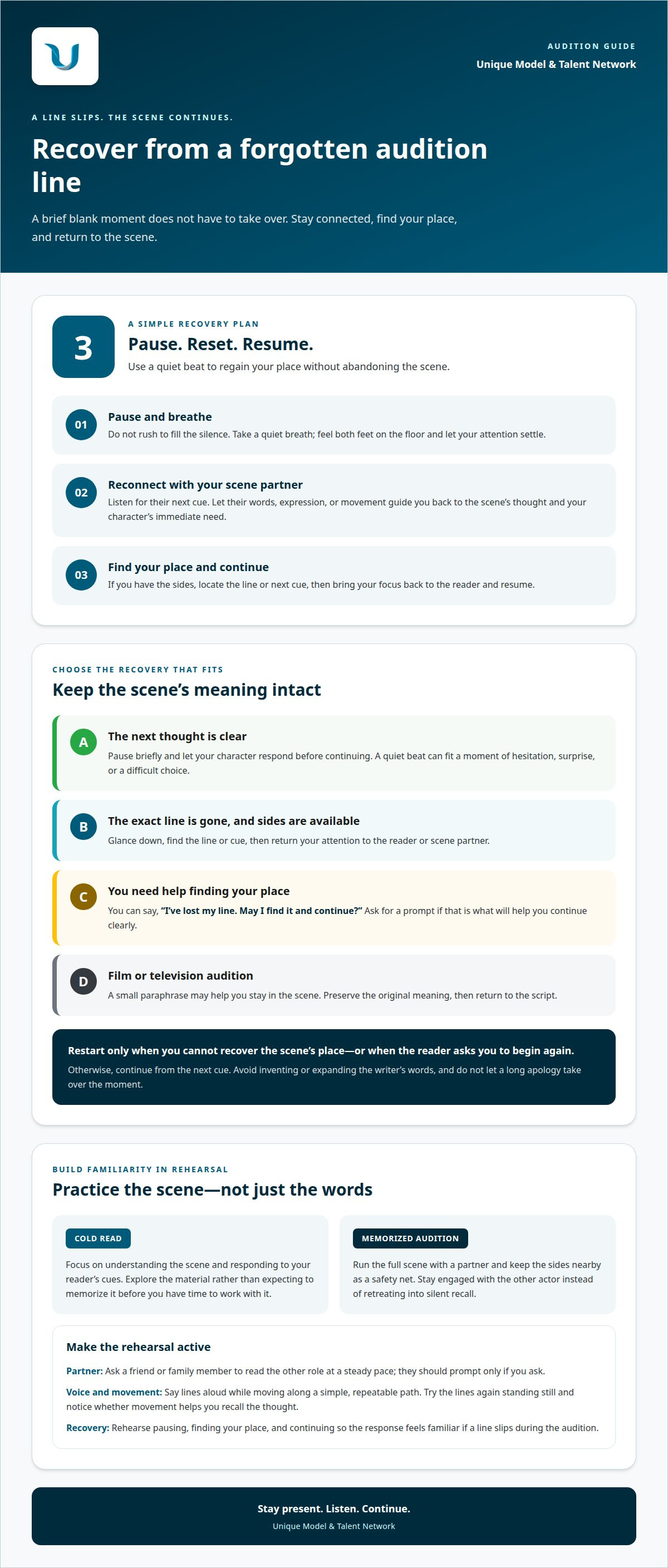
3. How can actors recover from a forgotten line without breaking character?
When a line disappears, don’t rush to fill the silence. Take a quiet breath, keep your attention on your scene partner, and let the character’s immediate need guide your next move. For example, if you’re playing someone asking for help, focus on getting an answer rather than showing frustration with yourself. That shift gives you an active objective while you regain your place.
Listen for the other actor’s next cue. Their words, expression, or movement may reconnect you with the scene’s thought, even if you can’t recall the exact line. If you miss a cue, respond in character to what they’re doing instead of staring into space. A brief pause can fit the moment: a character might hesitate before answering, weigh a difficult choice, or take in surprising news.
If the text still won’t come back, use the sides when they’re available. Look down, find the line, then bring your focus back to the reader or scene partner. Don’t invent, rewrite, or expand the writer’s words to cover the gap. In a film or television audition, a small paraphrase may help you stay in the scene, but preserve the original meaning and return to the script.
Once you recover, continue without repeatedly apologizing or watching the casting team for a reaction. An audition isn’t only a memory test; it also gives you a chance to show listening, intention, and adjustment. Treat the missed line as a brief interruption, not a new scene. For example, if your character was making a request, return to its purpose and let your next scripted line carry the moment forward.
A rehearsed recovery plan can reduce hesitation: pause, reset to neutral, and resume where you left off. Focus on helping your scene partner rather than on yourself.
4. Should you pause, paraphrase, or ask for a prompt when you forget audition lines?
Choose the recovery that preserves the scene’s meaning and follows the audition format. If the next thought is clear, pause briefly and let your character respond before continuing. A silent beat can suit a moment of surprise or hesitation. Keep your attention on your scene partner, not on hiding the pause from the casting team.
In television and film auditions, a small amount of paraphrasing can help you stay engaged in the scene. Preserve the original intention, relationship, and essential information. For example, if the scripted line asks a friend to stay, a brief request with the same meaning can carry the moment. Don’t add a new idea, rewrite the scene, or expand the writer’s line into a speech.
Ask for a prompt if you can’t find your place and the sides don’t help. Keep the request brief and professional: “Could I have the cue, please?” Then listen for the reader’s line, reconnect with the scene, and continue. If you’re working from sides, looking down to find the missed text is often the simplest way back. Don’t guess at wording that changes the scene.
Restart if you’ve lost the sequence and can’t rejoin cleanly, or if the reader or casting team offers one. Otherwise, resume from the next clear cue instead of restarting automatically. If you’re unsure, state what you need plainly: “May I take that line again?” Avoid a lengthy apology; one concise acknowledgment keeps attention on the work.
Before the audition, rehearse each option with a partner: pause and continue, check the sides, ask for a cue, or request a restart. Decide based on whether you know the scene’s next beat, whether the script is available, and whether your recovery preserves the writer’s meaning. This simple decision process can help you stay composed without forcing a line that isn’t there.
Unique Model & Talent Network: The Network Membership
Unique Model & Talent Network gives aspiring actors a place to keep developing their craft beyond one audition. If you want structured opportunities to build your performance skills and gain industry perspective, The Network Membership is a natural next step.
Use Live Industry Workshops to keep learning, Portfolio & Reel Reviews to refine how you present your work, and Monthly Skill-Building Challenges to maintain a regular creative practice. These offerings support continued development, but they don’t replace rehearsing your specific audition sides or following casting instructions. They can help you approach future auditions with stronger preparation habits and a clearer sense of your professional goals.
If you’re ready to continue developing your audition skills within a professional community, contact Unique Model & Talent Network or visit uniquemodelandtalentnetwork.com.
Build a Steadier Audition Practice
Knowing what to do if you forget your lines in an audition is part of developing a repeatable approach to the work. Carry that preparation into your next scene with a clear rehearsal intention, such as staying connected to your scene partner or making each choice specific. Afterward, reflect on what helped you stay present and what you want to practice next. That turns each audition into useful experience, rather than a verdict on your potential.
Career growth also comes from having thoughtful spaces to keep learning and refine your professional direction. If you’re ready to continue building your skills within an industry-focused community, explore your next step with Unique Model & Talent Network.
Keep showing up prepared, curious, and willing to grow. Each scene is another opportunity to make your work more grounded and fully your own.
Frequently Asked Questions
What should you do immediately if you forget a line during an audition?
Rejoin at the next clear thought instead of trying to reconstruct every missing word. If the reader has moved on, use their latest cue to understand where the exchange stands. For example, respond to the question they just asked, then continue with the next line you can place. If you can’t identify it, briefly ask to locate your place in the sides.
How can you prepare to reduce the risk of forgetting lines at an audition?
Build memory anchors around the scene’s sequence, not just individual sentences. Write down the lines, then note each beat’s objective, such as persuading, refusing, or changing the subject. Test yourself by starting from different cue points instead of always beginning at the top. You can also record a run-through and listen during downtime, then review the trickiest passage before sleep.


