

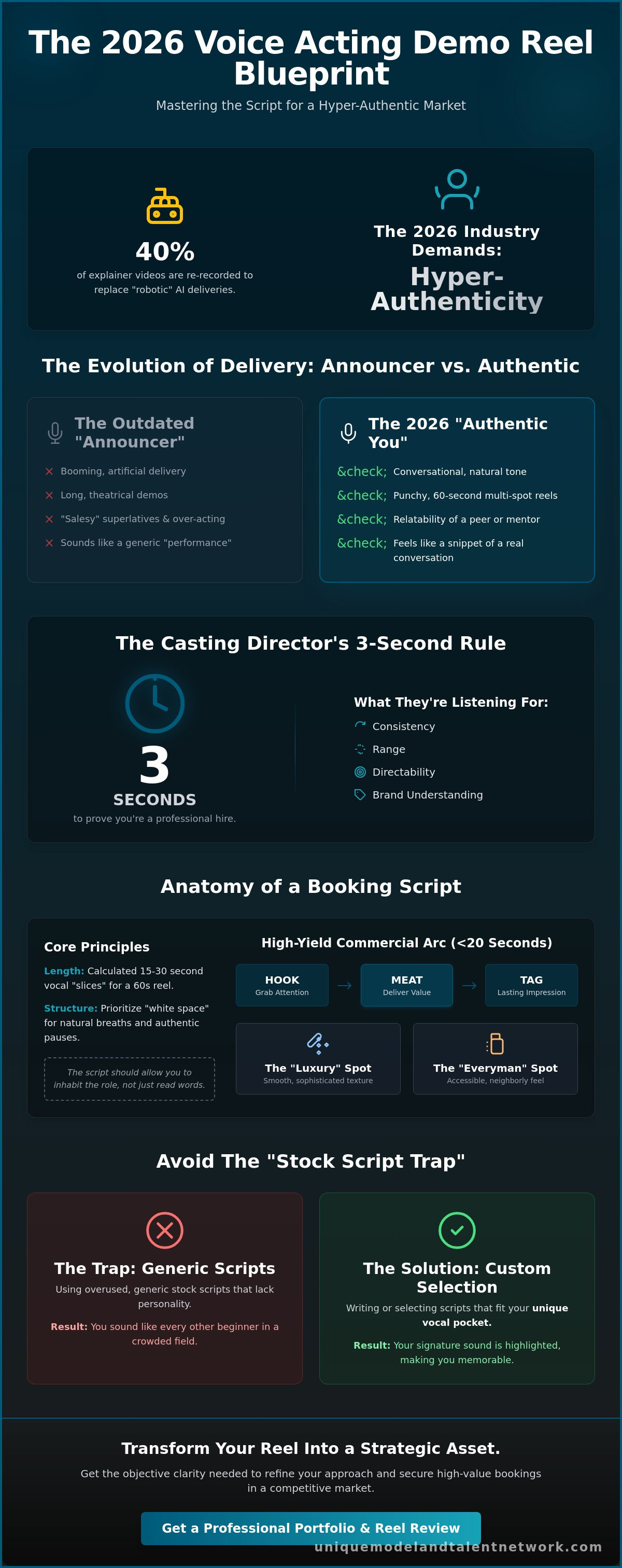
What if the script you think showcases your range is actually the reason casting directors hit stop after five seconds? In a market where 40 percent of explainer video projects are now being re-recorded to replace "robotic" AI deliveries, your voice acting demo reel script must do more than just sound polished. It has to sound unmistakably human. The 2026 industry demands hyper-authenticity over the tired announcer tropes of the past.
You likely feel the pressure of a crowded field and the frustration of sounding like every other beginner. It is difficult to choose material that highlights your signature voice when you are working without the clarity of professional feedback. We understand that you are not just looking for words on a page; you are looking for a strategic asset that transforms your career from a hobby into a high-standard business.
This guide will empower you to master the art of selecting, writing, and performing scripts that capture the attention of elite casting directors. We will analyze the strategic reasons why certain scripts fail and provide a clear roadmap for building a professional, unique portfolio. You will learn how to align your performance with the current shift toward conversational delivery, ensuring your reel stands out as a definitive source of talent in a chaotic market.
Key Takeaways
- Understand why 2026 casting directors prioritize "The Authentic You" over traditional announcer voices in every 15–30 second vocal slice.
- Learn to construct high-impact commercial and animation segments by mastering the problem-solution arc and sustainable character archetypes.
- Avoid the "stock script trap" by learning how to write or select a voice acting demo reel script that sits perfectly in your unique vocal pocket.
- Discover how to apply advanced script analysis and the "Internal Monologue" technique to bring professional depth to even the shortest recordings.
- Recognize why objective portfolio reviews and live industry workshops are essential for refining your interpretation and securing high-value bookings.
The Role of the Voice Acting Demo Reel Script in 2026
A voice acting demo reel script is much more than a paragraph of copy. It is a calculated, 15 to 30 second segment designed to showcase a specific vocal "slice" that resonates with modern buyers. In 2026, the industry has moved away from the long, theatrical demos that used to dominate the field. Instead, casting directors demand punchy, 60-second multi-spot reels that get straight to the point. Your script is the foundation of this presentation; it is the bridge that carries you from being a "talent" to being a "professional hire."
Casting directors now prioritize "The Authentic You." They want to hear the person behind the microphone, not a caricature. This shift means that the right script must highlight your signature sound while proving you can handle the grounded reality of professional business development. The Art of Voice Acting is ultimately the art of communication. Your script choices must reflect that you are a savvy industry insider who knows how to connect with a specific demographic.
The Death of the 'Announcer' Voice
The 2026 market has solidified the conversational tone as the most requested style in the industry. The booming, artificial delivery of the past has been replaced by a demand for naturalism. When selecting a voice acting demo reel script, look for copy that encourages a non-projected delivery. If the text feels like it requires a "performance," it might be the wrong choice. You want scripts that feel like a snippet of a real conversation. To identify scripts that allow for this natural delivery, look for these markers:
- Sentence fragments that mimic real, informal speech patterns.
- Copy with a clear focus on "you" or "we" rather than just the product.
- A lack of excessive adjectives or "salesy" superlatives.
Avoiding the trap of "over-acting" in commercial spots is vital. If you sound like you are trying to sell something, you've already lost the listener. Focus on scripts that allow you to speak with the warmth of a mentor or the relatability of a peer. This approach provides the career security that comes from being a reliable, modern talent.
The Psychology of the Casting Director
Understanding the 3-second rule is essential for professional growth. Casting directors often decide whether to keep listening within the first three seconds of your reel. This makes your opening script your most important asset. Beyond just a pleasant tone, these professionals are listening for consistency, range, and directability. They need to know that if they hire you, you can take direction and deliver a high-standard performance under pressure. A well-chosen script proves you understand the brand's target audience. It shows you can identify the "Who, Where, and Why" of a brand message instantly, positioning you as a disciplined professional rather than a hobbyist.
Anatomy of a Booking Script: Commercial, Animation, and Narration
Selecting a high-quality voice acting demo reel script requires an understanding of the structural DNA of your specific genre. A script is not a monologue; it is a strategic tool designed to prove you can solve a client's problem. In 2026, the most successful scripts prioritize "white space." These are the intentional gaps where breaths and natural pauses live. Without this room to breathe, your performance feels rushed and synthetic. A professional script allows you to inhabit the role rather than just reading words, making the delivery feel spontaneous and grounded.
Commercial Scripts: The High-Yield Market
Modern commercial spots have moved away from hard-sell tactics. To succeed, your script must follow a tight problem-solution arc in under 20 seconds. This structure typically consists of a hook to grab attention, the "meat" to deliver the brand value, and a tag to leave a lasting impression. You must adapt your delivery to sound like a trusted peer. If you only showcase one tone, you limit your marketability. Your reel should include at least one "luxury" spot requiring a smooth, sophisticated texture and one "everyman" spot that feels accessible and neighborly. If you are unsure if your current selections hit these marks, seeking a Portfolio & Reel Review can provide the objective clarity needed to refine your approach.
Animation and Character Ranges
When building an animation or gaming reel, avoid the temptation to use copyrighted material. Using existing movie or television scripts suggests a lack of original creativity. Instead, modify existing text to create original character archetypes that are sustainable for long recording sessions. Use your voice acting demo reel script to showcase vocal placement. A professional reel should demonstrate your ability to shift between a deep chest voice for authoritative characters and a lighter head voice for more youthful or eccentric roles. This variety proves to casting directors that you have the technical control required for complex character work.
Corporate and Explainer Narration
In the corporate sector, the "trusted advisor" is the standard for 2026. Your goal is to take technical, often dry text and make it sound warm and accessible. Pacing is your secret weapon in this genre. It is the rhythmic control that keeps a listener engaged through complex information without sounding clinical. A great narration script focuses on clarity and engagement, proving you can maintain a listener's interest for more than just a few seconds. By mastering these structural nuances, you position yourself as a disciplined professional ready for high-stakes bookings.
Stock Scripts vs. Original Writing: Choosing Your Path
Choosing a voice acting demo reel script is a critical fork in the road for your professional development. You can either follow the path of least resistance with free, generic copy or invest the time to craft a narrative that fits your specific vocal "pocket." In the 2026 market, where authenticity is the primary currency, generic scripts often act as a red flag to savvy casting directors. They suggest a lack of initiative and a failure to understand your own unique brand identity. Professional talent knows that a reel is a marketing tool, and a tool is only as effective as the material it is built upon.
The Dangers of Generic Copy
Casting directors have heard the same "Blueberry Muffin" or "Luxury Car" stock scripts thousands of times. When you use overplayed copy, you force the listener to compare your performance to every other actor who has recorded it. This boredom leads to a quick "stop" on your reel. Beyond that, stock scripts are often dated. They frequently reflect the hard-sell "announcer" style of 2010 rather than the conversational, peer-to-peer tone demanded today. Using fresh, contemporary copy shows you are in tune with current market trends and the high standards of an elite professional community.
How to Write Your Own VO Copy
Writing your own material is the most effective strategy to ensure your reel sounds unique. You can start by transcribing real commercials from the last six months. This exercise serves as a masterclass in modern timing and structure. Once you have a framework, apply the "Vocal Signature" test. Ask yourself: does this script highlight my natural resonance and the specific textures of my voice? If the answer is no, modify the text until it feels effortless. You can even use AI as a drafting tool to generate initial ideas, provided you refine the output to ensure it sounds like a real human conversation. A hybrid approach, which involves taking an existing concept and rewriting it to fit your brand, is often the best way to ensure legal safety while maintaining originality.
Protecting your career legitimacy means ensuring your scripts don't violate intellectual property. Avoid using recognizable character names or specific brand taglines that are currently in use. Instead, focus on the essence of the message. If you find the writing process daunting, participating in Live Industry Workshops can help you refine your scripts alongside experts who know what currently books. By moving beyond generic copy, you demonstrate the discipline and organization required to succeed at the highest levels of the industry. This commitment to original, high-quality material is what separates hobbyists from professionals who book paid work consistently.
Strategic Performance: Bringing the Script to Life
Even the most perfectly written voice acting demo reel script fails if the performance feels like a cold read. You must treat every 15-second spot as a miniature scene with a clear objective. Before you hit record, determine the "Who, Where, and Why." Who are you talking to? Where are you physically standing? Why are you sharing this information right now? Answering these questions creates the "Internal Monologue" that prevents your delivery from sounding flat or generic. This psychological grounding is what makes a listener believe you are an expert in the brand's field rather than just a narrator.
Your acting portfolio depends on a reel that sounds like a professional session rather than a rehearsal. Casting directors want to hear the final product. Varying your energy between scripts is the most efficient way to demonstrate professional range. If your first spot is high-energy retail, your second should showcase a lower, more intimate texture. This variety proves you can pivot between different brand needs without losing your signature sound or sounding like a caricature.
Finding the 'Moment Before'
Use a silent "lead-in" sentence to set the emotional tone before the actual script begins. If the script is about a relaxing vacation, imagine yourself saying, "I can't believe how peaceful it is here," right before you speak the first line. This technique ensures you land in the right emotional pocket immediately. Remember the "One Person" rule: you are speaking to an individual, not a crowd. This shift in perspective helps maintain natural warmth and prevents you from slipping into a forced, "salesy" tone. It makes the listener feel like they are receiving a personal recommendation from a trusted friend.
Technical Polish for Your Performance
Elite standards extend to your mic technique. Your interpretation of the script should dictate your distance from the microphone. Intimate narration requires you to move closer to capture the nuances of your voice, while high-energy spots might require more space to manage plosives and sibilance. Always record multiple takes of the same script for your editor. This provides varied options and demonstrates that you are a disciplined talent who can offer different interpretations of the same text. This level of organization is a hallmark of a professional who is ready for high-stakes paid work. You aren't just reading; you're producing a marketable asset.
To refine these performance techniques under the guidance of seasoned professionals, consider joining our Live Industry Workshops to get the direct feedback you need to succeed.
Beyond the Script: Professional Feedback and Networking
Even the most meticulously crafted voice acting demo reel script remains a static document until it is validated by a professional ear. You cannot be your own director. The 2026 industry is too competitive for guesswork. An objective review is the only way to ensure your performance meets the grounded reality of professional business development. This external perspective transforms your reel from a practice session into a legitimate marketing asset that proves your value to recruiters. It provides the clarity you need to move forward with confidence.
Moving from practicing to booking requires more than just repetition. It requires direct industry access. By leveraging a managed talent community, you move away from the superficiality of social media and toward a sense of career security. You need a space where high standards are the norm and where your growth is championed by those who actually hire talent. This environment removes external distractions and allows you to focus on the tangible success of your career acceleration.
The Power of the Portfolio Review
A professional Portfolio & Reel Review identifies the blind spots that often sabotage emerging talent. You might think a script highlights your range, but a seasoned coach might hear a lack of consistency or a dated delivery style. These reviews ensure your reel aligns with the rigorous standards of modern casting websites. In a globalized market, your competition is no longer just local. It's global. You must ensure your script selection and performance are optimized for international standards where clarity and authenticity are paramount. "Good enough" is a career killer in an industry that values elite membership and professional standards.
Accelerating Your Career with Unique Model & Talent
We provide the definitive solution for those serious about their craft. Our acting workshops online offer a concentrated focus on script interpretation and performance technique. You gain access to Live Industry Workshops with experts who hear hundreds of reels daily. This isn't a hobbyist group. It's a private, gated network dedicated to tangible success and financial legitimacy. We act as a reliable bridge between your emerging talent and established industry professionals.
If you're ready to remove the noise and focus on professional growth, join our Network Membership. You'll connect with vetted experts through our Industry Expert Q&A Sessions and participate in Monthly Skill-Building Challenges designed to keep your skills sharp. Join the Unique Model & Talent Network today to take your voice acting career to the next level. We're the source of direction you've been looking for in an uncertain field.
Take Command of Your Voice Acting Career
Success in 2026 hinges on shifting from outdated announcer tropes to the grounded reality of the conversational sound. You now understand that a high-quality voice acting demo reel script is a strategic marketing tool that requires original writing and disciplined script analysis. By avoiding generic stock copy and mastering your internal monologue, you position yourself as a high-standard professional rather than a hobbyist. You have the tools to ensure your reel sounds like a professional session, showcasing the authenticity that modern casting directors demand.
Even the most polished script needs an objective expert perspective to ensure it meets the rigorous standards of top recruiters. We provide the clarity and direction you need to move from practicing to booking. You deserve a community that values your integrity and offers tangible success through direct access to Casting Directors, Monthly Skill-Building Challenges, and Professional Portfolio & Reel Reviews. Don't leave your career acceleration to chance in an unorganized market.
Ready to book your first VO job? Join the Unique Model & Talent Network today!
Your signature voice is your greatest asset. It is time to protect your career growth and secure your place among the industry's elite talent. We look forward to seeing your professional success take flight.
Frequently Asked Questions
How long should a voice acting demo reel script be?
An individual script segment should last between 15 and 30 seconds. This duration is long enough to showcase a specific vocal "slice" without losing the interest of a busy casting director. In 2026, brevity is a sign of professional standards; it proves you can communicate a complete narrative arc quickly and efficiently.
Can I use scripts from famous movies for my character reel?
You should avoid using copyrighted material from famous films or television shows. Using recognizable scripts invites an immediate comparison between your performance and the original actor, which rarely works in your favor. Instead, modify existing texts to create original character archetypes that highlight your unique vocal range and creativity.
Where can I find free voice over scripts that aren't overused?
The best way to find unique material is to transcribe real commercials aired within the last six months. Avoid the generic "Blueberry Muffin" scripts found on popular free websites, as these are often dated and overplayed. By transcribing current ads, you ensure your voice acting demo reel script reflects the conversational, natural delivery currently demanded by the industry.
Should I write my own scripts or hire a professional writer?
Writing your own scripts allows you to tailor the copy to your specific vocal "pocket," but professional reviews are essential for quality control. Many successful talent start with their own drafts and then use Portfolio & Reel Reviews to refine the text. This hybrid approach ensures your material is both authentic to your sound and polished enough for high-level recruitment.
How many scripts should I include in a standard commercial demo?
A standard 60-second commercial reel should feature five to seven distinct spots. This variety demonstrates your professional range and your ability to pivot between different brand textures, such as "luxury" and "everyman" tones. Lead with your strongest, most authentic performance to capture attention within the first three seconds of the reel.
Is it okay to use AI-generated scripts for my voice acting reel?
You can use AI as a drafting tool, provided you rewrite the output to include human nuance and natural speech patterns. AI often generates repetitive structures that sound clinical or "robotic." Since 40 percent of some explainer projects in late 2025 were re-voices of rejected AI work, ensuring your script sounds unmistakably human is your biggest competitive advantage.
How do I know if a script matches my signature voice?
A script matches your signature voice if the delivery feels effortless and highlights your natural resonance. You shouldn't feel like you are struggling to "find" the character or tone. If the copy allows you to speak with the warmth of a trusted mentor or the relatability of a peer, it likely fits your professional brand sound.
What are the most in-demand voice acting styles in 2026?
The most in-demand styles are conversational, authentic, and "human-in-the-loop" deliveries. While technology is changing the landscape, over half of voiceover buyers still plan to use real human actors for brand marketing due to the need for emotional depth. There is also a significant increase in demand for diverse voices and localized dialects to reach a global audience.


