
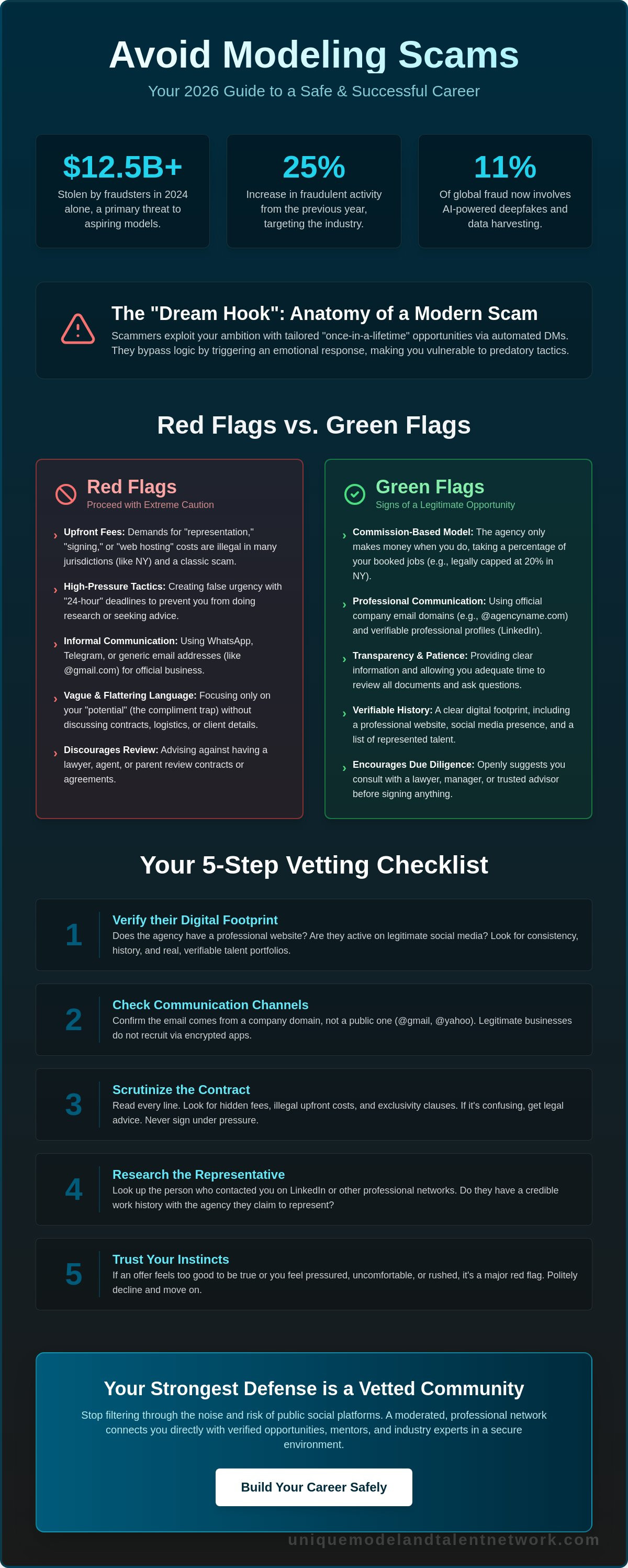
Did you know that fraudsters siphoned off over $12.5 billion in 2024 alone? That is a 25% increase from the previous year, and the modeling industry has become a primary target for these sophisticated predators. You are right to feel anxious about who to trust when every direct message feels like a potential trap and deepfakes now account for 11% of global fraudulent activity. It is exhausting to filter through the noise of social media just to find a safe space to grow. This guide will empower you with a clear framework for avoiding modeling scams so you can protect your finances, your image, and your reputation.
You deserve to pursue your craft without the constant fear of being financially exploited or physically unsafe. We will show you how to spot predatory tactics and verify opportunities so you can build a legitimate modeling career with confidence. You will learn about the critical protections provided by the New York State Fashion Workers Act, how to identify standard fee structures versus predatory costs, and why migrating your career development to a vetted, professional network is the most secure move you can make in 2026.
Key Takeaways
- Identify the "Dream Hook" manipulation tactics used by scammers to bypass your professional judgment through automated social media outreach.
- Master the art of avoiding modeling scams by recognizing illegal upfront fees and verifying the digital footprint of any agency that contacts you.
- Protect your digital likeness from emerging AI-driven data harvesting schemes and learn how to authenticate virtual agency portfolios.
- Implement a rigorous five-step verification process to ensure every contract, email domain, and representative aligns with legitimate industry standards.
- Discover why transitioning from public social platforms to a moderated, professional network is your strongest defense against industry predators.
The Anatomy of a Modeling Scam: Why Predatory Tactics Persist in 2026
Scammers in 2026 have perfected the "Dream Hook." It is a psychological tactic designed to exploit your career ambitions and cloud your professional judgment. By presenting a once-in-a-lifetime opportunity that seems perfectly tailored to your look, they trigger an emotional response that bypasses logic. This is why avoiding modeling scams has become so complex; the offer feels like the breakthrough you have been waiting for. These predators understand that your desire for success is a powerful motivator, and they use it to lead you away from professional safety.
The traditional "mall scout" has been replaced by sophisticated bots and automated social media DMs. These scripts are designed to mimic the voice of a legitimate professional, often using high-value industry terminology to establish a false sense of authority. Beginners are the primary target because they often lack the baseline knowledge of how professional business development actually works. Without a mentor or a vetted community to guide them, new talent often mistakes a predatory "pay-to-play" scheme for a necessary business investment. Real career growth requires investment, but that capital should go toward your own skills and materials, not into the pockets of a self-proclaimed gatekeeper.
The Psychology of the 'Urgent' Casting Call
Scammers rely heavily on artificial scarcity to force your hand. They create tight deadlines and "urgent" needs to prevent you from performing due diligence or consulting a professional mentor. If you feel pressured to sign a document or send money within hours, you are likely facing a trap. Legitimate casting directors value professional standards and rarely use high-pressure sales tactics. They understand that serious talent needs time to review terms and verify details. You should also watch for the "compliment trap." While flattery feels good, it is often used as a professional weapon to lower your guard. If a scout focuses entirely on your "limitless potential" without discussing technical requirements or professional logistics, proceed with extreme caution.
Modeling Industry Standards vs. Scam Narratives
Understanding the financial mechanics of the industry is your best defense. A legitimate agency-model relationship is built on shared success through commissions, not on charging the talent for the privilege of being listed. Under the New York State Fashion Workers Act, charging upfront signing fees is a major red flag and is legally prohibited as of June 19, 2025. You can research common modeling scam tactics to see how these "fake casting agent" setups have historically operated to exploit emerging talent.
Professionalism also shows in the method of communication used by scouts. Real agencies use dedicated email domains that match their official websites and business registrations. They do not conduct official business or recruit talent through encrypted messaging apps like WhatsApp or Telegram. If the conversation feels informal or unorganized, it probably is. Protecting your career starts with demanding the same high standards from others that you bring to your own craft every day.
Red Flags vs. Green Flags: A Professional Comparison
Distinguishing between a legitimate career opportunity and a predatory trap is the most critical skill you can develop in 2026. While the excitement of a new inquiry is natural, avoiding modeling scams requires a clinical eye for detail and a commitment to professional standards. Legitimate agencies operate on a commission-based model. In jurisdictions like New York, these commissions are now legally capped at 20% of your earnings. If an organization demands upfront "representation" fees or "web hosting" charges before you have booked a single job, you are likely facing a scam. The FTC guide to modeling scams provides a clear warning: if they want money first, walk away.
Communication standards offer another layer of protection. Legitimate professionals use verifiable LinkedIn profiles and official company email domains. They don't hide behind anonymous handles or encrypted messaging apps. Transparency is the hallmark of a professional partnership. A major green flag is when an agency encourages you to have a lawyer or parent review your contracts. Any representative who pressures you to sign immediately or discourages external review is prioritizing their gain over your safety.
Personal safety is non-negotiable. You should treat any request for suggestive photos during an initial screening as a massive red flag. Legitimate casting directors and scouts conduct business in professional offices or established studios, never in private residences or non-professional locations. If you are ever unsure about the legitimacy of a contact, joining a vetted industry community can provide the protective mentorship needed to verify the opportunity.
The 'Mandatory Photo' Scam Explained
A common tactic involves forcing talent to use a specific photographer for an "exclusive" package. This is a blatant conflict of interest. A legitimate agency may suggest a professional portfolio review to help you identify gaps in your book, but they won't demand payment for a specific vendor. Scam agencies often charge between $1,900 and $3,400 for these mandatory shoots. These prices are often inflated to provide kickbacks to the agency, a practice that is a clear departure from ethical industry standards.
Verifying the Professionalism of Casting Calls
Verify every opportunity by cross-referencing it on reputable casting websites. A real casting breakdown includes specific dates, professional production company names, and realistic rates. If a job offers $5,000 for a two-hour shoot with no experience required, it is likely a "too good to be true" scenario. These inflated rates are often used to lure talent into check-cashing schemes, where you are asked to deposit a fake check and wire a portion of the funds back for "expenses."
Digital Identity and AI Scams: The New Frontier of 2026
The digital landscape of 2026 presents risks that didn't exist just a few years ago. Scammers now use AI-generated "agents" to lure emerging talent into sophisticated data-harvesting schemes. These synthetic personas can maintain long, realistic conversations, making avoiding modeling scams more difficult than ever. By the time you realize the agent isn't real, they may have already collected enough personal information to compromise your digital identity. You must verify that the professional you are talking to actually exists in the physical world through video calls or in-person meetings at established offices.
Deepfake technology has also enabled the creation of entire "ghost agencies" with portfolios of models who don't exist. These high-quality, AI-generated images can make a fraudulent agency look like a top-tier firm. Before you share your sensitive information, consult the Federal Trade Commission guide to avoiding scams to understand your rights. Identity theft is a primary goal for these digital predators. You should never provide your Social Security Number or bank details until a physical, vetted contract is signed and you have verified the agency's physical location and registration certificate.
Social Media Impersonation Tactics
Fraudsters often "clone" the profiles of legitimate agents from the Unique Model & Talent Network to gain instant credibility. They copy the bio, photos, and even the posting style of a real professional to deceive you. Don't let a "Blue Check" fool you; verification on social media can be purchased and doesn't guarantee professional legitimacy. Legitimate agencies rarely scout via unprompted direct messages without providing a clear link to an official portal or a professional email domain. If a scout reaches out on Instagram but refuses to move the conversation to an official company email, it's a trap.
Safe Digital Practices for Emerging Models
Protecting your "digitals" is essential in the age of AI. These are the raw, unedited photos used for casting, and scammers harvest them to train AI models or create synthetic identities without your consent. To maintain control over your image, follow these safety protocols:
- Apply subtle watermarks to images submitted to unverified third-party sites.
- Maintain a professional website or a managed profile rather than just a social media presence.
- Never share unfiltered, high-resolution "digitals" with unverified accounts.
Investing in modeling career coaching is a proactive way to learn these digital safety protocols. A mentor can help you vet opportunities and ensure your image remains your own property as you build your career. By moving your professional development into a gated community, you remove the distractions and dangers of unmoderated public platforms.
Your 5-Step Vetting Checklist for Any Modeling Opportunity
Establishing a repeatable process for avoiding modeling scams is the most effective way to protect your career. You shouldn't rely on "gut feelings" when your financial security and personal safety are on the line. Instead, use this systematic checklist to evaluate every inquiry, regardless of how professional the initial outreach appears. By taking control of the vetting process, you shift the power dynamic back in your favor and signal that you are a serious professional who understands industry standards.
- Step 1: The Google 'Scam' Test. Perform a targeted search using the entity's name combined with keywords like "scam," "complaint," or "review." Look for recurring patterns in forums or specialized industry blogs. If multiple people report similar high-pressure tactics or unexplained fees, take it as a definitive warning.
- Step 2: Domain Verification. Scammers often use free email services or domains that closely mimic famous agencies. Ensure the sender's email domain matches the official company website exactly. A scout from a major agency will never contact you from a @gmail.com or @yahoo.com address.
- Step 3: The 'Physical Office' Check. Verify the business address on Google Maps. A legitimate agency should have a dedicated, professional office space in a commercial district. If the address leads to a residential home, a virtual mailbox, or a PO Box, you should proceed with extreme caution.
- Step 4: The Peer Review. Before responding, ask for feedback within a managed talent community. Accessing a network of peers and mentors allows you to verify if others have worked with the individual or if the "opportunity" is a known predatory script.
- Step 5: The Contract Pause. Never sign any document on the spot. Always request a minimum 24-hour review period. Legitimate professionals expect you to perform due diligence and will never rescind an offer simply because you asked for time to consult a mentor or lawyer.
Researching Agencies and Casting Directors
Deepen your investigation by using industry-specific watchdogs. Check the Better Business Bureau (BBB) for formal complaints and consult organizations like the Model Alliance for reports on agency conduct. You should also verify a professional's recent history on databases like IMDbPro. If a casting director claims to be a top-tier professional but hasn't booked a verifiable project in the last six months, their "opportunity" may be a front for a talent-scouting scam.
The 'No-Go' List: When to Walk Away Immediately
Certain behaviors require an immediate end to all communication. If you receive a request for "nude" or "suggestive" test shots via a messaging app, block the sender. Financial red flags are equally urgent. Be wary of offers to pay you via a check that is "more than the amount" with a request to wire back the difference; this is a classic check-cashing fraud. Finally, never agree to meetings in hotel rooms, private residences, or after-hours in non-public spaces. Real business happens in professional environments during standard business hours.
Join our managed talent community today to connect with vetted experts and peers who prioritize your safety and professional growth.
Why a Moderated Professional Network is Your Best Defense
Public social media platforms have become the primary hunting grounds for industry predators in 2026. While these open networks offer high visibility, they lack the structural safeguards necessary to protect emerging talent from the sophisticated scripts we have analyzed. The most effective strategy for avoiding modeling scams is to migrate your career development into a "gated community." Private networks like the Unique Model & Talent Network eliminate the noise of unmoderated platforms by ensuring that every professional interaction occurs within a secure, pre-vetted environment. When you join a community that requires professional standards for entry, you stop being a target and start being a member of an elite professional circle.
The power of a moderated network lies in its collective intelligence. In unorganized groups, a scammer can target hundreds of individuals with the same predatory script before being caught. Within a managed talent community, a single suspicious message is flagged by peers and mentors immediately. This protective shield ensures that fraudulent "opportunities" are neutralized before they ever reach your inbox. By surrounding yourself with savvy industry insiders, you benefit from a shared database of professional knowledge that keeps your career secure.
Once your safety is guaranteed by a secure environment, you can shift your focus from defense to offense. Instead of spending your energy dodging bad deals, you can invest it in your craft through acting workshops online and professional skill-building. High-level career growth happens when you stop worrying about who is trying to exploit you and start focusing on who can help you reach the next level of your professional development.
Direct Access to Decision-Makers
The Network Membership provides you with direct access to casting directors and industry experts in a safe, moderated setting. You don't have to wonder if a scout is legitimate when you are interacting with them during live workshops or expert Q&A sessions. These real-time interactions allow you to build genuine professional bonds without the fear of digital impersonation or "ghost agencies." In 2026, being recognized as "vetted talent" is a significant competitive advantage that signals your commitment to professional integrity and high industry standards.
Building Your Career with Integrity
Professional mentorship is the ultimate tool for increasing your industry IQ. When you engage with monthly skill-building challenges and expert reviews, you learn to recognize the nuances of legitimate business development. This knowledge makes you "un-scammable" because you understand exactly what a real professional relationship looks like. You deserve a career path that is defined by your talent and hard work, not by your ability to survive predatory tactics. It is time to step out of the chaos of public platforms and into a space designed for your success. Explore the Unique Model & Talent Network today and join a community that prioritizes your safety and professional growth.
Take Command of Your Professional Future
Building a successful career in 2026 requires more than just talent. It demands a disciplined approach to business development and a commitment to personal safety. By implementing the five-step vetting checklist and recognizing the shift toward AI-driven deception, you move from a place of vulnerability to one of professional authority. You now have the tools for avoiding modeling scams while maintaining the high standards that top-tier agencies expect. Real success isn't about dodging threats in unmoderated social spaces; it's about positioning yourself within a circle of integrity where your growth is the primary focus.
You don't have to navigate this complex industry alone. Our private, moderated platform on Mighty Networks provides a secure environment where you can thrive without the distractions of public platform predators. You will gain direct access to verified casting directors and photographers who share our commitment to professional excellence. Through ongoing educational workshops and expert Q&A sessions, you can continue to build your industry IQ and career security. Secure your career and join our vetted community of industry professionals. Your craft deserves a safe space to grow, and we are ready to open the door for you.
Frequently Asked Questions
Is it normal for a modeling agency to ask for money upfront?
No, legitimate modeling agencies do not charge upfront signing or registration fees. Under the New York State Fashion Workers Act, which became fully effective in late 2025, agencies are prohibited from charging these deposits. A professional agency makes its money by taking a commission from the jobs you book, which is currently capped at 20% in New York. If a company demands payment before you have earned any income, it is a significant red flag.
What should I do if I think I've already been scammed by a fake agent?
Stop all communication immediately and do not send any more money or personal data. Report the incident to the Federal Trade Commission (FTC) and your state's labor commissioner to help authorities track these predators. If you deposited a check from the scammer, alert your bank immediately to protect yourself from check-cashing fraud. Changing your passwords and monitoring your credit report is also a vital step in protecting your digital identity.
Can I get a legitimate modeling job through Instagram or TikTok DMs?
While scouts use social media to find talent, they will not finalize a professional deal through a direct message. A legitimate scout will move the conversation to an official company email domain and provide a physical office address for a meeting. Treat unprompted DMs with extreme caution, especially if they use high-pressure tactics. Professionalism in 2026 requires moving beyond the chaos of social media and into vetted, private networks for career development.
Do I need to pay for a professional portfolio before I can get signed?
You don't need an expensive portfolio to attract a legitimate agency. Most professional scouts prefer "digitals," which are simple, natural photos taken against a plain background. If an agency insists that you must use their "exclusive" photographer for a package costing thousands of dollars, they are likely running a kickback scheme. Real agencies focus on your potential and will help you build your book once you are signed through their vetted connections.
How can I tell the difference between a modeling school and a modeling agency?
A modeling school is a business that sells you a service, while an agency is a partner that earns when you earn. Schools charge tuition for classes and workshops regardless of whether you ever book a job. Agencies only take a commission after you have successfully completed a project for a client. You should never feel pressured to attend a specific school as a condition for agency representation; that is a classic predatory tactic.
Are there specific laws that protect models from scams in 2026?
The New York State Fashion Workers Act provides the most robust protections for models in 2026. This law requires all model management companies to register with the Department of Labor and provide models with copies of all signed contracts. It also mandates clear, written consent before an agency can use your AI-generated digital replica. These regulations are essential for avoiding modeling scams and ensuring that talent is treated as a protected class of workers.
What are the most common modeling scams to watch out for this year?
The "AI face model" scam and deepfake-enabled influencer fraud are the most prevalent threats this year. Scammers use synthetic identities to lure talent into "data-harvesting" jobs that are actually fronts for identity theft. They may also use AI to create fake agency websites that look identical to famous firms. Staying within a moderated community of peers is your best defense against these increasingly sophisticated digital deceptions.
How do I verify a casting director's identity before an audition?
Cross-reference the casting director's name on industry databases like IMDbPro to see their recent credits. A legitimate professional should have verifiable work on real projects within the last six months. You should also verify that the audition is held at a professional casting studio or a production office. If the location is a private residence or a hotel room, do not attend. Real business is conducted in public, professional environments during standard hours.


