

Digital tools can make scouting faster, but human judgment turns a promising profile into an informed agency decision. Scouting new models online works best when agencies use digital channels to find candidates, then assess their camera presence, professionalism, market fit, and potential through direct interaction.
It’s understandable to value the reach and speed of online discovery while wanting to see more than a polished profile or engagement metrics. This article explains how to assess candidates’ agency and client fit, professionalism, marketability, and development potential without letting technology replace the personal judgment talent scouting requires.
Key Takeaways
- Match each candidate’s strengths to the agency’s markets and client needs, not just the look of a profile.
- Assess communication, reliability, and response to direction alongside a candidate’s online presentation.
- Look beyond conventional physical traits to versatility, authenticity, and the audiences a model may connect with.
- Use digital tools to organize discovery, while relying on human judgment to recognize growth potential.
Evaluating candidates’ fit with agency markets and clients
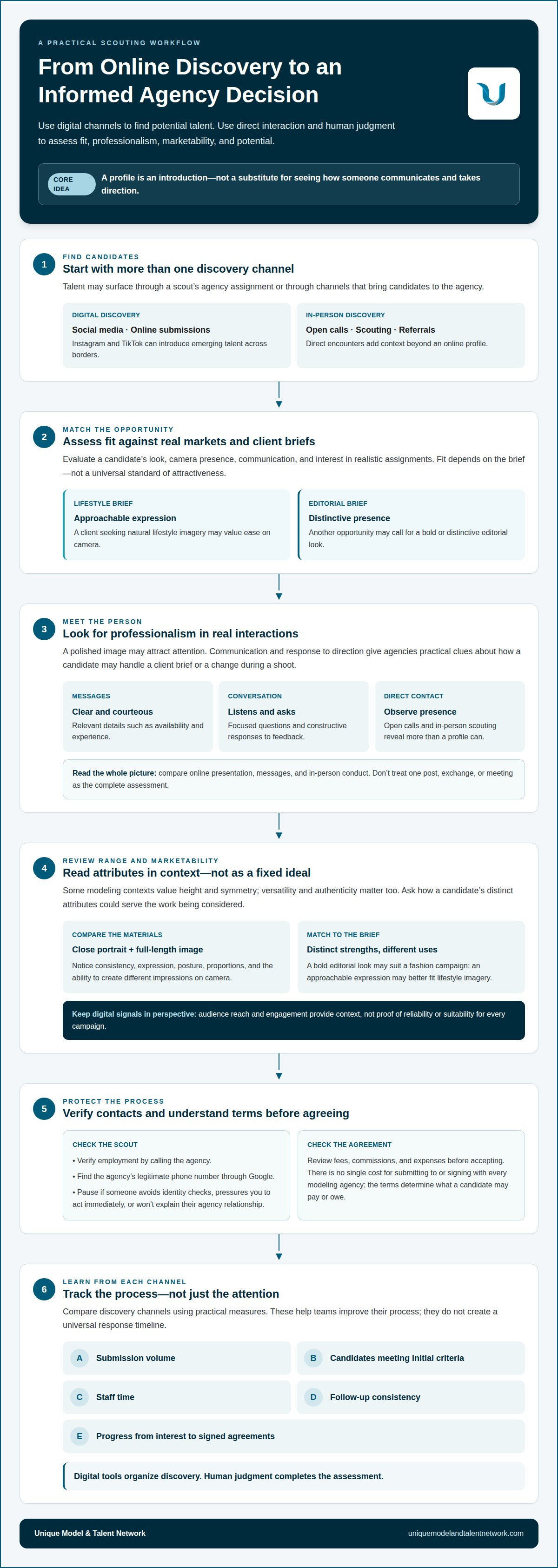
An agency should assess whether a candidate fits its actual markets and client briefs, not simply whether their profile attracts attention. Compare the candidate’s look, camera presence, communication, and interest in realistic assignments with the agency’s work. A client seeking natural lifestyle images, for example, may value an approachable expression and ease on camera. Another brief may call for a distinctive editorial presence. Fit depends on the opportunity, not a universal measure of attractiveness.
Discovery can happen during an agency assignment, when a scout notices someone who suits the agency’s needs. Scouts often work freelance for agencies, which also find candidates through social media, online submissions, open calls, in-person scouting, and professional referrals. Instagram and TikTok can introduce emerging talent to scouts across borders without requiring relocation. Digital messages can support feedback and virtual castings across time zones, too. Still, an online profile is an introduction, not a substitute for assessing how a candidate takes direction and communicates professionally.
To judge whether a channel is working, agencies can track submission volume, how many candidates meet initial criteria, staff time, follow-up consistency, and progress from interest to signed agreements. These measures help teams compare channels and improve their process. They don’t establish a universal response timeline, since submissions move through each agency’s review and contact workflow.
There’s no single cost for submitting to or signing with every modeling agency. Before accepting an agreement, review its fees, commissions, and expenses. The terms determine what a candidate may pay or owe.
For legitimacy, Heroes New York advises candidates to verify someone’s employment by calling the agency and to find its legitimate phone number through Google. Be cautious if a supposed scout avoids identity checks, pressures you to act immediately, or won’t explain their agency relationship. Pause the conversation and verify the contact through the agency’s legitimate number before sharing more information or agreeing to terms.
Evaluating personality and professionalism
A polished image can attract attention, but an agency also needs to see how talent communicates and responds to direction. Review a candidate’s messages for clarity, courtesy, and relevant details such as availability and experience. In conversation, notice whether they listen, ask focused questions, and respond constructively to feedback. These behaviors offer practical clues about how they may handle a client brief or a change during a shoot.
Engagement metrics provide context, not a complete assessment of character. Brands use digital channels to find models and consider audience reach and engagement, while agencies can track which images receive positive responses. On Instagram, compare a candidate’s strongest posts with the professional identity they want to present. A large audience alone doesn’t show reliability; thoughtful captions, consistent presentation, and respectful exchanges offer more useful context.
A safe, professional online portfolio should show relevant images and a concise bio without revealing private contact details, a home address, or a daily routine. Use a dedicated professional contact method, choose images that reflect the work you want, and keep captions focused on skills and experience. For example, a candidate seeking commercial work can include approachable lifestyle images alongside clear, current portraits. A Portfolio & Reel Review can help emerging models refine how their materials present their strengths.
Open calls and in-person scouting let agencies observe presence beyond a profile. At an open call, an agency can see how a candidate introduces themselves, follows simple direction, and communicates face to face. In-person scouting may also reveal potential during an everyday encounter. Neither replaces assessing fit for actual assignments, but both add human interaction to online discovery.
For agencies, consistency across settings is a useful signal: a candidate’s online presentation, messages, and in-person conduct should support the same professional impression. Compare these examples rather than treating a single post, interaction, or meeting as the whole picture.
Assessing physical attributes and marketability
Physical assessment should connect a candidate’s features to the work an agency is pursuing. Scouts need to understand current fashion demand, but no single look suits every casting. Height and symmetry remain valued in some modeling contexts, while versatility and authenticity are also sought. The practical question is how a model’s distinct attributes can serve a specific brief, not whether they match one fixed ideal.
Review how a candidate presents across images rather than relying on one carefully selected photograph. Compare a close portrait with a full-length image, for example, and note whether the candidate’s appearance reads consistently. Consider expression, posture, proportions, and their ability to create different impressions on camera. These observations help agencies distinguish a look that works for one image from qualities that may suit varied assignments.
Marketability also depends on the audience and brand relationship a model can help create. Agencies use predictive analytics to match models with brands where their features may resonate with audiences. This analysis can organize possibilities, but casting decisions still need context: a bold editorial look may suit a fashion campaign, while an approachable expression may better fit lifestyle imagery. The same candidate can bring different strengths to different briefs.
For online scouting, evaluate materials as evidence of range, not as a popularity contest. Engagement and audience reach can inform how brands assess digital presence, but neither establishes suitability for every campaign. Compare a candidate’s strongest images with the work being considered. Ask whether the portfolio communicates a clear point of view while leaving room for different styling, expressions, and client direction.
Representation should build on a realistic understanding of a candidate’s current strengths and potential market fit. An agency can note which attributes appear consistently, which settings bring out the candidate’s range, and where further development could broaden casting options. A model with a distinctive look, for instance, may suit niche campaigns even if their profile doesn’t match conventional fashion expectations. This assessment makes discovery more deliberate and client-focused.
Considering model development potential
A strong online candidate may still need coaching before they’re ready for particular assignments. Assess development potential by separating current ability from skills the candidate can build. An aspiring model, for example, may have expressive portraits but little experience following direction. A focused practice session can show whether they apply feedback, adjust posing, and become more comfortable on camera. Their response reveals more than a polished portfolio alone.
Technology can organize discovery and speed up candidate comparisons, but it can’t replace human judgment, communication, or the ability to recognize potential. A profile or automated match can highlight relevant images; a conversation can reveal motivation, openness to coaching, and realistic expectations. Consider how a candidate responds to specific direction, such as changing posture or shifting expression. Those observable details help distinguish a skill gap from a poor fit.
Development also depends on clear goals. An agency can identify which portfolio gaps matter for likely assignments, then consider whether practice, updated images, or broader experience could address them. A candidate interested in commercial work, for instance, may benefit from demonstrating several natural expressions and believable everyday poses. The aim isn’t to make every model look alike, but to build skills that strengthen each candidate’s market fit.
Assess progress over time rather than drawing conclusions from one submission. Agencies can track represented models’ development alongside booking outcomes, noting changes in portfolio quality, direction-taking, and the kinds of assignments secured. This helps teams understand whether support is building readiness for work. A contract should fit the candidate’s circumstances and goals, so discuss expectations and development plans clearly before making commitments.
Emerging talent can benefit from expert feedback on how a portfolio communicates current strengths and next steps. Request a Portfolio & Reel Review to get focused input on materials and development priorities.
Unique Model & Talent Network
Unique Model & Talent Network helps aspiring models build industry knowledge and strengthen their materials through professional learning and feedback. If you’re considering your next development step after assessing fit, professionalism, marketability, and potential, its educational resources can help you move forward with greater clarity.
The Network Membership connects members with industry experts, while Live Industry Workshops and Industry Expert Q&A Sessions offer opportunities to learn from professionals. Portfolio & Reel Reviews provide focused feedback on presentation, and Monthly Skill-Building Challenges support continued practice. These offerings are designed for people seeking guidance and development, not direct talent representation or commission-based booking services.
To explore educational support for your modeling goals, contact Unique Model & Talent Network.
Turn Online Discovery Into Thoughtful Career Progress
Strong scouting decisions can provide a starting point, but a candidate’s next steps should remain intentional. Treat each discovery as the beginning of a professional conversation, not a verdict on someone’s future. Clear expectations, useful feedback, and opportunities to build skills help emerging talent understand what to develop and how to present themselves.
For agencies, this approach balances digital efficiency with the human judgment that gives a profile context. For aspiring models, it offers a steadier path to visibility: focus on your craft, communicate professionally, and seek informed guidance as your goals take shape. Scouting new models online can open a door; continued learning helps candidates prepare to step through it with confidence.
If you’re ready to take a practical next step in your development, connect with Unique Model & Talent Network. Keep building your skills and stay open to the right opportunities.
Frequently Asked Questions
How Can Agencies Recognize Modeling Potential?
Agencies can look for qualities that suggest how a candidate might contribute beyond a single look. Notice whether they can describe the assignments they want and identify skills they’re working to improve. A candidate who understands their strongest expressions and can explain how they prepare for a shoot, for example, may be well positioned to grow with focused guidance.
How Can Your Agency Build a Scouting Strategy That Lasts?
Build a repeatable process around clear priorities, documented review criteria, and regular team discussion. An agency might record why a candidate advanced, then revisit those notes alongside later career outcomes. This helps the team learn which early indicators were useful and where its criteria need refinement. Consistent records also make scouting less dependent on one person’s memory or preferences.
What Ethical Scouting Practices Should Every Agency Follow?
Make each approach transparent: identify yourself, name the agency or professional context, and explain why you’re contacting the candidate. Give people room to decline or ask questions without pressure. Handle portfolio images and personal details carefully, and get permission before sharing a candidate’s materials. Clear communication helps establish a professional relationship from the first message.
Which Model Scouting Channels Are Working for Agencies in 2026?
Agencies can find candidates through social platforms such as Instagram and TikTok, online submissions, open calls, professional referrals, and in-person scouting. No single channel suits every agency or market. A regional open call may connect with local talent, while social platforms can surface candidates across borders. Compare the quality and relevance of responses, not just the attention each channel receives.
What does scouting new models online mean?
It means using digital channels to find potential models and review their public profiles or submitted materials as an initial stage of evaluation. An agency might find a candidate through a social post, for example, then arrange a conversation or casting to learn more. Online discovery expands access, but a profile alone doesn’t show how someone will perform in a professional setting.
What are the best websites and platforms for finding new models?
Instagram and TikTok are useful discovery platforms because models can present their work to broad audiences. Agencies can also use online submission processes, promote open calls, and receive professional referrals. The right channel depends on the agency’s target market and the talent it seeks. Treat each platform as a source of introductions, then assess candidates against specific agency needs.


