

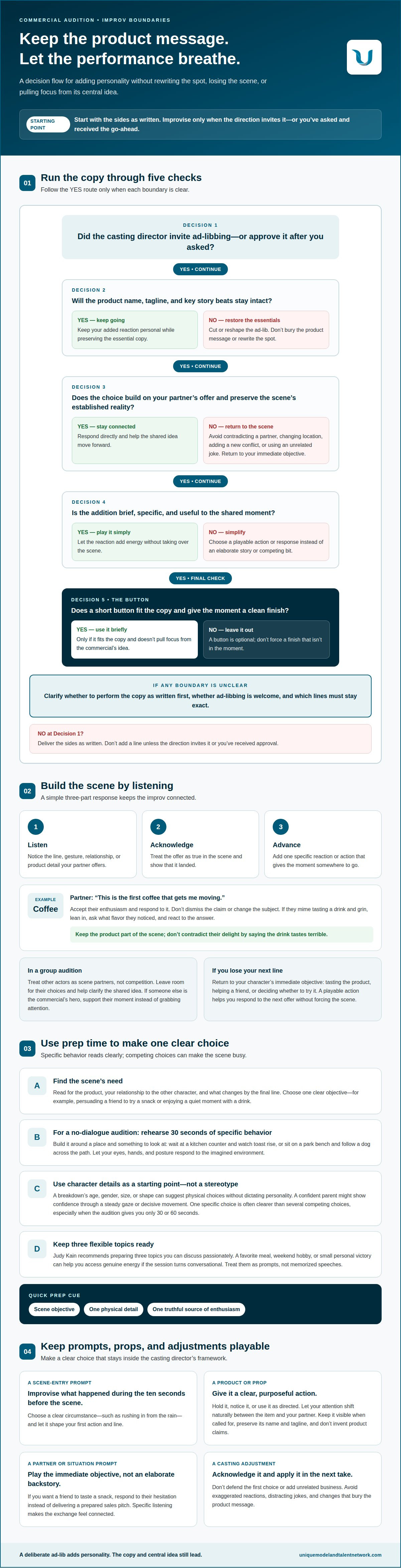
Changing your sides isn’t the default in a commercial audition. Start with the copy as written, and improvise only when the direction invites it or you’ve asked and received the go-ahead. Knowing how to improvise in a commercial audition means adding personality without losing the product message, the scene’s key beats, or the line that needs to land.
It’s natural to wonder whether a small change will make your read feel more spontaneous or take it off track. The safest approach is to stay grounded in the sides, listen closely to your scene partner, and treat any added line as a brief, deliberate choice rather than a rewrite. This guide explains when to stick to the copy, how to build on a partner’s offers, and how to use limited prep time to clarify your character. You’ll also learn when a short button can add a memorable finish without pulling focus from the commercial’s idea.
Key Takeaways
- Build on a scene partner’s offers by listening and advancing the shared idea instead of competing for focus.
- Use brief prep time to define your character’s immediate objective and make specific, believable choices.
- Keep any ad-lib within the audition’s direction, and preserve the product message and essential beats.
- Consider a short button only when it fits the copy and gives the moment a clean finish.
Accepting a scene partner’s offers
In a commercial improv scene, an offer is anything your partner gives you to build on. It might be a line, gesture, relationship, or product detail. Accepting the offer means treating it as true in the scene and adding a useful next beat. If your partner says, “This is the first coffee that gets me moving,” don’t dismiss the claim or change the subject. Let their enthusiasm shape your response, then give the moment somewhere to go.
Try a simple sequence: listen, acknowledge, and advance. Your partner makes an offer; show that it landed, then add a specific reaction or action. For example, if they mime tasting a drink and grin, you might lean in, ask what flavor they noticed, and react to their answer. The product stays part of the scene, while the exchange gains energy. Avoid contradicting your partner’s choice, such as saying the drink tastes terrible after they’ve shown delight.
In a group audition, treat the other actors as scene partners, not competition. Leave room for their choices, respond directly, and help clarify the shared idea. The commercial’s hero is the person using the product or placed at the center of the improvisation. If that isn’t you, support their moment instead of grabbing attention. For instance, a friend can show genuine interest when the hero demonstrates a product, rather than interrupting with an unrelated joke.
Keep the established reality intact unless the casting director asks for a different direction. A sudden change of location, a new conflict, or an exaggerated reaction can pull focus from the commercial’s central idea. If you lose your next line, return to your character’s immediate objective: tasting the product, helping a friend, or deciding whether to try it. That gives you a playable action and helps you respond to the next offer without forcing the scene.
Making use of brief audition preparation time
Use the moments before a commercial audition to identify what the scene needs from you. Read the sides for the product, your relationship to the other character, and the change by the final line. Choose one clear objective, such as persuading a friend to try a snack or enjoying a quiet moment with a drink. A focused objective guides your reactions without requiring a complicated backstory.
For a no-dialogue audition, practice thirty seconds of specific behavior built around a place and something to look at. Picture waiting at a kitchen counter and watching toast rise, or sitting on a park bench and following a dog across the path. Let your eyes, hands, and posture respond to that imagined environment. These details make your behavior readable, while the simple setting keeps the performance from feeling busy.
Use the character information in the breakdown as a starting point. Age, gender, size, and shape can suggest physical choices, but they don’t dictate a single personality. If the role describes a confident parent, show confidence through a steady gaze or decisive movement. Avoid relying on a broad, exaggerated stereotype. A commercial audition may give you only 30 or 60 seconds to convey a character, so one specific choice is often clearer than several competing choices.
Judy Kain recommends preparing three topics you can discuss passionately during auditions. Treat them as flexible prompts, not memorized speeches. A favorite meal, a weekend hobby, or a small personal victory can help you access genuine energy if the session turns conversational. Before you enter, settle on the scene’s objective, one physical detail, and one truthful source of enthusiasm. These choices keep preparation practical and leave room to respond in the room. For more focused audition preparation practice, build these choices into your regular rehearsal routine.
Improv and ad-libbing in commercial auditions
Commercial improv calls for fresh reactions within the casting director’s framework. Make a specific choice without rewriting the spot’s essential message.
Improv Techniques Versus Scripted Auditions
In a scripted audition, deliver the sides as written; in improv, create behavior or dialogue within the scene’s direction. Commercial auditions may blend both: keep the product name, tagline, and key story beats intact while making your reactions personal.
Before starting, ask whether the casting director wants the copy as written first, welcomes ad-libbing, or needs specific lines kept exact. These brief questions clarify the boundaries before you perform.
Common Commercial Improv Exercises
A common exercise is to enter a scene after improvising what happened during the ten seconds before it begins. Choose a clear circumstance, such as rushing in from the rain, and let it shape your first action and line.
Other prompts may ask you to respond to a product, a partner, or a simple situation. Treat each prompt as a playable objective, not a cue to invent an elaborate story. A clear choice gives the casting team something specific to evaluate.
Creating Natural Improvised Scenes
Make the moment believable by focusing on what your character wants right now. If you’re trying to convince a friend to taste a snack, respond to their hesitation instead of delivering a prepared sales pitch. Specific listening makes the exchange feel connected.
When the casting director gives an adjustment, acknowledge it and apply it in the next take. Don’t defend your first choice or add unrelated business. Common mistakes include exaggerated reactions, distracting jokes, and changes that bury the product message.
Working with Products and Props
If you’re given a product or prop, make it part of a clear action: hold it, notice it, or use it as directed. Let your attention shift naturally between the item and your scene partner. Avoid inventing product claims or turning the prop into an unrelated joke.
Keep the product visible when the scene calls for it, and preserve its name and tagline as written. A simple, purposeful interaction can communicate interest without forced enthusiasm. If the direction changes, adjust how you use the item while keeping the scene’s central idea clear.
What are common commercial audition improv exercises?
Commercial improv practice often starts with a simple prompt, then tests how clearly you build on it. A pre-scene entrance drill lets you choose what your character was doing before arriving. Enter carrying that circumstance in your body: brush imaginary rain from your sleeve, catch your breath, or hide a grin after good news. The action gives your first moment a specific point of view.
Try a product-reaction drill by imagining an ordinary use, not a dramatic reveal. If the prompt involves a travel mug, decide whether you’re warming your hands, taking a first sip, or offering it to a friend. Then speak or react from that action. This keeps the product connected to the scene instead of treating it as a prop you must constantly display.
A partner-response exercise can sharpen your listening. Ask a partner to offer a simple opinion, such as, “I never have time for breakfast.” Respond with a choice that moves the exchange forward: offer a bite, ask what they usually eat, or reveal that you’re in the same situation. Each response creates a different relationship and gives you a fresh direction to play.
For a character exercise, repeat the same line with a changed objective. Say “You have to try this” as a proud host, a shy friend, or someone sharing a useful discovery. Keep the words steady while shifting your focus, posture, and timing. The contrast helps you find a distinct character without relying on a bigger voice or exaggerated gestures.
After each practice round, identify the clearest choice and the moment that felt forced. Keep the useful action, then run the scene again with a new partner offer or objective. Build a regular commercial improv practice to strengthen these choices before your next audition.
Unique Model & Talent Network
Unique Model & Talent Network helps actors strengthen audition skills through professional learning and feedback. To build confidence in your commercial improv choices, take part in Live Industry Workshops and Monthly Skill-Building Challenges. Portfolio & Reel Reviews offer a way to assess how your performance materials present your range, while Industry Expert Q&A Sessions let you learn from experienced professionals.
The Network Membership connects aspiring actors with industry experts in a private professional community. Use these resources for structured practice, informed perspective, and a clearer view of how your audition choices come across. The focus is skill-building and industry connection, helping you approach your next commercial audition with greater preparation and intention.
Explore The Network Membership, workshops, and other learning opportunities with Unique Model & Talent Network.
Carry Your Choices Into the Next Audition
Let each audition sharpen your judgment, not just your performance. After a session, note which choice felt grounded, where you lost focus, and how you responded to the room. That reflection gives your next preparation a clear purpose. You’re building a repeatable craft: make a choice, stay present, and adjust with intention.
Learning how to improvise in a commercial audition isn’t about proving you can invent the most. It’s about making choices that serve the scene and show your point of view. Keep developing that balance through informed feedback and professional connection, especially when you want a fresh perspective on your audition materials or career direction.
Explore your next step with Unique Model & Talent Network. Bring your curiosity, keep refining your craft, and approach the next room ready to respond with clarity.
Frequently Asked Questions
Can I change the lines in my sides during an audition?
Keep the written lines unless the audition direction invites changes. If you’re unsure, ask before performing rather than surprising the room with a rewrite. For example, preserve a scripted product claim and adjust your facial reaction or timing instead. If you lose your place, pause briefly and resume at the next clear cue rather than inventing replacement copy.
Do I have to improvise if I’m asked?
You can clarify what’s being requested before you begin. For a union commercial audition, a principal performer may decline an improv request; the request to improvise must be communicated before the audition. If you’re willing, ask which parts of the copy must remain exact. If you’d rather not improvise, state that calmly and ask whether you can perform the written sides.
What do casting directors want when they ask you to improvise?
They want to see how you respond to the prompt, stay present, and make a clear, playable choice. For example, if asked to show excitement about a new kitchen tool, let the character’s discovery drive your reaction instead of adding a long sales pitch. A useful adjustment is one you can apply immediately while keeping the scene understandable.
What does improvisation mean in a commercial audition?
It means creating dialogue or behavior in the moment rather than relying only on prepared lines. The prompt might ask you to react to a situation, use a product, or interact with another actor. A practical way to learn how to improvise in a commercial audition is to respond to one clear circumstance at a time, rather than inventing an entire story.
How do you prepare to improvise for a commercial audition?
Read the sides and audition directions first, then identify the product, your relationship to the other character, and any required copy. Mark words that must stay exact, such as the product name or tagline, so you can deliver them clearly under pressure. Next, choose a simple objective and practice changing your reaction while keeping the essential information intact.
How can you improvise while staying on brand and following the audition brief?
Use the brief as your boundary: keep required claims, product details, and the scene’s intended tone intact. Add personality through delivery, listening, or a small reaction, not an invented feature or benefit. If the brief calls for a calm, practical tone, for example, show interest with a focused question rather than an exaggerated endorsement.


