

Did you know that a casting director often decides the fate of your audition within the first seven to twenty seconds? It's a sobering reality for many actors who spend hours wrestling with ring lights and backdrop stands only to feel their performance lacks the "spark" needed to book. You're likely feeling the pressure of the 48 hour turnaround window while wondering if your technical setup is actually sabotaging your craft. It's exhausting to navigate these shifting 2026 standards alone, especially when you're trying to balance technical precision with a grounded, believable performance.
If you've ever felt "flat" in a digital frame or uncertain about the latest slating protocols, you're in the right place. We're going to master the professional self tape audition tips that transform a standard video into a high-value asset. You'll gain a repeatable, professional workflow that eliminates technical frustration and restores your confidence. We will preview the exact nuances of the 2026 SAG-AFTRA requirements, from file naming conventions to script page limits, ensuring your work always meets the highest industry standards. By the end of this guide, your self-tapes will serve as elite networking tools that command attention and respect from the industry's top decision makers.
Key Takeaways
- Understand why the 2026 industry views your submission as a high-stakes digital meeting rather than just a video file.
- Build an efficient "Pro-Home" studio setup that highlights your performance without the need for expensive, high-end production gear.
- Apply professional self tape audition tips to master eyeline and framing, ensuring you build an immediate connection in the first 10 seconds.
- Streamline your submission process with a post-production checklist designed to respect casting directors' time and maintain technical polish.
- Leverage your audition library as a strategic networking tool to build lasting professional relationships with key industry gatekeepers.
What is a Professional Self-Tape in 2026?
In 2026, a self-tape is no longer a temporary alternative to an in-person meeting. It has matured into your most powerful digital calling card and your primary professional audition tool. Casting directors have shifted their workflow to prioritize these digital submissions over traditional cattle calls because it allows them to see a wider range of talent without the logistical nightmare of a physical studio. This shift means you're no longer just competing with local actors; you're competing with the world. Your tape is the first, and often the only, chance to prove you're the right fit for the role.
The standard has moved from "passable quality" to a "broadcast standard" for all experience levels. Whether you're an emerging talent or a seasoned pro, the industry expects your submission to look as though it could be dropped into a final edit tomorrow. These high-quality clips shouldn't just exist in a vacuum; they function as the backbone of your acting portfolio. When you consistently deliver polished work, you build a reputation for professional reliability that transcends any single project. Integrating these self tape audition tips into your daily practice is how you secure your place in a competitive market.
The Evolution of Digital Casting Standards
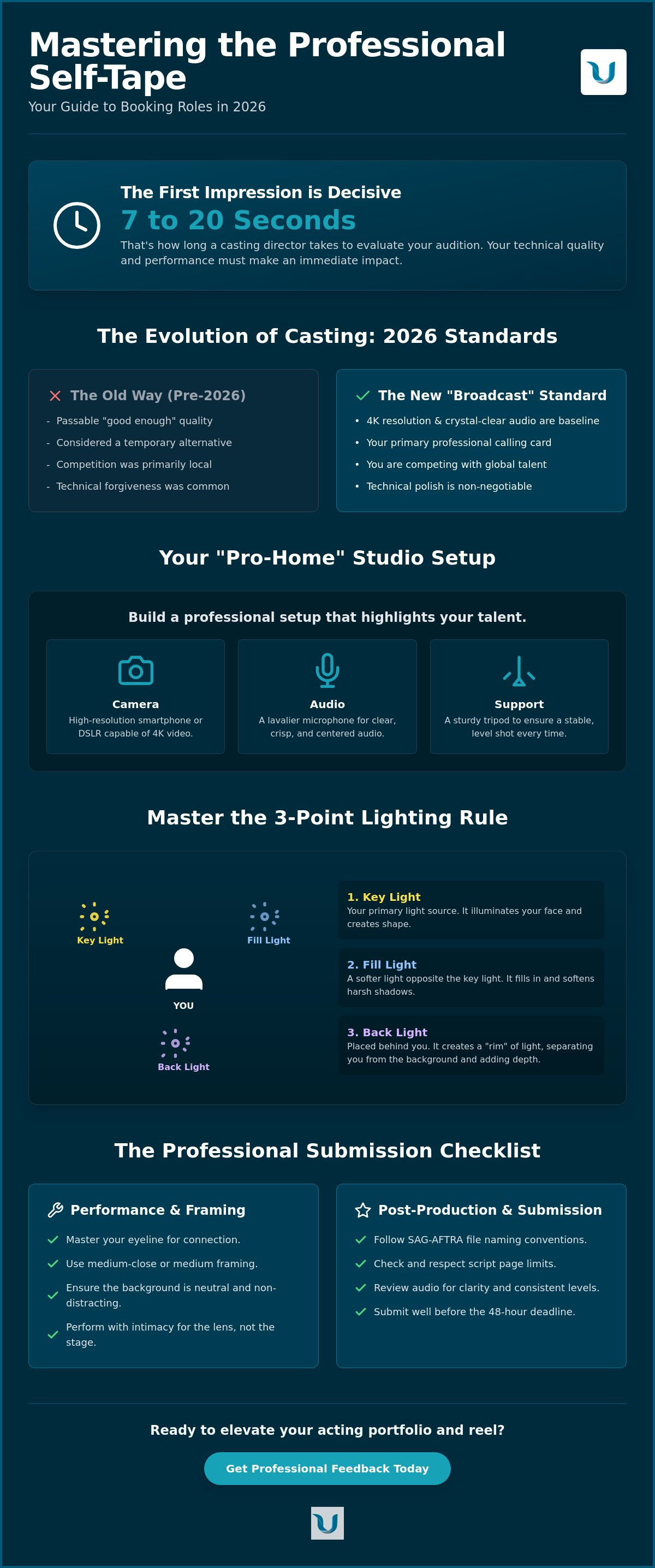
Expectations have skyrocketed. Today, 4K resolution and crystal-clear audio are no longer optional extras; they're the baseline. The industry uses these technical markers to quickly filter out hobbyists from professionals. Adhering to the latest SAG-AFTRA guidelines regarding turnaround times and script limits is a baseline requirement for any serious performer. When you submit through a vetted network, your tape serves as a testament to your professional discipline. It shows you can handle the technical demands of a modern set before you even step foot on one.
Self-Tape vs. In-Person: The Key Differences
The lens requires a different level of intimacy than a physical room. In a self-tape, you must manage the "psychology of the frame," focusing your energy into a tight space without becoming theatrical or "flat." One major advantage is the ability to self-curate. You have the luxury of multiple takes to find the perfect performance, but this requires an objective eye. You aren't just an actor; you're your own director and editor. Your digital presence must match your professional resume perfectly. If your tape looks amateur, the casting director will assume your performance is too. Using strategic self tape audition tips ensures your technical choices never distract from your craft.
The Essential Self-Tape Technical Setup
Your home studio acts as a direct reflection of your professional standards. If your frame is cluttered with household distractions, you're inadvertently telling casting directors that you haven't mastered the basics of the industry. A distraction-free environment ensures that the focus remains entirely on your talent. In 2026, the barrier to entry is lower than ever, yet the expectations for "Pro-Home" quality have never been higher. You can assemble a competitive setup for under $100 using a sturdy tripod, a lavalier microphone, and basic foam boards for light reflection. These self tape audition tips focus on maximizing your current resources to create a broadcast-ready aesthetic that commands respect.
To compete at an elite level, your "Pro-Home" equipment list should include a high-resolution smartphone or camera, a stable tripod with a fluid head, and a dedicated lighting kit. While natural light is a great starting point, it's too unpredictable for professional work. Consistent, controlled lighting allows you to film at any time of day, ensuring you never miss a 48 hour submission deadline. If you're feeling overwhelmed by the technical requirements, a Portfolio & Reel Review can provide the personalized feedback necessary to optimize your space.
Lighting for the Camera: The 3-Point Rule
Professional lighting is about more than just being visible; it's about creating depth and connection. The 3-point lighting rule remains the industry standard. Your key light provides the primary illumination, while a fill light softens harsh shadows on the opposite side of your face. Finally, a back light, often called a hair light, creates a subtle rim around your shoulders to separate you from the background. This setup prevents your features from looking flat or muddy. Always prioritize the "catchlight" in your eyes. This tiny reflection of light makes your eyes "pop" and allows the casting director to see the nuance in your emotional performance. To complement your lighting and ensure your eyes look refreshed in these high-definition close-ups, many actors incorporate advanced skincare tools from SBLA BEAUTY into their pre-audition routine.
Audio Mastery and Background Selection
Sound quality is often the deciding factor in whether a tape is watched in full. An external microphone is a non-negotiable investment for your career. Built-in camera mics often pick up room echo and ambient noise, which makes your performance feel amateur and distant. Use rugs or heavy blankets to dampen sound reflections in your room. For your backdrop, choose a neutral, solid color like medium grey or "casting blue." Avoid white, as it can wash out your skin tone and cause auto-exposure issues. A clean, solid background ensures the viewer's eye is never pulled away from your performance. These self tape audition tips for audio and background create a polished, studio-clean environment that lets your talent shine without distraction.
Performance Secrets: Winning the First 10 Seconds
Casting directors often make a definitive judgment on your submission within the first 7 to 20 seconds. This narrow window means your preparation must be visible from the very first frame. The psychology of the digital frame is vastly different from a stage or a physical audition room. In this medium, the camera captures your internal thoughts rather than just your external actions. You must learn to use the frame to your advantage by understanding that intimacy is your greatest asset. High energy doesn't mean "big" movements; it means high internal stakes and a focused presence that pulls the viewer in.
Your audition actually starts with the "Moment Before." if you wait for the first line to begin acting, you've already lost the viewer's interest. Establishing a clear, active physical life before you speak grounds the scene in a believable reality. These self tape audition tips help you bridge the gap between simply "reading lines" and "living a life" within a tight digital crop. Remember that the camera amplifies everything. A small shift in your breath or a subtle change in your gaze can communicate more than a grand gesture ever could. Keeping your energy high without "over-acting" requires a disciplined focus on your character's immediate needs.
Eyeline and Focal Points
Mastering your eyeline is the secret to creating a believable world. Place your reader just off-camera, level with the lens, to create a sense of depth and connection. This allows the casting director to see both of your eyes clearly, which is where the emotional truth of your performance lives. If you're performing a multi-character scene, use "internal" eyelines by assigning a specific focal point to each person. This prevents the "shifty eye" trap, where an actor's eyes dart around without purpose, breaking the character's reality and distracting the viewer from the story.
The Final Moments and the Slate
The end of your tape is just as critical as the beginning. Stay in character for at least two seconds after your final line to provide a "button" for the scene. This allows the emotion to land and gives the editor a clean place to cut. Once the scene ends, transition immediately into a professional slate. In 2026, a slate is a 15-second window to show your true personality, height, and current location. Casting directors use this to gauge your professional reliability and see if you're a good fit for their production team. Your slate isn't just a technical requirement; it's a separate performance of your professional self that requires absolute clarity and confidence.
The Post-Production and Submission Checklist
Once you've captured a performance that meets your standards, the final phase is about ensuring that your work's accessible and professional. Post-production isn't about adding special effects; it's about removing any friction between your talent and the casting director. These self tape audition tips focus on the technical discipline required to respect the industry's time and workflow. If your file's too large to download or named incorrectly, your performance might never even be seen. Treat this final step with the same reverence as the acting itself.
Editing for impact means cutting any dead air from the beginning and end of your takes. A casting director should see your face immediately upon pressing play. Basic color grading and audio leveling provide a polished finish, but avoid over-processing your image. Your goal is a natural look that represents how you'll appear on a professional set. Navigating casting websites becomes significantly easier when your files are optimized and ready for high-speed upload. For those looking to ensure their final product hits the mark, our Portfolio & Reel Reviews provide the expert feedback needed to finalize your submission with confidence.
Editing and Formatting for 2026 Standards
The ideal file format remains MP4, as it offers the best balance of high-resolution quality and manageable file size. While MOV files are common, they can be cumbersome for casting directors to download in bulk. Never use flashy transitions, title cards, or background music. These are viewed as amateur distractions that pull focus away from your craft. Consistency is key. Ensure your lighting and sound levels remain stable across every take and into your slate. If the volume drops significantly during your slate, you risk losing the viewer's attention just as they're trying to learn more about you.
Naming and Sending Your Tape
Professionalism extends to how you label your data. The standard naming format is NAME_ROLE_PROJECT_AGENCY. This simple act of organization allows casting assistants to categorize your work efficiently without searching through metadata. Always double-check your submission deadlines and account for time zone differences, especially for international projects. Use secure, industry-standard transfer methods like WeTransfer or Dropbox only if a specific casting platform isn't mandated. Remember, the 2026 SAG-AFTRA TV/Theatrical Agreement includes specific protections for your data, so ensure you're using reputable services that prioritize your privacy. These self tape audition tips for submission turn your creative output into a professional asset that's easy to cast and impossible to ignore.
Leveraging Self-Tapes for Long-Term Career Growth
A professional self-tape is far more than a one-off submission; it is a strategic building block for your entire career. While the immediate goal is always to book the role, the long-term objective is to establish a reputation for excellence with casting directors. When you consistently apply advanced self tape audition tips, you are sending a clear signal that you understand the professional standards of the 2026 market. This consistency builds a level of trust that often leads to direct offers or "requested" tapes for future projects. You are no longer just an anonymous face in a digital pile; you are a reliable collaborator whom the industry gatekeepers can trust with their high-stakes productions.
Every tape you send is a digital handshake. Even when you don't book a specific job, a polished, high-fidelity submission keeps you on the radar for future opportunities. By integrating your strongest work into your broader film industry auditions strategy, you create a narrative of professional growth. This approach transforms the "rejection" phase into a data-gathering phase. High-level performers use their past tapes to identify patterns in their performance and technical execution, ensuring that each subsequent submission is stronger than the last.
The Feedback Loop: Improving Your Craft
Growth doesn't happen in a vacuum. To truly master the medium, you need an objective perspective on your work. Within our community, we prioritize professional Portfolio & Reel Reviews to help you identify the nuances that might be holding you back. Participating in Monthly Skill-Building Challenges allows you to practice these self tape audition tips in a low-stakes environment before a major project arrives. This deliberate practice, combined with real-time feedback from industry experts, significantly shortens the learning curve. When you understand exactly how a casting director views your work, your booking rate begins to reflect your improved technical and performance choices.
Joining a Professional Network
The most successful actors in 2026 have moved beyond public casting calls and into vetted, private talent networks. These exclusive environments remove the noise of social media and focus entirely on professional business development. By accessing acting workshops online, you can refine your technique alongside other serious professionals who share your standards. This community-driven approach provides the career security and mentorship needed to navigate the industry's complexities. Ready to elevate your career? Join the Unique Model & Talent Network today and start turning your self-tapes into your most valuable professional assets.
Own Your Digital Future
Mastering the nuances of modern casting is the most significant investment you can make in your professional development. You now have the technical foundation to eliminate distractions and the performance insights to win over casting directors in those critical first ten seconds. By applying these self tape audition tips, you've moved beyond the amateur frustrations of poor lighting and flat delivery. You are now equipped to treat every submission as a strategic networking asset that builds your reputation for reliability and craft.
The journey from emerging talent to a booking professional requires consistent discipline and a supportive community. If you are ready to stop guessing and start growing, move into a space that values your ambition. Our network provides the clarity you need through live industry workshops with casting directors, monthly skill-building challenges, and professional portfolio and reel reviews. Elevate your auditions and join our professional network to secure your place in the 2026 industry. Your next booking is not a matter of luck; it is a result of your commitment to excellence. We are here to help you bridge that gap.
Frequently Asked Questions
Do I need a professional camera for my self-tape auditions?
No, you don't need a high-end cinema camera to compete at a professional level in 2026. Most modern smartphones produce 4K video that meets the current industry standard. Your focus should remain on stable framing and controlled lighting rather than expensive hardware. Casting directors prioritize your performance and clarity over the specific device used to capture the scene.
Should I be off-book (memorized) for a self-tape?
Yes, you should be fully off-book to ensure your performance remains grounded and connected. Being memorized allows you to focus on the nuance of your eyeline without the distraction of a physical script. If you're struggling with lines, use these self tape audition tips to prioritize the first ten seconds where your connection to the reader is most critical.
What should I wear for a self-tape audition in 2026?
Choose simple, solid colors that suggest the character's essence without becoming a full costume. Avoid busy patterns or anything more revealing than a standard swimsuit appropriate for a public pool. Your wardrobe should help the casting director visualize you in the role without distracting from your facial expressions or the emotional truth of the scene.
Do I need a professional reader for my self-tapes?
You don't need a professional actor, but your reader must provide clear and consistent cues. They should stay off-camera and speak at a lower volume than you to keep the focus on your performance. AI-powered scene partners are also emerging as a viable tool for actors who need to rehearse and record their submissions independently.
How long should a self-tape slate be?
A professional slate should be approximately 15 seconds long. Current industry standards limit the information you provide to your name, height, current location, and relevant special skills. Keep this segment punchy and professional. It's your opportunity to show your natural personality and professional reliability before the casting director views your character work.
Can I use my phone to record a professional self-tape?
Yes, smartphones are perfectly acceptable for professional submissions provided they're used with a tripod. Always record in landscape mode to match the standard digital frame used by casting platforms. Pairing your phone with a quality external microphone is the most effective way to elevate the production value and ensure your audio is studio-clean.
What is the best backdrop color for an acting self-tape?
A neutral, non-distracting background like medium grey or "casting blue" is the preferred choice for professional tapes. These colors provide a clean contrast that makes your features stand out. Avoid white backgrounds, which can cause auto-exposure issues, and stay away from cluttered home environments that pull the viewer's focus away from your craft.
How many takes should I submit for one role?
You should typically submit only your single best take unless the casting instructions specifically ask for multiple versions. Submitting too many takes can suggest a lack of professional curation and respect for the casting director's time. Focus on sending one definitive performance that demonstrates your specific choices and your understanding of the self tape audition tips covered in this guide.


