
What if the most critical skill you could master wasn't your vocal range or your dramatic timing, but your ability to bounce back from a "no"? In an industry where the stakes are high and feedback is often personal, learning how to handle rejection as an actor is a fundamental business requirement. You've likely felt the weight of a quiet phone or the sting of imposter syndrome after a callback didn't go your way. It's a heavy burden that can turn a passion into a source of chronic stress without a professional strategy in place.
We agree that the path to a sustainable career is paved with more than just talent. It requires a disciplined approach to your psychological well-being. This guide reveals the essential mental health tools and professional strategies you need to build lasting resilience and safeguard your craft. We'll explore actionable coping mechanisms for audition anxiety, identify industry-specific support networks, and explain why viewing mental health as a career investment is the smartest move you can make for your longevity. Whether you're navigating the rising costs of private therapy or seeking a stable peer network, you'll gain the clarity needed to thrive in an uncertain field.
Key Takeaways
- Master the rejection-resilience cycle by understanding why your brain treats a "no" like physical pain and learning how to handle rejection as an actor.
- Reframe mental wellness as emotional stamina, a high-value professional asset that helps you book work more consistently.
- Identify specialized support systems like BAPAM and the Entertainment Community Fund that cater specifically to the needs of working performers.
- Implement strategic professional boundaries and dark periods to safeguard your energy from the demands of the entertainment industry.
- Combat the isolation of the freelance life by engaging with a gated, moderated network that prioritizes your career growth.
Understanding the Unique Psychological Pressures of the Performance Industry
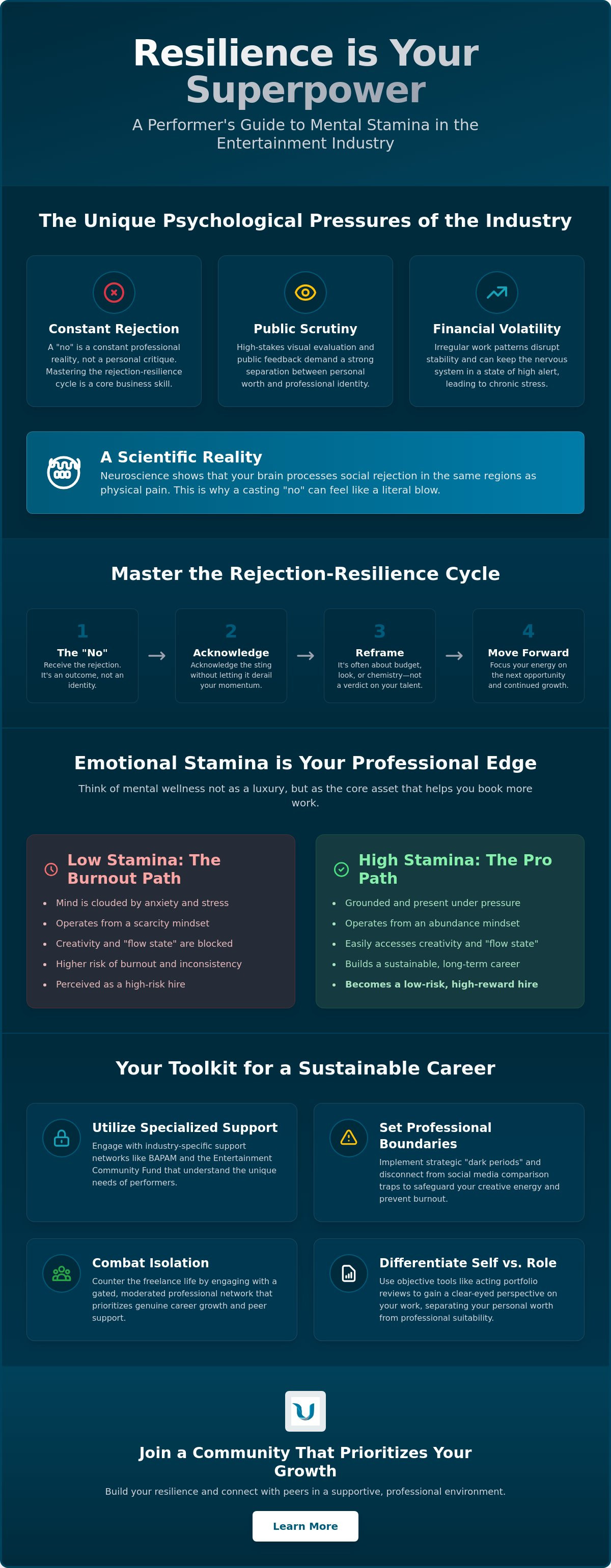
The entertainment industry is a high-stakes environment that demands more than just creative talent; it requires a resilient nervous system. Performers face a unique trio of professional stressors: constant rejection, public scrutiny, and chronic financial volatility. These factors aren't merely "part of the job." They're physiological challenges that can lead to burnout if left unmanaged. In 2026, the most successful talent treats their mental health as a core business asset, moving away from the outdated "tortured artist" myth that suggests pain is a prerequisite for great work. In reality, chaos sabotages professional growth and limits your ability to maintain the high standards that top tier recruiters expect.
Neuroscientific research shows that the brain often processes social rejection in the same regions as physical pain. This is why a casting "no" can feel like a literal blow to the chest. When you're learning how to handle rejection as an actor, you're essentially training your brain to shorten its recovery time. The "rejection-resilience cycle" is a professional skill that allows you to acknowledge the sting without letting it derail your momentum. Furthermore, irregular work patterns frequently disrupt the nervous system and sleep hygiene. Without a predictable schedule, your body stays in a state of "high alert," which can lead to chronic stress and imposter syndrome if you don't implement a disciplined routine.
Rejection Sensitivity and the Actor’s Ego
Differentiating your personal worth from your professional suitability for a specific role is the first step toward career longevity. It's vital to remember that a "no" is often about a specific look, a chemistry match, or a budget constraint rather than a critique of your talent. To protect your ego, practice "leaving the room" mentally the moment an audition ends. Use objective tools like acting portfolio reviews to gain a clear-eyed perspective on your professional standing. This objectivity is especially critical when exploring the psychological effects of Method acting, which can sometimes blur the lines between your personal identity and your character's emotional recall.
The Modeling Industry: Body Image and Professional Identity
Models face a specific type of pressure because they are, in a very literal sense, the product being sold. This high-stakes visual evaluation can make body image stress a constant professional hazard. To navigate this, you must adopt a business-first mindset. View your digital submissions as professional assets rather than personal snapshots. It's also essential to set boundaries with social media "comparison traps." These platforms often mimic professional competition but lack the integrity and organized value of a private, gated community. By focusing on accredited opportunities and professional standards, you protect your mental health from the noise of the open market.
Building Resilience: Why Mental Health is a Professional Asset
Think of mental wellness not as a luxury, but as "emotional stamina." In a high-stakes industry, your ability to remain grounded under pressure is a competitive advantage. The return on investment for resilience is clear: stable performers book more work. When a casting director sees that you possess the professional poise to manage a 14-hour day without a meltdown, you become a low-risk, high-reward hire. Proactive care, such as utilizing Entertainment Community Fund mental health services, ensures you have the support needed to maintain this professional standard.
Peak performance relies on reaching a "flow state," where your preparation meets your presence. If your mind is clouded by anxiety or a scarcity mindset, you block the very creativity you need to succeed. Moving toward an abundance mindset means recognizing that one missed role doesn't define your career trajectory. It allows you to focus on the work itself rather than the outcome. If you want to strengthen this mindset, participating in Monthly Skill-Building Challenges can help you stay sharp and focused on growth during quiet periods.
Managing Performance Anxiety and Audition Nerves
Anxiety is often just physical energy looking for a direction. Instead of fighting it, use tactical breathing to ground yourself in the casting waiting room. Inhale for four counts, hold for four, and exhale for eight to signal your nervous system that you're safe. Successful film industry auditions often depend on a ritualized approach. By treating every audition as a professional meeting rather than a test of your worth, you learn how to handle rejection as an actor before you even step through the door. Reframing "nerves" as "excitement" for the camera transforms your energy into something magnetic.
The Importance of Creative Autonomy
For many performers, finding ways to truly disconnect is a key part of this balance; for instance, taking the time to explore Ocean Cruises or other curated vacations can provide the mental reset needed to return to your craft with renewed energy.
Essential Mental Health Resources for Performers in 2026
Accessing high-quality care in 2026 requires a strategic approach to navigating a shifting financial landscape. With the national average for a single therapy session now ranging from $100 to $250, and often climbing above $300 in major hubs like Los Angeles or New York, the cost of wellness can feel like another industry barrier. Specialized specialized treatments for trauma or performance-related anxiety frequently command premium rates of $175 to $350 per session. However, you don't have to navigate these costs alone. Organizations like the Entertainment Community Fund and the British Association for Performing Arts Medicine (BAPAM) provide clinical pathways specifically tailored to the creative professional's unique lifestyle and financial reality.
For performers seeking affordable clinical care, the Open Path Collective is a vital resource, offering therapy sessions at reduced rates of $30 to $80 after a one-time $65 membership fee. It's also important to stay informed about legislative changes that impact your access to care. For example, the "Mental Health Access and Provider Support Act," introduced in March 2026, aims to improve provider availability by increasing Medicare reimbursement rates for counselors. Understanding these options is a key part of learning how to handle rejection as an actor; it ensures that your professional resilience is backed by tangible, affordable support systems.
Digital tools also play a critical role in maintaining daily focus. Freelancers often struggle with the lack of a stable peer network, making peer-led support groups essential. Talking to people who "get it" prevents the isolation that often leads to chronic stress. Apps designed for habit-tracking and focus can help you maintain a sense of agency when your schedule feels chaotic, turning the downtime between gigs into a productive period for personal growth.
Industry-Specific Support Organizations
The Entertainment Community Fund offers more than just counseling; they provide support groups and emergency financial assistance tailored to the 2026 industry climate. For those in the music and touring sectors, MusiCares and Backline provide specialized grants and mental health networks that understand the specific pressures of life on the road. If your career is expanding internationally, ArtsMinds and Industry Minds offer global perspectives on navigating the psychological demands of high-stakes performance across different cultures and markets.
Crisis vs. Maintenance: Choosing the Right Resource
Distinguishing between clinical crisis intervention and professional maintenance is a vital skill. If you're struggling with deep-seated trauma or depression, a licensed therapist is non-negotiable. However, if your primary stress is a lack of direction or industry uncertainty, modeling career coaching can provide the professional accreditation and strategy needed to regain your confidence. Be alert for red flags in "career advice" that prioritizes fame over well-being. True professional growth involves knowing how to handle rejection as an actor by using a mix of clinical support and savvy career direction.
Creating a Sustainable Career Environment: Boundaries and Routines
The "always-on" hustle is a fallacy that leads directly to burnout. Professional longevity requires "dark periods" where you're completely unreachable by the industry. This isn't laziness; it's essential recovery. If you treat your career like a chaotic, 24/7 scramble, your mental health will eventually pay the price. Establish a "Workday Routine" that mirrors a professional office environment. Even on days without a booking, dedicate specific hours to business development, craft practice, and administrative tasks. This structure provides the stability that the freelance lifestyle naturally lacks, helping you stay grounded when the phone isn't ringing.
Financial wellness is inseparable from mental wellness. Managing the "feast or famine" cycle requires a disciplined budget and a clear-eyed view of your insurance options. This is especially critical given recent legislative shifts. As of July 4, 2025, federal funding for Medicaid was cut by 15%, a change that the Congressional Budget Office estimates will result in 11.8 million individuals losing coverage over the next decade. Navigating these financial realities is a core part of learning how to handle rejection as an actor. When your basic needs are secured through careful planning, a missed role feels like a professional pivot rather than a personal catastrophe.
Set clear professional boundaries with your agents and casting directors regarding your availability. You are a business owner, not a 24-hour service provider. By communicating your "office hours" and sticking to them, you command respect and protect your creative energy for the work that matters most. To build this sense of professional security and connect with like-minded peers, consider joining The Network Membership for a more focused, gated environment.
Navigating Digital Spaces Without the Noise
Public casting websites are essential tools, but they can easily become sources of anxiety. Use them efficiently by setting specific times for submissions rather than scrolling endlessly. Private, moderated communities offer a protective layer that public social media groups lack. They remove the "predatory" feel of the open industry and replace it with organized value. Implement digital detox strategies, such as turning off industry notifications after 6:00 PM, to ensure your home remains a sanctuary.
Preparing for the "Quiet Seasons"
Downtime is an opportunity for skill acquisition rather than rumination. Instead of letting self-doubt take over during a slow month, use acting workshops online to maintain your professional momentum. This keeps your craft sharp and provides a sense of agency when external opportunities are scarce. Build a "resilience kit" of past wins, positive feedback, and accreditation to review on low days. This tangible record of your success acts as a psychological buffer against the inevitable ebbs and flows of the entertainment industry.
The Power of Community: How Unique Model & Talent Network Supports Your Growth
Isolation is the primary enemy of the performer's mental health. When you're navigating the industry alone, every "no" feels like a personal indictment rather than a business decision. This isolation magnifies the sting of missed opportunities and makes the search for how to handle rejection as an actor feel like an uphill battle. A private, moderated environment removes the "predatory" feel often associated with the open industry. By surrounding yourself with serious professionals, you replace the superficiality of social media with a sense of security and community belonging.
Direct access to seasoned mentors provides the clarity needed in an uncertain field. When you have a vetted roadmap, the "fear of the unknown" begins to dissipate. Fostering professional bonds within a managed talent community ensures you have a stable peer network to lean on during the inevitable quiet seasons. This collective support is what turns a volatile career into a sustainable business.
Mentorship and Professional Direction
Expert Q&A sessions and Live Industry Workshops are more than just learning opportunities; they are psychological anchors. These sessions provide a direct line to industry insiders who have already walked the path. Having a clear professional direction reduces the chronic stress caused by trial and error. It allows you to transition from "aspiring" to "professional" through community-led accreditation and high standards. This structured approach helps you view your progress objectively, which is vital for maintaining your long-term mental stamina.
Joining a Network That Values Your Success
There is a significant difference between a standard "fan group" and a professional acting industry networking platform. While general social media groups often prioritize fame or vanity, a gated community focuses on tangible success and career security. Monthly Skill-Building Challenges and Portfolio Reviews provide a sense of achievement that keeps your momentum high, even between bookings.
By joining a network that treats your mental health as a career asset, you're making a decisive investment in your longevity. You'll learn how to handle rejection as an actor not through isolation, but through the strength of a collective that values integrity and professional growth. Your career deserves a protective environment where your talent can thrive without the distractions of external platforms.
Take Command of Your Professional Future
Building a career in the entertainment industry requires more than just a polished reel; it demands the emotional stamina to sustain a lifelong path. By establishing clear boundaries, utilizing specialized clinical resources, and mastering how to handle rejection as an actor, you transform potential burnout into professional momentum. Your talent is a business. Like any successful business, it requires a stable foundation and a reliable support system to weather the inevitable "quiet seasons" that define the freelance life.
Stop navigating the chaos of public social media alone. You're serious about your craft, so it's time to join a space that reflects that commitment. Secure your career and join a supportive community at Unique Model & Talent Network. Our moderated, private community on Mighty Networks provides direct access to vetted industry experts and a structured roadmap through regular skill-building challenges and workshops. You have the craft; now give yourself the community that honors it.
Frequently Asked Questions
Where can performers find free or low-cost mental health support?
Performers can access affordable therapy through the Open Path Collective, which offers sessions between $30 and $80. There is a one-time membership fee of $65 to join their network of licensed therapists. This is a vital alternative when private therapy rates in major cities often climb to $250 or more. You can also reach out to the Entertainment Community Fund for industry-specific counseling and support groups.
How do I manage performance anxiety before a major film industry audition?
Manage anxiety by implementing tactical breathing and ritualized preparation. Inhale for four counts, hold for four, and exhale for eight to signal your nervous system that you are safe. Treating the audition as a professional business meeting rather than a personal test shifts your focus from the outcome to the process. This grounding technique allows your creative flow to remain accessible under pressure.
Is it okay to tell my agent that I need a mental health break?
Yes, professional agents prefer a rested performer to one who is struggling with burnout. Communicate your "dark period" clearly as a scheduled break for maintenance. This prevents you from being unavailable for a major booking without notice and maintains your professional reputation. Most savvy agents understand that longevity requires periodic recovery to keep your craft at its highest standard.
What are the most common mental health challenges for models?
Models frequently face body image stress and the psychological pressure of being "the product." This can lead to comparison traps on social media that mimic professional competition. Adopting a business-first mindset helps separate your professional identity from your personal worth. It is essential to set boundaries with digital spaces and focus on accredited opportunities to protect your mental well-being from industry noise.
How can joining a professional network help with my mental well-being?
A professional network provides a stable peer community that eliminates the isolation of freelance life. Access to vetted industry experts gives you a clear roadmap, which reduces the uncertainty that causes chronic stress. Learning how to handle rejection as an actor is much easier when you have mentors providing objective feedback. This structured environment replaces the chaotic feel of the open industry with organized value.
How do I stop taking audition rejection personally?
Reframe rejection as a lack of "fit" for a specific project rather than a critique of your talent. Mastering how to handle rejection as an actor involves understanding that casting decisions often hinge on chemistry, look, or budget. Leave the room mentally the moment the audition ends. By focusing on your professional standards rather than external validation, you protect your ego and maintain your momentum.
What should I do if I feel burned out by the entertainment industry?
Step back and evaluate your professional boundaries immediately. If you've been in an "always-on" mode, you need a recovery period to reset your nervous system. Reconnect with non-results-oriented creative outlets to rediscover your passion without the pressure of commercial success. Building a life outside the industry prevents the identity crises that often follow long periods of high-stakes performance work.
Are there specific resources for performers dealing with imposter syndrome?
Industry-specific support groups and career coaching are excellent for managing imposter syndrome. Reviewing your professional accreditation and past wins helps build objective confidence in your abilities. The Entertainment Community Fund provides counseling specifically for performance-related psychological pressures. Engaging with a community of peers who share similar experiences can also help normalize these feelings and provide practical strategies for overcoming them.


