

A first shoot should feel like a professional collaboration, not a test a new model has to pass. To understand how to work with new models, share a clear brief, explain what to expect, and give calm, specific direction throughout the shoot. Patience and respect help a new model focus, learn, and do their best work.
It’s natural to want strong images and a smooth shoot, especially when a model is still building confidence and experience. With preparation, constructive feedback, and professional communication, you can create a positive first experience and lay the groundwork for future bookings. This guide covers how to prepare, direct the shoot, give useful feedback, and support a model’s development over time.
Key Takeaways
- Set clear expectations for the shoot and use focused direction to help a new model work with confidence.
- Build the conditions for repeat bookings through dependable, professional collaboration and constructive feedback.
- Match each model to the task by weighing the brief, the intended audience, and the skills the work calls for.
- Support long-term growth with ongoing practice, portfolio development, and opportunities to learn from industry professionals.
First shoots, jobs, and repeat bookings
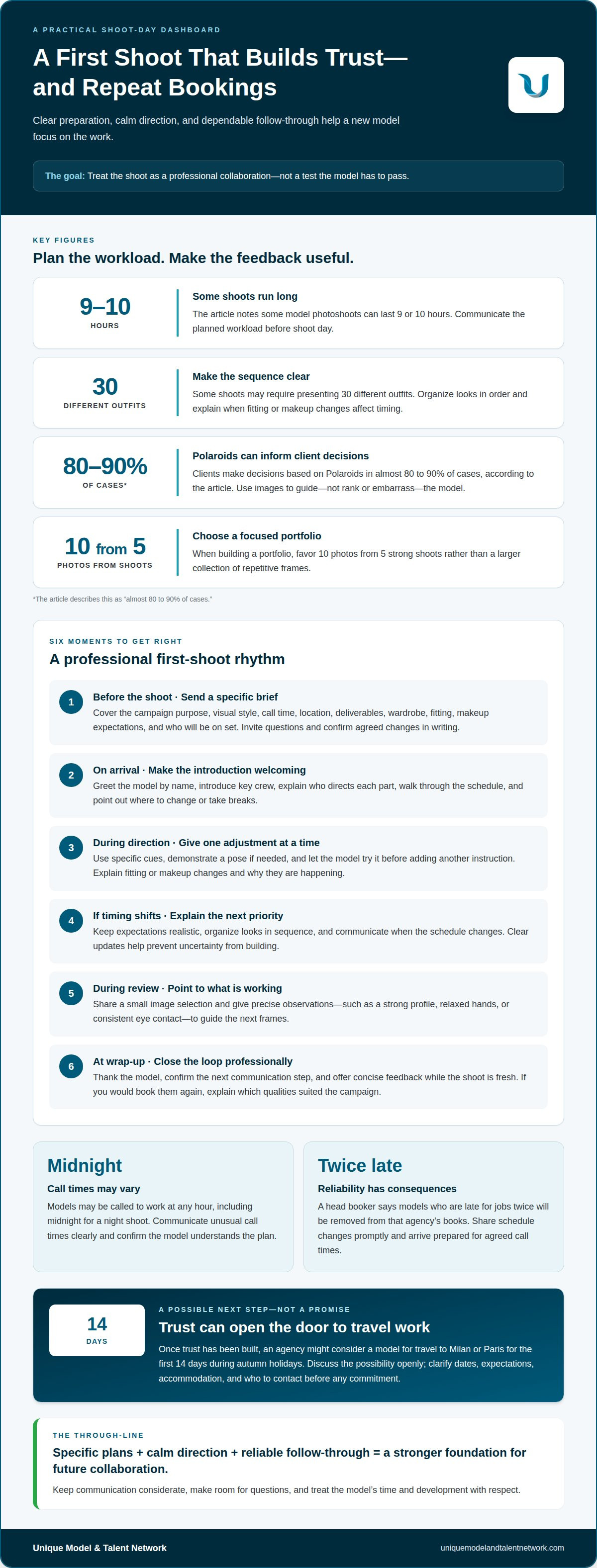
- Send a specific brief before the shoot. Explain the campaign’s purpose, visual style, call time, location, and expected deliverables. For example, say whether the shoot calls for relaxed e-commerce poses or sharper fashion editorial expressions. Describe the wardrobe plan, fitting process, makeup expectations, and who will be on set. A prepared model can focus on the work instead of guessing what happens next. Invite questions early, then confirm any agreed changes in writing so the model and crew share the same plan.
- Make the first introduction professional and welcoming. Greet the model by name, introduce the photographer, stylist, makeup artist, and other key crew, then explain who directs each part of the shoot. Walk through the schedule and show where the model can change or take breaks. If a pose or styling choice feels unfamiliar, describe the visual result you want rather than criticizing the model’s body or experience. Clear direction helps a first-time collaborator understand the job and contribute with confidence.
- Direct one adjustment at a time. Start with simple cues such as “turn your shoulders toward the light” or “hold that expression for the next frame.” Demonstrate a pose when words aren’t enough, and let the model try it before adding another instruction. During makeup or a fitting, explain what is changing and why. This approach keeps feedback actionable and makes it easier to decide which poses, expressions, and angles suit the campaign. Avoid vague comments such as “be more interesting,” which give no practical next move.
- Keep the schedule and expectations realistic. Some model photoshoots can last 9 or 10 hours and require presenting 30 different outfits, so communicate the planned workload before the day. Organize looks in sequence, keep essential styling details close, and tell the model when a fitting or makeup change affects timing. If the shoot runs behind, explain the next priority instead of letting uncertainty build. Professional preparation shows respect for the model’s time and helps the whole team stay focused.
- Review images with a purpose. Share a small selection during the shoot and explain what is working, such as a strong profile, relaxed hands, or consistent eye contact. Polaroids can be central to client decisions, with clients making decisions based on them in almost 80 to 90% of cases. Use the images to give precise direction, not to rank or embarrass the model. When building a portfolio, favor 10 photos from 5 strong shoots rather than a larger collection of repetitive frames.
- Close the job with clear follow-through. Thank the model, confirm the next communication step, and give concise feedback while the shoot is still fresh. If you would book them again, say which qualities suited the campaign and what future assignment could fit. Reliability matters: a head booker says models who are late for jobs twice will be removed from that agency’s books. Agents and clients need dependable collaborators, so communicate schedule changes promptly and arrive prepared for each agreed call time. A thoughtful wrap-up can turn a first shoot into a professional relationship.
Availability can be part of the work, so ask about a model’s schedule before making assumptions about when they can take a booking. Models may be called to work at any hour, including midnight for a night shoot. When a shoot requires an unusual call time, communicate it clearly and confirm that the model understands the plan. Share any updates promptly, including changes to the location, schedule, or expected work, and leave space for questions. After the shoot, thank the model and follow up on any agreed next steps. Reliability and considerate communication help make it easier for both sides to decide whether another booking is a good fit.
An agency may also consider a model for work away from home once trust has been built. If an agency has built trust in a model, the model might travel to Milan or Paris for the first 14 days during autumn holidays. Discuss the possibility openly rather than presenting travel as guaranteed. Before any commitment, clarify the intended dates, expectations, accommodation arrangements, and who the model should contact with questions. Keep communication consistent while plans are developing, and make sure the model has time to consider the opportunity. Trust grows when expectations are clear and commitments are handled carefully. A positive first shoot can therefore lead not only to a repeat booking, but also to a longer working relationship in which the model and agency can plan with greater confidence. Both sides benefit when follow-through is as professional as the shoot itself.
How do you choose the right new model for a task?
- Start with the brief, not a familiar look. Write down what the images or performance must communicate, where they’ll appear, and who needs to connect with them. A fashion editorial may call for expressive movement and a distinct visual presence; an e-commerce campaign may need clear product presentation across consistent poses. These are different casting needs. Rank the brief’s priorities before reviewing profiles, so one striking photo doesn’t outweigh the qualities the assignment actually requires.
For example, a beauty shoot focused on skincare may prioritize expressive close-ups, while a campaign for activewear may need ease of movement. Decide which qualities are essential and which are preferences. That distinction helps you assess each applicant fairly, including someone who has limited experience but fits the creative direction.
- Match physical requirements to the actual category. Don’t treat runway height expectations as a rule for every modeling job. A 5'3" applicant may suit petite, commercial, or beauty modeling rather than runway work. A 5'9" requirement applies to runway and some editorial fashion, not all modeling assignments. Tie any height criteria to the client’s brief and the garment or production needs, rather than using a single industry stereotype to screen every profile.
Traditional runway expectations illustrate why context matters. Female runway models signed by major agencies are often described as 5'9" to 6' tall, while male runway models are generally 6' to 6'3". Those ranges may help assess a runway-specific casting. They don’t decide whether someone can succeed in commercial, beauty, or petite work. Treat measurements as relevant only when the assignment depends on them.
- Evaluate the profile for evidence of fit. Look for images that show the model’s range, not just one polished pose. A casting profile should help you assess expression, movement, styling versatility, and how the person photographs from different angles. For a catalog brief, check whether the model can present products clearly. For a beauty concept, consider whether close-ups communicate the mood. A focused portfolio can reveal useful strengths even when it contains few shoots.
Separate what the images demonstrate from what you still need to learn. If a profile shows confident still poses but no movement, ask for a simple walk or gesture during casting. Give the same task to each shortlisted candidate. Consistent prompts make it easier to compare suitability without expecting a new model to arrive with every skill already mastered.
- Assess presence and direction-taking together. A strong match isn’t only about appearance. Notice whether the model listens, adapts, and stays engaged when the direction changes. Try a practical example: ask for a relaxed expression, then a more energetic one. Observe whether the model can shift without losing the campaign’s tone. Give clear prompts, since unclear direction can make even an experienced performer look uncertain.
Don’t confuse limited experience with limited potential. A new model may need a demonstration or a moment to understand an unfamiliar pose. Look for responsiveness and curiosity, then consider whether the shoot’s pace leaves room for guidance. If the assignment requires highly specialized movement, weigh that specific demand honestly against the model’s demonstrated abilities.
- Consider the complete production, including wardrobe. Review the fitting needs, styling plan, makeup, and setting before making a final selection. A model who fits the creative direction should also be comfortable with the planned presentation and able to work within the production’s practical requirements. For instance, a campaign with several outfit changes calls for someone prepared to collaborate through fittings and maintain continuity across looks.
Discuss the concept plainly during casting. Explain the clothing, poses, and intended image, then listen to the model’s questions. Their response helps you understand whether the assignment is a good professional fit. Clear expectations protect the quality of the work and help the model decide whether they can contribute confidently.
- Make the decision against the brief’s priorities. Compare each candidate using the same criteria: visual fit, relevant skills, direction-taking, and production requirements. If two profiles look promising, a short casting exercise can clarify who better conveys the campaign’s intended mood. Keep notes tied to observable examples, such as “held product naturally” or “shifted expressions smoothly,” rather than subjective labels.
For emerging talent, thoughtful evaluation supports better opportunities and more purposeful development. If you’re refining how to work with new models, practical model casting guidance can help you connect selection decisions to a model’s next steps.
Unique Model & Talent Network: Live Industry Workshops
Unique Model & Talent Network helps models and industry professionals build practical skills through Live Industry Workshops. Turn to these sessions when you want to strengthen your on-set communication, learn from industry experts, or support a new model’s development beyond a single shoot.
For a model refining their presentation, Portfolio & Reel Reviews offer focused feedback on how their materials communicate their strengths. Monthly Skill-Building Challenges provide structured practice, while The Network Membership connects members with a professional community. These opportunities complement thoughtful casting and clear direction, helping models and collaborators keep learning as their careers develop.
If you’re ready to build stronger industry skills and connections, contact Unique Model & Talent Network.
Turn a First Shoot Into a Stronger Creative Partnership
A model’s first shoot can be the start of a lasting professional relationship. Build on that potential by making development an ongoing part of your work: identify a skill to strengthen, offer direction the model can apply, and keep future collaboration focused on the needs of each project. That steady approach gives emerging talent room to grow while helping creative teams work with greater clarity.
If you want structured support for that growth, Unique Model & Talent Network offers The Network Membership, Live Industry Workshops, and Portfolio & Reel Reviews. These opportunities can help models and industry professionals keep learning and developing their work. Explore the next step in how to work with new models by contacting Unique Model & Talent Network. Keep creating thoughtful opportunities, and let each collaboration open the door to stronger work.
Frequently Asked Questions
What does “working with new models” mean in AI, software, or fashion?
The meaning depends on the industry: in fashion, it means collaborating with emerging models on assignments and career development. In AI or software, “model” usually refers to a computational system, so working with new models can mean integrating, testing, or training them. For a fashion shoot, focus on clear communication, appropriate direction, and a professional collaboration that helps the model understand the creative brief and perform the task.


