

The longest résumé isn’t always the strongest fit. To learn how to find non-union talent, compare each actor’s role-specific experience, reel, and profile details against the production’s needs, then distinguish digital-only casting from broadcast or cable work. In the United States, SAG-AFTRA’s Commercials Contract governs union voiceover rates for broadcast and cable commercials, while its New Media Contract covers union voiceover work for digital and streaming media.
It’s easy to focus on credits or a polished headshot and miss more useful signals: performance range, relevant on-camera or voiceover experience, and how clearly a profile presents an actor’s strengths. A focused comparison gives you a stronger basis for deciding who fits the role and the project’s format.
Here, you’ll learn how to assess experience and profile details, compare digital-only and other non-union casting situations, and use practical criteria to guide your decision. The goal is a shortlist grounded in the work, not assumptions based on a résumé or profile alone.
Key Takeaways
- Match an actor’s relevant credits, reel, and demonstrated range to the demands of the role, rather than relying on profile polish alone.
- Separate digital-only casting from broadcast and cable scenarios before deciding which performers and contract considerations apply.
- Use casting platforms and professional networks as different discovery routes, then narrow the field with consistent role-specific criteria.
- Build stronger profiles and sharper evaluation skills through targeted feedback, expert learning, and structured practice.
Digital-only and non-union casting scenarios
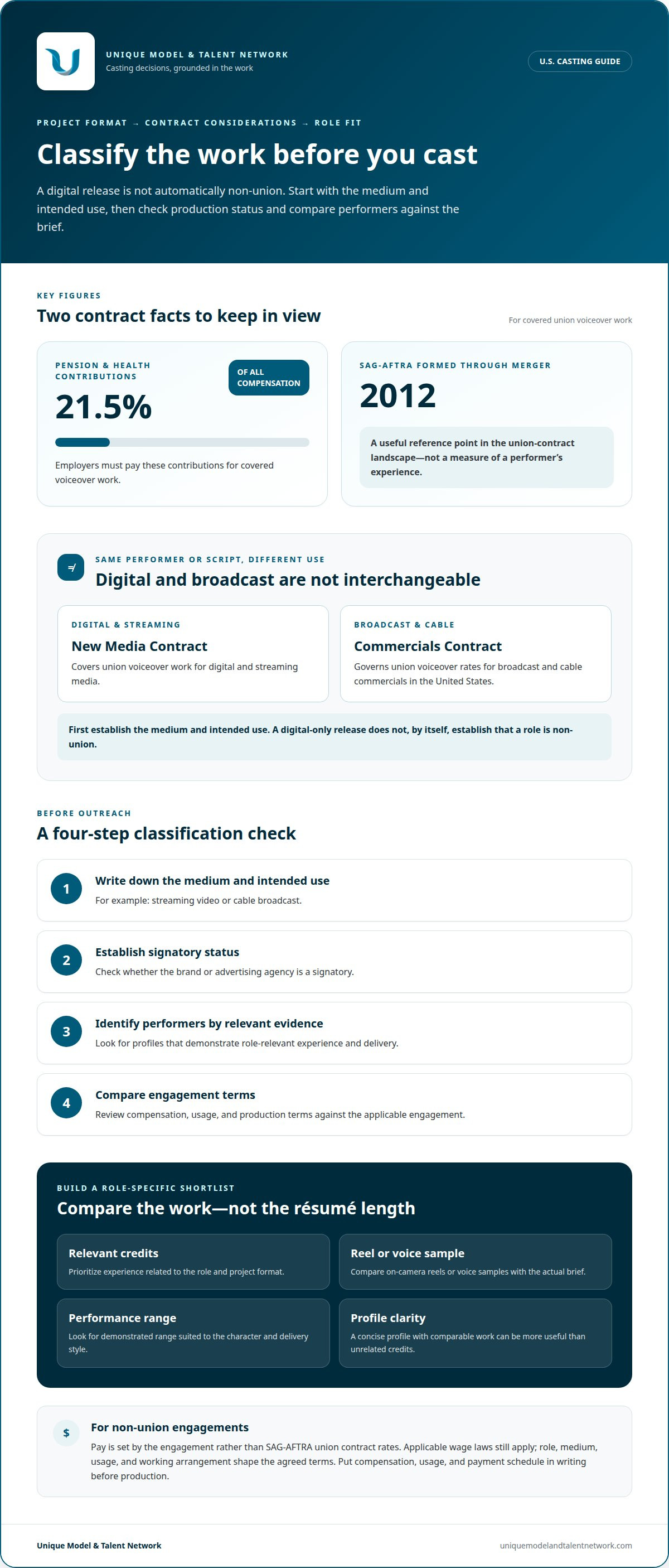
Start with the project’s medium, intended use, and production’s union status. A digital-only release does not automatically mean the role is non-union, so assess those details before comparing performers.
Casting Websites and Platforms
Casting websites and online platforms let producers search profiles by location, skills, credits, and role characteristics. Their main advantage is speed: a casting notice can reach performers beyond a local referral circle. Compare platforms by the profile details they show, such as reels, voice samples, availability, and relevant experience. A listing alone doesn’t establish whether a performer is union or non-union, so record that status separately when shortlisting.
For a digital commercial, compare each candidate’s voice sample or on-camera reel with the actual brief. A concise profile showing a similar delivery style can be more useful than a long list of unrelated credits.
Local Talent Searches
For local casting, narrow your search by production city, travel expectations, and role-specific skills. Local theatre groups, film-school communities, and regional performer networks can surface actors who may not appear in broad platform searches. For a nationwide search, use location filters and remote self-tapes to compare performers across states without confusing geography with experience.
Apply the same criteria to every candidate: role-relevant credits, performance range, reel quality, and ability to follow the brief. A local actor with a strong regional accent may suit a community campaign better than a distant performer with more screen credits.
For non-union performers in the United States, pay is set by the engagement rather than SAG-AFTRA union contract rates. Applicable wage laws still apply, while the role, medium, usage, and working arrangement shape the agreed terms. Put compensation, usage, and the payment schedule in writing before production.
A non-union actor can work on a union production in some circumstances. SAG-AFTRA’s Taft-Hartley waiver can allow a signatory to hire non-union talent for a union job when the role calls for it. SAG-AFTRA generally requires a union job when either the advertising agency or brand is a signatory. Rule One generally prevents union members from working non-union jobs for union signatory companies.
Digital-only work still needs a careful classification. SAG-AFTRA’s New Media Contract covers union voiceover work for digital and streaming media, while its Commercials Contract governs union voiceover rates for broadcast and cable commercials in the United States. SAG-AFTRA formed through a merger in 2012. For covered voiceover work, employers must pay pension and health contributions of 21.5% of all compensation. These distinctions mean a streaming placement and a television spot can involve different contract considerations, even when the same performer and script are involved.
Use this decision sequence before outreach:
- Write down the medium and intended use, such as streaming video or cable broadcast.
- Establish whether the brand or advertising agency is a signatory.
- Identify performers whose profiles show relevant experience and delivery.
- Compare compensation, usage, and production terms against the applicable engagement.
This process helps you find non-union talent for a genuinely non-union project while identifying when a union production’s rules may apply.
Where can I find non-union actors and performers in the United States?
Build your search around the production’s location, role requirements, and discovery method. For a local commercial in Austin, start with performers who can attend an in-person audition or shoot nearby. For remote voiceover, search nationally and request samples that match the script’s tone. To find non-union talent, choose discovery channels based on the actual work.
Local theatre communities can reveal performers with stage experience, strong character work, and rehearsal discipline. Contact theatre departments, community theatres, and independent production groups near the filming location. A stage résumé can show range, but request an on-camera reel if the role requires natural delivery to camera.
Film schools and student production communities offer another route. Their actors may have self-tapes, short-film credits, or experience working with small crews. Share a casting notice with the role type, location, format, usage, audition instructions, and compensation terms. Specific details help performers decide whether the opportunity fits before submitting.
Referrals from directors, photographers, and local production teams can surface actors who are less visible in broad searches. Treat each referral as a lead, then review the performer’s materials. Request a current headshot, résumé, and reel or sample relevant to the role. For a narrator, a voice sample provides more useful evidence than unrelated screen credits.
Use a consistent process to keep a regional search focused:
- Define the market: Set the filming city, travel expectations, and whether remote auditions are suitable.
- Describe the role: Include the performance style, required skills, and any accent or language needs.
- Choose discovery channels: Combine local theatre and film-school outreach with referrals or online casting searches.
- Review submissions consistently: Compare role fit, relevant credits, reel quality, and response to the audition brief.
- Track status: Record each candidate’s union status, location, availability, and submitted materials.
For a nationwide search, use the same role description across regions and invite comparable self-tapes. This makes an actor in Atlanta easier to assess alongside someone in Denver. Keep audition sides, framing instructions, and review criteria consistent so production circumstances don’t overshadow acting choices.
Local searches suit roles requiring in-person collaboration or regional specificity. A nationwide search broadens the pool for remote voice work or roles that can be auditioned by self-tape. When deciding how to find non-union talent for a production, let its location, format, and performance needs guide your search.
Which casting websites and platforms list non-union talent?
Online casting platforms can help you search performer profiles, publish a breakdown, and collect audition materials in one place. Actors Access and Backstage are examples of platforms where performers can find casting opportunities. Non-union performers may appear on casting platforms, but a profile or listing alone doesn’t establish union status.
Actors Access is associated with Breakdown Services and is used for performer profiles and casting breakdowns. Backstage provides a casting marketplace where performers can find opportunities. These are not interchangeable databases: search fields, profile details, and listing visibility can differ. Before posting, consider which platform’s tools best fit the production’s location, role type, and submission process.
Start with the role, not the platform. A voiceover search needs usable audio samples; an on-camera commercial needs a relevant reel or self-tape. If the role requires a specific skill, such as singing or fluent delivery in another language, include it in the casting notice and assess submitted materials directly. A headshot supports a profile, but it can’t demonstrate vocal range or screen presence.
Use a consistent profile review process across platforms:
- Set the filters: Define location, role type, performance skills, and whether remote auditions are acceptable.
- Review the materials: Compare current headshots, résumés, reels, and voice samples against the brief.
- Record status clearly: Track each performer’s stated union status separately from their credits and profile details.
- Request relevant auditions: Give candidates the same sides, script, and submission instructions for a fair comparison.
- Keep communication organized: Record submissions and follow-up in one casting tracker rather than scattered messages.
For example, a digital explainer video may call for a clear, conversational voice and a quiet self-recorded sample. A regional retail spot may need expressive on-camera delivery and a self-tape. The platform helps locate profiles; audition materials show how each performer handles the task.
Don’t choose based on the size of a search result list. Compare profile relevance, submitted materials, and how closely each audition follows the brief. Then establish the performer’s status and project terms before finalizing the shortlist. This separates discovery from the hiring decision and makes platform results easier to assess consistently.
Unique Model & Talent Network
Unique Model & Talent Network helps performers build professional skills and profile materials that support stronger casting opportunities. If you’re refining a reel, clarifying your experience, or seeking informed industry perspectives, its educational community offers a practical next step alongside your casting search.
The Network Membership connects aspiring actors and models with industry experts in a private, moderated community. Portfolio & Reel Reviews help you assess how clearly your materials show your strengths, while Live Industry Workshops and Industry Expert Q&A Sessions offer structured learning. Monthly Skill-Building Challenges provide a focused way to keep developing your craft.
Turn to the network when you want guidance on presenting your experience and making your profile more casting-ready. Contact Unique Model & Talent Network to learn more.
Build Your Next Casting Decision with Confidence
Turn your casting criteria into a repeatable professional practice. As you consider how to find non-union talent for future projects, keep refining how you assess performers and present your own experience. Clear materials and thoughtful industry connections can support stronger conversations about your work.
Unique Model & Talent Network offers ways to continue developing through The Network Membership, Live Industry Workshops, and Portfolio & Reel Reviews. These learning opportunities can help you gain perspective on your profile and creative materials while engaging with industry experts and peers. Choose guidance that matches your current goals, whether you’re preparing a reel or building confidence in your professional direction.
Take a considered next step and keep your growth focused on the work. Contact Unique Model & Talent Network to explore how its professional community can support your development. Your next opportunity starts with the skills and materials you build today.
Frequently Asked Questions
How do I post a casting call for non-union talent?
Write a casting notice that lets performers evaluate the opportunity before submitting. Identify the character, production format, filming location, expected performance, compensation terms, usage, audition method, and submission deadline. State that the role is non-union, then give clear instructions for sending a headshot, résumé, and relevant sample. Keep the notice consistent across platforms so submissions arrive in a comparable format.
How can I verify whether an actor is union or non-union?
Ask the performer to state their current union status in writing, and record the answer alongside the audition materials. If they have representation, their representative can clarify the performer’s status for the specific engagement. Don’t infer status from a résumé, profile, or past credits. Also distinguish a union member with fi-core status, who may work non-union jobs while remaining in the union, from a non-union performer.
What are the risks of hiring non-union talent, and how can I avoid scams?
A digital-only project is not automatically non-union, and a platform listing does not establish a performer’s union status. Record status separately, check whether the brand or agency is a signatory, and put compensation, usage, and the payment schedule in writing; the material provides no specific scam-prevention guidance.


