

A strong casting session isn’t about finding the most polished performance; it’s about seeing who fits the role, responds to direction, and works well with others. To direct actors in a casting session, give clear, simple adjustments and watch how each actor interprets them. A common schedule allows 15 minutes per actor, but the most useful evaluation comes from focused, consistent observation.
It’s easy to focus on first impressions, but a single read rarely reveals the full picture. A respectful, well-organized process helps actors do their best work and gives you clearer evidence for casting decisions. Learn how to prepare the room, guide cold reads and rehearsed scenes, and take practical notes on acting choices, voice, movement, and collaboration. Clear expectations also help every actor know what to expect and let you compare performances with greater confidence.
Key Takeaways
- Set clear expectations for scheduling, callbacks, and casting decisions, then communicate them consistently.
- Use cold reads and rehearsed scenes to observe different skills, and give simple adjustments that reveal how actors respond to direction.
- Record specific notes on role fit, voice, movement, collaboration, and performance choices to make comparisons more thoughtful.
- Look beyond a single strong read: consider how actors work with others and contribute to the production’s goals.
1. Recording auditions and treating actors respectfully
Prepare an audition information sheet before inviting actors. Include the production synopsis, genre, character breakdown, script availability, audition format, and requirements. Add the time and location, callback plans, rehearsal schedule, mandatory rehearsals, performance dates, and when and where you’ll post the cast list. These details help actors decide whether they can commit and arrive ready to work.
What instructions should directors give actors before an audition? Explain what to prepare, which role or scene to read, and how the session will run. For a prepared audition, state whether actors should memorize a monologue; a common guideline is no longer than 2 minutes. For a cold read, explain whether actors will read individually or in groups. A day sheet can collect contact details, availability, performance experience, and role preferences. For prepared auditions, use a signup sheet to assign specific times.
Start by welcoming each actor, explaining the room’s process, and thanking them for coming. If someone loses their place, let them restart when they ask. Avoid eye-rolling, side comments during a performance, or discussing someone’s audition in the room or a public space. A common schedule allows 15 minutes per actor, while some sessions use 4-hour blocks. Keep the audition reader familiar with the script so their cues don’t misdirect the performer.
How can directors communicate character and scene objectives clearly? Give an actionable direction, such as “convince your sister to stay,” rather than naming a broad emotion or offering a lengthy backstory. Ask what the actor wants from the other character, then suggest one simple adjustment to test a different choice. This gives the performer a clear direction and lets you observe how they respond.
Recording auditions can help directors review performances after the session. Tell actors how you’ll use the recording in the process, then focus on the scene instead of constantly checking the screen. Set a decision timeline and explain whether you may hold callbacks. Notify actors using the communication method you announced beforehand. Keep feedback professional and specific, and don’t present a callback as a casting promise.
2. Being transparent and professional
Set expectations before auditions begin, then follow the process you announce. Share the rehearsal schedule, performance dates, and any mandatory rehearsals. Explain your production vision in plain language, such as a contemporary staging with intimate, naturalistic performances. Actors can then decide whether their availability and approach fit the production. Clear expectations also help everyone prepare for the same creative goal.
Tell actors what you’re looking for without making promises. You might explain that a role calls for controlled comic timing, strong listening, and the ability to shift tone. Apply those criteria consistently to every audition. Don’t promise a role to a friend while other actors are still under consideration. That protects the integrity of the process and gives your stated standards real meaning.
Explain how callbacks fit into the decision process. A callback isn’t a casting guarantee, and not receiving one doesn’t mean an actor won’t be cast. You may need to compare different role combinations or see actors perform scenes with particular partners. State the expected decision timeline and communication method before auditions conclude. If you say decisions will arrive by email, use email to notify every auditioning actor.
Once you post the cast list, stand by your decision and respond calmly to disappointment. If an actor asks to talk, listen respectfully and explain the casting criteria without comparing them negatively with another performer. Keep the conversation focused on the role and production needs. Don’t disclose private audition details or debate another actor’s performance. A concise, consistent explanation preserves professional boundaries while treating the person with care.
Professional communication continues after the announcement. Send decisions through the method you promised, and give cast members clear next steps. If someone isn’t selected, avoid implying that a callback or future role is assured. A courteous, direct message closes the process clearly and keeps expectations grounded in what you can genuinely offer.
3. Cold readings and rehearsed scenes
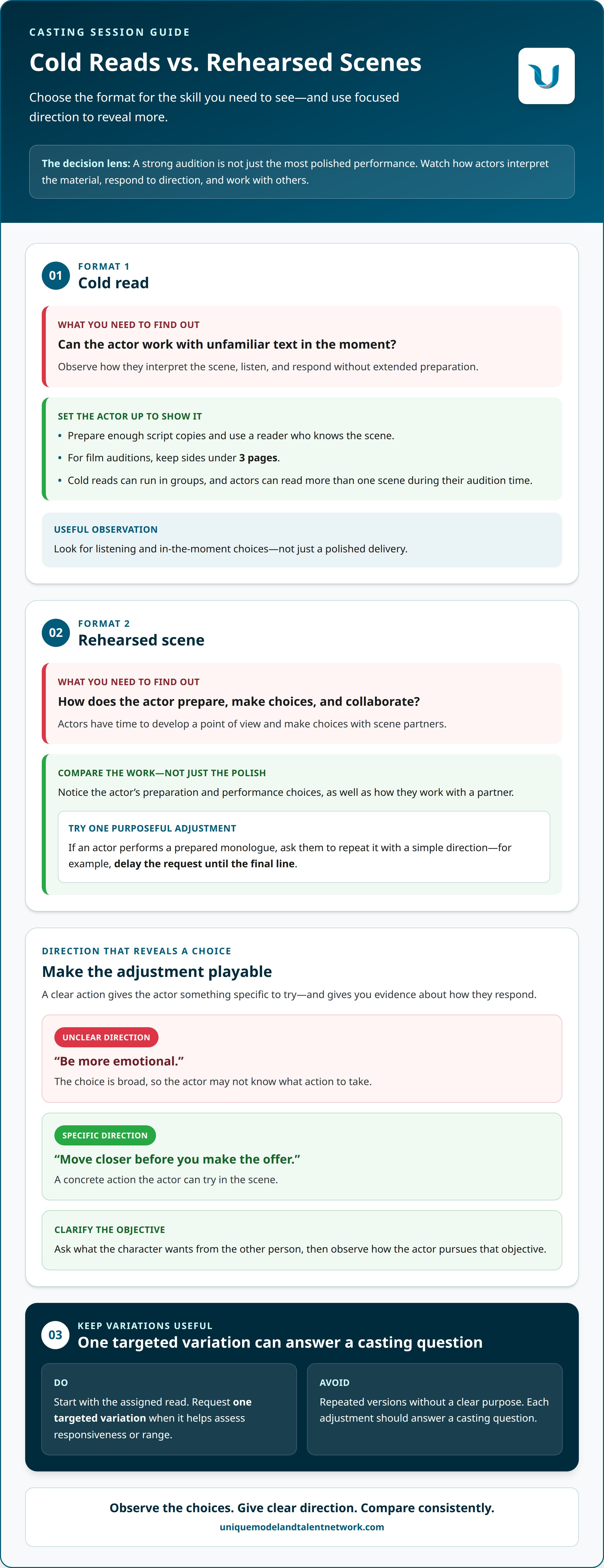
Choose the audition format based on what you need to observe. A cold read shows how actors interpret unfamiliar text, listen, and respond in the moment. Prepare enough script copies and use a reader who knows the scene. For film auditions, keep sides under three pages so actors can work with the scene without handling excessive material. Cold reads can run in groups, with actors reading more than one scene during their audition time.
A rehearsed scene reveals different strengths. Actors have time to make choices, develop a point of view, and collaborate with scene partners. Compare their preparation and choices, not just their polish. If the session includes a prepared monologue, ask an actor to repeat it with a simple direction. For example, ask them to delay a request until the final line. This tests whether they can adjust their performance purposefully.
How many takes or variations should actors perform at an audition? Start with the assigned read, then request one targeted variation if it will help you assess responsiveness or range. Avoid asking for repeated versions without a clear purpose. Each adjustment should answer a casting question.
Keep directions playable and specific. “Move closer before you make the offer” gives an actor an action to try. A broad instruction such as “be more emotional” leaves the choice unclear. Ask what the character wants from the other person, then observe how the actor pursues that objective. Their answer can clarify the intention behind a performance choice.
Which exercises help assess range and chemistry? Start with a short warm-up, then invite actors to improvise a scene with a clear objective. For callbacks, pair actors who share scenes and observe their rapport. Blocking a callback scene can show how actors collaborate, make creative choices, and hit their marks. If improv matters to the production, a brief improvisation can reveal how partners listen and build on each other’s ideas. Callbacks after prepared or improv auditions can also show how actors handle the production’s actual text.
4. Evaluating actors and recording notes
Use the same role criteria for each performer, then write your observations immediately. Assess acting choices, voice, stage presence, movement, and suitability for the character. For example, note whether an actor’s speech stays clear during an emotional shift. Record what you observed, not a general verdict like “good” or “not right.” Specific evidence makes later comparisons more useful.
Track how each actor responds to direction. Note whether they apply an adjustment, make a distinct new choice, or need the instruction clarified. Include physical and vocal skills: can the actor move convincingly through the scene, and can the audience hear and understand their words? Appearance may matter for a role, but evaluate it alongside performance and production needs, not as a substitute for acting ability.
Take brief notes under consistent categories, such as strengths, concerns, role fit, and collaboration. A useful entry might say, “listened closely to partner, clear diction, could sharpen the character’s objective.” Also note whether the actor contributes ideas, works hard, and supports scene partners. Casting depends on the production as a whole, not talent alone. Chemistry, shared commitment, and the ability to work together can shape a balanced ensemble.
Keep a separate file for actors who could suit a future production. Note the roles they read for and the qualities worth remembering, so a strong audition doesn’t disappear from consideration once this cast is set. When choosing between candidates, return to the role requirements and production goals. Don’t make a decision simply to avoid conflict; choose the combination that best serves the work.
For more guidance on assessing performance and professional fit, build your casting evaluation skills with focused industry insight.
Unique Model & Talent Network: Industry Expert Q&A Sessions
Unique Model & Talent Network’s Industry Expert Q&A Sessions help actors and industry professionals build their understanding of casting. Turn to these sessions to explore audition choices, prepare stronger questions, or learn how casting decisions are considered. They offer practical perspective from industry experts and complement the evaluation methods covered in this guide.
For continued development, The Network Membership connects members with industry insight, while Live Industry Workshops offer focused learning. Portfolio & Reel Reviews help actors refine the materials they use to present their work. Choose the option that fits your current goal, whether you’re building audition skills or strengthening your professional presentation.
If you’d like to learn more, contact Unique Model & Talent Network.
Make each casting session a stronger foundation
Every audition gives you another chance to refine your creative judgment. As you learn how to direct actors in a casting session, keep developing a process that supports clear choices and productive collaboration. The goal isn’t to make every performance look the same. It’s to create the conditions for actors to show their craft and for you to recognize what serves the production.
For actors developing their professional practice, The Network Membership, Live Industry Workshops, and Portfolio & Reel Reviews offer ways to keep learning and improve how they present their work. Choose the support that matches your next goal, whether you’re seeking industry insight or refining a portfolio.
Contact Unique Model & Talent Network to explore a next step that fits your goals. Keep building your skills, and bring that clarity into your next room.
Frequently Asked Questions
What should I look for?
Look for choices that make the character’s behavior understandable and compelling, not just technically polished. Notice whether an actor stays present when a scene partner changes pace or emphasis. For example, an unexpected pause can reveal who listens and adapts naturally. Consider whether those choices support the specific role, rather than judging every performer against one preferred acting style.
How should a director prepare for an actor casting session?
Before auditions begin, decide which qualities matter most for each role and choose a scene that can reveal them. A character who must conceal information needs different material from one who persuades openly. Keep a consistent evaluation form nearby, and agree with the audition reader on cue timing. That preparation makes it easier to compare relevant evidence instead of relying on memory.
What are effective ways to direct actors during a casting session?
Give one concise adjustment that changes a playable element, then let the actor interpret it. For example, ask for a more deliberate pace without specifying how the character should feel. When considering how to direct actors in a casting session, leave room for distinct choices instead of demonstrating one “correct” performance. Observe what changes and whether the new choice still fits the scene.
How can directors give useful feedback without leading an actor?
Describe what you observed, then offer a neutral prompt that invites exploration. Instead of saying, “Make the character angrier,” you might ask, “What are you trying to get from your scene partner here?” If you need another read, give the actor space to choose an approach. This keeps your feedback focused on the work without prescribing a facial expression or emotional result.
How should directors evaluate actors fairly during casting?
Separate role suitability from your overall impression of the performer. An actor may not fit one character but could be strong for another. Write down observable details, such as a clear change in vocal energy or a well-timed response, and compare candidates against the same role priorities. If possible, review your notes before making final choices to catch snap judgments that lack performance evidence.
How can directors create an inclusive, accessible casting session?
Make practical details easy to understand and reduce avoidable barriers. Give clear directions to the room, share audition materials in a readable format, and explain the session flow before starting. Offer actors a way to communicate access needs privately, then discuss reasonable adjustments without making assumptions about their abilities. Respectful flexibility helps performers focus on the scene and show their work.


