

Strong UGC casting starts with fit, not follower count. Agencies find creators on TikTok, Instagram, and YouTube, as well as in customer communities, then shortlist people whose audience, market, and on-camera style suit the campaign. Finding talent for user-generated content ads also means agreeing on usage rights before production begins, including where and for how long a brand can use the content, which edits are allowed, and whether it can run as paid advertising.
A strong creator can make a campaign feel relevant, but a vague brief can leave both sides unclear about deliverables and permissions. This guide explains how to cast for audience, location, language, content format, and campaign goals, then assess creators and set expectations for payment, approvals, and paid-ad use. It also explains why usage rights belong in the casting conversation from the start, not as an afterthought once the video is ready.
Key Takeaways
- Define paid-ad permissions clearly, including where content can run, how long it can be used, and what edits are allowed.
- Cast for the audience’s age, language, location, and family context so each creator feels relevant to the people the campaign needs to reach.
- Match platform and video format to the campaign goal, whether you’re building awareness, generating sales, or producing reusable content.
- Assess creators through audience fit, posting consistency, past content, and delivery quality, not follower counts alone.
Usage rights and paid-ad permissions
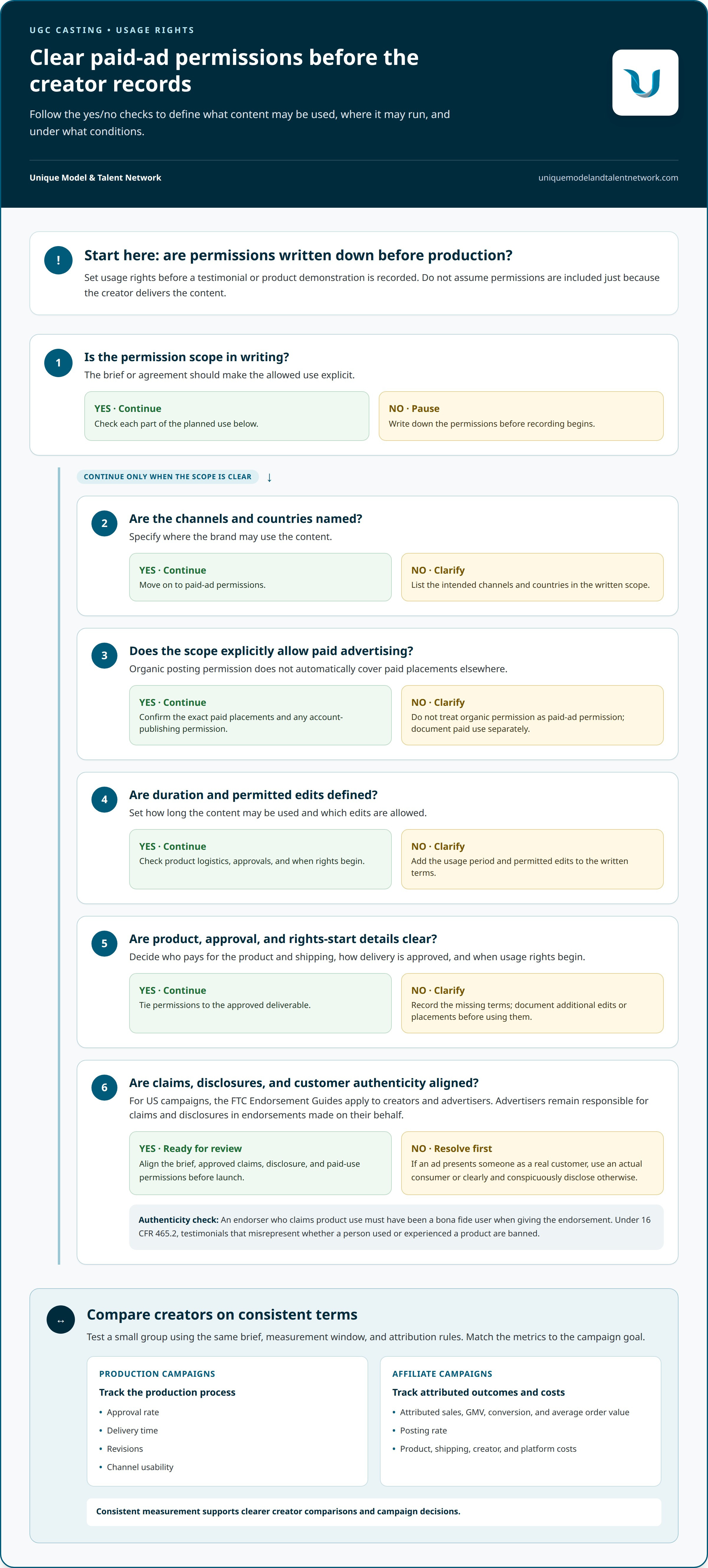
Set usage rights before a creator records a testimonial or product demonstration. When finding talent for user-generated content ads, put permissions in writing rather than assuming they come with delivery. Specify channels, countries, duration, permitted edits, paid-ad placements, and whether the creator’s account may publish the content. Permission to post organically on Instagram, for example, doesn’t automatically cover paid placements elsewhere.
Make the brief clear about the product and approval process. State who pays for the product and shipping, how delivery is approved, and when usage rights begin. Tie permissions to the approved deliverable so both sides understand what content may be used and when. Document any additional edits or placements before using them.
To compare creator performance, test a small group with the same brief, measurement window, and attribution rules. Match the metrics to the campaign goal. Production campaigns can track approval rate, delivery time, revisions, and channel usability. Affiliate campaigns can track attributed sales, GMV, conversion, average order value, posting rate, and product, shipping, creator, and platform costs. Consistent measurement supports better decisions when finding talent for user-generated content ads.
The FTC Endorsement Guides apply to creators and advertisers in the United States. Advertisers remain responsible for claims and disclosures in endorsements made on their behalf. If an ad presents someone as a real customer, use an actual consumer or clearly and conspicuously disclose otherwise. The Federal Trade Commission’s 16 CFR 465.2 bans testimonials that misrepresent whether a person used or experienced a product.
The FTC Endorsement Guides also require an endorser who claims product use to have been a bona fide user when giving the endorsement. Keep that distinction clear during casting: a polished performance doesn’t make a fictional customer experience genuine. Align the brief, approved claims, disclosure, and paid-use permissions before launch, then evaluate creators using consistent measurement rules.
Casting for age, gender, language and family roles
Cast for the person a campaign needs to reach, not just a broad demographic label. Define the audience’s age range, language, household context, and the creator’s role. A parent explaining a family product needs a different lived perspective from a student demonstrating a study tool. Gender can inform casting when it reflects the intended audience or story, but don’t use it as a shortcut for interests or behavior.
Language can shape both comprehension and trust. In 2018 to 2022, 21.7% of US residents aged 5 and over spoke a language other than English at home. Spanish accounted for 61.1% of non-English languages spoken at home, while 78.3% spoke only English at home. These figures point to distinct language audiences, not a reason to assume every person in a group prefers the same content.
For a bilingual campaign, cast creators who can speak naturally to the intended audience. Decide whether the concept needs English, Spanish, or both, then assess fluency for the specific script and format. A creator who can deliver a conversational product demo may suit a different brief from one asked to explain detailed instructions. Include language expectations in the casting brief.
Family roles need the same care. If a concept shows a parent, caregiver, or multigenerational household, cast people whose relationship to that role feels credible. For example, a family meal campaign may need several household perspectives rather than one creator speaking for every family. Describe the scene and relationships clearly, without relying on stereotypes about age, gender, or who handles household tasks.
Use a casting grid to compare each candidate against the intended audience, language, and role. Mark essential criteria separately from preferences, such as “Spanish-speaking parent” versus “warm, informal delivery.” For a sharper assessment of audience-specific casting choices, consider how the creator’s portfolio supports the role and tone before selecting a final match.
Defining audience, market, content format, and campaign goals
Start with the intended audience and market, then select creators and platforms that can reach them. A US campaign aimed at older adults may call for different platform choices than a product designed for students. Pew Research Center found that 71% of US adults aged 50 to 64 used Facebook in a survey conducted January 30 to June 18, 2026. In the same survey, 59% of US adults aged 65 and over used Facebook, while 21% used Instagram. These figures can guide platform planning, but they don’t replace audience fit.
Define the campaign goal before choosing a format. A product demonstration can explain how an item works, while a testimonial can highlight a creator’s experience. A short vertical video may suit social placements; a series of still images may better support a product comparison. For each format, decide what the audience should understand or do after seeing it. Consider the intended market, since language, cultural references, and product availability can affect whether a concept feels relevant.
A useful UGC creator brief states the audience, target market, campaign objective, platform, format, key message, and required deliverables. It also clarifies product details and claims creators may use, along with the review and approval process. Spell out the opening idea, essential scenes, tone, and call to action while leaving room for the creator’s natural delivery. For example, a skincare brief might request a routine demonstration for a defined audience rather than dictate every line.
Separate essential requirements from creative preferences. Mark the format and message as fixed, then identify where creators can adapt their wording or presentation. This helps casting teams compare candidates against the same campaign needs instead of favoring personal style alone. It also gives creators a clearer picture of the assignment before they commit. Once audience, market, goal, and format align, shortlist talent whose existing content makes the brief feel credible.
How do brands vet UGC creators and assess video quality?
Review each creator against the campaign brief, not follower count alone. Compare audience language, location, interests, previous shoppable content, GMV, posting frequency, and performance on samples when available. These details help show whether a creator’s audience and publishing habits fit the campaign. For a product demo, for example, relevant past videos can show how clearly the creator explains product features.
Consistency can indicate whether a creator is positioned to deliver on schedule. Check whether they posted at least four times in the last 30 days; fewer posts may signal delivery risk. On TikTok, a views-to-followers ratio below 2% may indicate an account is coasting on an older follower base. Treat that ratio as a prompt for closer review, not a verdict on the creator.
Assess a sample or portfolio video using the same practical criteria for each candidate:
- Sound: Can viewers hear the creator clearly without distracting background noise?
- Framing and light: Is the product visible, with the creator positioned naturally?
- Delivery: Does the creator explain or demonstrate the product in a clear, credible way?
- Editing: Do cuts, captions, and pacing support the message rather than obscure it?
A polished video isn’t automatically a strong ad. Check whether the opening quickly establishes the product or problem, then whether the demonstration supports the message. For example, a kitchen-tool video should show the tool in use, not just make a spoken claim. Review caption accuracy, on-screen text, and the final call to action against the brief. Record revisions and approval decisions consistently so creative preferences don’t become shifting standards between candidates.
Use a shared scorecard to compare audience fit, reliability, delivery, and technical quality. Keep notes tied to observable evidence, such as clear audio or relevant shoppable content, instead of subjective labels. If you’re building confidence in portfolio assessment, develop your creator-evaluation skills through focused industry learning.
Unique Model & Talent Network
Unique Model & Talent Network helps emerging creators build the skills and industry perspective to present themselves confidently for UGC opportunities. If you’re refining your portfolio, clarifying your on-camera strengths, or learning how industry casting works, its educational community offers a practical next step.
The Network Membership connects aspiring models and actors with industry experts in a private community. Live Industry Workshops and Industry Expert Q&A Sessions offer opportunities to learn from professionals, while Portfolio & Reel Reviews help creators strengthen their presentation materials. Monthly Skill-Building Challenges encourage continued practice and creative growth.
These resources suit creators seeking guidance and professional development as they prepare for casting opportunities. Explore The Network Membership to learn more about joining Unique Model & Talent Network’s professional community.
Turn a casting brief into your next professional step
A thoughtful casting process is also a chance to develop your professional direction. As you pursue finding talent for user-generated content ads, consider how your strengths, presentation, and creative choices can support the work you want to do. A focused portfolio gives industry professionals a clearer sense of your on-camera style and the roles that suit you. Ongoing learning can help you approach each opportunity with greater preparation and confidence.
For emerging models and actors, progress comes from developing your craft alongside industry awareness. Unique Model & Talent Network offers a professional community where you can learn from industry experts and strengthen your materials. Take the next step at a pace that fits your goals, with a clearer sense of how you want to present your work.
Contact Unique Model & Talent Network to explore a professional path built around learning, creative growth, and meaningful industry connection.
Frequently Asked Questions
Where do UGC agencies find creators?
Agencies often discover creators on TikTok, Instagram, YouTube, and in customer communities. A useful starting point is content about the brand’s product category, which can reveal creators’ communication styles and subject familiarity. Search by product type, audience interest, or relevant community conversations. Then review each creator’s recent work to see whether their tone and presentation suit the campaign, rather than selecting solely from a large list.
Can a platform identify creators who will convert?
No platform can establish in advance that a specific creator will generate sales. Discovery tools can surface creators by audience traits or content history, but those signals don’t prove how an ad will perform. For example, a creator with relevant product videos may be a sensible candidate to test, while actual conversion depends on the offer, creative, audience, and campaign setup.
Can agencies cast older, male, Spanish-speaking or mom creators?
Yes. A casting brief can specify age range, gender, language, or a family role when those traits matter to the intended audience or concept. For example, a campaign about school lunches might call for a parent who can speak naturally about family routines. Treat each attribute as one casting criterion, not a complete description of someone’s interests, experience, or ability to deliver the content.
Can you choose your own UGC creator?
Yes, brands can select a creator whose style fits their campaign. A practical approach is to define the campaign’s non-negotiable needs, then compare a shortlist against those criteria. For instance, a brand launching a kitchen product might prioritize clear demonstrations and an on-camera presence that feels comfortable. Keep the final selection tied to the brief so personal preference doesn’t outweigh the creator’s suitability for the content.
Do UGC creators need a big following?
No. A creator making content for a brand doesn’t necessarily need a large personal audience, especially if the brand plans to publish the finished asset on its own channels. A following matters more when the campaign also relies on the creator posting to their own account. First decide which role matters: producing persuasive content, reaching an existing audience, or both.
Where can brands find UGC creators for paid ads?
Brands can find candidates on TikTok, Instagram, YouTube, and in customer communities. Look for creators whose existing videos show a natural fit with the product and the ad’s intended audience. Then distinguish between content the brand will publish itself and content posted through a creator’s account. That distinction helps shape the casting brief and clarify what the campaign needs from each creator.


