

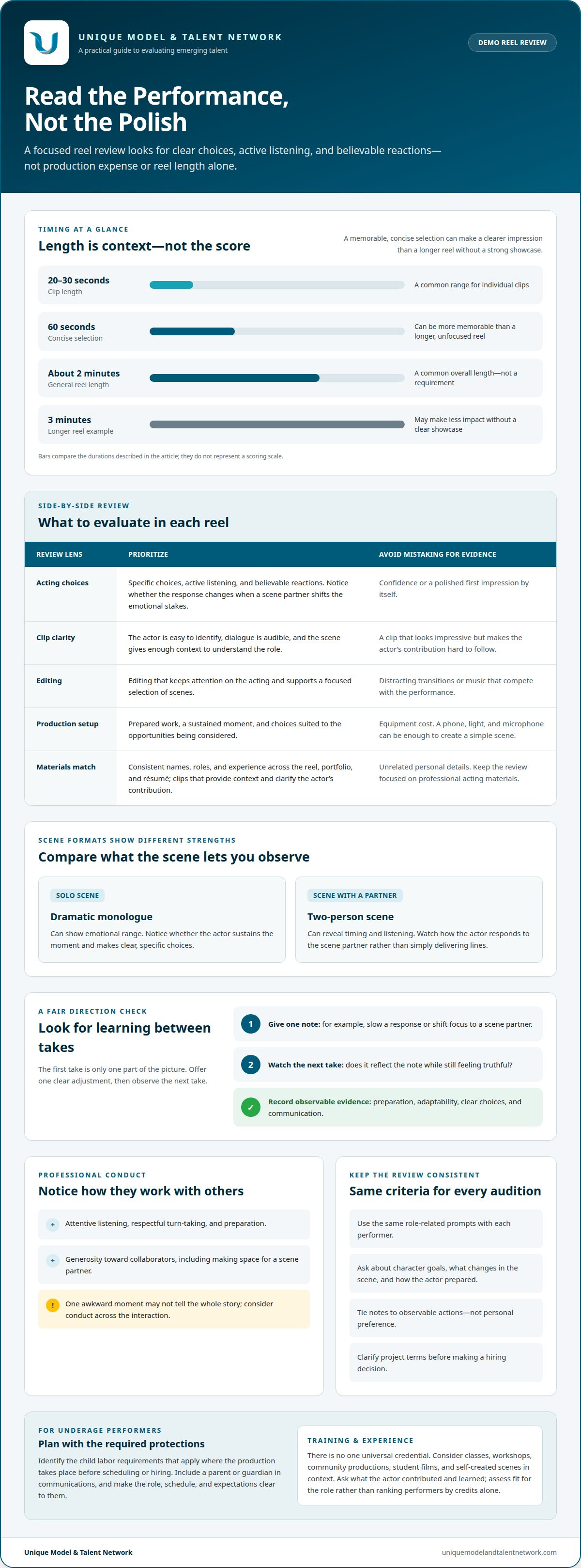
A strong demo reel can reveal more than a polished headshot: it shows how an actor listens, responds, and holds a scene. Learning how to vet aspiring actors starts with watching focused performance clips, not judging a reel by length alone. Acting reels often run about two minutes, with clips around 20-30 seconds each, but a concise, memorable selection can make a clearer impression than a longer reel.
When considering how to vet aspiring actors, look beyond confidence and range on screen. A reel is only one part of the assessment: preparation, thoughtful responses to feedback, and professional conduct also help show whether an actor is ready to work and grow.
This guide explains what to look for in demo reels, how to use feedback constructively, and which professional behaviors matter during auditions and collaboration. Use the practical steps to assess emerging talent fairly, consistently, and with a focus on the work.
Key Takeaways
- Look beyond polish in a demo reel and notice how the actor makes clear, specific choices within a scene.
- Use feedback and professional conduct to assess how an actor learns, collaborates, and responds to direction.
- Weigh training and experience in context; readiness is about ongoing craft development, not a single credential.
- Check that a résumé is clear and a headshot presents the actor’s face accurately, then consider a Portfolio & Reel Review for focused feedback.
1. Demo reels
Start with the performance, not the production polish. Acting demo reels generally run about two minutes, with clips lasting 20-30 seconds. A concise reel can still work: a memorable 60-second selection may reveal more than three minutes without a clear showcase. Look for specific choices, active listening, and believable reactions. For example, notice whether an actor’s response changes when a scene partner shifts the emotional stakes.
Assess each clip before judging the reel as a whole. Check that the actor is easy to identify, the dialogue is audible, and the scene gives enough context to understand the role. A dramatic monologue can show emotional range, while a two-person scene reveals timing and listening. Good editing keeps attention on the acting, not distracting transitions or music.
New performers may have limited footage. A phone, light, and microphone can be enough to create a simple scene, so evaluate the acting choices rather than the cost of the equipment. Consider whether the clip feels prepared, the actor sustains the moment, and the work suits the opportunities in question. A focused reel is more useful than a collection of unrelated clips.
In the United States, audition and hiring requirements can depend on the production’s location and employment arrangement. Apply consistent, job-related criteria and establish the project’s terms before making a hiring decision.
For an underage actor, identify the child labor requirements that apply where the production takes place before scheduling or hiring. Include a parent or guardian in communications, and make the role, schedule, and expectations clear to them.
Review an actor’s online presence by comparing the reel, portfolio, and résumé for consistent names, roles, and experience. Focus on professional acting materials, not unrelated personal details. For portfolio clips, consider whether they provide useful context and make the actor’s contribution clear.
Record observations against the same criteria for every audition. A Portfolio & Reel Review can offer focused feedback on presentation and help identify which clips best demonstrate an actor’s current strengths.
2. Feedback and professionalism
Notice how an actor responds to direction, not just whether the first take feels polished. Offer one clear adjustment, such as slowing a response or shifting focus to a scene partner. Then see whether the next take reflects the note while still feeling truthful. Dylan Godwin advises treating every audition and at-home practice as a chance to learn. That mindset supports steady craft development throughout an acting career.
Professionalism also shows in how talent treats collaborators. Melissa Molano encourages actors to be generous and supportive of others in the audition room. Look for attentive listening, respectful turn-taking, and preparation. For example, an actor who shares space during a paired reading helps their scene partner deliver stronger work, too. One awkward moment may not tell the whole story, so consider conduct across the interaction.
To verify training, credits, and references, ask the actor for relevant details and permission to contact listed references. Discuss their role in each credit, the skills developed through training, and what a reference observed firsthand. When you vet aspiring actors, compare these explanations for consistency rather than treating one school or credit list as the sole measure.
During an audition or interview, ask what the character wants, what changes in the scene, and how the actor prepared. Offer a direction and ask what they adjusted. To vet aspiring actors fairly, use the same role-related prompts with each performer and assess preparation, curiosity, and collaboration.
Red flags include credits that change when clarified, dismissive treatment of scene partners, or repeated failure to follow agreed audition instructions. Address specific behavior calmly and give the actor a fair chance to explain. Keep notes tied to observable actions, such as preparation and clear communication, so personal preference does not replace a consistent assessment.
For a focused second look at presentation and performance materials, Portfolio & Reel Reviews can help identify useful next steps.
3. What qualifications and experience should aspiring actors have?
Aspiring actors do not need one universal credential to demonstrate potential. Training can show commitment to technique, while practical work reveals how an actor applies it. Consider classes, workshops, community productions, student films, and self-created scenes as different kinds of experience. Ask what the actor learned from each, rather than expecting every résumé to follow the same path.
David Rainey advises actors to keep studying their craft and learning from people with more knowledge. Look for evidence in an actor’s reflections: can they describe a technique they are developing, a note that changed their approach, or a skill they are working to strengthen? A specific example, such as adjusting pace to clarify a scene’s tension, says more than a broad claim of versatility.
Consider experience in context. A performer with limited credits may still demonstrate preparation through a staged reading, an independent short, or regular scene practice. Ask what the actor contributed, what challenge arose, and how they responded. These details reveal more about active learning than a list of titles that offers little insight into the work.
Assess an actor’s fit for the role instead of treating experience as a ranking. For a period drama, relevant movement or speech work may matter; for a contemporary comedy, timing and responsive listening may carry more weight. Invite the actor to explain how their training connects to the character’s needs. Their answer can reveal self-awareness without requiring a particular school or career route.
Keep your assessment consistent across performers. Apply the same role-related criteria, then note concrete evidence: preparation, scene choices, adaptability, and the ability to explain decisions. Distinguish skills the production requires from those an actor can continue building. This gives you a fairer picture than reputation or résumé length alone.
Emerging performers often progress through repeated practice, useful feedback, and chances to apply new skills. Recognize curiosity and discipline alongside credits. An actor who can identify a learning goal and explain how they are pursuing it gives a clearer picture of their development than a polished claim without an example.
4. What should a strong actor résumé and headshot include?
A clear résumé helps casting teams understand an actor’s experience quickly. Group credits by category, such as film, television, theatre, or commercial work. Identify the production and the actor’s role in each entry. This makes it easier to see how their experience relates to the project.
Accuracy matters more than an impressive-looking list. Keep role titles and production names consistent across the résumé and portfolio. Label a staged reading or student film clearly rather than implying a different format. For a newer actor with few credits, relevant training and performance experience can still demonstrate focused preparation.
Make training details easy to interpret. Include the class or workshop, instructor or organization, and area of study when available. Scene study, voice work, or movement training, for example, gives a more useful picture than a general claim of being “well trained.” Review the information for clarity, then ask about skills that relate directly to the role.
A professional actor headshot is a color photograph framed from the chest up, with the actor’s face clearly visible. It should help casting teams recognize the performer and see their current appearance. Compare the photo with the actor at the audition; a substantially different hairstyle or look may affect recognition and fit for the role.
For in-person auditions, actors should keep 8-by-10-inch headshot prints available. Check that the print matches the digital image and remains easy to identify with the résumé. A practical review is to place both documents together and confirm the name and photograph correspond. Clear labeling helps prevent mix-ups when casting teams handle several submissions.
Assess the résumé and headshot as working materials, not as proof of talent by themselves. A focused review can reveal missing context, unclear credits, or a photograph that doesn’t represent the actor well. To sharpen these materials, get focused feedback on an actor’s résumé and headshot.
Unique Model & Talent Network
Unique Model & Talent Network helps aspiring actors connect with industry experts and build practical career skills. If you want guidance applying the evaluation steps in this article, The Network Membership offers a professional community, while Live Industry Workshops and Industry Expert Q&A Sessions provide opportunities to learn from industry perspectives.
For focused feedback on presentation materials, Portfolio & Reel Reviews help actors assess how their work comes across. Monthly Skill-Building Challenges offer a way to keep developing between auditions. Use these resources to refine a reel, strengthen your craft, or get informed feedback on next steps.
Contact Unique Model & Talent Network to explore the community and its learning opportunities.
Build a Consistent Path From Evaluation to Growth
A casting decision can also support an actor’s development. Keep feedback specific, respectful, and connected to the role so performers know what to strengthen for future opportunities. A consistent process for vetting aspiring actors helps teams make thoughtful decisions and gives emerging talent practical direction.
To gain an informed perspective and keep refining professional materials, explore Unique Model & Talent Network. The Network Membership connects members with a professional community, Live Industry Workshops support continued learning, and Portfolio & Reel Reviews provide focused feedback on presentation.
Choose the next step that matches your current need, whether that’s developing skills or improving a portfolio. Contact Unique Model & Talent Network to explore how its community can support your next move. Keep your standards clear, your feedback constructive, and your focus on growth.
Frequently Asked Questions
How can you assess an aspiring actor’s acting skills and range?
Assess range by giving the actor contrasting material that tests different performance choices. For example, ask them to play the same short exchange with restrained urgency, then with guarded humor. Notice whether each interpretation feels specific and believable, rather than simply louder or more emotional. Consider how they maintain character through pauses, interruptions, and shifts in their scene partner’s energy.
How can you evaluate an actor’s professionalism, reliability, and communication?
Evaluate professionalism by setting clear expectations and observing consistently throughout casting. Send each performer the same schedule and preparation details, then note whether the actor acknowledges them, asks relevant questions, and communicates promptly if circumstances change. An early update about a scheduling conflict, for example, gives the team time to respond. Look for respectful, clear communication, not just a polished audition.
What legal rules apply when auditioning or hiring actors in the United States?
Requirements can depend on the production’s location and employment arrangement. Apply consistent, job-related criteria and establish the project’s terms before hiring. For an underage actor, identify the applicable child labor requirements and include a parent or guardian in communications.


