

The same note can help one actor make a breakthrough and leave another unsure what to do next. Knowing how to give effective feedback to actors starts with focusing on the performance, not the person, and making each note specific enough to try. Feedback matters because it can reveal habits an actor may not notice alone, but it works best when it gives a clear direction for growth.
It’s understandable to want your feedback to be honest and useful without discouraging the actor. The key is to focus on the work: describe what you observed, ask clarifying questions, and consider how different perspectives might shape a performance. This guide explains how to give actionable notes, adapt your approach to each actor, and turn feedback into practical next steps.
Key Takeaways
- Ask focused clarifying questions to turn an unclear note into a specific, playable adjustment.
- Weigh perspectives by considering the feedback giver’s experience and whether the suggestion serves the performance.
- Adapt your delivery to the actor’s needs so the note supports learning instead of creating confusion.
- Test useful feedback in the scene, then choose a practical next step for continued development.
What Is Feedback In Acting And Why Does It Matter?
Give notes on observable acting choices, not an actor’s personality or worth. In rehearsal, identify a specific moment, explain its effect, and offer a next step the actor can test.
-
Clarify Feedback’s Role and Common Misconceptions
Treat feedback as information for developing the work, not a verdict on talent. In acting training, a note about rushed lines can help an actor notice a habit and try a different pace. Useful criticism identifies what to adjust and offers a practical way to explore it. Harshness isn’t proof of honesty, and vague praise rarely tells an actor what to repeat.
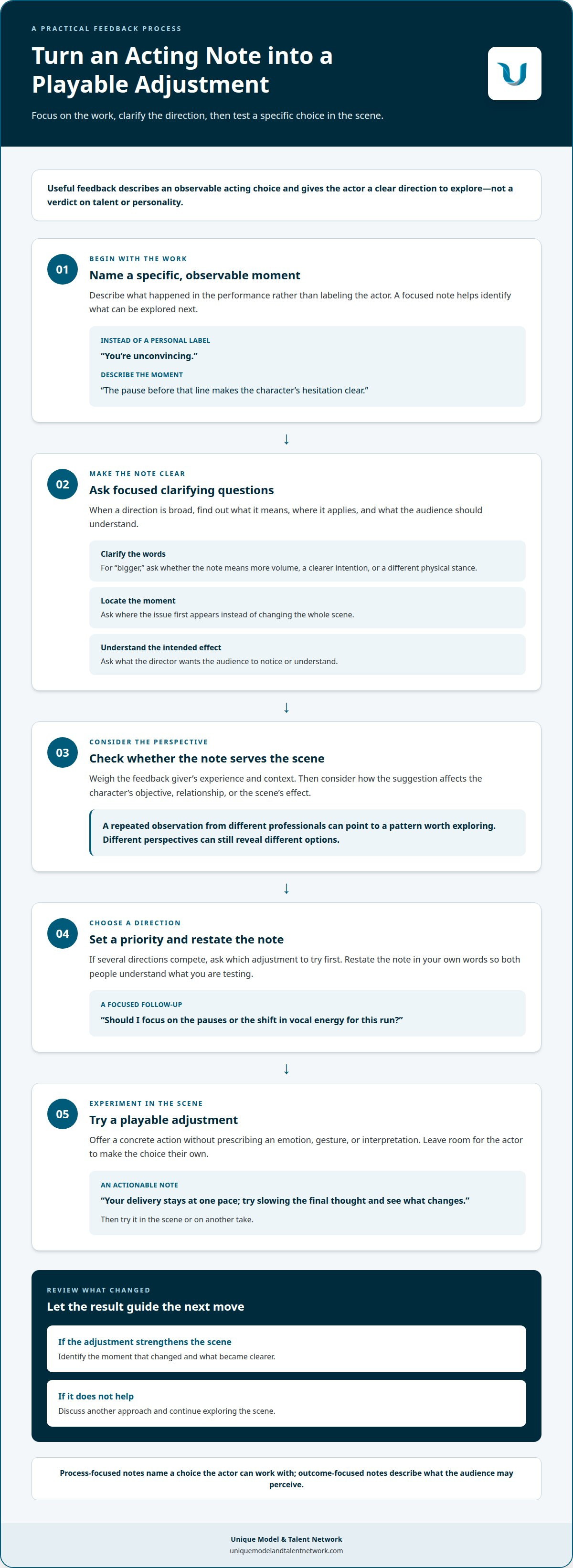
Give notes during rehearsal after a run, while the actor can still apply them to the scene. During filming, keep feedback timely and focused on a playable adjustment between takes. Avoid personal labels such as “you’re unconvincing.” Describe the moment instead: “The pause before that line makes the character’s hesitation clear.”
-
Distinguish Process and Outcome Feedback
Separate the actor’s choices from the effect they create. Process-focused feedback names what the actor did, such as listening closely before responding or changing vocal volume on a key line. Outcome-focused feedback describes what the audience may perceive, such as confusion about the character’s intention. Both perspectives can help, but process notes give actors a choice they can work with.
For example, replace “make the scene more emotional” with “let the other character’s accusation land before you answer.” The first note asks for a result without explaining how to explore it. The second suggests an acting action while leaving the actor room to find an honest response.
-
Make Notes Actionable Without Prescribing Choices
Offer an observation, describe its effect, and invite the actor to experiment. For an audition scene, you might say, “Your delivery stays at one pace; try slowing the final thought and see what changes.” This gives the actor a concrete preparation task without prescribing an emotion, gesture, or interpretation. Ask for another take so the actor can test the adjustment.
Then watch what changes. If the new pace strengthens the scene, identify the moment; if it doesn’t, discuss another approach. Avoid prescribing every facial expression or movement. Clear feedback makes a note actionable while supporting the actor’s own performance choices and keeping the work collaborative.
Asking clarifying questions
Ask for clarification whenever a note feels too broad to apply. A focused follow-up turns constructive feedback into an experiment the actor can understand and assess. An essential part of how to give effective feedback to actors is making sure both people understand the note before changing the work.
- Pin down the unclear term. Ask what the director means by “bigger,” “lighter,” or “more grounded.” These words can point to different choices. Try, “Do you mean more volume, a clearer intention, or a different physical stance?” This keeps the conversation practical and helps avoid guessing at the director’s preferred interpretation.
- Locate the moment. If a note covers the entire scene, ask where the issue first appears. “Does the tension drop after the entrance, or during the exchange with the other character?” helps identify a specific beat. You can revisit that moment instead of making broad changes that might weaken choices already serving the scene.
- Clarify the intended effect. Ask what the director wants the audience to understand or notice. If they say, “Make the ending land,” you might ask whether the final line should reveal a new decision or leave the character uncertain. Understanding the intended effect gives you a direction to explore while preserving your own way of getting there.
- Find the priority when notes compete. Ask which adjustment to try first if you’ve received several directions. For example, “Should I focus on the pauses or the shift in vocal energy for this run?” A clear priority helps you concentrate, then assess how that change affects the scene before adding more adjustments.
- Confirm your understanding and test it. Restate the note in your own words, then try it in the scene if there’s an opportunity. When practicing how to give effective feedback to actors, build in space for the performer to report what changed and what felt unclear. Monthly Skill-Building Challenges can also support structured practice between sessions.
Considering different perspectives
Compare each note with the scene, the character’s objective, and the person giving it. Different perspectives can reveal options, but not every suggestion will suit every performance.
- Consider the source’s experience. A director working closely with the scene may notice how one choice affects its pace. A classmate may offer a useful audience response but have less context about the production. Weigh the perspective and its relevance rather than accepting or dismissing feedback based only on who said it.
- Test whether the note fits the scene. Ask what the suggestion would change in the character’s objective or relationship. If a teacher suggests more stillness, try it during the character’s moment of hesitation. Notice whether the choice sharpens the beat or reduces the character’s energy. Testing the note helps you decide whether it’s useful.
- Look for recurring notes. Different teachers may prefer different acting styles, so disagreement doesn’t make either perspective invalid. If several respected professionals say that a character’s intention becomes unclear near the same line, examine that moment again. A repeated observation can point to a pattern worth exploring, while leaving your final performance choice to you.
- Pause before responding emotionally. If a note feels upsetting or unfair, take a breath and listen before explaining your choice. Ask which moment prompted the response, then consider whether the criticism applies to the work. You can disagree respectfully without arguing immediately. When practical, try the adjustment first, then assess what it changes.
- Choose what to carry forward. Separate a specific observation from a personal opinion, especially when feedback comes from friends or online comments. For example, “I couldn’t follow the character’s decision” describes an audience response; “you can’t act” judges the person. Keep notes that offer a usable insight, and write down the next action you’ll test.
Finding a feedback approach that works for the individual
Adapt your delivery to the actor, the moment, and the session’s goal. A useful approach helps each performer turn feedback into growth without flattening their individual process.
- Ask how they prefer to receive notes. Before a coaching session, ask whether the actor wants one priority at a time or a fuller review after the scene. One performer may welcome direct, concise direction; another may need a brief explanation of the intention behind it. Agreeing on a format helps the actor focus on the work.
- Notice how the actor responds. If a note creates visible tension or confusion, pause and ask what would make it easier to apply. For example, an actor struggling with an emotional scene may benefit from starting with a physical action, such as releasing their hands before a line. Adjust the route, not the standard for the work.
- Match the note to the actor’s current task. A performer preparing an audition may need a clear adjustment they can practice independently. An actor in rehearsal may benefit from exploring how a choice changes across scene partners. Keep the immediate objective in view so your feedback supports the work they’re doing now.
- Give the actor room to process. After offering a note, allow a moment for the actor to take it in before asking for another take. If they seem overwhelmed, suggest focusing on one change, such as shifting the pace in a single exchange. A brief reset can help them work with the scene’s emotion without confusing it with the feedback.
- Review what helped. After the exercise, ask which note led to a clearer or more grounded performance. Use the answer to shape future feedback, rather than assuming one delivery style suits every actor. Build a feedback practice that supports actor growth through deliberate reflection and continued work.
Unique Model & Talent Network
Unique Model & Talent Network helps actors develop their craft and industry understanding through a professional community connected with industry experts. The Network Membership, Live Industry Workshops, and Industry Expert Q&A Sessions offer structured opportunities to keep learning. Portfolio & Reel Reviews help you consider how your materials communicate your performance strengths, while Monthly Skill-Building Challenges encourage focused practice.
Use these learning opportunities to apply feedback beyond a single rehearsal, explore professional perspectives, or strengthen your portfolio and reel. The focus is practical development: take useful notes, test acting choices, and build a process that fits your goals.
Explore learning and development opportunities with Unique Model & Talent Network.
Make feedback part of your ongoing practice
Make each rehearsal an opportunity to build a more intentional feedback practice. Keep brief notes on which approaches helped an actor move forward, then use those observations to shape future coaching. This can make how to give effective feedback to actors a more thoughtful, adaptable part of your work.
For ongoing support in your development, Unique Model & Talent Network offers The Network Membership, Live Industry Workshops, and Portfolio & Reel Reviews. These opportunities help you engage with industry perspectives, strengthen your materials, and keep developing your craft.
Contact Unique Model & Talent Network to explore a next step that fits your goals. Keep listening, keep learning, and bring that clarity into the room.
Frequently Asked Questions
What is constructive criticism?
Constructive criticism is feedback intended to help someone improve, not judge their personal worth. It identifies an issue in the performance and gives the actor a usable way to work on it. For example, instead of saying “that scene doesn’t work,” explain that the character’s goal becomes hard to follow when the actor changes tactics, then invite them to explore a clearer shift.
What makes feedback effective when directing actors?
Effective direction connects a clear observation to the scene’s purpose and gives the actor room to respond. For example, if a confession feels abrupt, identify the moment the character decides to speak and ask the actor to explore what triggers that decision. Then watch the next take for a changed intention, rather than judging only whether the delivery matches your preferred style.
How should you phrase feedback to actors so it is specific and actionable?
Use direct, neutral language tied to an observable moment. Try: “On the final line, your focus shifts toward the doorway; can you keep your attention on your scene partner and see what changes?” This identifies the moment, offers an experiment, and leaves the interpretation to the actor. Avoid labels such as “lazy” or “unprepared,” which describe a person rather than a choice they can adjust.
What are examples of constructive acting notes for a scene?
Useful notes point to playable actions. For a negotiation scene, say, “Try asking for the favor as though you’re protecting the other person from a difficult choice.” For a comic exchange, suggest letting the scene partner finish before responding, then observe whether the timing shifts. Each note gives the actor a specific experiment without requiring one fixed emotional result.
How can you give feedback without undermining an actor’s confidence?
Deliver notes privately when possible, and keep the discussion focused on the task. Recognize a specific strength, such as clear articulation, then identify one adjustment for the next take. Avoid comparing the actor with another performer or making absolute judgments about ability. If the note lands hard, give them a moment to absorb it before discussing how to proceed.
How should feedback differ for beginners and experienced actors?
Beginners often benefit from clear, foundational direction, such as marking where a thought changes or identifying whom a line addresses. Experienced actors may prefer notes about subtext, rhythm, or how a choice serves the scene’s larger arc. In either case, tailor the detail to the actor’s current work: offer enough structure to guide exploration without dictating every beat.


