

Your acting demo reel is not a career retrospective; it is a 60-second sales pitch designed to solve a casting director's immediate problem. If you are struggling to get noticed, the issue often isn't your talent, but how you are packaging it. Learning how to make an acting demo reel that stands out in 2026 requires moving past the "greatest hits" montage and focusing on high-impact, individual clips that prove you can deliver a professional performance.
It is frustrating to feel invisible to casting directors or worry that your self-shot footage looks amateur compared to high-budget productions. You deserve the career acceleration that comes with a professional industry calling card that actually opens doors. This guide will show you how to master the art of the professional showreel through strategic footage selection and industry-standard presentation. We will cover everything from the ideal 60 to 90 second length to the way platforms like Actors Access charge $22 per minute for media hosting, ensuring your reel looks polished regardless of your current budget. By the time you finish reading, you will have a clear roadmap to transform your footage into a tool that consistently books work.
Key Takeaways
- Shift your focus from a career retrospective to a high-impact digital calling card that emphasizes "sizzle" and immediate performance value.
- Discover how to make an acting demo reel without professional credits by strategically sourcing scripts that showcase your most bookable character types.
- Categorize your footage using the industry hierarchy to ensure you are leading with the professional-grade clips that casting directors demand.
- Apply the "first 10 seconds" rule to hook talent evaluators instantly and keep them engaged through your entire performance.
- Learn the importance of an expert reel review to polish your presentation before distributing it to the industry's most competitive casting platforms.
The Strategic Role of an Acting Demo Reel in 2026
In the current professional landscape, your demo reel is no longer just a compilation of past work. It has evolved into a high-impact digital calling card, acting as your primary representative in rooms you haven't entered yet. To understand What is a Demo Reel? in 2026, you must view it as a concentrated burst of your professional essence. It is a targeted sales tool that proves your financial legitimacy to producers and helps in getting noticed by casting directors who are managing tighter schedules than ever before.
Efficiency is the hallmark of a successful career. Your theatrical reel should showcase your range in film and television, while your commercial reel focuses on your ability to sell a brand or a lifestyle. Mixing these two often confuses the narrative of your professional brand. Understanding how to make an acting demo reel requires you to prioritize "sizzle" over length. In an era dominated by short-form content, talent evaluators care more about the immediate impact of your performance than the total number of minutes you have been on screen.
Reel vs. Portfolio: Understanding the Difference
A professional acting portfolio provides the context for your career, but your reel provides the proof. There is a clear hierarchy in how industry gatekeepers evaluate you: your headshot stops the scroll, your reel confirms your talent, and your resume validates your experience. If these three elements don't align with your specific "type" or brand, you risk looking disorganized. Your reel must act as the bridge between your visual appearance and your specialized acting ability, ensuring there is no friction in the casting process.
The Death of the 'Long' Showreel
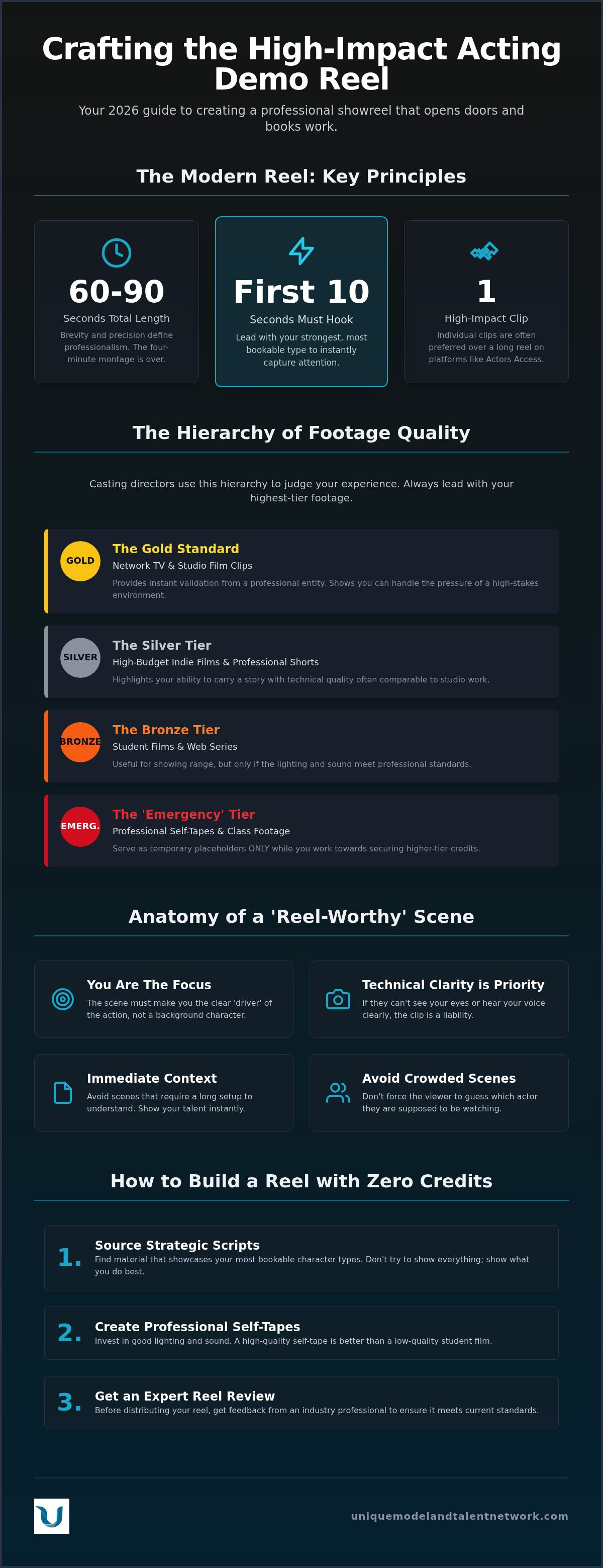
The days of the four-minute montage are over. Industry standards in 2026 favor a consolidated reel of 60 to 90 seconds. Research suggests that many casting directors stop watching a video after the first 30 seconds if they aren't immediately convinced. This has led to a significant shift toward individual 30 to 40 second clips on casting sites like Actors Access. When learning how to make an acting demo reel, focus on the first 10 seconds. If your strongest credit or most bookable type isn't front and center, you are likely losing the opportunity before it even begins. Professionalism today is defined by brevity and precision.
Selecting Your Scenes: The Hierarchy of Footage Quality
Not all footage carries the same weight in the eyes of a casting director. When you are determining how to make an acting demo reel, you must understand that your footage acts as a direct reflection of your current professional standing. Talent evaluators use a specific hierarchy to judge your experience and financial legitimacy. If you lead with a clip from a major network, you are instantly vetted by a professional entity. If you lead with a student film, the evaluator might question your readiness for a high-stakes set. To build a reel that commands respect, you should categorize your available footage into these tiers:
- The Gold Standard: Network TV and studio film clips. These provide instant validation and show you can handle the pressure of a professional environment.
- The Silver Tier: High-budget indie films and professional shorts. These often have technical quality comparable to studio work and highlight your ability to carry a story.
- The Bronze Tier: Student films and web series. These are useful for showing range, provided the lighting and sound meet professional standards.
- The 'Emergency' Tier: Professional self-tapes and class footage. These serve as temporary placeholders while you work toward higher-tier credits.
What Makes a Scene 'Reel-Worthy'?
A scene only earns its place on your reel if it makes you the clear focus of the story. You must be the "driver" of the action, not just a background character reacting to others. Technical clarity is your absolute priority. If a casting director can't see the nuance in your eyes or hear the specific tone of your voice, the clip is a liability. Avoid scenes with too many people or those that require a long setup to understand the context. Your goal is to show your talent immediately, without forcing the viewer to guess which actor they are supposed to be watching.
The Problem with Class Footage
Many actors rely on class footage when they are first learning how to make an acting demo reel, but this footage often carries an "amateur" signature. Echoing audio, flat lighting, and visible classroom backgrounds can signal a lack of professional experience. Only include a class scene if the performance is undeniably powerful and the technical flaws are minimal. A more effective strategy is to produce your own high-quality "demo scenes" or participate in Monthly Skill-Building Challenges to generate footage that meets industry standards without the classroom aesthetic. This proactive approach ensures your reel looks like a professional portfolio rather than a student project.
The Anatomy of a High-Conversion Reel
A high-conversion reel functions as a lean, efficient machine. It doesn't just show that you can act; it proves you are a solution to a casting director's specific problem. When mastering how to make an acting demo reel, you must treat every second as prime real estate. If a clip doesn't immediately serve your professional brand, it is a distraction that needs to be removed. Efficiency isn't just about total runtime; it's about the density of talent shown in every frame.
The "First 10 Seconds" rule is your most critical benchmark. Industry professionals often decide within this window whether to keep watching or move to the next candidate. You should lead with your most recognizable credit or your absolute strongest "type" to establish credibility instantly. Strategic sequencing means you don't save the best for last. You put your most bookable, high-value performance at the very beginning to hook the evaluator before they have a chance to click away.
Adopting a "no-fluff" editing philosophy is essential. You should eliminate title cards, montage intros, and long transitions that delay the start of your performance. Casting directors want to see you acting, not your name in a fancy font. Once you have a draft, you must vet your edit through professional acting industry networking. Objective feedback from peers and mentors will reveal whether your sequencing is effective or if you are holding onto footage out of vanity rather than strategy.
Structuring for Your 'Type'
Your reel's structure should reflect your primary market niche. If you are targeting procedural dramas, lead with authority roles like detectives or lawyers to show you can handle the technical dialogue and gravitas those parts require. If your strength is comedy, start with a scene that highlights your timing and unique personality. You should never bury your range at the end of a long reel. If you have a secondary type that is equally strong, ensure it appears within the first 45 seconds to maximize its visibility.
Technical Standards for 2026
Technical precision signals that you are a professional who respects the industry's standards. A resolution of 1080p is the absolute baseline for 2026; anything lower suggests amateurism. Audio leveling is equally important. You must ensure volume is consistent between disparate clips so the viewer doesn't have to adjust their speakers. Finally, use clear file naming conventions. A file named "FirstName_LastName_DramaticReel_2026.mp4" is far more useful to an agent or casting site than "Final_Reel_v3_compressed.mp4." Deciding how to make an acting demo reel that converts requires this attention to detail.
How to Build a Reel with Zero Professional Credits
Starting your career without network credits is a common hurdle, but it shouldn't stall your momentum. If you lack professional footage, you must become the producer of your own digital calling card. Learning how to make an acting demo reel from scratch requires a disciplined, four-step approach to ensure your materials meet the financial legitimacy expected by top-tier casting sites.
- Step 1: Identify your top 3 'bookable' types. Don't guess; ask trusted peers what roles they see you playing immediately. Focus on the characters you could realistically be cast as tomorrow.
- Step 2: Source or write 'sides' (scripts). Find short, high-impact scripts that highlight these types. Avoid using famous scenes from well-known movies, as this invites a direct and often unfavorable comparison to established stars.
- Step 3: Execute a professional-grade self-tape. Use a neutral backdrop, three-point lighting, and a dedicated microphone. The technical quality must signal that you are ready for a professional set.
- Step 4: Edit into a 'Starter Reel'. Combine these clips into a concise 60-second presentation. If you struggle to find the right material, participating in Monthly Skill-Building Challenges is an excellent way to generate professional-grade footage under expert guidance.
The 'Strategic Self-Tape' Method
A high-quality self-tape is far more valuable than a poorly produced student film. When using self-taped material for your reel, prioritize a "tight-medium" shot. This framing keeps the focus entirely on your eyes and the nuance of your performance. Always use a professional reader for your scenes. If the person off-camera sounds flat or amateur, it will inevitably pull the viewer's attention away from your acting. Your goal is to create an environment where the dialogue feels real and the stakes are palpable.
Leveraging Student Films and Web Series
Student projects can be a source of high-value footage if you vet them properly. Before signing on, ask to see the director's previous work to ensure they understand lighting and sound. One of the biggest risks is "post-production limbo," where a project takes years to finish. Protect your career by negotiating to receive your raw footage or a "performer's cut" shortly after filming wraps. If the edit looks good but the colors are flat, offering to pay for a professional color grade for your specific scenes can elevate your footage from "student project" to "indie film" quality instantly.
Ready to turn your raw footage into a booking machine? Join the Network Membership today to get your reel reviewed by industry experts who know exactly what casting directors are looking for.
Final Polish and Professional Distribution
The finish line is often where the most critical mistakes happen. After you have spent hours deciding how to make an acting demo reel, you are likely too close to the footage to remain objective. This is why the "Expert Review" phase is mandatory. A single scene that you personally love, but that a casting director finds distracting or tonally inconsistent, can undermine your entire sales pitch. You need a savvy industry insider to evaluate your work with a cold, professional eye before you commit to a final export.
Professionalism is defined by the company you keep and the feedback you trust. Vetting your edit through a moderated community ensures that your reel meets the high standards of the current market. This step prevents you from submitting "amateur-looking" footage to top-tier agents and casting directors who have zero tolerance for unorganized presentations. Once your footage is polished, you can confidently begin the process of optimizing your presence on major casting websites.
Using the Unique Model & Talent Network for Vetting
Our private community provides a secure environment to post your reel for constructive feedback. Instead of the chaotic and often unhelpful comments found on general social media, our forum offers a disciplined space where members and mentors focus on tangible success. You can also participate in Portfolio & Reel Reviews or live workshops with guest casting directors. These sessions provide the internal industry perspective necessary to clarify your "type" and ensure your sequencing is as high-conversion as possible.
Where to Host Your Reel for Maximum Impact
Your reel needs a universal "Reel Link" that functions perfectly across all devices. Vimeo remains the industry standard because it offers professional privacy settings and a clean, ad-free interface. When you host on Vimeo, you can replace the video file without changing the URL, which is essential when you apply the "One In, One Out" rule. This rule dictates that the moment you acquire a higher-quality credit, you must remove your weakest clip to maintain a 60 to 90 second runtime.
Accessibility is your greatest ally in a fast-paced environment. Integrate your reel link into your professional email signature and social media bios so talent evaluators can find your work with a single click. It is also a best practice to keep a high-resolution version of your reel saved directly on your phone. If you find yourself in a sudden networking situation, you won't have to rely on a spotty internet connection to show your "industry calling card." Precision in distribution is just as important as the quality of the acting itself.
Take Command of Your Professional Narrative
Your reel is more than a video; it's the professional foundation of your career. By mastering how to make an acting demo reel that prioritizes high-impact "sizzle" over length, you position yourself as a serious professional ready for the 2026 market. Remember to lead with your strongest "type" and maintain the industry-standard 60 to 90 second runtime. Don't let your talent go unnoticed because of an unorganized presentation or technical errors that suggest a lack of set experience.
You don't have to navigate this path alone. To ensure your footage meets the financial legitimacy required by top-tier agents, you need objective feedback from those who understand the gatekeeper's perspective. Join the Unique Model & Talent Network to get your reel reviewed by industry experts today! Our members gain direct access to casting directors and photographers, alongside live workshops focused on reel and portfolio development. In our supportive community of professional actors, you'll find the clarity and direction needed to turn your calling card into a booking machine. Your breakthrough is waiting; let's build the reel that gets you there.
Frequently Asked Questions
Should I include my headshot at the beginning of my demo reel?
No, you shouldn't waste the first few seconds of your reel on a static headshot. Casting directors already have your headshot from your submission profile. They want to see you in motion immediately. Start with your strongest acting clip to hook them within the first ten seconds. If you delay your performance with title cards or photos, you risk the viewer clicking away before they even hear you speak.
Is it okay to use self-taped auditions in my acting reel?
You can absolutely use self-taped auditions if they meet professional technical standards. High-quality self-tapes are often superior to poorly lit student films. Ensure your lighting is three-point, your backdrop is neutral, and your audio is crisp. When you are learning how to make an acting demo reel, these clips act as vital placeholders that prove you can handle professional dialogue and deliver a grounded, nuanced performance.
How many scenes should be in a 2-minute demo reel?
A 2-minute reel is actually considered long by 2026 standards, where 60 to 90 seconds is the preferred duration. You should aim for three to four high-impact scenes that showcase your most bookable types. Each clip should be approximately 30 seconds long. If a scene doesn't move the narrative of your brand forward, it doesn't belong in your edit. Quality and "sizzle" will always beat total runtime in a professional talent evaluation.
Do I need separate reels for comedy and drama roles?
Specialized reels are highly effective for targeted submissions. If you are auditioning for a procedural drama, a comedy reel might distract the casting director from your dramatic range. Having separate 60-second reels for comedy and drama allows you to present yourself as the specific solution to a production's needs. This organized approach signals that you understand the business side of the industry and respect the time of the talent evaluators.
What should I do if a director won't give me my footage?
If a director is withholding footage, remain professional and refer to your initial talent agreement. You should always try to secure your footage before a project enters a long post-production phase. If the footage is truly unrecoverable, don't let it stall your career. You can recreate the scene as a professional-grade demo scene or use Monthly Skill-Building Challenges to generate new, high-quality material that you control entirely from start to finish.
Can I use a scene where I have no lines if I'm acting with a famous person?
You should avoid using scenes where you have no lines, even if you are sharing the screen with a recognizable star. Your reel is a tool to evaluate your specific acting ability and vocal quality. A "reaction-only" clip doesn't provide enough information for a casting director to book you. It is far more effective to lead with a scene where you are the driver of the action and the primary focus of the dialogue.
How often should I update my acting demo reel?
You should update your reel using the "one in, one out" rule. Whenever you acquire a new piece of footage that is higher quality than your current weakest clip, make the swap immediately. This ensures your reel always represents your best work and current look. Consistently reviewing how to make an acting demo reel keeps your digital calling card fresh and aligned with the high standards of the most competitive casting platforms.
Is it worth hiring a professional editor for my first showreel?
Hiring a professional editor can provide the objective eye you need to cut out "vanity" shots that don't serve your brand. However, an editor is only as good as the footage you provide. If you are on a budget, you can edit the reel yourself and then seek a Portfolio & Reel Review through a professional network. This provides the expert vetting required to ensure your sequencing is strategic and your technical standards are met.


