

The strongest new performers often appear in student films before they have a long list of professional credits. If you’re deciding where to find emerging acting talent, explore local film-school productions, acting classes, workshops, and industry events, then build connections with people who can speak to an actor’s work.
Finding emerging acting talent takes more than spotting a compelling screen presence. Student film credits can show how an actor performs on camera, while references and professional connections offer context about preparation, collaboration, and reliability. A thoughtful search helps you recognize potential without relying on a résumé alone.
This guide explains how to explore student films, build useful industry relationships, and gather meaningful references. You’ll also learn how to review an agency’s roster and follow its submission process when considering representation. With a clear approach, you can discover emerging performers and make informed decisions about who merits a closer look.
Key Takeaways
- Assess acting-school training alongside on-camera work to spot performers whose skills fit your production.
- Use theater festivals and fringe productions to observe actors in live performance and identify potential collaborators.
- Compare talent profiles and reels across casting platforms to build a focused shortlist.
- Evaluate open casting calls by reviewing the role details, submission process, and legitimacy of the opportunity.
Which acting schools and conservatories are known for producing new talent?
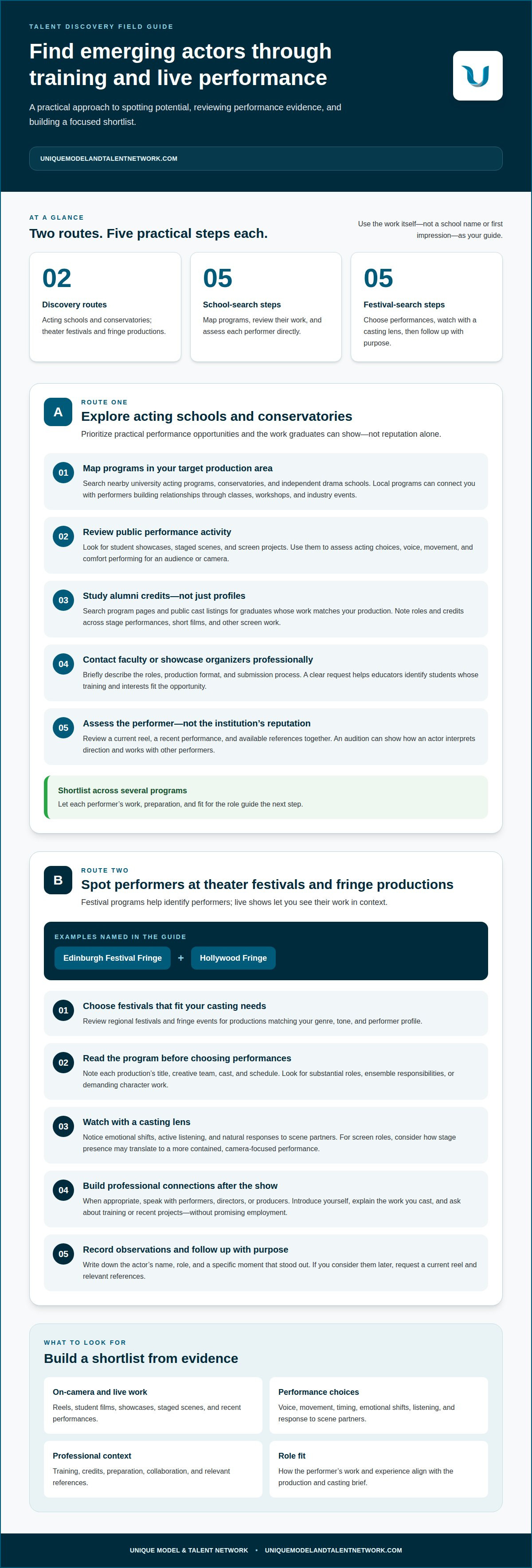
Start with acting schools and conservatories whose training connects students with practical performance opportunities. Focus less on a school’s reputation and more on the work its graduates can show and the professional relationships they build.
- Map schools in your target production area. Search for university acting programs, conservatories, and independent drama schools near the cities where you cast. A local focus can reveal emerging performers already building connections through classes, workshops, and industry events.
- Review each program’s public performance activity. Look for student showcases, staged scenes, and screen projects listed by the school. These give you a practical way to assess acting choices, voice, movement, and comfort performing for an audience or camera.
- Study alumni credits, not just school profiles. Search program pages and public cast listings for graduates with work that matches your production. Note the kinds of roles they take and whether their credits include stage performances, short films, or other screen work.
- Contact faculty or showcase organizers professionally. Send a concise note describing the roles you’re casting, the production format, and how performers can submit. A clear request helps educators identify students whose training and interests fit the opportunity.
- Assess the performer, not the institution’s reputation. Review a current reel, recent performance, and available references together. A conservatory background can show structured training, while an audition reveals how an actor interprets direction and works with other performers.
Build a shortlist across several programs rather than relying on a single celebrated name. Schools and conservatories can introduce you to developing actors, but each performer’s work, preparation, and fit for the role should guide your next step. When deciding where to find emerging acting talent, treat educational programs as discovery points, then assess actors through the material and performance evidence they share.
University acting programs, conservatories, and independent drama schools can all be useful sources of new talent, particularly those near your target production area with active showcases, staged scenes, and screen projects.
How can you find emerging actors at theater festivals and fringe productions?
- Choose festivals with a clear connection to your casting needs. Regional theater festivals and fringe events bring independent productions together, often across varied styles and budgets. For example, the Edinburgh Festival Fringe and Hollywood Fringe can help you identify work beyond established commercial stages. Review their programs for plays that match your production’s genre, tone, and performer profile.
- Read the program before selecting performances. Note each production’s title, creative team, cast, and performance schedule. Look for actors with substantial roles, ensemble responsibilities, or demanding character work. A program gives you names to track, while the live performance shows how those performers use voice, movement, timing, and space.
- Watch with a casting lens. Assess specific choices rather than relying on general impressions. Notice whether an actor sustains a character’s emotional shifts, listens actively, and responds naturally to scene partners. If you’re casting for screen, consider how a performer’s stage presence might translate to a more contained, camera-focused performance.
- Use post-show discussions to build professional connections. Talk with performers, directors, or producers when the event offers an appropriate opportunity. Introduce yourself, explain the kind of work you cast, and ask about the actor’s training or recent projects. Keep the exchange focused on their work, not an immediate promise of employment.
- Record observations and follow up with purpose. After each performance, write down the actor’s name, role, and a specific moment that stood out. If you later consider them for a project, request a current reel and relevant references. People who have worked with the performer can add useful context about collaboration and preparation.
Festivals let you see actors perform for live audiences, while festival programs can help turn a strong performance into a professional lead. Combining both gives you a more grounded shortlist than relying on a name alone.
What casting websites and talent platforms feature emerging actors?
- Search casting platforms by project and location. Use filters for production type, role requirements, and filming area where available. A student short seeking a first-time lead needs a different search from a commercial needing a specific performance style. Start with the role, then widen your search to discover less familiar profiles.
- Review the full profile, not only the headshot. Check the actor’s résumé, training, credits, and stated skills together. A profile listing student films may reveal experience that a short biography misses. Look for specific roles and project types, then decide whether those credits align with your casting brief.
- Watch reels for performance evidence. View more than the opening moments, and note how the actor handles dialogue, reaction, and changes in tone. A polished headshot attracts attention, but recorded scenes show choices in context. If a reel includes several clips, assess the work relevant to your role.
- Compare profiles against a consistent shortlist. Record each candidate’s name, relevant credits, reel link, and role fit. For example, a shortlist for a grounded drama might prioritize natural dialogue and emotional restraint. Applying the same criteria across profiles makes comparisons clearer and reduces decisions based on presentation alone.
- Use student film credits as a discovery trail. Search actor profiles for short films and student productions, then note recurring collaborators. A director or producer connected to a promising performer may point you toward other emerging actors. Follow the credit trail to discover talent beyond the profiles surfaced by your first search.
- Keep outreach professional and specific. Identify the project, role, production format, and submission material you need. Ask for a current reel or relevant scene when the profile doesn’t show work suited to the part. A clear, role-focused message helps actors understand the opportunity and respond with appropriate materials.
Use platforms to broaden your initial search, then assess each actor through relevant work and credits. A profile is a lead, not a complete picture of an actor’s performance or fit.
How do open casting calls work, and where are legitimate ones posted
- Start with the production’s official channels. Look for open-call announcements on the production company, theater, film-school, or casting office’s official website and social accounts. Match the notice to the production’s own name and confirm that the role, location, and submission instructions are consistent across its channels.
- Read the breakdown before submitting. A casting notice should identify the project, role, performance format, and materials requested. Check whether the production wants a résumé, headshot, reel, self-tape, or audition appointment. Follow the stated process rather than sending materials through an unrelated contact method.
- Prepare a focused audition submission. Choose a scene or monologue that suits the character and follows the requested format. If the notice asks for a self-tape, use clear sound, steady framing, and the specified slate details. Label files with your name and role so the casting team can identify each submission.
- Track the audition process professionally. Keep a record of the project, role, submission date, and any response instructions. If invited to read, prepare the provided sides and follow directions about timing, location, or recording. A callback is a further opportunity to demonstrate how you interpret direction and work with scene partners.
- Recognize warning signs in a notice. Be cautious if an announcement hides the project identity, gives conflicting instructions, or asks you to ignore the production’s official channels. Do not treat a social post alone as proof of legitimacy. Verify the notice through the named production or casting office before sharing sensitive information.
For casting teams, clear role details and a consistent submission process make open calls easier to assess. Build professional connections with emerging performers as you develop a thoughtful casting approach.
Casting director Marci Liroff says agents sometimes submit actors using headshots that are 10 years old, so performers should ensure their images reflect their current appearance.
Unique Model & Talent Network
Unique Model & Talent Network helps aspiring actors and industry professionals build connections around developing talent. If you’re looking beyond auditions and production credits, The Network Membership offers a professional community where emerging creatives can connect with industry experts. Live Industry Workshops and Industry Expert Q&A Sessions offer opportunities to learn from working professionals, while Portfolio & Reel Reviews help actors strengthen the materials that present their work. Monthly Skill-Building Challenges provide a structured way to keep developing craft and professional readiness.
For actors, these resources support career development and stronger industry relationships. For professionals, the network offers a private setting to discover vetted talent and engage with emerging creatives. Explore The Network Membership and its development opportunities with Unique Model & Talent Network.
Turn talent discovery into lasting professional connections
To decide where to find emerging acting talent, turn promising first impressions into informed professional relationships. Keep a clear record of performers whose work stands out, and approach each conversation with a specific purpose. A thoughtful introduction can open the door to future collaboration without making assumptions about an actor’s experience or career goals.
For actors and industry professionals alike, progress comes from staying connected and continuing to develop. Unique Model & Talent Network offers a place to build connections, learn from industry experts, and strengthen professional materials through its community and development opportunities.
If you’re ready to explore a more connected approach to your next step, contact Unique Model & Talent Network. Keep your focus on the craft, the people, and the professional relationships that help emerging talent move forward.
Frequently Asked Questions
Where do casting directors find emerging actors in the United States?
Casting directors find emerging actors through local production communities, student projects, professional referrals, and casting platforms. To broaden your search, connect each performer’s name with their résumé, credited projects, and professional references. For example, a student-film credit may lead you to a director who worked with the actor and can speak to their collaboration and preparation. This gives you a more informed view than a profile alone.
Which film schools and student film programs are good sources of new actors?
University film departments, conservatories, and local student production programs can all introduce you to developing performers. Look for schools that share student screenings or production notices, then identify actors in films that fit your casting needs. A campus film club or production office may also connect you with directors seeking performers. Focus on the scenes and note which actors make clear, specific choices on camera.
How can talent agents and managers help identify promising new actors?
Agents and managers can recommend performers whose experience, strengths, and career goals align with a role. Review an agency’s roster to understand its represented talent, then ask actors you know about their experience with that agency. Follow the agency’s submission guidelines, and avoid unsolicited email unless its rules allow it. Before signing an agency agreement, have someone independent review the contract so you understand its terms.


