
In 2026, having a "good voice" is no longer the golden ticket to a career; it's simply the baseline. If you've been searching for how to get into voice acting, you've likely encountered a chaotic mix of expensive equipment lists and predatory classes that promise fame but deliver nothing. It's frustrating to feel like an invisible gatekeeper is standing between you and a real casting director. You want clarity, and you deserve a professional path that respects both your talent and your time.
We understand that the industry can feel like a minefield of "pay-to-play" schemes and AI-generated noise. This guide serves as your professional roadmap to mastering the transition from an aspiring talent to a working professional. You'll learn exactly which studio tools are essential and which are expensive distractions. We'll also explore why human-voiced performances are now a premium service in an automated market and provide a strategy for networking that builds lasting career security without the dread of cold calling. It's time to stop guessing and start building a legitimate, sustainable business.
Key Takeaways
- Learn why vocal flexibility and acting fundamentals are more critical for booking professional work than simply having a traditional "radio voice."
- Discover a comprehensive roadmap on how to get into voice acting by mastering the business side of the industry, from personal branding to professional networking.
- Build a broadcast-quality home studio and a professional audio demo that acts as your "audio headshot" without overspending on unnecessary equipment.
- Move beyond the uncertainty of public casting sites by implementing a strategy for direct engagement with industry gatekeepers and casting directors.
- Gain career clarity and security by leveraging a gated professional community that offers direct access to industry expert Q&A sessions and portfolio reviews.
What is Voice Acting in 2026? Moving Beyond the "Good Voice" Myth
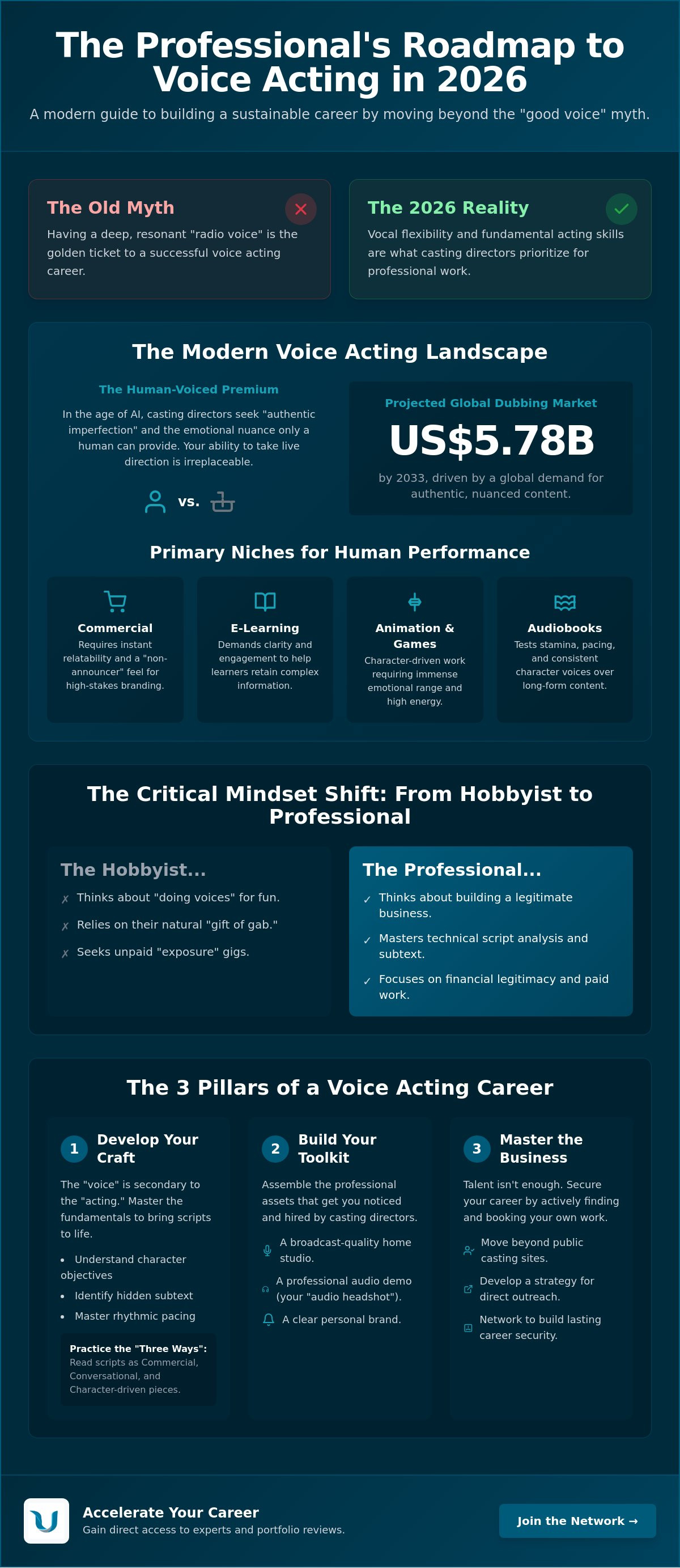
When you research What is Voice Acting, you'll find it defined as the art of performing scripted content to convey character, information, or emotion through audio alone. But in 2026, the definition has shifted. It's no longer about having a "golden" radio voice. In fact, that's a myth that keeps many talented people from succeeding. Modern casting directors prioritize vocal flexibility and acting chops over a deep, resonant tone. If you're wondering how to get into voice acting, start by realizing that your voice is just the instrument; your ability to interpret a script is the music.
The industry landscape has bifurcated. While automated corporate narration handles high-volume, low-budget tasks, the demand for high-end human performance has surged in gaming and animation. The global dubbing industry is projected to reach US$5.78 billion by 2033, driven by a global appetite for authentic, culturally nuanced content. Success in 2026 requires finding your lane in these primary niches:
- Commercial: High-stakes branding that requires instant relatability and a "non-announcer" feel.
- E-learning: Complex instructional content where clarity meets engagement to help learners retain information.
- Animation and Video Games: Character-driven work requiring immense emotional range and the ability to sustain high-energy performances.
- Audiobooks: Long-form storytelling that tests your stamina, pacing, and ability to maintain consistent character voices over several hours.
The Professional vs. The Hobbyist
A hobbyist thinks about "doing voices" for fun. A professional thinks about building a business. This mindset shift is the first hurdle in learning how to get into voice acting. Professionals focus on financial legitimacy, seeking out paid, professional-grade work rather than "exposure" gigs. While a hobbyist relies on the "gift of gab," a professional masters technical script analysis. They understand how to find the objective, subtext, and pacing in every line to deliver what the client actually needs.
The Human Element in the Age of AI
With the advancement of the NO FAKES Act of 2026, the legal protections for your vocal likeness are stronger than ever. This has created a "human-voiced premium" in the market. Casting directors today aren't looking for robotic perfection. They want "authentic imperfection" and the emotional nuance that only a human can provide. You aren't just a vocal source; you're a creative partner. In professional recording sessions, your ability to take live direction and pivot your performance in real-time is what makes you irreplaceable by an algorithm.
Developing Your Craft: Why Acting Comes First
Voice acting is often misunderstood as simply "doing voices," but the industry treats it as a high-stakes performance art. If you want to know how to get into voice acting, you must first accept that the "voice" is secondary to the "acting." Acting involves understanding the character's objective, identifying the hidden subtext within the lines, and mastering the rhythmic pacing required to keep an audience engaged. Without these fundamentals, even the most beautiful vocal tone will sound flat and artificial to a seasoned casting director. Developing these skills is the most critical step for anyone learning how to get into voice acting.
Mastering your craft requires more than just reading aloud in your bedroom. You need to develop a toolkit of techniques, such as the "Three Ways" method. This involves practicing a single script through three distinct lenses:
- Commercial: Focused on clarity, brand authority, and a persuasive call to action.
- Conversational: The "real person" read that feels like a private chat between friends.
- Character: A fully realized persona with specific motivations and emotional weight.
Working with a Professional Voice Coach
Professional coaching is the most effective way to prevent vocal strain and expand your usable range. When selecting a coach, look for someone who focuses on skill development rather than just selling you a demo. Avoid "demo mills" that promise a finished reel after only a few weeks of training. Genuine growth takes time. You should seek specialized coaching for the specific genres you intend to enter. The technical demands of medical narration differ vastly from those of high-energy anime. Setting realistic milestones for your vocal development ensures you don't burn out before your career takes off.
The Power of Live Industry Workshops
Engaging in acting workshops online provides a unique opportunity to hear what "professional" actually sounds like. These sessions allow you to observe the successes and mistakes of your peers in a moderated, safe environment. More importantly, they give you the experience of taking direction in real-time. If you can't pivot your performance during a live "patch-in" session, you won't last in a high-stakes recording environment. Building these skills is a journey of career acceleration. If you are serious about refining your technique under the guidance of veterans, participating in Live Industry Workshops can provide the structured practice you need to stand out.
The Voice Actor’s Toolkit: Demos, Home Studios, and Professional Branding
Your talent is the engine, but your technical toolkit is the vehicle that delivers your performance to the client. If you are serious about learning how to get into voice acting, your setup must reflect professional standards from day one. You don't need a five-figure recording booth to start, but you do need a "broadcast-quality" space that eliminates external noise and echoes. In 2026, the industry expects you to be a creative partner who can deliver clean, edited audio that is ready for immediate use.
Professional branding is where many aspiring actors fail. They treat their voice as a standalone product, forgetting that they are part of a larger entertainment ecosystem. Your acting portfolio must be more than just a folder of MP3s. It should be a curated digital space that includes professional headshots, a clear list of your technical capabilities, and your industry affiliations. This holistic approach signals to casting directors that you understand the business side of the industry and are ready for high-level recruitment.
Crafting a Competitive Demo Reel
Your demo reel is your "audio headshot." It is the single most important asset in your professional arsenal. A winning 60-second commercial demo features your most marketable reads in the first ten seconds to grab immediate attention. You should never self-produce your first professional demo. A seasoned producer understands how to layer music and sound effects to highlight your voice without overpowering it. Plan to update your reel every 12 to 18 months to stay aligned with current industry trends and your own vocal growth.
The "Good Enough" Home Studio for 2026
Focus on acoustic treatment over soundproofing. Soundproofing keeps noise out, but acoustic treatment makes your voice sound clear inside the room by removing "boxiness" and echoes. The "Starter Trio" for 2026 includes a high-quality XLR microphone, quality closed-back headphones, and a reliable audio interface. For stable drivers and low latency, interfaces with USB4 or Thunderbolt 4 connectivity are recommended. The Focusrite Scarlett Solo (4th Gen) remains a popular entry-level choice for those starting out. Room tone is the silent killer of auditions. If your recording space has a noticeable hum, a casting director will pass on you regardless of your acting ability.
Finally, you must master a Digital Audio Workstation (DAW). Adobe Audition is the current industry standard for professional production, though Audacity remains a viable free option for beginners. Learning basic editing skills, such as removing breaths and normalizing levels, is non-negotiable for anyone researching how to get into voice acting as a career.
The Business of Booking: Networking and Finding Work
Securing your first paid gig is a major milestone, but building a sustainable career requires more than just luck. If you are learning how to get into voice acting, you must transition from a passive applicant to an active business owner. While many beginners start on public casting websites, relying solely on these platforms is a slow path to success. These sites are often saturated with hobbyists, making it difficult for professional talent to stand out. The real "Insider Strategy" involves direct professional engagement with casting directors and production houses where the highest-quality work is actually found.
Professionalism also means understanding your financial worth. In 2026, industry standards are well-defined. For instance, the solo session fee for a union voice-over actor on an audio commercial is $404.30 under the 2025 SAG-AFTRA contract. In the non-union sector, e-learning narration rates typically range from $15 to $55 per finished minute. Adhering to the GVAA Rate Guide ensures you aren't undercutting the market or yourself. You must also respect the legal side of the craft, which includes understanding usage rights and strictly adhering to non-disclosure agreements (NDAs) that protect client intellectual property.
Direct Networking with Casting Directors
Approaching industry professionals requires a disciplined, non-spammy strategy. Instead of cold-calling with generic requests, focus on providing value and demonstrating social proof. Casting directors are looking for reliable creative partners, not just "voices." Building these professional bonds through acting industry networking is the most reliable predictor of long-term career stability. It allows you to bypass the noise of public boards and enter the private circles where the majority of high-budget work is awarded.
Treating your craft as a business means mastering basic invoicing and tracking your "booking ratio" to see which types of auditions yield the most work. For those who want to professionalize their workflow further, you can visit Frank Novak to discover how business automation and marketing strategies can support your growth. Always prioritize "The Follow-Up" after a successful session; a simple thank-you note can keep you top-of-mind for future recruitment.
Treating your craft as a business means mastering basic invoicing and tracking your "booking ratio" to see which types of auditions yield the most work. Always prioritize "The Follow-Up" after a successful session; a simple thank-you note can keep you top-of-mind for future recruitment. Additionally, be prepared for film industry auditions that may require a voice component or a self-taped performance. Mastery of these business fundamentals is essential for anyone serious about how to get into voice acting. To accelerate your professional growth and gain direct access to industry gatekeepers, consider exploring The Network Membership for targeted career development.
Accelerating Your Career with the Unique Model & Talent Network
The transition from learning how to get into voice acting to actually booking consistent work requires a fundamental shift in your professional environment. While public forums and social media groups are often cluttered with misinformation and unorganized communication, The Network Membership provides a private, moderated sanctuary for serious talent. It functions as a reliable bridge between emerging actors and established industry professionals. By joining this gated community, you gain direct access to industry experts, casting directors, and photographers who are focused on high-level recruitment and talent evaluation.
One of the primary benefits of this environment is the structure it provides for your development. Monthly Skill-Building Challenges are designed to turn your practice sessions into portfolio-ready assets. Instead of working in a vacuum, you engage in exercises that mirror real-world professional demands. This protective mentorship is a cornerstone of the brand, ensuring that you navigate the industry safely and focus only on vetted, legitimate opportunities. It is about moving away from the superficiality of fame-seeking and toward the grounded reality of career security.
Real-Time Feedback and Portfolio Reviews
Professional growth thrives on objective, high-level critique. Through Portfolio & Reel Reviews, you receive the critical benefit of having your "audio headshot" evaluated by a veteran before it ever reaches an agent's desk. This process helps you identify the specific genres where your voice is most marketable, whether it's commercial branding or character-driven animation. Live Industry Expert Q&A Sessions further demystify the hiring process, providing the clarity you need to understand how casting directors make their final decisions. This interaction transforms you from a lone creator into a connected professional with a strategic roadmap.
Joining a Community of High Standards
In an industry that can often feel chaotic, exclusivity acts as a badge of professional standards. When you surround yourself with peers who value integrity and efficiency, your perceived value to clients naturally rises. The Unique Model & Talent Network emphasizes these high standards, creating an optimized digital space where external distractions are removed. For those looking for a definitive source of direction on how to get into voice acting as a sustainable business, the "Early Adopter" advantage offers a sense of shared ownership and prestige. It is an invitation to join an elite group that prioritizes tangible success over vanity. Join The Network Membership today and start booking the work you deserve.
Take Command of Your Voice-Over Future
Success in this industry depends on your ability to pivot from an aspiring talent to a disciplined business owner. You've learned that a "good voice" is merely the starting point; true career longevity is built on acting fundamentals and a broadcast-quality technical setup. Mastering the journey of how to get into voice acting requires a strategic focus on high-value networking rather than competing in the noise of public casting boards. By prioritizing financial legitimacy and professional standards, you set yourself apart as a premium creative partner in an increasingly automated market.
Don't navigate this path alone. You deserve a clear roadmap and a community that protects your interests. Ready to turn your voice into a career? Join The Network Membership for exclusive access to industry insiders. You'll gain direct access to vetted casting directors, live weekly workshops, and skill challenges within a private, moderated community free from social media distractions. It's time to stop guessing and start building the professional life you've imagined. Your audience is waiting to hear what you can do.
Frequently Asked Questions
Do I need a professional home studio to start voice acting?
Yes, in 2026, a broadcast-quality home studio is a mandatory requirement for any professional voice actor. Most casting directors and clients expect you to record, edit, and deliver high-fidelity audio from your own space. While you don't need a five-figure booth, you must have a space with professional acoustic treatment that eliminates room tone and external noise. Stable drivers and low-latency audio interfaces, such as those with USB4 connectivity, are the current industry standard.
How much does it cost to get into voice acting in 2026?
The initial investment varies based on your existing equipment, but you should prioritize budget for coaching and professional demo production. Entry-level professional gear, like the Focusrite Scarlett Solo (4th Gen), is relatively affordable. However, the most significant costs involve specialized training and a professionally produced demo reel. Avoid cutting corners on your "audio headshot," as a low-quality demo will prevent you from booking the high-paying work that justifies your investment.
Can I get into voice acting with no prior experience?
You can certainly begin your journey with no prior experience, but you cannot succeed without professional training. If you are researching how to get into voice acting, focus first on acting fundamentals rather than just your vocal tone. Legitimate industry recruitment is based on your ability to interpret scripts and take direction. Starting with live workshops and skill-building challenges is the most effective way to gain the experience necessary to compete with seasoned professionals.
What is the difference between a voice-over and voice acting?
Voice-over is a broad term that covers all recorded speech, while voice acting is the specific art of performing a character or narrative. Voice-over includes utility tasks like automated announcements or simple corporate narration. Voice acting requires emotional nuance, subtext, and the ability to sustain a character's personality. In 2026, the market for "human-voiced" premium content specifically rewards those who master the acting side of the craft.
How do I find a legitimate voice acting agent?
Legitimate agents are found through industry directories, such as the SAG-AFTRA agency list, and they never charge upfront fees for representation. An agent earns a commission only when you book a paid job. Be wary of "talent scouts" who demand payment for "registration" or mandatory "in-house" classes. The best way to attract a legitimate agent is to build a strong portfolio and demonstrate a track record of professional networking and financial legitimacy.
Is voice acting a stable career choice with the rise of AI?
Voice acting remains a stable career for professionals who offer emotional depth and authenticity that AI cannot replicate. Legal protections like the NO FAKES Act of 2026 have strengthened an individual's right to control their vocal likeness. While AI handles high-volume, low-budget narration, 79% of business leaders believe inauthentic AI voices hurt brand perception. This has created a premium market for real human actors who can act as creative partners for high-end brands.
How long does it take to book your first paid voice-over job?
The timeline for booking your first job typically ranges from three to nine months of consistent training and auditioning. Your success when learning how to get into voice acting depends on the quality of your demo and your ability to network effectively. Those who participate in moderated communities and receive real-time feedback often book work faster than those who rely solely on public casting boards. Patience and persistence are your most valuable assets during this initial phase.
What are the best websites for voice acting casting calls?
The best opportunities are found on private, gated networks and professional industry sites rather than public "pay-to-play" boards. While some beginners use general casting sites, these are often saturated with hobbyists and offer lower rates. Professional talent often finds work through direct outreach to production houses or through exclusive memberships that offer direct access to vetted casting directors. Focus on platforms that emphasize professional standards and financial legitimacy for their members.


