

You don’t need a speaking line to appear in a commercial. Non-speaking roles in commercials include background extras and featured performers, and a performer can even be cast as a principal without dialogue. The key is to find suitable casting calls and show that you communicate naturally on camera.
If you’re unsure where to start, you’re not alone. Commercial casting can involve self-tapes, recalls, and different terms for shoot fees and usage. Knowing what each stage involves helps you make informed choices.
This guide covers finding opportunities, preparing for auditions, handling recalls, and understanding shoot fees and buyouts. You’ll also learn how background and other non-speaking roles fit into commercial work, so you can pursue opportunities with greater clarity and confidence.
Key Takeaways
- Build a simple, camera-ready profile that helps casting teams quickly see your look, skills, and suitability for a role.
- Prepare for auditions by, responding naturally on camera, and staying ready for a recall.
- Distinguish background work from featured roles, and understand how shoot fees and usage terms affect compensation.
- Use focused training and professional feedback to strengthen your materials and pursue casting opportunities with more confidence.
How Can I Work in Commercials?
Start by targeting commercial casting calls, then prepare a concise profile and camera-ready audition. Commercial work rewards clear visual choices that support a brand’s message.
No, you don’t need an agent for every commercial audition. Some casting calls accept direct submissions, while others require representation, so follow the instructions for each role.
-
Explore Auditions Without Acting Experience
Apply for entry-level commercial auditions that welcome newcomers, including background and non-speaking roles in commercials. Check each casting notice for the role description, submission method, shoot dates, and requested materials. Commercial forms may ask you to list work from the previous three years, so answer accurately if you have credits. If you don’t, focus on relevant experience, availability, and your ability to follow direction.
Prepare a short introduction and practise simple reactions on camera. A commercial may have no dialogue, so a smile, a moment of surprise, or a focused look can carry the scene. Research the brand before auditioning, then show genuine enthusiasm without forcing a performance.
-
Find Commercial Acting Work
Search casting notices and talent platforms for commercial roles, and review local production announcements for nearby opportunities. Filter for commercial, background, featured, and non-speaking work. Save suitable notices and track each deadline, role description, and submission requirement. Tailor your materials instead of applying automatically with the same ones: a family scene, for example, may call for a different presentation than a product demonstration.
Commercial acting differs from film and theater because the performance must quickly serve a specific brand message. Film scenes can build over time, while theater performances reach a live audience from the stage. For a commercial audition, practise communicating an idea through concise facial expressions and movement. Acting classes can build on-camera confidence, and improvisation exercises can help you respond naturally when direction changes.
-
Find and Apply for Non-Speaking Auditions
Search casting notices using terms such as “background,” “extra,” and “non-speaking,” then check whether the role is background or featured. The distinction matters: a featured performer may receive focused screen time, while background performers help create the setting. Read the role description closely for wardrobe guidance, location, shoot dates, and whether the notice asks for a self-tape or photos.
Submit exactly what the casting notice requests. Use clear, current photos, describe relevant experience honestly, and keep your response brief and professional. Before sending, confirm your contact details and availability. Acting practice can help you make specific choices, such as reacting to a product or listening to another performer, without relying on spoken lines.
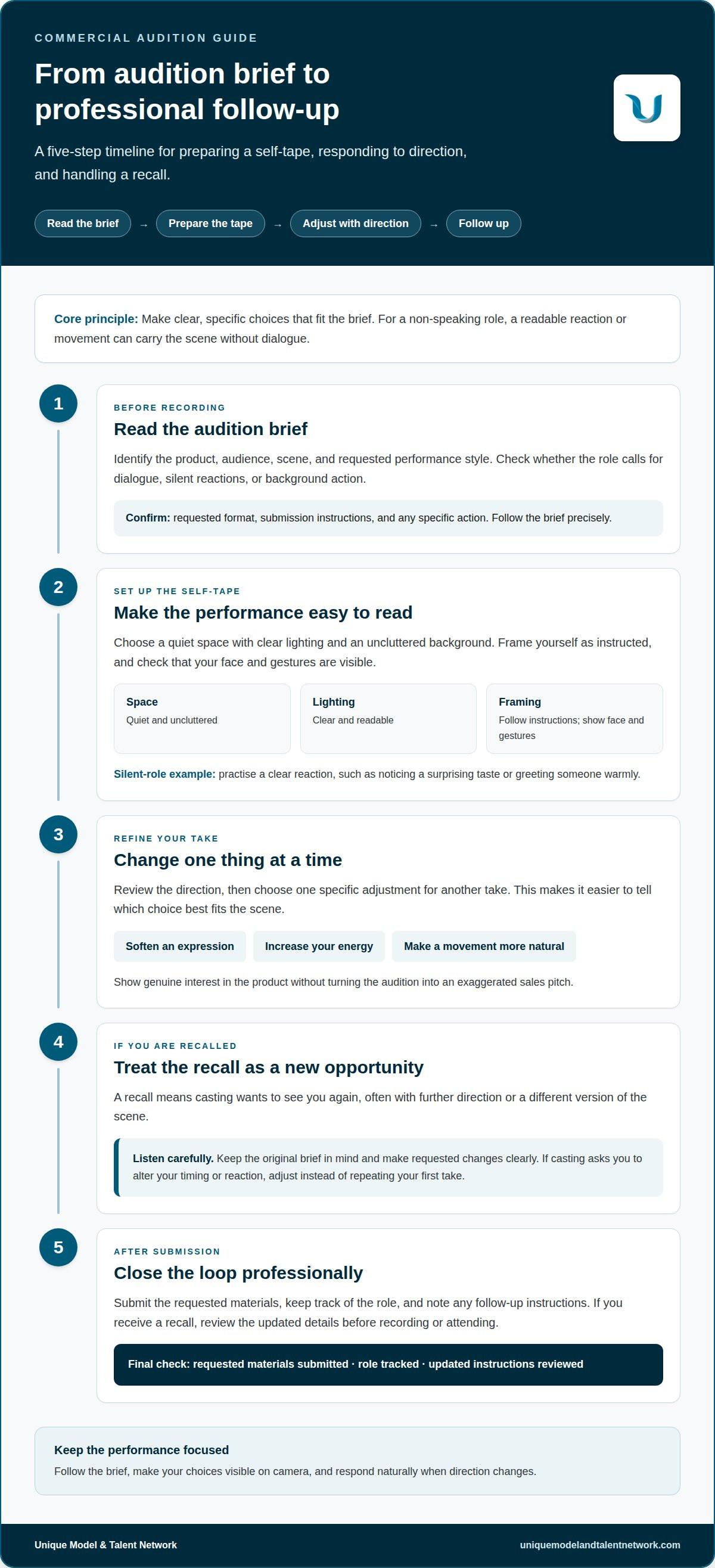
Commercial audition and recall process
- Read the audition brief before recording. Identify the product, audience, scene, and requested performance style. Note whether the role calls for dialogue, silent reactions, or background action. Follow the requested format and submission instructions precisely. If the brief asks for a specific action, such as using a product, make it easy to read on camera.
- Prepare a focused self-tape. Commercial auditions often involve a self-tape, so choose a quiet space with clear lighting and an uncluttered background. Frame yourself as instructed, check that your face and gestures are visible, and keep your performance within the brief. For a silent role, practise a clear reaction, such as noticing a surprising taste or greeting someone warmly.
- Make each take purposeful. Review the direction, then choose one specific adjustment for another take. You might soften an expression, increase your energy, or make a movement more natural. Avoid changing several things at once, so you can tell which choice best fits the scene. Show genuine interest in the product without turning the audition into an exaggerated sales pitch.
- Treat a recall as a new opportunity to adjust. A recall means casting wants to see you again, often with further direction or a different version of the scene. Keep the original brief in mind, listen carefully, and respond to the requested changes. If the casting team asks you to alter your timing or reaction, make the adjustment clearly instead of repeating your first take.
- Close the loop professionally. Submit the requested materials, then keep track of the role and any follow-up instructions. If you receive a recall, review the updated details before recording or attending. Questions about auditions and performance choices can also be explored in an industry expert Q&A session, helping you approach the next casting stage with a clearer plan.
Background extras and non-speaking commercial roles
For a commercial background actor headshot, use a recent, clear image that shows your face and current appearance. Include your contact details, location, relevant experience, and practical skills on your résumé, such as dancing, sports, or playing an instrument.
- Understand the role before applying. Background extras help create a believable setting, such as shoppers in a store or fans at a game. Featured non-speaking performers receive more focused attention or specific actions, such as demonstrating a product. Read the casting notice to see which category fits, what the scene requires, and whether the role includes visible interaction.
- Set realistic expectations about compensation. Background performers usually receive a day rate and no residuals, while featured roles can have different terms. The role and contract determine the details.
- Prepare a useful headshot and résumé. Choose a straightforward headshot that resembles how you look now, rather than a heavily edited portrait. Keep your résumé concise and easy to scan. List relevant on-camera work, special skills, and commercial experience honestly. If you have no credits, highlight a practical ability that matches the casting notice, such as cycling for a bike-shop scene.
- Follow background direction precisely on set. Listen for instructions about where to stand, when to move, and how to repeat an action. In a café scene, for example, keep the same cup, seat, and gesture between takes. Avoid looking into the camera unless directed. Consistent reactions and movements help maintain continuity across shots.
How do I find and apply for non-speaking commercial auditions?
- Search with role-specific terms. Use casting platforms and production notices, filtering for commercials, background performers, featured roles, and non-speaking work. Search terms like “commercial extra” or “silent featured role” can narrow results. Save suitable notices and note their deadlines, locations, shoot dates, and submission instructions so you can apply on time.
- Match the role before submitting. Read the full breakdown and identify the character, action, and intended setting. A notice might seek a shopper, a parent, or someone demonstrating a product. Apply when your appearance, skills, and availability fit the brief. Don’t send the same generic message to every casting call; connect your experience to the specific role.
- Prepare the requested materials. Follow the notice’s requirements for headshots, résumé details, self-tapes, or availability. Use clear, current photos and list relevant skills, such as sports, dancing, or playing an instrument. If the casting team requests a silent action, show the reaction naturally and keep the product or prop visible when instructed.
- Review shoot and usage terms. Before accepting, understand the shoot schedule, role category, payment terms, and where and how long the commercial may run. Casting notices can describe very different projects. For example, an Ottawa product promotion sought performers for a 60-second video and additional 10-15-second videos. Those details help clarify what the production expects.
- Track applications and follow up professionally. Keep a simple record of each role, submission date, requested materials, and any response. Reply promptly to audition or recall instructions, and keep your availability accurate. If you want a sharper plan for choosing opportunities and presenting yourself, get guidance on commercial auditions through an industry-focused discussion.
Unique Model & Talent Network
Unique Model & Talent Network helps aspiring performers build the skills and materials needed to pursue commercial work. If casting calls, silent performance choices, or recalls still feel unfamiliar, its professional community offers opportunities to learn from industry experts and strengthen your approach.
Live Industry Workshops and Industry Expert Q&A Sessions can help you understand casting expectations and prepare thoughtful questions. Portfolio & Reel Reviews provide focused feedback on how your materials present you, while Monthly Skill-Building Challenges offer structured practice. The Network Membership brings these learning opportunities together in a professional community.
Use these resources as you prepare for auditions and plan your next steps. Contact Unique Model & Talent Network to learn more.
Build Momentum With Your Next Audition
Choose a practical goal for your next casting opportunity: make a silent reaction clearer, shape a more focused self-tape, or present your on-camera personality with confidence. A specific goal gives each audition purpose and helps you develop a natural performance style.
As you pursue non-speaking roles in commercials, treat professional development as an ongoing process. Stay open to direction, learn from each experience, and keep refining how you communicate without dialogue. Consistent preparation can help you approach new opportunities with greater clarity and make considered choices about the roles you pursue.
If you’re ready to map out your next step, start a conversation with Unique Model & Talent Network. Keep building your craft and bring that preparation into every audition.
Frequently Asked Questions
How Do You Audition for Commercials?
Audition by submitting the materials and performance format the casting notice requests. Commercial casting may involve a self-tape and a recall, where casting asks you to perform again or adjust your approach. For example, a brief may ask you to react to a product without speaking. Follow directions closely, keep your performance clear, and make each requested adjustment distinct.
How Much Do Actors Get Paid to Do Commercials?
Commercial pay depends on the role, union status, shoot fee, and usage terms. Compensation can also reflect where an ad airs, its distribution medium, language, and foreign showings. A buyout covers the usage period stated in the contract and is separate from the shoot fee. Compare the role’s payment terms with the expected work and usage before accepting, rather than relying on a single industry-wide figure.
What Do I Need to Know About Working in Commercials?
Understand what the role requires, how the commercial may be used, and what the payment covers. A featured performer and a background extra can have different duties and compensation arrangements. Read the agreement for the shoot fee, any buyout, usage period, and applicable residual terms. Commercial work also calls for concise, brand-focused performances, so practise conveying a clear intention through movement and expression.
What are non-speaking roles in commercials called?
These roles are commonly described as background, extra, featured, or non-speaking. “Extra” usually refers to a performer who helps create the scene’s setting, while “featured” can describe someone given a distinct action or more focused screen time. A performer can also be cast as a principal without dialogue. Use the exact role label in a casting notice to understand the requested contribution.
What do commercial background actors do on set?
Commercial background actors help make a scene feel populated and believable. They might portray customers in a shop, guests at a gathering, or fans at a game. The production may ask them to repeat simple actions, such as browsing a shelf or reacting to an event, for several takes. Follow the assistant director’s instructions, maintain continuity, and avoid drawing focus from featured performers.
How much do non-speaking commercial actors get paid in the U.S.?
There isn’t one standard U.S. rate for every non-speaking commercial role. Background performers usually receive a low-scale day rate and no residuals, while featured or principal roles can have different compensation.


