

A casting director general meeting isn’t an audition, and it won’t decide a role on the spot. If you’re asking what a general meeting with a casting director is, it’s an informal chance to meet, share a little about yourself, and learn about the casting professional’s work. Getting one can be difficult: actors may be invited because they’re already known to the casting director, have a strong reel or self-tape, or have representation with industry connections.
When there’s no specific role to prepare for, focus on being clear, curious, and ready to talk about your work. This guide explains how actors get general meetings, what casting directors may ask, and how to answer “Tell me about yourself” with confidence. You’ll also find ways to prepare questions of your own, so you can approach the conversation with purpose rather than guessing what the casting director wants to hear.
Key Takeaways
- Understand what can help an actor get a general meeting, and focus your preparation on the factors casting professionals may notice.
- Prepare for questions about your background and acting experience, and stay ready for a conversation or a possible performance request.
- Shape a concise introduction around your training, recent work, and next career goals.
- Plan thoughtful questions about the casting office’s work to make the conversation more specific and engaging.
How actors get general meetings
A general meeting is an informal meet-and-greet, not an audition. It isn’t inherently a fee-based service; if an invitation requests payment, clarify whether the event is a meeting, workshop, or another format before agreeing.
- Build professional visibility. Casting directors may invite actors they already know, or those whose showreels and self-tapes make a strong impression. Keep your current materials easy to review, with recent work that clearly shows your casting range.
- Use representation to make introductions. Actors with well-connected representation are among those who secure general meetings. A representative can make a targeted introduction, but the meeting still depends on the casting director’s interest and schedule.
- Make your materials memorable. A strong reel or self-tape can give a casting director a reason to remember your work. Choose clips that demonstrate your strengths clearly, rather than trying to show every role or style at once.
- Research the casting office before accepting. Review the casting director’s past projects, the genres they work in, and their frequent collaborators. Watching an episode from a show cast by that office can help you understand its work and identify relevant conversation topics.
- Treat the meeting as relationship-building. General meetings have become less common, partly because online profiles let casting directors review actors without meeting them individually. Use an invitation to learn about the professional’s office and share where your work may fit, not to press for a role.
- Follow up with care. After the meeting, spend five minutes noting who you met, what the office was working on, and details you want to remember. Send a brief thank-you that refers to something specific you discussed and asks for nothing.
Typical questions at a general meeting
Prepare for a personal conversation, not a fixed script. A casting director or associate may ask about your background, then invite you to ask about their work.
-
Prepare for Common Questions
Practise brief, natural answers about where you’re from, how long you’ve been acting, and how long you’ve lived in Los Angeles, New York, or Atlanta. Connect your experience to a recent class, production, or self-tape, rather than reciting your whole career history. A casting professional may also invite you to cold-read or perform a speech you know well, so be ready to shift from conversation to performance.
-
Prepare Questions for the Casting Director
Research the casting office and prepare three questions about its work. Review projects it is casting now or cast in the last year, and identify one or two where you genuinely fit. Ask about the office’s process, the performances that make an impression, or how its approach varies across genres. Keep questions curious and specific. Don’t ask for a role or put the casting director on the spot.
- Answer with a clear example. If asked about your experience, choose one relevant detail instead of listing every credit. A concise answer gives the casting professional room to follow up.
- Listen before responding. If you’re asked to cold-read, take in the direction first. For a familiar speech, focus on making a grounded, considered choice instead of rushing to impress.
- Keep the exchange conversational. Respond directly, then let the casting director guide the next topic. Bring in your prepared questions when there’s a natural opening, and show genuine interest in the office’s projects.
For more practice discussing your work with industry professionals, explore actor development resources.
Answering “tell me about yourself”
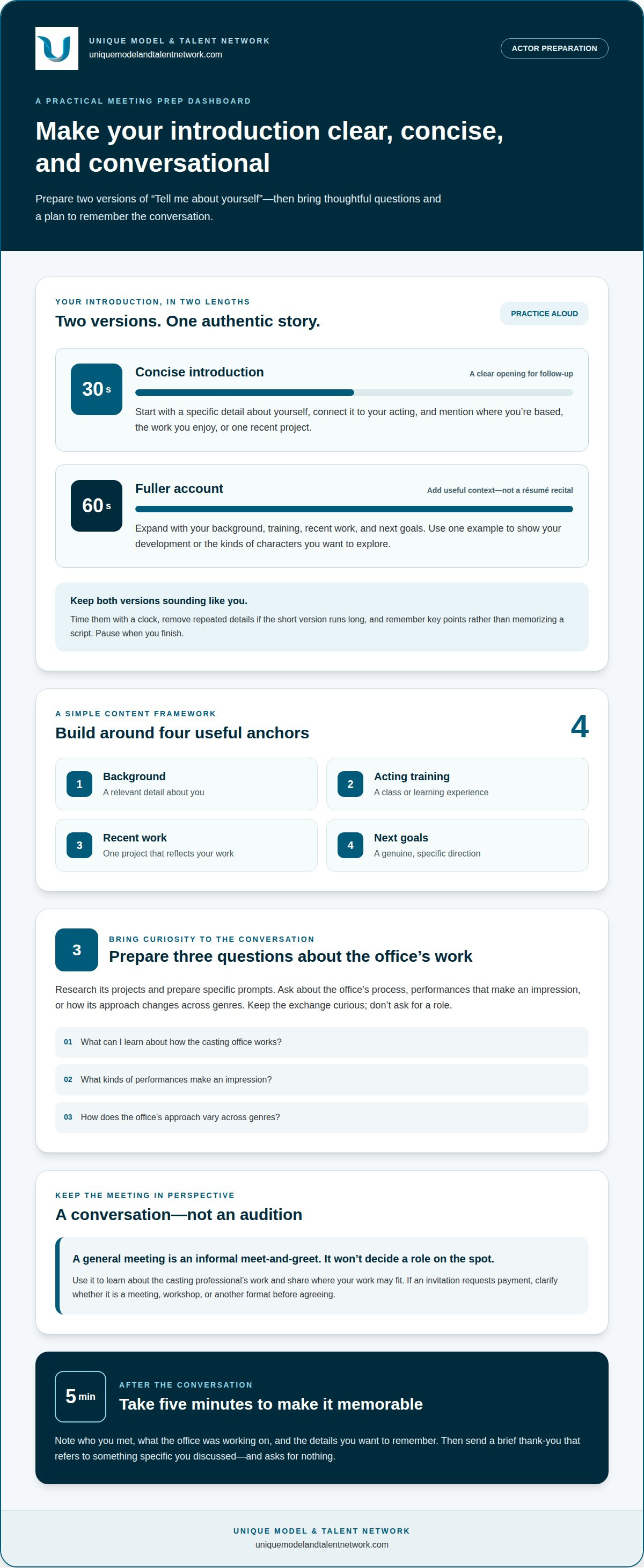
Prepare two versions of your introduction: a concise response and a fuller account. Both should sound like you, not a memorized biography.
- Choose your key details. Select background, acting training, recent work, and your next goals. Include details that help the casting director understand the performer you are. For example, mention a recent production that reflects the roles you’re pursuing, rather than listing every credit on your résumé.
- Build a 30-second version. Start with a specific detail about yourself, then connect it to your acting. You might say where you’re based, what kind of work you enjoy, and one recent project. Keep the focus on information that gives the casting director a clear opening for follow-up questions.
- Prepare a 60-second version. Add your background, training, recent work, and next goals. For example, explain how a scene-study class shaped your approach, then describe a recent role and the kinds of characters you want to explore. Use the extra time to add context, not unrelated personal history.
- Practice aloud, then refine. Time both versions with a clock. If the 30-second answer runs long, remove repeated details. If the 60-second version feels like a résumé recital, replace a list of credits with one clear example of your work or development.
- Keep it conversational. Remember the main points, not a script to recite word for word. Pause after your answer and give the casting director room to respond. If they ask about a recent project, add a useful detail instead of starting your introduction over.
- End with a forward-looking detail. Close with a genuine next goal, such as developing a particular skill or pursuing roles in a genre you enjoy. Make it specific enough to invite conversation, but don’t frame the meeting as a request for a job.
What should actors ask a casting director during a general meeting?
Use your questions to learn about the casting office, not to angle for a role. Prepare specific prompts, then listen closely to the answers.
- Research the office’s recent work. Review projects the casting office is working on now or cast in the last year. Identify one or two where your type genuinely fits. This gives you a concrete starting point, such as asking what qualities helped shape the performances in a particular production.
- Prepare three questions in advance. Build them around the office’s work, casting process, or the genres it handles. For example, ask what the team looks for when casting a character role, or how its approach differs between comedy and drama. Specific prompts show you’ve prepared without turning the meeting into an interview.
- Ask about the casting director’s perspective. Invite them to talk about a project or collaboration that interests you. A question such as “What made this project especially rewarding to cast?” encourages a genuine exchange and helps you understand the professional’s interests and priorities.
- Keep your questions open and respectful. Ask questions that invite a thoughtful answer, rather than a promise or immediate opportunity. Don’t ask whether the casting director can get you an audition. The meeting is a chance to learn about their work and build a professional connection.
- Follow the conversation. You don’t need to ask all three prepared questions. If the casting director discusses a recent production, use that detail for a relevant follow-up. Listen carefully, stay polite, and show genuine interest in how the office approaches its projects.
- Choose one final question. If time is short, ask the question most relevant to your goals. A focused discussion about the office’s work leaves more room for natural conversation than rushing through a list.
Build confidence for professional conversations by practicing your industry meeting skills.
Unique Model & Talent Network
Unique Model & Talent Network helps actors build industry knowledge and strengthen their professional materials between casting conversations. If you’re preparing to meet casting professionals, The Network Membership provides a community for continued career development. Live Industry Workshops and Industry Expert Q&A Sessions offer opportunities to learn from industry professionals.
Use Portfolio & Reel Reviews for focused feedback on the materials that introduce your work. Monthly Skill-Building Challenges help you continue developing your craft and professional habits. These resources support your preparation and growth, while you build your own career relationships.
If you’d like to explore these opportunities, contact Unique Model & Talent Network.
Turn the Conversation Into Career Momentum
Understanding what a general meeting with a casting director is helps you approach it as one part of a larger professional path, not a single moment that defines your future. After each industry conversation, choose a next step: sharpen a skill, refresh your materials, or learn more about the work you want to pursue. Continued development gives you more to bring to future conversations.
For ongoing support, The Network Membership, Live Industry Workshops, and Portfolio & Reel Reviews offer ways to learn, develop your craft, and strengthen your professional materials. Choose what fits your current focus, whether you want feedback on your reel or the chance to learn directly from industry professionals.
Contact Unique Model & Talent Network to explore the next step in your professional growth. Keep building your craft and approach each new connection with purpose.
Frequently Asked Questions
How should I prepare?
Prepare your materials, schedule, and setup so you can focus on the conversation. Bring two printed copies of your current headshot and résumé, and aim to arrive ten minutes early for an in-person meeting. For a virtual meeting, check that your face is visible and your voice is clear. Studio-quality lighting and a lapel microphone aren’t necessary.
Is a general meeting an audition?
No. A general meeting isn’t an audition for a specific role, and no casting decision is made during the conversation. The casting professional may still ask you to cold-read or perform a familiar speech, so be ready to respond. Treat it as a chance to demonstrate your work, not as a promise of a part.
What can you expect?
Expect to talk about your background and acting experience, and to hear about the casting professional’s work. They may ask where you’re from or how long you’ve been acting. The meeting may also include questions and answers or prepared work. Keep your responses relevant, and follow the casting director’s lead if the conversation shifts.
What is a general meeting with a casting director?
A general meeting with a casting director is an informal conversation between an actor and a casting professional, without a specific project or role in mind. It gives you the opportunity to introduce yourself and learn about the casting professional’s office. Think of it as a professional conversation, not a meeting where a job offer is decided.
What is the purpose of a general meeting in acting?
The purpose is to build a professional connection and give both people the chance to learn about each other’s work. You can learn more about the casting office’s projects and interests, while the casting professional becomes familiar with your background and strengths. The conversation may help them remember you when suitable roles arise.
How is a general meeting with a casting director different from an audition?
A general meeting is an introductory conversation, with no specific role under consideration. An audition focuses on your performance for a particular project or part. A casting professional might ask for a cold read during a general meeting, but that doesn’t make it an audition for a specific role. The purpose and context are different.


