

Background acting isn't passive human wallpaper; it's the most immersive, paid masterclass in modern filmmaking. Yet, when you're trying to learn how to find work as a background actor, the entertainment industry often feels like a confusing maze of predatory registration scams, cryptic jargon, and closed doors. Moving from aspiring performer to a booked talent starts with knowing exactly where to look and who to trust.
If you feel intimidated by terms like digital vouchers and core background, or worried about making an amateur mistake during your first call, that hesitation is completely normal. You don't have to risk your savings or guess your way onto a studio lot. In this guide, you'll discover the proven, step-by-step process to secure consistent, paid background roles on legitimate film and television sets without falling for pay-to-play traps.
We'll walk through the verified casting agencies operating today, the essential on-set etiquette that earns director respect, and how to leverage your production days toward SAG-AFTRA vouchers and long-term career momentum.
Key Takeaways
- Master the exact process for how to find work as a background actor by registering directly with verified casting directors and established industry casting platforms.
- Optimize your profiles with the precise wardrobe measurements and unretouched photos that professional casting teams demand.
- Handle digital vouchers, basecamp check-ins, and production protocols with complete confidence from your very first call time.
- Protect your finances and your reputation by identifying legitimate production employers and steering clear of predatory casting scams.
- Transform background days into an active on-set masterclass, using technical observation and union vouchers to build long-term industry momentum.
What Is a Background Actor and How Does the Industry Hire Them?
Background actors create the living atmosphere of any scene, transforming an empty soundstage into a buzzing hospital ward, a tense courtroom, or a crowded transit terminal. Far from acting as passive set dressing, these performers provide the physical continuity and contextual realism that makes a fictional world believable. If you want to master how to find work as a background actor, you first need to understand the industry hierarchy and how casting directors categorize on-screen talent.
Working background gives you front-row access to high-budget filmmaking. Every shoot day functions as an active classroom where you observe director instructions, track camera movements, and study technical timing without the pressure of carrying primary dialogue.
Key Classifications: General Extras, Core Background, and Stand-Ins
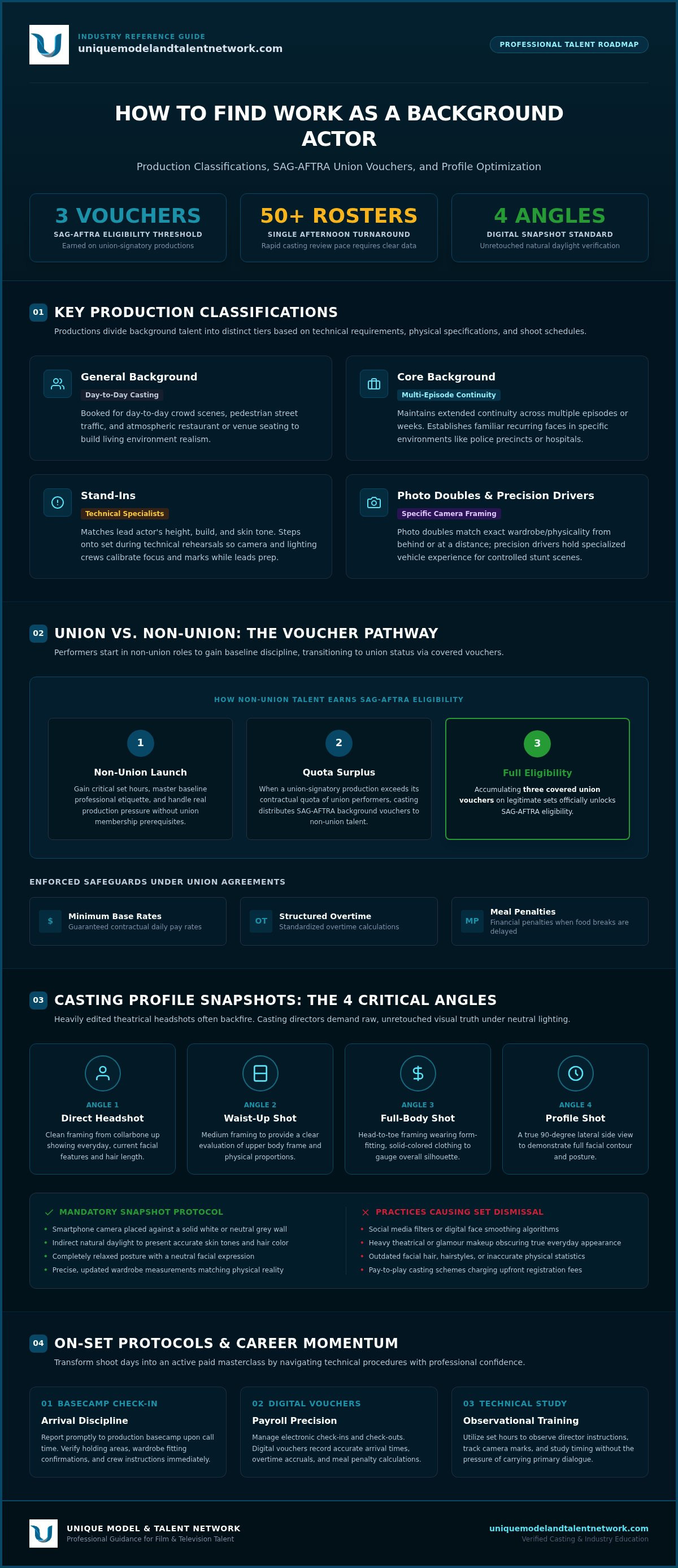
Productions divide background talent into distinct classifications based on technical skill, physical specifications, and production schedules:
- General Background: Performers booked for day-to-day crowd scenes, pedestrian traffic, or atmospheric restaurant seating.
- Core Background: Performers booked for extended continuity across multiple episodes or production weeks. Core talent establishes familiar faces in recurring environments, such as precinct detectives or hospital staff.
- Stand-Ins: Technical specialists chosen to match a principal actor's height, build, and skin tone. Stand-ins step onto set during technical rehearsals, allowing the director of photography and lighting crew to calibrate focus, camera marks, and lighting setups while the lead actors prepare.
- Photo Doubles and Precision Drivers: Skilled talent hired for specific camera framing. Photo doubles step in when an exact physical or wardrobe match is filmed from behind or at a distance, while precision drivers hold specialized vehicle experience for controlled stunt scenes.
Union vs. Non-Union: Understanding SAG-AFTRA Vouchers
You don't need union membership to start booking paid sets. In fact, most performers launch their careers in the non-union tier, gaining essential set hours and building baseline professional discipline. Non-union days provide the practical experience needed to handle real production pressure.
Union-signatory productions operate under SAG-AFTRA agreements that enforce daily minimum base rates, structured overtime calculations, and meal penalty protections when food breaks are delayed. When a union production reaches its contractual quota of union performers, casting directors can distribute SAG-AFTRA background vouchers to non-union talent. Earning three of these covered union vouchers grants you official SAG-AFTRA eligibility.
Understanding how to find work as a background actor on legitimate union-signatory sets creates a clear, transparent bridge to professional accreditation, helping you build genuine industry equity day by day.
Essential Preparation: Crafting Profiles and Materials That Get You Booked
Precision booking begins long before you arrive at a studio gate. Background casting directors work under brutal turnaround deadlines, often pulling rosters of fifty or more performers in a single afternoon. If you want to know how to find work as a background actor consistently, your casting profile must give associates absolute visual truth rather than dramatic glamour. Heavily edited photos and outdated statistics only lead to wasted fitting appointments or immediate dismissal from set.
Taking Effective Digital Snapshots Without Expensive Gear
Theatrical headshots often work against you in the background arena. While principal auditions require stylized lighting that suggests character, background casting relies on raw, unretouched digital snapshots. Casting coordinators need to evaluate your current hair length, facial hair, skin tone, and body frame under neutral lighting.
Grab a smartphone and stand against a solid white or neutral grey wall in indirect daylight. Avoid filters, heavy studio makeup, or dramatic shadows. Keep your expression neutral and your posture relaxed. Every competitive database profile needs four fundamental angles:
- Direct Headshot: Clean framing from the collarbone up, showing your everyday appearance.
- Waist-Up Medium Shot: Clear view of your upper body proportions.
- Full-Body Shot: Head-to-toe framing wearing form-fitting, solid-colored clothing.
- Profile Shot: A 90-degree side profile capturing your silhouette and current hair length.
As documented in the U.S. Bureau of Labor Statistics occupational outlook for actors, physical continuity and adaptability remain essential in professional production environments. Providing truthful snapshots ensures you get matched with productions that fit your exact look.
Documenting Accurate Sizes, Props, and Unique Vehicles
Costume departments pull wardrobe based entirely on raw numbers. Never guess your measurements based on retail tags, as vanity sizing creates costly delays on set. Use a flexible measuring tape to document your exact height, weight, jacket size, collar circumference, sleeve length, waist, inseam, shoe size, and hat measurement.
Expand your booking opportunities by uploading organized look galleries. Include clean photos in sharp corporate attire, casual weekend wear, period vintage, and athletic gear. If you own specialized uniforms, musical instruments, or an unblemished personal vehicle, register them. Productions frequently pay daily allowance bumps for personal items. For a complete blueprint on structuring these assets, consult our acting portfolio guide.
If you need expert eyes to verify your photos before applying to casting calls, getting targeted feedback through The Network Membership ensures your profile meets professional industry benchmarks from day one.
How to Find Work as a Background Actor Step by Step
Breaking into studio production does not happen by accident. Learning how to find work as a background actor requires a systematic approach to talent databases, communication protocols, and rapid booking confirmations. Follow these five sequential steps to transform your raw profile into steady days on set:
- Step 1: Register directly with primary background casting agencies. Onboard with legitimate regional casting offices that handle large-scale television and theatrical background rosters.
- Step 2: Establish verified casting profiles and payroll accounts. Complete your profiles on major casting portals and link necessary digital paperwork accounts like Entertainment Partners and Everyset.
- Step 3: Monitor daily job boards and SMS notifications. Check casting feeds early in the morning and throughout the afternoon when production needs drop.
- Step 4: Respond rapidly to availability checks. Submit updated, zero-filter selfies displaying your current hairstyle and facial hair within minutes of receiving an inquiry.
- Step 5: Lock in your booking details. Confirm your booking immediately, note your call details, and prepare your wardrobe options the evening before.
Registering with Legitimate Background Casting Bureaus
Start your search at the primary source. Central Casting serves as the largest employer of background talent in major hubs like Los Angeles, New York, Georgia, and Louisiana. Registration with Central Casting is completely free under state advance-fee fraud laws, so walk away from any entity demanding upfront registration fees.
Beyond Central Casting, regional hubs rely on dedicated casting directors who manage specific episodic rosters, such as Waldron Casting or Grant Wilfley in New York, and Hylton Casting in Atlanta. Review our breakdown of verified casting websites to separate reputable casting offices from misleading third-party aggregators.
Responding to Availability Inquiries and Rush Calls
Speed determines whether you work or sit at home. Background casting coordinators face tight deadlines and send availability inquiries to dozens of matching candidates at once. The first qualified performers to answer secure the spots.
Learn the vocabulary of these alerts. An availability inquiry (or "avail check") asks if you are free on specific dates; it is not a binding job offer. A soft hold means you are on a shortlist awaiting director approval. An official booking confirmation means your slot is locked. When replying to an avail check or a last-minute rush call, always attach a fresh, real-time snapshot showing your exact hair length, facial hair, and current look so the casting coordinator can book you with full confidence.
Navigating Production Day: On-Set Etiquette, Digital Vouchers, and Rebooking
Your call sheet sets the clock ticking long before you step in front of a camera. Successfully understanding how to find work as a background actor means little if you can't deliver seamless professionalism on set. Assistant Directors remember the performers who make production effortless, just as quickly as they blackball those who disrupt it.
Modern productions have left carbon-copy paper timecards in the past. Platforms like Entertainment Partners' SmartVoucher and Everyset now govern daily workflows. You will complete your initial check-in on your smartphone, log meal out and meal in times electronically, and receive your digital timecard upon wrapping. Check that digital voucher thoroughly. You have a strict 24-hour window to review your call, meal breaks, and allowances before the system auto-locks your signoff and routes your timecard to payroll.
Basecamp Protocol, Wardrobe Fitting, and Holding Areas
Report to basecamp at least fifteen minutes prior to your official call time. Arrive camera-ready: hair clean, face washed, and personal grooming squared away. Pack three distinct, pre-pressed wardrobe options that match your booking notes, complete with matching shoes and accessories. Lay them across clean garment hangers so the wardrobe department can approve your look immediately.
Once approved, holding is your headquarters. Maintain quiet focus while waiting, as Assistant Directors and production assistants constantly enter to pull groups for rehearsal. Keep your smartphone silenced and out of sight. Never point personal cameras toward soundstages, prop carts, or monitors. Violating a non-disclosure agreement by posting on-set snapshots will end your booking on the spot and flag your profile across casting databases.
Set Etiquette: Working Seamlessly with Assistant Directors
Set discipline depends on sharp listening and technical consistency. Always tune your ears to standard operational commands:
- "Picture is up!" Rehearsal is finished and cameras are rolling soon. Stop all side conversations instantly.
- "Background action!" Begin your assigned physical movement at normal speed. Never anticipate the cue or look directly into the camera lens.
- "Back to one!" Return immediately to your exact starting position, holding the identical prop in the identical hand to protect continuity.
Treat principal actors with professional distance. Do not ask for selfies, hand over personal business cards, or initiate small talk between takes. If you want to refine your technical instincts and learn directly from working industry professionals before stepping onto major soundstages, join The Network Membership to gain direct insider guidance.
Advancing Your Career: Transitioning from Background Performer to Principal Roles
Extra work gives you steady cash flow and set familiarity, but remaining in background holding forever won't book you a lead role. While learning how to find work as a background actor gets your foot on a studio soundstage, turning those shoot days into a springboard for principal speaking auditions demands intentional career strategy. One critical industry rule stands firm: never list background credits on your professional acting resume. Casting directors view background credits on a theatrical resume as an immediate indicator of an amateur, so save that document exclusively for speaking roles, formal training, and specialized physical skills.
Treating Background Days as Practical Film School
Consider every call time as paid lab hours. When you are on set between takes, pay close attention to how the director communicates tone adjustments to the leads. Watch how camera operators calibrate focus pulling on complex dollies, and notice how script supervisors track minute prop continuity across coverage angles.
Observe the seasoned principal performers carefully. Notice how they conserve vocal and emotional stamina between rehearsals, hit their tape marks without looking down, and repeat precise physical actions across twelve consecutive takes. Absorbing this technical rhythm demystifies the production machine, giving you quiet confidence when you step into audition rooms. For detailed strategies on booking speaking parts, review our guide to film industry auditions.
Expanding Beyond Background Work Through Community and Mentorship
Making the leap from silent background talent to working actor requires structured training and sharp self-protection. Predatory operations routinely prey on newcomers, selling overpriced photo packages, bogus talent directories, and fake agency contracts. Navigating this business alone leaves you vulnerable to expensive missteps and stagnant momentum.
Surround yourself with disciplined peers and working mentors who hold each other to high professional standards. Engaging in monthly skill-building challenges, getting targeted portfolio and reel reviews, and attending live workshops will bridge the gap between background calls and principal representation. Joining a verified community like the Unique Model & Talent Network connects you with direct industry expert Q&As, safe networking circles, and practical craft education. When you combine practical set experience with dedicated craft refinement, you position yourself not just to learn how to find work as a background actor, but to build a lasting career across the entertainment industry.
Turn Your Set Experience Into Long-Term Career Momentum
Building a sustainable entertainment career isn't about luck; it's about disciplined strategy. Knowing how to find work as a background actor opens the soundstage doors, giving you invaluable technical training, crucial digital voucher experience, and real industry connections. When you treat every call time as an active masterclass and handle digital paperwork like a pro, casting directors remember your reliability.
Your journey doesn't have to stall in background holding. Moving toward principal auditions requires intentional craft development and honest mentorship away from predatory industry noise. Inside our private professional community hosted on Mighty Networks, you receive direct access to working casting directors and industry pros through live industry workshops, portfolio and reel reviews, and expert Q&A sessions.
Take charge of your development today. Accelerate your acting career with Unique Model & Talent Network, connect with serious peers, and transform your on-set momentum into lasting industry success.
Frequently Asked Questions
How much money does a background actor make on professional sets?
Union background scale pays $231 for an eight-hour day under current SAG-AFTRA theatrical agreements, with overtime compounding after eight hours. Non-union rates generally reflect local minimum wage laws, averaging between $150 and $200 for a ten to twelve-hour guarantee. Performers can also earn daily wage bumps for bringing personal wardrobe changes, providing vehicles or specialized props, and working through delayed meal breaks.
Do you need an agent or manager to book background acting work?
No, you don't need an agent or talent manager to book background acting work. Talent agents represent principal talent for speaking roles and negotiate commercial contracts for commissions. Background casting coordinators hire talent directly through database rosters and open calls. Learning how to find work as a background actor means registering directly with casting bureaus like Central Casting, allowing you to secure bookings without paying representation fees.
How do digital vouchers and check-ins work on modern film sets?
Modern productions manage payroll and timecards through cloud platforms like Entertainment Partners' SmartVoucher and Everyset. When you arrive at basecamp, an Assistant Director scans your digital profile to log your call time. The system records your meal breaks and wardrobe bumps automatically. At wrap, you receive a digital timecard summary on your phone, giving you a 24-hour review window to approve hours before payroll processes.
Can working as a background actor help me join SAG-AFTRA?
Yes, earning background vouchers provides a dependable path toward SAG-AFTRA union eligibility. When a union production exceeds its daily quota of SAG-AFTRA background performers, assistant directors can issue union vouchers to qualified non-union talent on set. Once you collect three covered SAG-AFTRA background vouchers from union signatory productions, you achieve official eligibility to join the union and access professional industry protections.
Should I list background acting credits on my acting resume?
No, you should never list background acting credits on a theatrical acting resume. Casting directors consider background credits on an acting resume an amateur mistake, since background performers provide atmospheric support rather than scripted performances. Keep your professional acting resume reserved exclusively for speaking roles, verified training, and specialized physical skills. Use your background work for practical technical observation, not resume building.
What should I pack in my bag for a full day on set as an extra?
Pack a portable phone charger, basic grooming supplies, a pen, and government photo identification for payroll onboarding. Bring three distinct, pressed wardrobe options on clean hangers, complete with matching footwear and accessories requested by casting. Because background holding involves long stretches of downtime, bring a book, notebook, or offline tablet. Keep your belongings organized in a single, durable bag that you can move quickly.
What happens if I need to cancel a background booking after confirming?
Canceling after accepting a booking damages your professional standing unless handled with immediate transparency. If an emergency occurs, notify the casting office through their official cancellation line or digital portal as early as possible so coordinators can schedule a replacement. Failing to show up or canceling at the last minute gets your profile flagged, effectively cutting you off from future bookings with that agency.


