

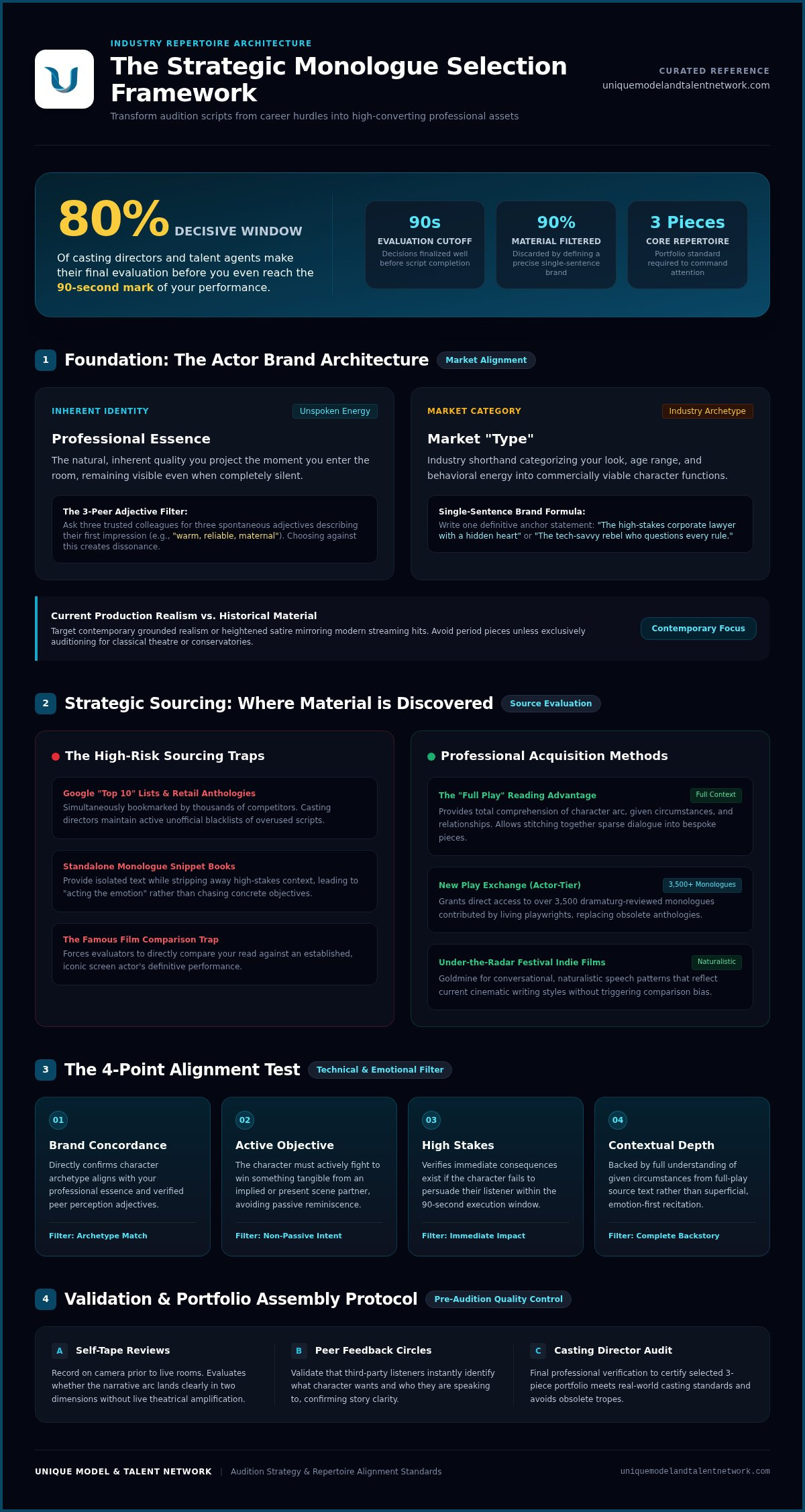
Nearly 80% of casting directors and talent agents make their final evaluation before you even reach the 90-second mark of your performance. If you're struggling with how to find a monologue that fits you, you likely know the frustration of picking a "cliché" piece or hearing that your material is overused. It's exhausting to spend weeks rehearsing only to realize your script doesn't align with your age or professional essence. You deserve a repertoire that acts as a business asset rather than a hurdle.
This guide delivers a strategic, industry-aligned framework to showcase your unique brand to the people who hire. You'll discover how to navigate the 2026 casting landscape using the 4-Point Alignment concept. We'll break down the specific scripts casting panels currently avoid, the way to source fresh material from modern repositories, and the steps to build a go-to portfolio of three monologues that command attention. By the end, you'll have the confidence that your material is industry-standard, ensuring higher callback rates and a more secure career path.
Key Takeaways
- Identify your professional essence to ensure your material aligns with the specific character archetypes the industry is currently buying.
- Learn how to find a monologue that fits you by sourcing contemporary scripts from full plays instead of relying on overused online lists.
- Apply the 4-Point Alignment Test to verify that your chosen character has a clear, active objective and high emotional stakes.
- Validate your selection through self-tape reviews and peer feedback to ensure your story is landing effectively before you step into the room.
- Gain a competitive edge by seeking professional reviews from casting directors who can verify if your repertoire meets current industry standards.
Defining Your Actor Brand: The Foundation of Monologue Selection
Choosing a monologue isn't just about finding a script you like; it's about strategic business alignment. Casting directors don't just look for talent. They look for a solution to a specific character problem within a script. Understanding how to find a monologue that fits you starts with identifying your personal brand. If you don't know what you're selling, you can't expect a casting panel to buy it. Start by writing a single sentence that captures your vibe, such as "The high-stakes corporate lawyer with a hidden heart" or "The tech-savvy rebel who questions every rule." This sentence acts as your primary search filter, helping you discard 90% of the material that doesn't serve your professional career goals.
The "Essence" vs. "Type" Distinction
Your "essence" is the inherent quality you project the moment you walk into a room. It's the energy that remains even when you aren't speaking. In contrast, "type" is the industry's shorthand for how they categorize your look and energy into specific archetypes. To bridge the gap, ask three trusted peers for three adjectives that describe their first impression of you. If they consistently say "warm," "reliable," and "maternal," searching for a cold-blooded assassin script will likely create a disconnect that confuses auditors. When you understand dramatic monologue conventions, you see that the most effective pieces highlight this natural essence while serving a specific industry type. This level of clarity narrows down thousands of potential scripts to a handful that truly showcase your strengths.
Researching Current Market Trends
The entertainment industry moves fast. What felt fresh in 2024 might feel dated in 2026. Take time to analyze current streaming hits and network procedurals to see which types are in high demand right now. When you're researching how to find a monologue that fits you, look at whether productions are leaning toward gritty, grounded realism or heightened, satirical comedy. Your monologue should feel like it belongs in a modern production. Unless you're specifically targeting classical theatre or a conservatory audition, you should generally avoid period pieces. Stick to contemporary material that mirrors the roles you're most likely to be cast in today. Aligning your repertoire with current market needs proves to casting directors that you're a professional who understands the business side of the craft. It shows you're ready to step onto a professional set tomorrow.
Strategic Sourcing: Finding Material Beyond the "Overused" Lists
Searching for "best monologues" on Google is a shortcut to being forgotten. Every "Top 10" list you find is likely being bookmarked by thousands of other actors simultaneously. If you want to know how to find a monologue that fits you, you must look where your competition isn't looking. Casting directors often maintain unofficial "blacklists" of pieces they've heard too many times; performing one of these instantly signals a lack of industry awareness. Using NYFA's guide to choosing an audition monologue can help you identify these red flags before you waste time on a cliché.
The "Full Play" Advantage
Snippet books are a trap. They offer the words but strip away the high-stakes context required for a professional audition. When you read a full play, you understand the character's arc, their relationship with the listener, and the "given circumstances" that drive the scene. This prevents the superficial performance choices that often lead to "acting the emotion" rather than pursuing a concrete objective. You might even find a "hidden" monologue by stitching together consecutive lines of dialogue from a scene where the other character says very little. This results in a unique piece that belongs only to you, ensuring you aren't the fifth person that day performing the same speech.
Where the Pros Look for Scripts
Professional actors utilize digital libraries like the New Play Exchange, which recently updated its actor-tier subscriptions to provide access to over 3,500 playwright-contributed monologues. This repository of work from living, dramaturg-reviewed writers is a superior alternative to retail anthologies. Watching "under-the-radar" indie films or short films from festivals is another goldmine for conversational, naturalistic material. Avoid famous film monologues at all costs. This "Comparison Trap" is dangerous; it forces the casting director to compare your performance to an established star rather than focusing on your unique essence. To stay ahead of industry trends, monitor casting websites to see the types of scripts being requested for current projects.
If you're unsure if your found material is current enough, participating in The Network Membership allows you to get real-time feedback on your selections from industry experts who know what's trending in the room today.
The 4-Point Alignment Test: Technical and Emotional Criteria
Once you've sourced a potential script, you must put it through a rigorous vetting process. Learning how to find a monologue that fits you requires looking past the surface level of the words. You need to verify four critical pillars: active pursuit, emotional resonance, language fit, and timing. If a character is just venting or ranting without a specific objective, the piece will feel passive. Industry professionals look for an active pursuit where the character is speaking to change the listener's mind or get something tangible. This objective is the engine of your performance and keeps the audience engaged.
You must personally relate to the core struggle of the character. If you don't feel the high stakes, neither will the casting director. However, high stakes don't mean high volume. Avoid uncontrollable shouting or crying, as these alienate adjudicators. Also, respect the 90-second rule. Industry data shows that 70% to 80% of theatrical casting directors and talent agents cut monologue evaluations off at or before the 90-second mark, regardless of the time slot allocated. Brevity is the hallmark of a professional who values the panel's time and knows how to get to the point quickly.
Evaluating the "Arc" of the Piece
Every professional piece needs a journey. You want to ensure the character goes on a distinct internal shift from start to finish. Avoid one-note monologues that stay angry or sad from the first line to the last. Casting directors want to see your range and your ability to navigate transitions. To anchor your performance immediately, you should define the "moment before." This is the specific event that happened seconds before the first line. It provides the necessary friction to start the scene with urgency rather than warming up on stage. If you're still struggling with how to find a monologue that fits you, checking for a clear tactical shift is a great way to filter out weak writing.
Language and Rhythmic Compatibility
The rhythm of the playwright's voice must sit naturally in your own speech patterns. Read the text aloud to check for awkward phrasing or tongue-twisters that might trip you up under pressure. Your natural vocal quality and dialect should complement the writing rather than fighting against it. For more specialized advice, these audition preparation and monologue selection tips emphasize staying open to directorial adjustments once you've mastered the rhythm. Adjust your pace to ensure you aren't rushing through high-value beats. If you're constantly stumbling over the words during rehearsal, the piece likely isn't a fit for your current vocal brand.
Testing the Fit: How to Validate Your Selection Before an Audition
Practicing in front of a mirror is a common amateur mistake. It forces you to split your focus between performing and observing, which prevents a truly authentic connection to the material. If you want to master how to find a monologue that fits you, you must move toward objective validation methods. The most effective way to do this is by recording a high-quality self-tape. This allows you to see exactly what a casting director will see, without the distraction of your own reflection. It's the only way to catch technical habits that might be undermining your performance.
The Self-Tape Litmus Test
Once you have a recording, watch it with the sound turned off. This is a classic industry trick to evaluate your physical storytelling. If your body language doesn't convey the emotion and stakes of the scene without the dialogue, you likely haven't fully embodied the character's essence. Look for "dead spots" where your energy drops or where you seem to be waiting for the next line. A professional performance maintains tension through the silences, whereas a student performance often feels like a series of disconnected sentences. This test helps you ensure your selection aligns with your broader acting portfolio goals for the current year.
Seeking Objective Peer Feedback
Perform the piece for a "non-actor" friend after you've cleared the visual check. Actors often give feedback based on technique, but a non-actor will tell you if the story is actually clear. If they can't identify who you are speaking to or what you want by the end of the 90 seconds, the material might be too abstract or poorly structured. You should also conduct a "Vulnerability Check." Do you feel safe but challenged by the material, or does it feel like you're hiding behind a generic, cliché character? If the performance feels "safe," you're likely falling into a generic trap that won't help you stand out in a crowded field.
Conflicting feedback is a natural part of the process. One peer might love your intensity, while another finds it overwhelming. The key is to look for recurring themes in the notes you receive. If three different people mention that the pacing feels rushed, it's time to adjust. To get an even more rigorous evaluation, consider submitting your tape for Portfolio & Reel Reviews. Having a seasoned pro verify that your material is industry-standard can save you months of wasted effort on the wrong scripts.
Professional Feedback: Why Expert Review is the Final Step in Your Search
The final step in mastering how to find a monologue that fits you is moving from subjective feeling to professional verification. You've sourced, tested, and self-taped; now you need an industry perspective to confirm your choices. While an acting teacher focuses on your artistic growth and emotional expansion; a casting director focuses on marketability and immediate fit for a specific project. This distinction is vital for your business development. A piece might be excellent for your craft in a classroom setting but entirely wrong for your current "type" in the 2026 market.
Participating in acting workshops online allows you to live-test your material in a low-stakes environment before a high-stakes audition occurs. This is where you transition from "finding" a monologue to truly "owning" it. A Portfolio & Reel Review acts as the final quality control, ensuring your monologue serves as a strategic marketing tool that complements your headshot and overall brand essence. Without this professional lens, you risk walking into rooms with material that doesn't align with how the industry actually sees you.
Accessing Industry Decision-Makers
The Unique Model & Talent Network provides a bridge between your private rehearsal space and the professional industry. By engaging in this gated community, you get direct access to casting directors who can answer the critical question: "Does this material fit my current marketability?" This direct access removes the guesswork that plagues so many emerging actors. Consistent participation in monthly skill-building challenges helps you refine your repertoire through expert review, positioning you as a disciplined professional rather than a hobbyist. This protective mentorship ensures you aren't wasting time on scripts that industry insiders find dated or ineffective.
Finalizing Your Repertoire
A professional repertoire usually consists of a "Contrasting Pair," which includes one dramatic and one comedic piece. Both should be under 90 seconds and reflect the specific character archetypes you are most likely to book today. Both monologues should remain "active," meaning you are constantly refining them as your brand and age range evolve. Once your material is verified by industry experts, you'll have the confidence to step into any room. Your next logical step is applying these tools to book a film industry audition with a portfolio that commands respect and proves you understand the standards of the craft.
Master Your Repertoire and Secure Your Next Callback
Selecting the right material is a strategic career move that separates serious professionals from hobbyists. You now have the framework for how to find a monologue that fits you by aligning your natural essence with current industry types. By sourcing from contemporary playwrights and strictly adhering to the 90-second rule, you ensure your performance feels fresh and focused. Remember that your repertoire is a living asset; it requires regular updates and objective validation to remain effective in the 2026 casting landscape. This isn't just about reading scripts; it's about building a professional brand that resonates with decision-makers.
Don't leave your career trajectory to chance. You can gain direct access to live workshops with casting directors and receive personalized portfolio and reel reviews within a supportive community of industry insiders. This network acts as your protective mentor in a chaotic field. Stop guessing and start booking; join the Unique Model & Talent Network for expert monologue reviews today.
Your talent deserves a platform that matches your ambition. Take these steps to build a repertoire that truly represents your craft and watch your callback rates transform as you move toward tangible success.
Frequently Asked Questions
How long should a professional audition monologue be?
A professional monologue should ideally be between 60 and 90 seconds. While some conservatory auditions allow up to 2 minutes, industry standards in 2026 favor brevity. Casting directors often make their decision within the first 30 seconds of your performance. Keeping your piece punchy and under the 90-second mark demonstrates respect for the panel's time and shows you can deliver high stakes quickly without unnecessary filler.
Is it okay to use a monologue from a famous movie or TV show?
It's generally best to avoid monologues from famous movies or TV shows. Doing so triggers the "Comparison Trap," where auditors compare your performance to a well-known star instead of seeing your unique talent. Instead, focus on how to find a monologue that fits you by sourcing from contemporary plays or independent films. This ensures your material feels fresh and allows you to own the character completely.
How many monologues should an actor have ready at all times?
You should maintain a repertoire of two to four active monologues at all times. A standard "audition package" includes one dramatic and one comedic piece, both contemporary. If you're targeting classical theatre, add two contrasting Shakespearean or classical monologues. Having these pieces ready allows you to pivot quickly for unexpected opportunities or specific requests from agents and casting directors during general meetings.
Can I use a monologue written for a different gender or age?
You should prioritize material that matches your current age range and professional essence. While gender-blind casting is increasingly common in 2026, choosing a monologue written for a significantly different age can create a disconnect for the auditor. Focus on the character's objective and stakes. If the piece aligns with your industry "type" and vocal quality, the original gender of the character is often less important than the emotional truth you provide.
What is the most common mistake actors make when choosing a monologue?
The most common mistake is selecting "passive" material where the character is simply reminiscing or venting. Professional auditors look for "active" monologues where you're speaking to change the listener's mind or achieve a specific goal. If your character isn't fighting for something in the moment, the performance will feel flat. Always ensure there is a clear "moment before" and a high-stakes objective driving every line of the script.
How do I know if a monologue is 'overused' by other actors?
You can identify overused material by checking unofficial "blacklists" published by major drama schools and casting offices. Pieces from popular "Top 10" Google lists or standalone monologue anthologies are usually over-performed. To stand out, research how to find a monologue that fits you through platforms like the New Play Exchange. Finding a script from a living playwright ensures your material isn't the fifth version the panel has seen that day.
Should I use a comedic or dramatic monologue for a general audition?
For a general audition, you should typically prepare a contrasting pair. If the casting call doesn't specify, lead with the piece that best represents your "brand" or primary industry type. If you're naturally more adept at dry wit, start with the comedic piece. If your strength lies in grounded realism, choose the dramatic one. The goal is to show the industry what you're most likely to be cast in right now.
Where can I get professional feedback on my monologue selection?
You can receive expert evaluations through the Unique Model & Talent Network. Members get direct access to Portfolio & Reel Reviews where casting directors provide honest feedback on material selection and performance. Additionally, participating in live industry workshops allows you to test your monologues in a professional environment. This type of expert review is the final step in ensuring your repertoire meets current industry standards for 2026.


