

To decide how to choose an acting coach, match their experience and teaching approach to your goals, read reviews for specific patterns, and try a class or audit before making a longer commitment. Look for clear, actionable performance feedback and an encouraging, professional environment. A class of 6–12 students can allow room for regular individual work and a sense of community.
A strong reputation can help you build a shortlist, but it can’t show you exactly how a coach responds to your work. Reviews are most useful when you look beyond praise for details about teaching, feedback, and the student experience.
This guide explains how to assess coaching feedback, match a coach’s background and methods to your goals, and use reviews and trial sessions to make an informed choice. You’ll also learn what to notice in class, from the usefulness of performance notes to the attention each student receives.
Key Takeaways
- Look for feedback that identifies what’s working, explains what needs attention, and gives you a practical way to improve.
- Compare a coach’s experience and teaching approach with the skills and professional direction you want to develop.
- Use reviews to spot consistent patterns in students’ experiences, not just broad praise or criticism.
- Try a class or audit before committing, and notice whether the environment feels respectful, focused, and supportive of your growth.
1. Clear feedback and performance analysis
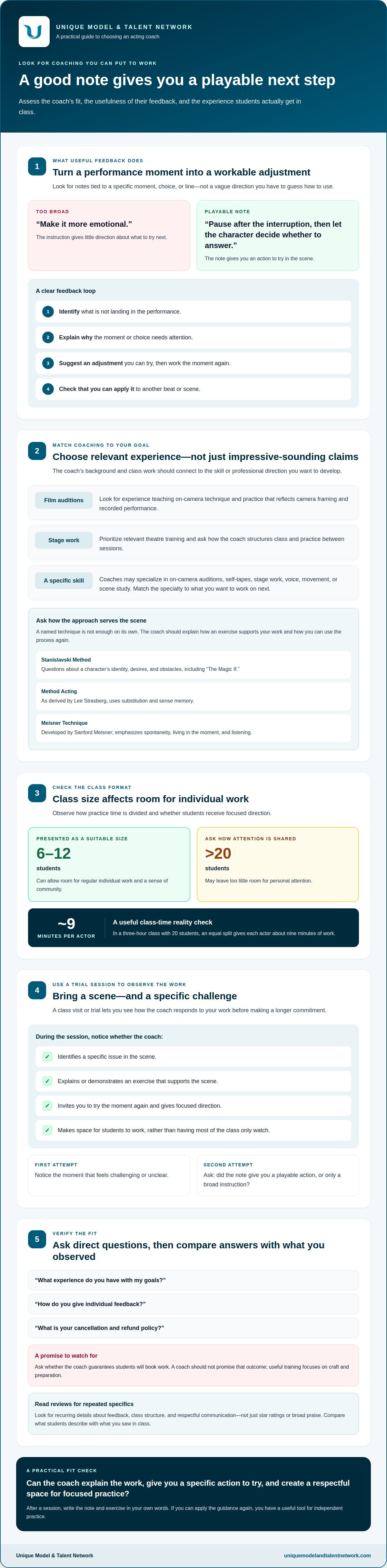
Useful coaching turns a performance into specific, workable notes. After a scene, the coach should identify what is not landing, explain why, and suggest an adjustment you can try. “Make it more emotional” gives little direction. “Pause after the interruption, then let the character decide whether to answer” offers a playable action. Ask for feedback tied to a specific moment, choice, or line in your performance.
Listen for a method you can understand and apply again. A coach might ask you to identify your character’s desire, obstacle, and next action before changing a line reading. They should explain how the exercise supports the scene, then help you use the same process elsewhere. Clear reasoning helps you practise independently instead of guessing what the coach wants.
Named acting techniques can help you understand a coach’s approach. The Stanislavski Method uses questions about a character’s identity, desires, and obstacles, including “The Magic If.” Method Acting, as derived by Lee Strasberg, uses substitution and sense memory. The Meisner Technique, developed by Sanford Meisner, emphasizes spontaneity, living in the moment, and listening. A coach should explain how their exercises serve your scene, not just name a technique.
For a trial session, bring a monologue or scene with a specific challenge. Notice whether the coach identifies the issue, demonstrates an exercise, and invites you to try the moment again. Compare your first and second attempts: did the note give you a playable action, such as listening before responding, or just a broad instruction? That difference shows how useful the feedback is.
Afterward, write down the note and exercise in your own words. If you can apply the guidance to another beat, the coach has given you a useful tool. If the explanation is vague, ask how the adjustment changes the character’s intention. A clear answer shows whether the coach can connect technique, analysis, and performance.
2. How Do I Pick the Right Acting Coach?
To find an acting coach near you, search by location, then compare local options by teaching experience and class format. Check whether their background suits your goal, such as audition preparation, on-camera work, or scene study. A nearby studio may be convenient, but location alone does not show whether its training fits your needs.
Look for relevant experience, not just impressive-sounding claims. If you’re preparing for film auditions, look for experience teaching on-camera technique. If you want to strengthen your stage work, prioritize theatre training. Ask how the coach structures classes and how students practise between sessions. A clear answer should connect their experience to the work you want to do.
Before hiring, ask: “What experience do you have with my goals?”, “How do you give individual feedback?”, and “What is your cancellation and refund policy?” Ask whether the coach guarantees students will book work, too. A coach should not promise that outcome; useful training focuses on craft and preparation.
Class size affects how much individual practice fits into a session. Classes with more than 20 students may leave too little room for personal attention. In a three-hour class with 20 students, an equal split gives each actor about nine minutes of work. Classes with 6–12 students are presented as a suitable size for regular individual work and community.
Observe a class or try a session before making a longer commitment. Notice how practice time is divided and whether students receive focused direction. For example, does each actor get a chance to work on a scene, or do most students spend the session watching? Ask current students about their experience, then compare their comments with what you observed.
If you want to hear directly from industry professionals, Industry Expert Q&A Sessions can help you explore career questions alongside your coach search.
3. Matching coaching to personal and professional goals
Acting coaches may specialize in on-camera auditions, self-tapes, stage work, voice, movement, or scene study. Choose a specialty that matches the skill you want to develop next. For example, an actor preparing for screen auditions needs practice that reflects camera framing and recorded performance.
To assess whether a coach fits your goals and experience, describe a specific challenge and ask how coaching would address it. A beginner may need structured scene exercises and foundational direction. An experienced actor may want sharper choices for a particular role or audition. The coach’s response should suit your level, not follow a one-size-fits-all plan.
Separate craft goals from career goals. “I want to listen more actively in scenes” is a training goal; “I want to prepare for a self-tape” is a practical professional goal. A coach should explain what class work can address and how you’ll practise between sessions. If your priorities change, discuss the new target before continuing.
Pay attention to the professional tone during a class or session. An encouraging coach can give direct notes without insults, intimidation, or personal attacks. If an exercise involves intense emotional material, ask what it requires and set limits on what you share. You’re there to work on acting, not to disclose private experiences under pressure.
Before committing, identify one goal and one boundary. For example, you might want help with a self-tape while keeping personal history out of the exercise. Then notice whether the coach listens, explains the work, and respects your choice. A professional environment supports focused practice; it does not rely on humiliation or pressure to produce a performance.
4. Checking reviews and trying different coaches
Read Google reviews for recurring details, not just star ratings. Look for comments about specific feedback, class structure, and respectful communication. One glowing review says little, while repeated descriptions of clear notes provide useful context. Consider criticism too, especially repeated concerns about disorganization or pressure. Then compare the coach’s stated focus with students’ examples. Does their experience match your goals?
Compare coaches’ reviews using the same questions. Do students describe progress in a particular skill, such as scene work or self-tapes? Do they explain what classes involve? Look for specific accounts rather than broad praise. Reviews reflect individual experiences, so use them to prepare questions for a trial, not as a substitute for seeing how the coach teaches.
In a trial session, expect to work on a scene, monologue, or audition piece. The coach should explain the exercise, observe your choices, and give you a chance to apply direction. Notice whether the session has a clear focus and whether you know what to practise afterward. Write down your impressions right away, including how the coach handled questions and feedback.
Warning signs include promises that coaching will guarantee booked work, pressure to commit before you understand the class, and vague answers about teaching methods or cancellation terms. Take note if a coach dismisses reasonable questions, uses humiliation as instruction, or ignores boundaries you’ve stated. One review cannot establish a pattern, so compare accounts with your own experience in a trial before deciding.
After trying different coaches, compare notes on teaching style, focus, and how comfortable you felt working. If you also want expert feedback on your materials, use Portfolio & Reel Reviews to assess how your current presentation supports your goals.
Unique Model & Talent Network: The Network Membership
Unique Model & Talent Network’s Network Membership can complement acting coaching with ongoing industry learning and a creative community. It’s a fit when you want more than one-to-one craft development, including ways to strengthen your professional perspective and continue building skills.
Live Industry Workshops and Industry Expert Q&A Sessions connect you with working professionals, while Portfolio & Reel Reviews provide focused feedback on your materials. Monthly Skill-Building Challenges offer another way to practise between coaching sessions. These services support your development; they do not replace choosing a coach whose approach fits your acting goals.
To keep learning alongside your coaching, visit uniquemodelandtalentnetwork.com to explore the Network Membership.
Turn your coaching choice into a growth plan
Choosing a coach starts a working relationship; it is not a finish line. As you decide how to choose an acting coach, define what you want your next stage of training to make possible. A stronger audition process, more confident scene choices, or steadier on-camera work can each point your practice in a different direction.
Before your next session, write down one specific intention. Afterward, note what you tried, what changed, and what you want to explore next. This simple record helps you track how your goals develop and gives you a clearer basis for future conversations about your training.
Keep building your professional path with support from an industry community. Contact Unique Model & Talent Network to explore your next step. Stay curious, keep practising, and trust yourself to choose the direction that fits your ambitions.
Frequently Asked Questions
How Do I Pick the Right Acting Coach?
A practical way to decide how to choose an acting coach is to start with the work you want to do next. Write down one current challenge, such as preparing a dramatic audition or building confidence with scripted comedy. Use it to discuss how coaching could help. Before deciding, compare the coach’s response with your priorities, schedule, and preferred learning style.
What If You Can't Afford a "Great" Coach?
You can keep developing your craft without committing to frequent private sessions. Consider group training, occasional coaching for a specific audition, or structured practice with a scene partner. Set one skill target for each practice session, then record your work and review it for choices to adjust. Consistent, focused practice can make limited coaching time more useful.
What Sets a Brilliant Coach Apart?
A strong coach helps you make independent choices rather than copy one performance style. For example, they might ask you to play a scene with different objectives, then discuss how each choice changes the character’s behavior. They welcome thoughtful questions and keep the work focused on acting. Their guidance should leave you with tools you can use beyond class.
What qualifications should an acting coach have?
Look for relevant acting experience, a clear teaching approach, and examples that connect to your training goals. A degree or professional credit can provide context, but neither alone shows how well someone teaches. Ask how the coach developed their method and adapts exercises for different experience levels. Specific answers help you assess their preparation and fit.
How much does an acting coach cost per session?
Session fees vary by coach and format; the price depends on the case and is given after a quote request. Factors can include session length, private or group instruction, the coach’s experience, and the type of preparation involved. Ask what the session includes and whether follow-up work is part of the arrangement, so you can compare options clearly.
How can I evaluate an acting coach’s experience and track record?
As you consider how to choose an acting coach, ask for examples tied to your goals, such as experience teaching audition technique or coaching stage scenes. Clarify what the coach personally did in those settings and how it informs their instruction. You can also ask former students what skills they developed. Look for relevant evidence rather than relying on credits alone.


